


Last Updated: October 2026
Whether goodwill is amortized or impaired depends on whether you mean tax or financial reporting. For federal income tax, acquired goodwill is amortized straight-line over 15 years under IRC Section 197. Under U.S. GAAP, public companies do not amortize goodwill; they test it for impairment at least once a year. So the same asset follows two different rule sets at the same time, with that fixed 15-year tax life as the anchor on one side.
The team at Sofer Advisors prepares goodwill and purchase price valuations for owners, CPAs, and auditors, backed by Inc. 5000 recognition in both 2024 and 2025. The split matters most during a deal, when it shapes the balance sheet, the tax return, and the deferred taxes in between. Owners and their advisors have to track both treatments at once.
This guide explains the GAAP impairment rule, the 15-year tax rule, how impairment testing works, and the private company option. It also shows why the two paths usually create a deferred tax liability that has to be carried on the balance sheet for years.
Key Takeaways
- Two systems: goodwill is amortized over 15 years for tax but, under GAAP, is tested for impairment rather than amortized for public companies.
- Tax rule: IRC Section 197 sets a mandatory 15-year straight-line amortization for acquired goodwill.
- GAAP rule: ASC 350 requires an annual impairment test, using the one-step method from ASU 2017-04.
- Private option: private companies may elect to amortize goodwill over up to 10 years and test only on a triggering event.
- Deferred tax: the gap between tax and financial-reporting treatment usually creates a deferred tax liability that must be tracked over time.
Each point below builds on the one before it, from the two rule sets to the deferred tax they leave behind. The sections that follow examine each in detail.
Why Is the Book vs Tax Split Important to Understand?
The split drives real money in a deal, and the governing standards pull in opposite directions. IRC Section 197 sets a mandatory 15-year straight-line amortization for acquired goodwill on the tax return. ASC 350, as updated by ASU 2017-04, bars amortization for public companies and requires an annual impairment test instead. Because tax deducts the asset while the financial statements hold it, a timing difference forms that becomes a deferred tax liability. Tracking it wrong can distort both the statements and the after-tax math of a future sale.
What Is the GAAP Rule for Goodwill?
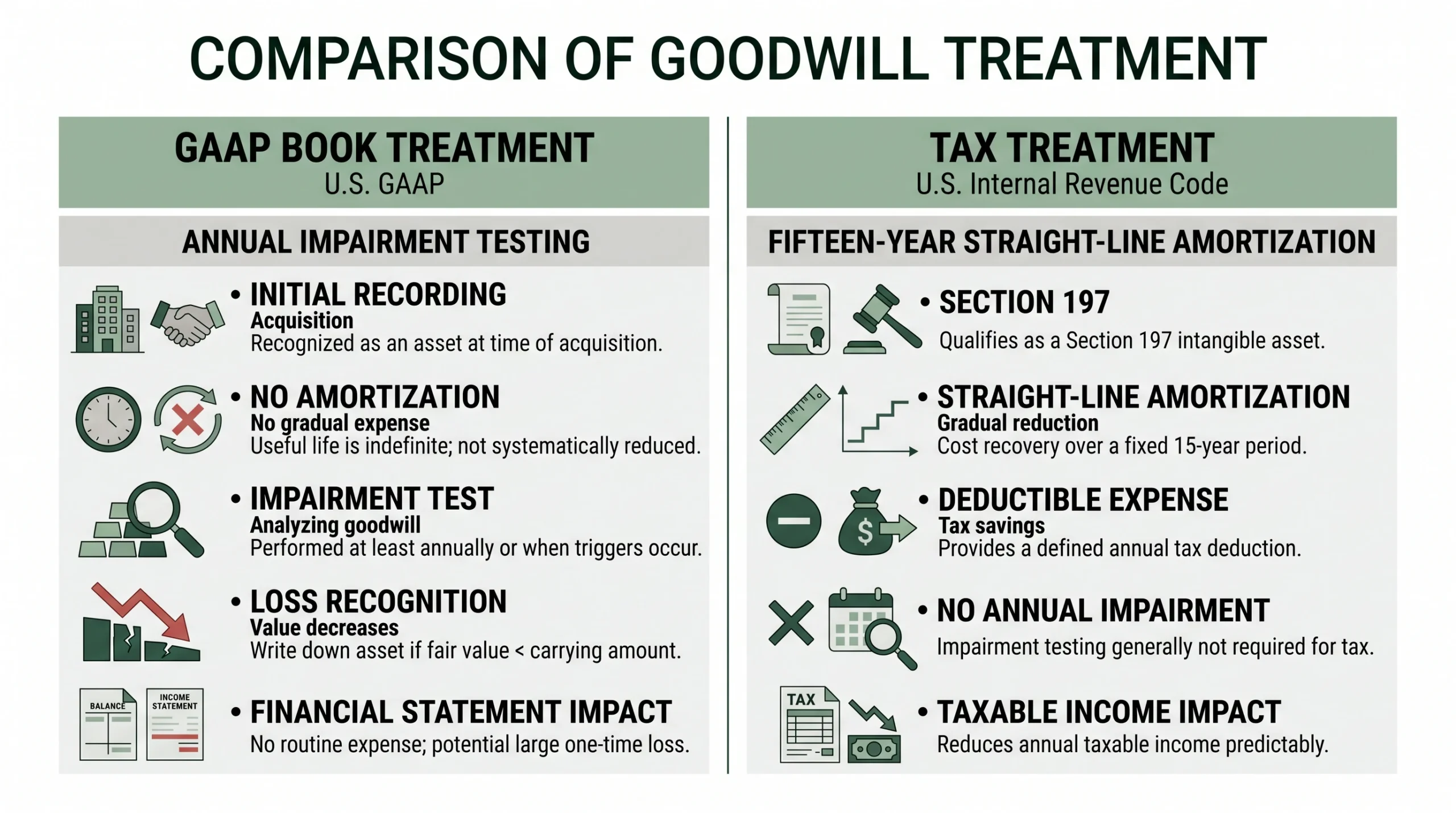
Under U.S. GAAP, public companies do not amortize goodwill. They treat it as an indefinite-lived intangible asset and test it for impairment at least once a year rather than writing it down on a fixed timetable. The test checks whether the recorded value still holds. If a reporting unit’s fair value drops below its carrying amount, the company records an impairment loss. The FASB chose this model on purpose, reasoning that impairment testing gives users better information than a mechanical write-down. The trade-off is more analysis, since the company must perform a rigorous review each year.
How Is Goodwill Treated for Tax?
For tax, the rule is simpler. Goodwill acquired in a business purchase is amortized straight-line over 15 years under IRC Section 197, and the acquirer deducts a portion of the cost each year regardless of the asset’s real economic life. The 15-year period is fixed by statute, so the deduction is predictable. That predictability is the point: the tax code trades precision for consistency, and every buyer recovers the cost of acquired intangibles the same way. Because financial reporting and tax treat the asset differently, a timing difference appears that drives the deferred tax effect.
Can Private Companies Amortize Goodwill?
Yes. Private companies can elect an accounting alternative from the Private Company Council. It lets them amortize goodwill straight-line over a period of up to 10 years, which avoids the cost and complexity of an annual impairment test. For many private owners, that relief is the main appeal. Under the alternative, a private company tests for impairment only when a triggering event occurs, meaning a sign that fair value may have fallen below carrying value. This shifts the work from a yearly review to an event-based one, saving time while still protecting the balance sheet when real warning signs appear.
How Do Financial Reporting and Tax Compare?
The clearest way to see the split is side by side. The table below contrasts the two treatments for a typical acquired goodwill balance, and the differences in method, period, and testing all flow from the different goals of each system.
| Feature | GAAP (public company) | Tax (IRC Section 197) |
|---|---|---|
| Amortization | Not amortized | Straight-line over 15 years |
| Annual testing | Impairment test required | No impairment concept |
| Based on | Fair value of the reporting unit | Original acquired cost |
| Private company option | Amortize up to 10 years | Same 15-year rule applies |
| Effect over time | Value held unless impaired | Deduction each year |
Companies pick a valuation partner for this work based on complexity and audit sensitivity. Larger national firms such as Alvarez & Marsal, Stout, and Kroll serve big public companies with broad advisory teams. Sofer Advisors focuses on defensible, partner-led goodwill and purchase price valuations for closely held and middle-market businesses, with expert witness testimony in 11+ cases behind its reports. It works through a four-phase process it calls The Sofer Difference, moving from Discovery to Diligence to Analysis to Delivery. That structure reflects the Heart of a Teacher approach, explaining the reasoning behind each figure so an auditor can follow it.
Why Does a Deferred Tax Liability Arise?
A deferred tax liability appears when tax deductions come before the matching expense in the financial statements, which is exactly what happens with goodwill. The tax return deducts amortization each year, while the financial statements keep the asset at full value until an impairment, so taxable income falls faster than reported income. The company records a deferred tax liability to capture this future cost. As the tax basis of goodwill shrinks, the gap between reported and tax value grows, and if the asset is later sold or impaired, the difference reverses. Tracking the liability is essential for accurate statements and for planning the tax effects of a future sale.
Getting the reporting and tax treatment right from the start saves rework later. Talk to a Sofer Advisors valuation specialist about the purchase price allocation behind your goodwill.
How Does Deal Structure Affect Goodwill?
Whether tax amortization is even available depends on the deal. In an asset purchase, the buyer acquires the assets directly, goodwill is created at the buyer level, and the 15-year Section 197 deduction applies. This is why buyers often prefer an asset deal, since the yearly deduction has real cash value. A stock purchase works differently: the buyer acquires the company’s shares, the asset basis usually carries over, and there is often no new goodwill to amortize for tax. A special election can sometimes treat a stock deal as an asset deal, but it has conditions, so the structure is a central point in deal negotiation.
Frequently Asked Questions
Does goodwill depreciate or amortize?
Goodwill does not depreciate, because it is an intangible asset, not a tangible one like equipment. It may be amortized for tax under IRC Section 197 over 15 years, and for financial reporting only if a private company elects the accounting alternative. Public companies do not amortize at all; they test goodwill for impairment each year instead. Sofer Advisors prepares the valuation behind either treatment, so the balance sheet and the tax return both rest on supported numbers.
Why is goodwill never amortized for public companies?
Public companies do not amortize goodwill because the FASB decided impairment testing gives financial-statement users better information. The model assumes goodwill holds its value unless events show a decline, so a yearly valuation either supports or challenges the recorded balance. Amortizing on a mechanical timetable, the FASB reasoned, would not reflect whether the asset kept its worth. Sofer Advisors performs that annual fair value analysis, giving auditors a defensible basis for the carrying amount on the balance sheet.
Is goodwill amortized under GAAP?
Not for public entities, which use annual impairment testing under ASC 350. Private companies may elect an alternative that allows straight-line amortization over a period of up to 10 years, in exchange for testing only when a triggering event appears. The choice affects both the balance sheet and the ongoing compliance workload. Sofer Advisors helps private owners weigh that election and then supports whichever path they choose with a documented valuation.
How long do you amortize goodwill for?
For federal income tax, goodwill is amortized over a mandatory 15 years under IRC Section 197, regardless of its real economic life. For private company financial reporting, an entity that elects to amortize does so over a period not to exceed 10 years. Public companies do not amortize at all and test for impairment instead. Sofer Advisors calculates the figures behind each period, so the deduction and the carrying amount are both supported if a reviewer asks.
What is a goodwill impairment triggering event?
A triggering event is a sign that a reporting unit’s fair value may have fallen below its carrying amount. Common examples include a worse business climate, the loss of key people or a major customer, a sharp drop in industry multiples, or a sustained decline in a company’s own share price. Any of these prompts an impairment test outside the normal annual cycle. Sofer Advisors evaluates whether an event has crossed that threshold and, if so, measures the loss.
How does goodwill amortization affect taxes?
Tax amortization creates a deduction that lowers the acquirer’s taxable income over the 15-year Section 197 period. Because financial reporting does not match that timing for public companies, the same deduction also drives a deferred tax liability on the balance sheet. Coordinating the two keeps the tax provision accurate and avoids a surprise when the asset is later sold. Sofer Advisors models both effects together, so the deferred tax position and the after-tax proceeds of a sale are clear.
What is the difference between goodwill and other intangibles?
Goodwill is the premium in a purchase that cannot be tied to a specific, separable asset. Identifiable intangibles, such as patents, customer lists, or technology, have finite lives and are amortized for financial reporting as well as tax. Goodwill, by contrast, is indefinite-lived for reporting and is not amortized by public companies, though it is amortized over 15 years for tax. Sofer Advisors separates the identifiable intangibles from goodwill in a purchase price allocation, which sets each figure correctly.
How much does goodwill impairment testing cost?
A goodwill impairment test usually ranges from $7,500 to $25,000. The fee depends on the number of reporting units and the timeline for the audit. A flat scope is quoted up front, so the cost is clear before any work begins, with no hourly surprises. It covers a defensible, audit-ready report that supports the figures during a regulatory review. Sofer Advisors sets the scope first, then quotes a fixed price. Request a free estimate for your reporting units.
Related Case Studies
- Personal Goodwill vs Enterprise Goodwill: Tax & Divorce Guide
- Is Goodwill Tax Deductible: Section 197 Guide
- Goodwill Impairment Testing ASC 350: Complete Guide for 2025-2026
Executive Summary
Whether goodwill is amortized or impaired depends entirely on the reporting framework. For tax, IRC Section 197 requires straight-line amortization over 15 years. For financial reporting under ASC 350, public companies do not amortize goodwill; they run an annual impairment test, using the one-step method from ASU 2017-04. Private companies may instead elect to amortize over up to 10 years and test only on a triggering event. Because tax deducts the asset while the financial statements hold it, a deferred tax liability usually forms and must be carried for years. Most impairment tests run $7,500 to $25,000. The first step is to name the purpose of the valuation and gather three years of financial statements.
What Should You Do Next?
Start by naming the purpose of your valuation, since tax, financial reporting, and transaction needs each call for a different scope. Gather three years of income statements, balance sheets, and the purchase price allocation before the work begins, and confirm whether a private company election is on the table. This guide was prepared by David Hern CPA ABV ASA, founder of Sofer Advisors, an Inc. 5000 firm specializing in neutral third-party valuations for financial reporting. Schedule a free consultation to discuss your specific situation.
People Also Read
About the Author
This guide was prepared by David Hern CPA ABV ASA, founder of Sofer Advisors, a business valuation firm headquartered in Atlanta, GA serving clients across the United States. David holds dual accreditations as an Accredited Senior Appraiser (ASA) and is Accredited in Business Valuation (ABV), credentials recognized by the IRS, SEC, and FINRA. He also holds the Certified Exit Planning Advisor (CEPA) designation. With 15+ years of valuation experience, David has served as an expert witness in 11+ cases across multiple jurisdictions and built Sofer Advisors into an Inc. 5,000-recognized firm with 180+ five-star Google reviews. Its full W2 employee team maintains subscriptions to all major valuation databases and operates under a next business day response policy.
For professional business valuation services, visit soferadvisors.com/about-us/ or contact Sofer Advisors at soferadvisors.com/contact-us/.
This content is for informational purposes only and does not constitute professional valuation advice. Business valuation conclusions depend on specific facts and circumstances. Contact Sofer Advisors for guidance regarding your specific situation.









