

Last Updated: November 2026
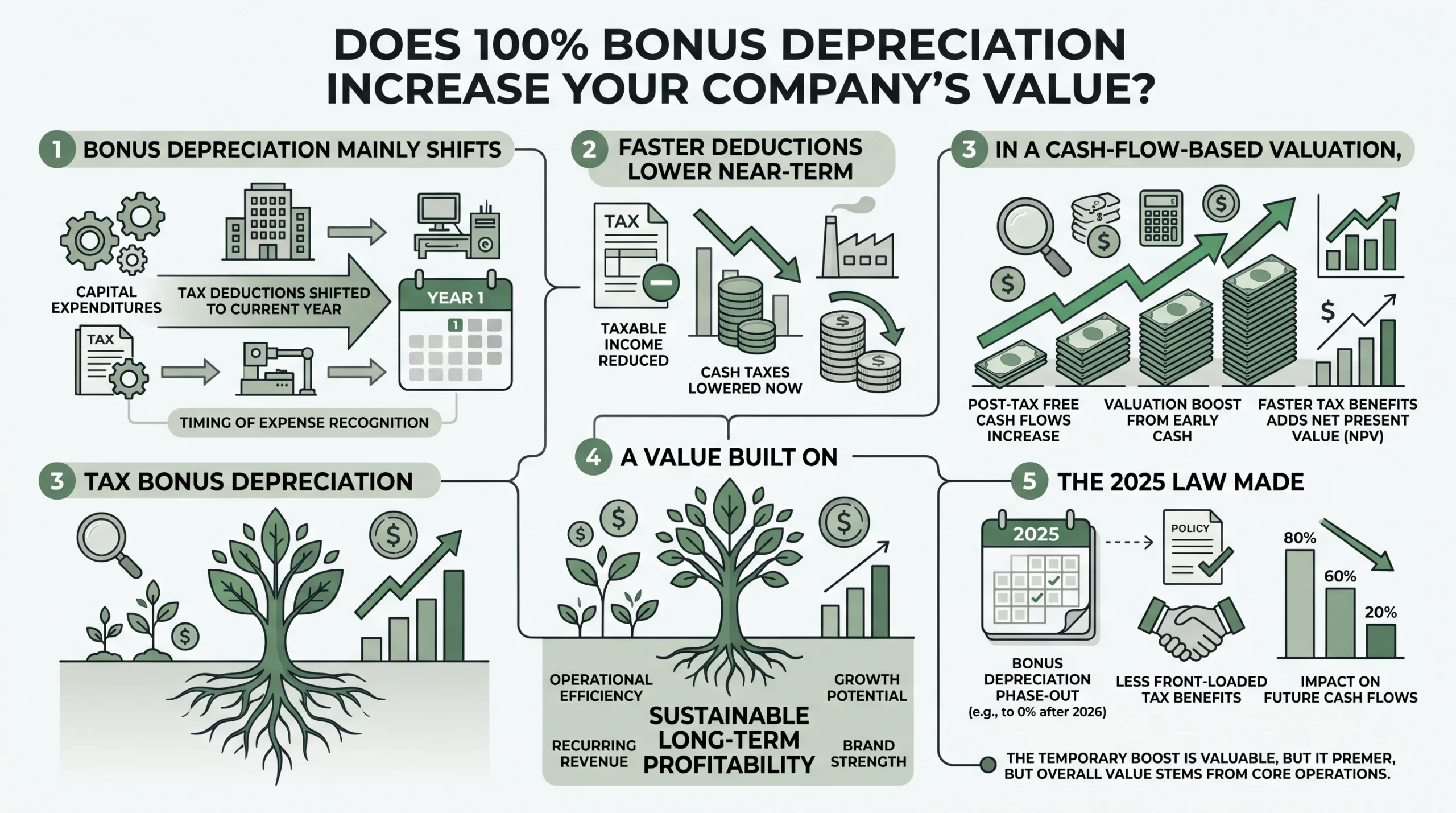
100% bonus depreciation can raise your company’s value, but usually only by a small amount. It mainly shifts the timing of your tax deductions, pulling future write-offs into the present. That lowers near-term taxes and raises near-term cash flow. In a discounted cash flow model, that timing can lift the result a little through the time value of money. A value built on an EBITDA multiple is not directly moved, because EBITDA excludes depreciation.
The team at Sofer Advisors values closely held businesses for owners, investors, CPAs, and attorneys across the country.
This guide explains when bonus depreciation matters, why it is mostly a timing difference, and how appraisers treat it in a valuation.
Key Takeaways
- Bonus depreciation mainly shifts the timing of tax deductions. It pulls future write-offs into the present.
- Faster deductions lower near-term taxes. That raises near-term after-tax cash flow.
- In a cash-flow-based valuation, that time value can modestly raise the result.
- A value built on an EBITDA multiple is not directly raised by bonus depreciation. EBITDA excludes depreciation.
- The 2025 law made 100% bonus depreciation permanent for qualifying property. The benefit is a timing effect, not free value.
What is 100% bonus depreciation?
100% bonus depreciation is an accelerated write-off for business assets. It lets you deduct the entire cost of qualifying property in the first year. Normal depreciation spreads that cost over the asset’s useful life. Bonus depreciation does not wait.
The rule lives in IRC Section 168(k). It applies to qualifying property with a tax life of 20 years or less. Common examples include machinery, equipment, and many vehicles. Both new and used assets can qualify. The use just has to be new to your business.
The 2025 One Big Beautiful Bill Act restored the full 100% rate. It also made that rate permanent for qualifying property. Under the older rules, the rate was set to fall each year and then end. That phase-down no longer applies to qualifying property.
The tax goal is simple. A faster write-off frees up cash sooner. Owners can then reinvest that cash or pay down debt. The deduction does not change what the asset cost. It changes when you get the tax benefit.
Does bonus depreciation increase your company’s value?
Bonus depreciation can raise value, but the effect is usually modest. It mainly changes the timing of your tax deductions. A faster deduction means lower taxes now and higher taxes later. The core earning power of the business stays the same.
Value depends on how the appraiser measures it. In a discounted cash flow model, timing matters. Lower near-term taxes raise near-term free cash flow. Cash today is worth more than cash tomorrow. So that shift can lift the present value a little. The gain comes from the time value of money, not from new profit.
In a market approach, the picture differs. Here the appraiser applies a multiple to a measure like EBITDA. EBITDA means earnings before interest, taxes, depreciation, and amortization. It strips out depreciation on purpose. So a bigger depreciation deduction does not raise EBITDA. A value built on an EBITDA multiple is not directly moved by bonus depreciation.
The result is balanced. Bonus depreciation can add a small amount of value in a cash-flow model. It does not change the business’s underlying economics. Anyone who promises a large value jump from a tax election is overstating the case.
Why is bonus depreciation mostly a timing difference?
Bonus depreciation is mostly a timing difference because total deductions do not change. You claim more now and less later. Over the life of the asset, the sum of the deductions is the same. Only the schedule moves.
Think of it as pulling a future benefit into the present. You deduct the full cost in year one. In later years, there is little or no depreciation left to claim. So taxable income tends to be higher in those later years. The early tax saving is partly a deferral.
This is why value does not jump. The business earns the same operating profit either way. It sells the same goods and serves the same customers. A tax election cannot create earning power that was never there. It can only move cash around in time.
One real benefit is still worth naming. Money has time value. A dollar saved on taxes this year is worth more than a dollar paid later. That spread is the genuine economic gain here. It is real, but it is usually small next to the whole value of a company.
How does bonus depreciation affect EBITDA and cash flow?
Depreciation is a non-cash expense. It lowers reported profit, but no cash leaves the business when you record it. For this reason, EBITDA adds depreciation back. The goal is to show the operating earning power of the business on its own.
Bonus depreciation does not change EBITDA. It changes cash taxes. A large first-year deduction cuts the tax bill for that year. Lower taxes mean more cash in the owner’s hands. That extra cash is what shows up in a cash flow analysis.
So the two measures react in different ways. EBITDA ignores the deduction. Free cash flow reflects the tax saving. This is the heart of why the valuation method matters so much. A cash-flow method captures the benefit. A pure EBITDA multiple does not.
Appraisers watch for this gap. They want the value to reflect real, lasting earning power. They do not want a short-term tax move to distort the result. Careful analysis keeps the two straight.
A simple example helps here. Say a company buys new equipment and expenses it in full. Its EBITDA for the year does not move. Its cash taxes fall, so its free cash flow rises. The numbers are illustrative, but they show the pattern. The cash-flow method sees the benefit, while the EBITDA multiple does not.
How does bonus depreciation affect the sale of a business?
Bonus depreciation can matter a lot in a sale. The deal structure drives the effect. Deals come in two broad forms. One is a stock sale. The other is an asset sale. The tax treatment is not the same.
In an asset sale, the buyer gets a step-up in the tax basis of the assets. The buyer can then apply bonus depreciation to much of what it buys. That gives the buyer a fresh, fast write-off after closing. This benefit can make an asset deal more attractive. In some cases, it supports a higher price.
In a stock sale, the buyer takes the seller’s existing basis. There is usually no step-up on the assets. So the buyer cannot restart bonus depreciation the same way. This difference often shapes how the two sides negotiate.
Sellers should also know about depreciation recapture. Say you expensed an asset and later sell it. Part of the gain can then be taxed as ordinary income. A buyer may factor the lost future deductions into its offer. A good valuation looks at both sides of the trade.
How do appraisers treat bonus depreciation in a valuation?
Appraisers normalize earnings before they apply a method. Normalization removes one-time and non-recurring items. The aim is to show the sustainable earning power of the business. A large one-year tax swing is exactly the kind of item they adjust for.
The method then decides how the benefit shows up. The table below shows the common approaches at a glance.
| Valuation approach | What it measures | Effect of bonus depreciation |
|---|---|---|
| Discounted cash flow | Present value of future cash flows | Small lift from lower near-term taxes |
| Market multiple on EBITDA | A multiple of normalized earnings | No direct effect, since EBITDA excludes depreciation |
| Asset sale with step-up | The buyer’s after-tax cash flows | Can support a higher price through fresh write-offs |
A skilled appraiser ties the treatment to the purpose of the report. A valuation for a sale may weigh the step-up benefit. A valuation for a gift or estate filing may focus on sustainable cash flow. The facts drive the choice. The goal is always a defensible number.
What should owners do before claiming bonus depreciation?
Owners should plan the deduction with both tax and value in mind. A fast write-off helps cash flow now. It may raise taxes in later years. If a sale is near, the timing can affect how a buyer sees the business.
Keep clean records of every asset and its basis. Note what you expensed and when. A buyer’s advisors will review this during due diligence. Clear records make the review faster and protect your price.
Talk through the trade-off with a qualified advisor. A tax saving today is real. It is not the same as a lasting rise in company value. Knowing the difference helps you set the right expectations before a transaction.
Frequently Asked Questions
Is 100% bonus depreciation permanent now?
The 2025 One Big Beautiful Bill Act restored 100% bonus depreciation. It also made the full rate permanent for qualifying property. Under the prior rules, the rate was set to phase down and expire. That phase-down no longer applies to qualifying property.
Does bonus depreciation increase my company’s value?
It can raise value modestly in a cash-flow-based valuation. Lower near-term taxes lift near-term cash flow. It does not change the core earning power of the business. A value based on an EBITDA multiple is not directly affected.
Why does bonus depreciation not raise EBITDA?
EBITDA means earnings before interest, taxes, depreciation, and amortization. It adds depreciation back on purpose. A larger depreciation deduction does not change EBITDA. So an EBITDA-based value is not directly moved by it.
Is bonus depreciation free money?
No. It is mostly a timing difference. You claim more depreciation now and less later. Total deductions over the asset’s life stay the same. The real gain is the time value of the earlier tax saving.
What property qualifies for bonus depreciation?
Bonus depreciation applies to qualifying property with a tax life of 20 years or less. Common examples are machinery, equipment, and many business vehicles. Both new and used assets can qualify. The use just has to be new to your business.
How does bonus depreciation affect a business sale?
It depends on the deal structure. In an asset sale, the buyer gets a step-up and can claim fresh bonus depreciation. That can make an asset deal more attractive. In a stock sale, the buyer usually keeps the seller’s basis and cannot restart it the same way.
What is depreciation recapture?
Depreciation recapture happens when you sell an asset for more than its remaining tax basis. The earlier deductions lowered that basis. Part of the gain is then taxed as ordinary income rather than capital gains. Buyers and sellers both weigh this in a deal.
Should EBITDA be adjusted for bonus depreciation?
EBITDA already excludes depreciation, so no add-back is needed there. The adjustment matters in cash-flow models, where taxes are a real outflow. Appraisers normalize earnings so a one-year tax swing does not distort the value.
Related Case Studies
- How to Value Construction Company: Expert Business Valuation Guide
- Book Value vs Business Value: Why Your Balance Sheet Almost Never Reflects What Your Company Is Worth
- How to Value Your Business When Selling: Complete Guide
Executive Summary
Bonus depreciation mainly shifts the timing of tax deductions. It pulls future write-offs into the present. Faster deductions lower near-term taxes. That raises near-term after-tax cash flow. In a cash-flow-based valuation, that time value can modestly raise the result. A value built on an EBITDA multiple is not directly raised by bonus depreciation. EBITDA excludes depreciation. The 2025 law made 100% bonus depreciation permanent for qualifying property. The benefit is a timing effect, not free value.
What Should You Do Next?
Gather your asset records, recent tax filings, and financial statements before any valuation or sale. For a defensible valuation that reflects these tax effects, Sofer Advisors offers business valuation services led by David Hern CPA ABV ASA CVA. Schedule a consultation to discuss your situation.
People Also Read
- How to Value a Franchise Business: Complete Guide
- How to Value Manufacturing Company: Complete Guide 2026
About the Author
This guide was prepared by David Hern CPA ABV ASA CVA, founder of Sofer Advisors, a business valuation firm headquartered in Atlanta, GA serving clients across the United States. David holds accreditations as an Accredited Senior Appraiser (ASA) and is Accredited in Business Valuation (ABV), credentials recognized by the IRS, SEC, and FINRA, and is also a Certified Valuation Analyst (CVA). David has served as an expert witness in dozens of cases across multiple jurisdictions, and Sofer Advisors is an Inc. 5000 honoree in 2024 and 2025 with 240+ five-star Google reviews.
For professional business valuation services, visit soferadvisors.com/about-us/ or contact Sofer Advisors at soferadvisors.com/contact-us/.
Disclaimer: This content is for informational purposes only and does not constitute professional valuation advice. Business valuation conclusions depend on specific facts and circumstances. Contact Sofer Advisors for guidance regarding your specific situation.