


Last Updated: November 2026
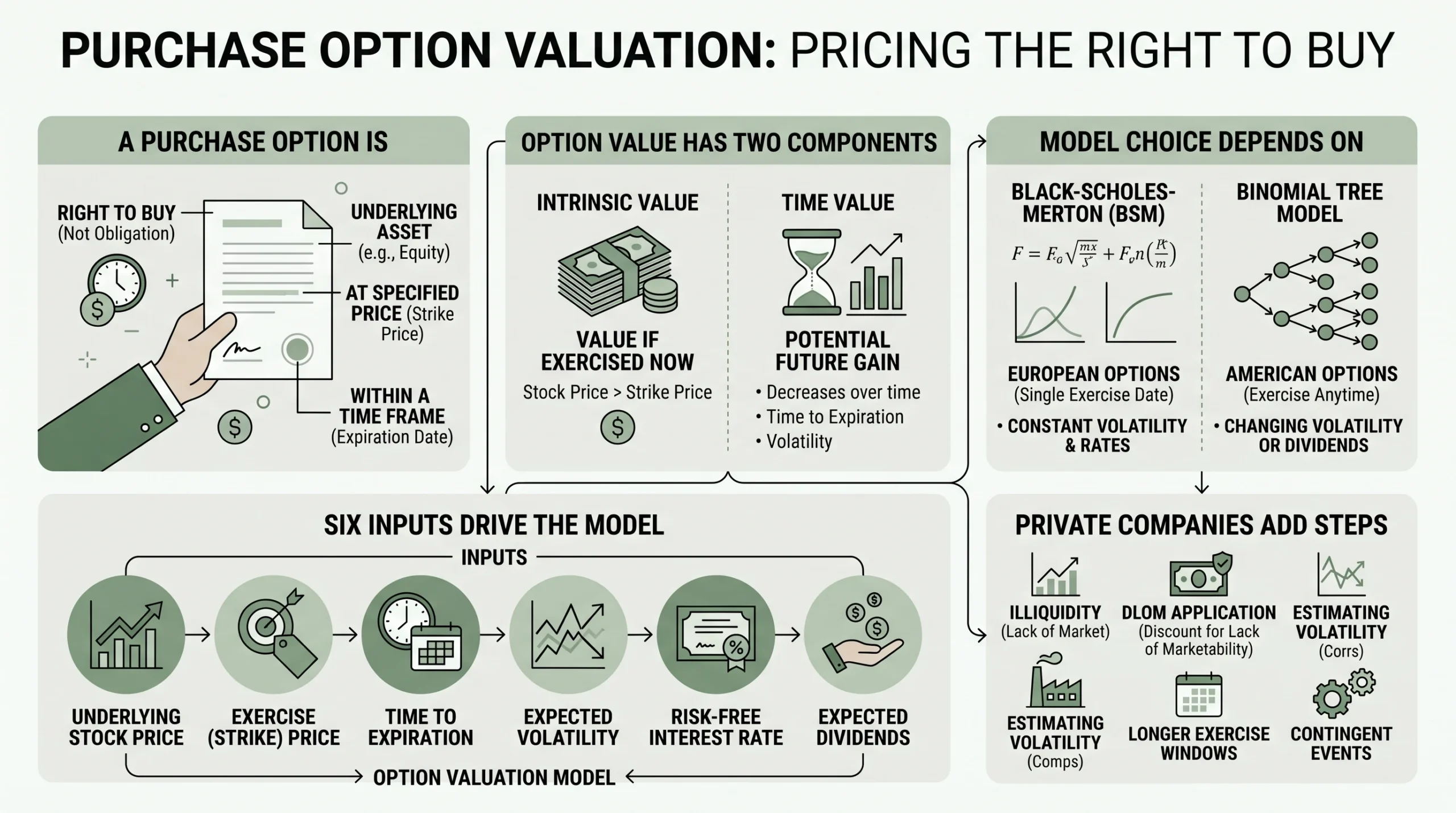
A purchase option is the right, not the obligation, to buy an asset at a set price within a set time. In finance, this is a call option. That choice has value because the asset could rise above the set price. If it does, the holder gains. If it does not, the holder lets the option lapse. Analysts price that choice with option-pricing models.
Sofer Advisors builds these valuations for owners, CPAs, and attorneys.
This guide explains how an option is valued, the six inputs that drive the price, and the extra steps a private company requires.
Key Takeaways
- A purchase option is a call option. It gives the right, not the duty, to buy.
- Option value has two parts. Intrinsic value plus time value equals the total.
- Model choice depends on the terms. The main options are Black-Scholes, binomial, and Monte Carlo.
- Six inputs drive the price. These are asset value, strike, time, volatility, the risk-free rate, and distributions.
- Private companies add steps. A 409A value and a volatility proxy come first.
What is a purchase option?
A purchase option is a contract. It gives the holder the right to buy something. The price is fixed in advance. So is the time window. The holder is not forced to buy. That is the key feature.
In finance, this is a call option. The fixed price is the strike, or exercise price. The asset under the option is the underlying. It could be a share of stock. It could be a whole business. It could be real estate or equipment.
The holder exercises only when it pays to do so. If the asset is worth more than the strike, exercise makes sense. If it is worth less, the holder walks away. The most the holder can lose is the price paid for the option.
This one-sided payoff is why options have value. The upside is open. The downside is capped. Valuation measures that balance.
Why does purchase option valuation matter?
Purchase option valuation matters for real decisions and filings. A sound number protects the people who rely on it.
Financial reporting is one driver. Companies report equity awards at fair value. Standards like ASC 718 govern stock compensation. Fair value measurement under ASC 820 applies as well. A sound option value keeps those reports accurate.
Deals are another driver. A buyer and seller must price any option in the contract. A warrant or convertible note changes the deal’s value. Both sides need a defensible figure.
Disputes make up a third. Owners may argue over the worth of an option in a buy-sell agreement. A clear valuation helps settle the question. It also holds up better if the matter reaches court.
Tax is the fourth. Options granted to employees or owners can carry tax consequences. A supportable value helps meet IRS expectations. It lowers the risk of a later challenge.
How is a purchase option valued?
Analysts value purchase options with option-pricing models. The right model depends on the terms. Three models cover most cases.
The Black-Scholes-Merton model suits simple options. It works well for European-style options. Those can be exercised only at expiration. The model gives a closed-form answer. You plug in the inputs and solve.
Binomial and lattice models suit American-style options. Those allow early exercise, any time before expiration. The model builds a tree of possible price paths. At each node, it checks whether early exercise pays. This flexibility is why it fits early-exercise rights.
Monte Carlo simulation suits complex terms. Some options depend on the path the price takes. Others have several linked conditions. Monte Carlo runs thousands of random scenarios. It then averages the payoffs. That average becomes the option’s value.
| Model | Best for | How it works |
|---|---|---|
| Black-Scholes-Merton | Simple European-style options | Closed-form formula |
| Binomial or lattice | American-style options with early exercise | A tree of price paths |
| Monte Carlo simulation | Complex or path-dependent terms | Thousands of random scenarios |
What are the six key inputs?
Six inputs drive an option’s value. Each one pulls the price in a known direction.
The first is the underlying asset value. A higher asset value raises a call option’s worth. The second is the strike price. A lower strike also raises it.
The third is time to expiration. More time means more chance for the asset to rise. So more time usually means more value. The fourth is volatility. This measures how much the asset’s price swings. Higher volatility raises option value. The upside grows while the downside stays capped.
The fifth is the risk-free rate. This is the return on a safe asset, such as a Treasury. A higher rate tends to lift call values. The sixth is expected distributions. Dividends or payouts lower the underlying’s value over time. That carrying cost reduces a call option’s worth.
Volatility is the hardest input to pin down. For public stocks, analysts use trading history. For private assets, there is no trading history. That gap makes private-company work harder.
Analysts rarely treat the inputs in isolation. They test how the value moves as each input changes. This step is called sensitivity analysis. It shows which assumptions matter most. It also flags where the figure is fragile.
How do intrinsic value and time value fit together?
An option’s value has two parts. They add up to the total.
Intrinsic value is the gain from exercising now. It equals the underlying value minus the strike. If that figure is positive, the option is “in the money.” If it is zero or less, intrinsic value is zero. The holder would not exercise at a loss.
Time value is the rest. It reflects what might happen before expiration. The price could move further in the holder’s favor. Time value is highest when expiration is far off. It shrinks as expiration nears. At expiration, only intrinsic value remains.
Here is a short, illustrative example. Suppose a share is worth $12. The strike is $10. Intrinsic value is $2. If the option is worth $3, then $1 is time value. These figures are illustrative only.
Where do purchase options appear?
Purchase options show up across business and finance. Each setting changes what the valuation must capture.
Buy-sell agreements often include them. One owner may hold the right to buy another’s stake. Warrants are another case. They give the holder the right to buy shares from the company. Employee stock options work the same way. They reward staff with the right to buy at a set price.
Convertible instruments embed an option too. A convertible note can turn into equity. That conversion right is a call option. Leases sometimes carry a purchase option. The tenant may buy the asset at the end of the term.
Real-option analysis extends the idea to decisions. A company may hold the “option” to expand a project later. Valuing that choice uses the same models. The logic carries across all of these cases.
How does option valuation work for private companies?
Private companies add a layer of difficulty. Their shares do not trade. So two inputs are missing. There is no market price and no volatility history.
The first step solves the price. A private company values its common stock first. For U.S. companies, this often follows IRC Section 409A. The result is a defensible fair market value. That value feeds the option model.
The second step solves volatility. Analysts build a peer group of public companies. The peers share similar size, industry, and risk. Their trading history gives a volatility estimate. That estimate stands in for the private firm’s own.
The two steps also interact. The 409A value sets the starting asset price. The peer group sets the volatility. A change in either moves the option value. So both deserve the same care.
Both steps need support. Auditors and the IRS review the assumptions. Clear documentation protects the result. Weak inputs invite challenge.
What are common mistakes in option valuation?
A few errors show up often. Each one can distort the value.
The first is using the wrong model. Black-Scholes cannot price early exercise well. Using it for an American-style option understates value. A lattice or Monte Carlo model fits better.
The second is a weak volatility input. Volatility drives the result more than any other input. A guess, or a poor peer group, undermines the whole figure. The input needs real data and clear logic.
The third is ignoring vesting and forfeiture. Employee options often vest over time. Some are forfeited before they vest. A valuation for financial reporting must reflect this. Standards like ASC 718 require it.
The fourth is a mismatched term. The model’s time input must match the contract. Using the full legal term when early exercise is likely can overstate value. Analysts often use an expected term instead.
The fifth is thin documentation. The best number still fails without support. A report should state each input and its source. That record is the defense in an audit or dispute.
Frequently Asked Questions
What is a purchase option in simple terms?
It is the right to buy something at a set price. The holder picks a time within an agreed window. There is no duty to buy. If the price is not worth it, the holder walks away.
Is a purchase option the same as a call option?
Yes. A purchase option gives the right to buy, which is what a call option does. The word “call” is common in traded markets. “Purchase option” is common in contracts and leases.
Which model should I use to value a purchase option?
It depends on the terms. Use Black-Scholes for simple options exercised only at expiration. Use a binomial or lattice model when early exercise is allowed. Use Monte Carlo for complex or path-dependent terms.
What are the main inputs to an option valuation?
There are six. They are the underlying asset value, the strike price, the time to expiration, the volatility, the risk-free rate, and expected distributions. Volatility is usually the hardest to estimate.
How do I value an option on private company stock?
Start by valuing the common stock, often under IRC Section 409A. Then build a peer group of public companies to estimate volatility. Those two steps replace the market data a private firm lacks.
What is the difference between intrinsic value and time value?
Intrinsic value is the gain from exercising now. It is the underlying value minus the strike, if positive. Time value is the extra worth from the chance of future gains. The two together make the option’s total value.
Why does volatility matter so much?
Higher volatility means a wider range of outcomes. The upside grows, while the downside stays capped at the option’s cost. That balance raises the option’s value. So a small change in volatility can move the result a lot.
Can a lease purchase option be valued this way?
Yes. A lease purchase option is a call option on the leased asset. The same inputs and models apply. The strike is the agreed buyout price, and the term sets the time to expiration.
Do employee stock options need special treatment?
Yes. They often allow early exercise and vest over time. Some are forfeited before vesting. A valuation for financial reporting must reflect these features, as standards like ASC 718 require.
Related Case Studies
- 409A Valuation Cost: Pricing Guide for Startups
- Goodwill Valuation Methods: Which Approach Is Right?
- Business Valuation Cost Georgia: Complete Pricing Guide 2026
Executive Summary
A purchase option is a call option. It gives the right, not the duty, to buy. Option value has two parts. Intrinsic value plus time value equals the total. Model choice depends on the terms. The main options are Black-Scholes, binomial, and Monte Carlo. Six inputs drive the price. These are asset value, strike, time, volatility, the risk-free rate, and distributions. Private companies add steps. A 409A value and a volatility proxy come first.
What Should You Do Next?
Start with the contract. Read the strike price, the window, and any special terms. Match those terms to the right model, then gather the six inputs and document each one. If the underlying is private stock, value that stock first. Sofer Advisors provides independent, defensible option valuations, led by David Hern CPA ABV ASA CVA. Schedule a consultation to discuss your situation.
People Also Read
About the Author
This guide was prepared by David Hern CPA ABV ASA CVA, founder of Sofer Advisors, a business valuation firm headquartered in Atlanta, GA serving clients across the United States. David holds accreditations as an Accredited Senior Appraiser (ASA) and is Accredited in Business Valuation (ABV), credentials recognized by the IRS, SEC, and FINRA, and is also a Certified Valuation Analyst (CVA). David has served as an expert witness in dozens of cases across multiple jurisdictions, and Sofer Advisors is an Inc. 5000 honoree in 2024 and 2025 with 240+ five-star Google reviews.
For professional business valuation services, visit soferadvisors.com/about-us/ or contact Sofer Advisors at soferadvisors.com/contact-us/.
Disclaimer: This content is for informational purposes only and does not constitute professional valuation advice. Business valuation conclusions depend on specific facts and circumstances. Contact Sofer Advisors for guidance regarding your specific situation.