


Last Updated: November 2026
A distribution company is valued mainly with the income approach and the market approach, both built on normalized earnings. These wholesale businesses buy goods from makers and sell them to retailers or other firms. Their value rests on a few specific drivers. Margins are often thin, inventory is large, and working capital is heavy. A small change in any one of these can move the final number by a lot.
Sofer Advisors prepares these valuations for owners, CPAs, and attorneys across the country.
This guide explains how distributors are valued, the drivers that matter most, and where the analysis tends to go wrong.
Key Takeaways
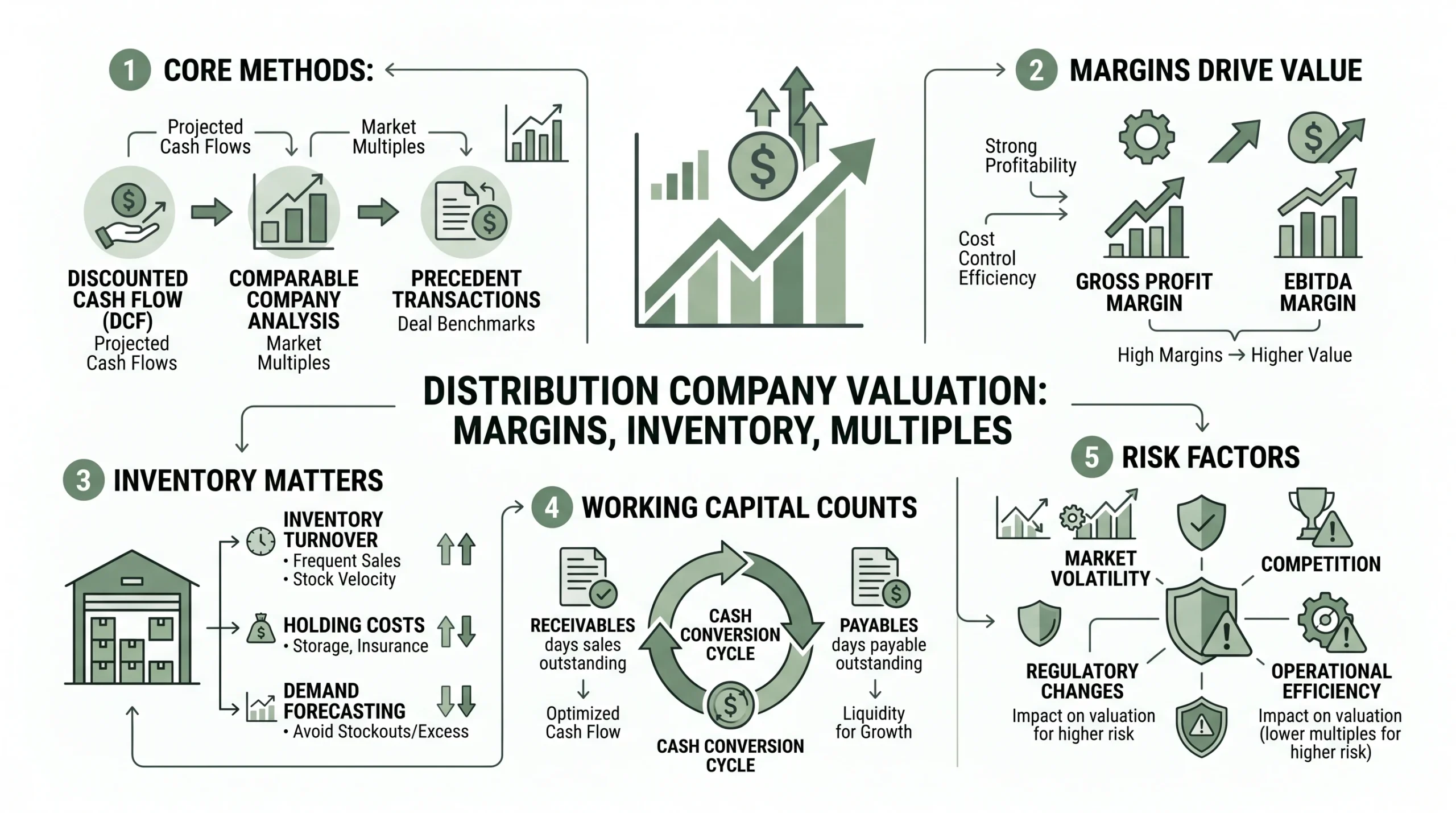
- Core methods: Analysts value distributors with the income approach and the market approach.
- Margins drive value: Gross margins are often thin, so a small shift can move the result a lot.
- Inventory matters: Stock levels, turnover, and obsolete goods all affect the final figure.
- Working capital counts: Buyers negotiate a working capital target that can change the price.
- Risk factors: Customer and supplier concentration can lower value. Strong, transferable contracts can raise it.
How is a distribution company valued?
Two approaches do most of the work. The first is the income approach. The second is the market approach. Both start with earnings that have been cleaned up, or normalized.
The income approach values the business on its cash flow. One version is a discounted cash flow, or DCF, model. It projects future earnings and discounts them to today’s dollars. A simpler version capitalizes a single year of earnings at a market multiple. The earnings measure is usually EBITDA or seller’s discretionary earnings, often called SDE.
The market approach looks outward. It applies multiples drawn from comparable company sales and past transactions. The idea is simple. Similar businesses should trade for similar prices. The analyst adjusts for size, growth, and risk.
An asset approach is used less often. It values the net assets on the balance sheet. This can fit an asset-heavy distributor with thin or unstable earnings. In most healthy distributors, though, the income and market approaches carry more weight.
Why do gross margins matter so much?
Distribution is a thin-margin business. A distributor buys a product and resells it for a modest markup. The gross margin is the slice left after the cost of goods. That slice is often small compared with total revenue.
This is why margins drive value. When margins are thin, a small change has a large effect on profit. A shift of one or two points can swing earnings up or down by a wide amount. Because value tracks earnings, the final number moves with it.
A buyer studies margin trends closely. Stable or rising margins suggest pricing power or useful services. Falling margins raise a flag. They may point to price pressure from suppliers or customers. The analyst normalizes margins before drawing a conclusion. That means removing one-time items so the trend is clear.
How do inventory levels and turns affect value?
Inventory is usually a distributor’s largest asset. It is also a source of risk. A valuation looks hard at both how much stock sits on hand and how fast it moves.
Inventory turnover is the key gauge. It shows how many times the stock sells and is replaced over a year. Fast turns are a good sign. They mean cash is not stuck on the shelf. Slow turns suggest the opposite. Goods may be aging, out of style, or simply unwanted.
The analyst reviews an inventory aging report. This report groups stock by how long it has been held. Old or damaged goods may need a write-down. A write-down lowers the stated value to what the goods can actually fetch. Skipping this step inflates the balance sheet and overstates value.
How does working capital affect the deal?
Distributors tie up a lot of cash in working capital. They hold inventory, wait on customer payments, and pay suppliers on their own terms. The money caught between these cycles is the working capital a buyer must fund.
This matters at the deal table. Most sales set a net working capital target, often called a peg. The peg is the normal level of working capital the business needs to run. The seller is expected to deliver that level at closing. If the actual amount is higher, the price may rise. If it is lower, the price may drop.
A valuation accounts for this need. A business that runs lean on working capital is worth more than one that ties up extra cash for the same sales. The analyst looks at how much working capital the business truly needs to support its revenue.
What role do customer and supplier concentration play?
Concentration is a central risk in distribution. It shows up on both sides of the business. One side is customers. The other is suppliers.
Customer concentration means a few accounts drive much of the revenue. If one large customer leaves, sales can fall sharply. A buyer sees this as fragile. A broad base of customers is safer and tends to support a higher value.
Supplier concentration works much the same way. Many distributors depend on a handful of key vendors. If one vendor raises prices or cuts off supply, the business suffers. The analyst weighs how easily the business could replace a lost supplier. Deep reliance on one vendor is a risk that can pull value down.
Does the warehouse and logistics footprint matter?
The physical side of the business carries weight too. Distributors run on warehouses, racking, trucks, and software. A buyer looks at whether this footprint can support future sales. A lean, well-run operation is a plus. Spare capacity can let a buyer grow without heavy new spending.
The opposite also holds. A cramped or outdated warehouse may need investment soon. Long leases on the wrong sites can be a burden. The analyst factors these costs and risks into the final view of value.
How do distribution and dealership agreements affect value?
Many distributors hold formal agreements with the makers they represent. These can be exclusive territory rights or dealership contracts. Strong agreements are often a real source of value. They can lock out rivals and secure a steady supply of product.
But the terms matter more than the title. A buyer asks a few plain questions. Is the agreement exclusive? How long does it run? Can it be transferred in a sale?
Transferability, or assignability, is the key issue. Some agreements end if the business changes hands. Others let a supplier cancel at will. A contract that cannot survive a sale offers little protection to a buyer. That weakness can lower value. A long, exclusive, transferable agreement does the opposite.
How is EBITDA normalized before a multiple is applied?
A multiple is only as good as the earnings it sits on. So the analyst normalizes earnings first. Normalizing means adjusting reported profit to show what the business truly earns.
Two kinds of adjustments are common. The first is owner compensation. Many owners pay themselves more or less than a hired manager would cost. The analyst resets pay to a market rate. The second is one-time items. A legal cost, a move, or a single large repair does not repeat. These items are added back.
Here is an illustrative example. Suppose a distributor reports $500,000 in pretax profit. The owner takes $200,000 in pay, but a hired manager would cost $120,000. That difference adds back $80,000. A one-time legal fee of $30,000 is also added back. Normalized earnings rise to $610,000. These figures are illustrative only. The steps, though, are the same in real work.
Once earnings are normalized, the analyst applies a market multiple. That multiple comes from comparable sales, not from a rule of thumb.
Which valuation method fits a distributor?
No single method fits every case. The right choice depends on the data, the earnings, and the purpose of the report. The table below shows the common options.
| Approach | How it works | Best fit |
|---|---|---|
| Income (DCF or capitalized earnings) | Projects or capitalizes future cash flow | Distributors with stable, predictable earnings |
| Market (comparable multiples) | Applies multiples from similar companies and deals | Cases with solid comparable data |
| Asset-based | Values net assets on the balance sheet | Asset-heavy firms with thin or unstable profit |
In many engagements the analyst uses more than one approach. The results are then checked against each other. When two methods point to a similar range, the conclusion is stronger.
Frequently Asked Questions
What approaches are used to value a distribution company?
Two approaches do most of the work. The income approach values the business on its cash flow, through a DCF or a capitalized earnings figure. The market approach applies multiples from comparable companies and deals. An asset approach is used less often, mainly for asset-heavy firms.
Why are margins so important in distribution valuation?
Distribution runs on thin margins. A product is bought and resold for a modest markup. Because the margin is small, a shift of a point or two has a large effect on profit. Since value tracks earnings, the final number moves with the margin.
How is inventory treated in a distributor valuation?
Inventory is usually the largest asset, so it gets close review. The analyst studies turnover and the inventory aging report. Old, damaged, or slow-moving goods may need a write-down. That adjustment keeps the stated value in line with what the stock can actually sell for.
What is a net working capital peg?
The peg is the normal level of working capital a business needs to operate. In a sale, the seller is expected to deliver that level at closing. If the delivered amount is higher or lower than the peg, the final price is adjusted up or down.
How does customer concentration affect value?
Customer concentration means a few accounts drive much of the revenue. That makes the business fragile, because the loss of one account could cut sales sharply. A buyer usually pays less for that risk. A wide customer base tends to support a higher value.
Does supplier concentration matter too?
Yes. Many distributors rely on a small set of key vendors. If a vendor raises prices or stops supply, the business is exposed. The analyst weighs how easily a lost supplier could be replaced. Heavy reliance on one vendor can lower value.
Are SDE and EBITDA both used for distributors?
Both are used. SDE suits smaller, owner-run firms, because it adds back one owner’s pay and perks. EBITDA suits larger firms with hired management. The analyst picks the measure that fits the size and structure of the business.
Do exclusive distribution agreements add value?
They can, but only if the terms are strong. The key questions are whether the agreement is exclusive, how long it runs, and whether it can be transferred in a sale. An agreement that ends when the business changes hands offers little protection and adds little value.
Which approach is most common for distributors?
The income and market approaches are the most common. Many valuations use both and compare the results. When the two methods land in a similar range, the conclusion is easier to defend.
Related Case Studies
- Retail Company Valuation Multiples: Complete Guide 2026
- Construction Company Valuation Multiples by Trade
- Atlanta Retail Company Valuation Multiples: 2026 Guide
Executive Summary
Analysts value distributors with the income approach and the market approach. Gross margins are often thin, so a small shift can move the result a lot. Stock levels, turnover, and obsolete goods all affect the final figure. Buyers negotiate a working capital target that can change the price. Customer and supplier concentration can lower value. Strong, transferable contracts can raise it.
What Should You Do Next?
Start by gathering clean financial statements for the last several years. Pull an inventory aging report and flag slow-moving or obsolete stock. Collect your key supplier and customer agreements so their terms can be reviewed. These records let an analyst study margins, turnover, and working capital properly. Sofer Advisors prepares independent, defensible distribution company valuations, led by David Hern CPA ABV ASA CVA. Schedule a free consultation to discuss your situation.
People Also Read
- Tech Company Valuation: Multiples for Private SaaS
- Georgia Manufacturing Company Valuation: EBITDA Multiples and Market Data
About the Author
This guide was prepared by David Hern CPA ABV ASA CVA, founder of Sofer Advisors, a business valuation firm headquartered in Atlanta, GA serving clients across the United States. David holds accreditations as an Accredited Senior Appraiser (ASA) and is Accredited in Business Valuation (ABV), credentials recognized by the IRS, SEC, and FINRA, and is also a Certified Valuation Analyst (CVA). David has served as an expert witness in dozens of cases across multiple jurisdictions, and Sofer Advisors is an Inc. 5000 honoree in 2024 and 2025 with 240+ five-star Google reviews.
For professional business valuation services, visit soferadvisors.com/about-us/ or contact Sofer Advisors at soferadvisors.com/contact-us/.
Disclaimer: This content is for informational purposes only and does not constitute professional valuation advice. Business valuation conclusions depend on specific facts and circumstances. Contact Sofer Advisors for guidance regarding your specific situation.