


Last Updated: October 2026
A private annuity removes the asset from the estate only if the pricing is genuinely arm’s length. A private annuity is a sale, not a gift. A parent transfers a business interest to a child, and the child promises to pay the parent a fixed amount for life. The payments stop at the parent’s death. If the price matches fair market value, nothing is a gift, and the asset leaves the estate for good.
The team at Sofer Advisors values these transfers for business owners, CPAs, and estate attorneys, backed by Inc. 5000 recognition in both 2024 and 2025. The whole plan rests on one number. If the payment stream is priced too low, the IRS calls the shortfall a gift and taxes it.
This guide explains how a private annuity is valued, what payments the buyer must make, and how the structure affects estate and gift tax. It also covers IRC Section 72 and Section 7520, Form 709 reporting, and how a private annuity differs from a self-canceling installment note.
Key Takeaways
- What a private annuity does: it sells an asset for lifetime payments that end at death, so the asset and its future growth leave the estate.
- Pricing drives the result: the payment stream must equal the asset’s fair market value, measured on the transfer date.
- IRS tables set the number: the payments are priced off IRS actuarial tables and the Section 7520 rate, which supply life expectancy and the discount rate.
- Arm’s length stops a gift: a payment stream worth less than the asset lets the IRS treat the gap as a taxable gift to the child.
- Unsecured by design: the promise to pay must stay unsecured, which puts real credit risk on the parent.
Each of these pieces ties into the wider estate plan. The sections below take them one at a time.
Why Is a Private Annuity Valuation Important to Understand?
A private annuity valuation decides whether a family transfer is a sale or a gift. The owner wants the business interest, and its future growth, out of the estate at the lowest tax cost. The private annuity does that, but only if the payments are priced like a real sale. The valuation is the proof. Price the payment stream to match fair market value and the transfer stands. Price it short and the IRS recharacterizes the gap as a gift, adds gift tax, and can unwind the plan during an audit or estate review.
How Is a Private Annuity Valued?
A private annuity is valued in two steps, and the two must match. First, you value the asset. The appraiser sets a fair market value for the business interest on the transfer date. That often includes a discount for lack of control and a discount for lack of marketability, since a minority stake in a private company is hard to sell.
Second, you value the promised payments. The yearly payment is set so the present value of all expected payments equals the asset value. Two inputs drive that math. The IRS actuarial tables give the parent’s life expectancy by age. The Section 7520 rate, published monthly by the IRS, sets the discount rate. A longer life expectancy lowers each payment. A higher 7520 rate raises it. The appraiser documents both so the exchange reads as a fair sale, not a bargain.
How Does a Private Annuity Family Transfer Work?
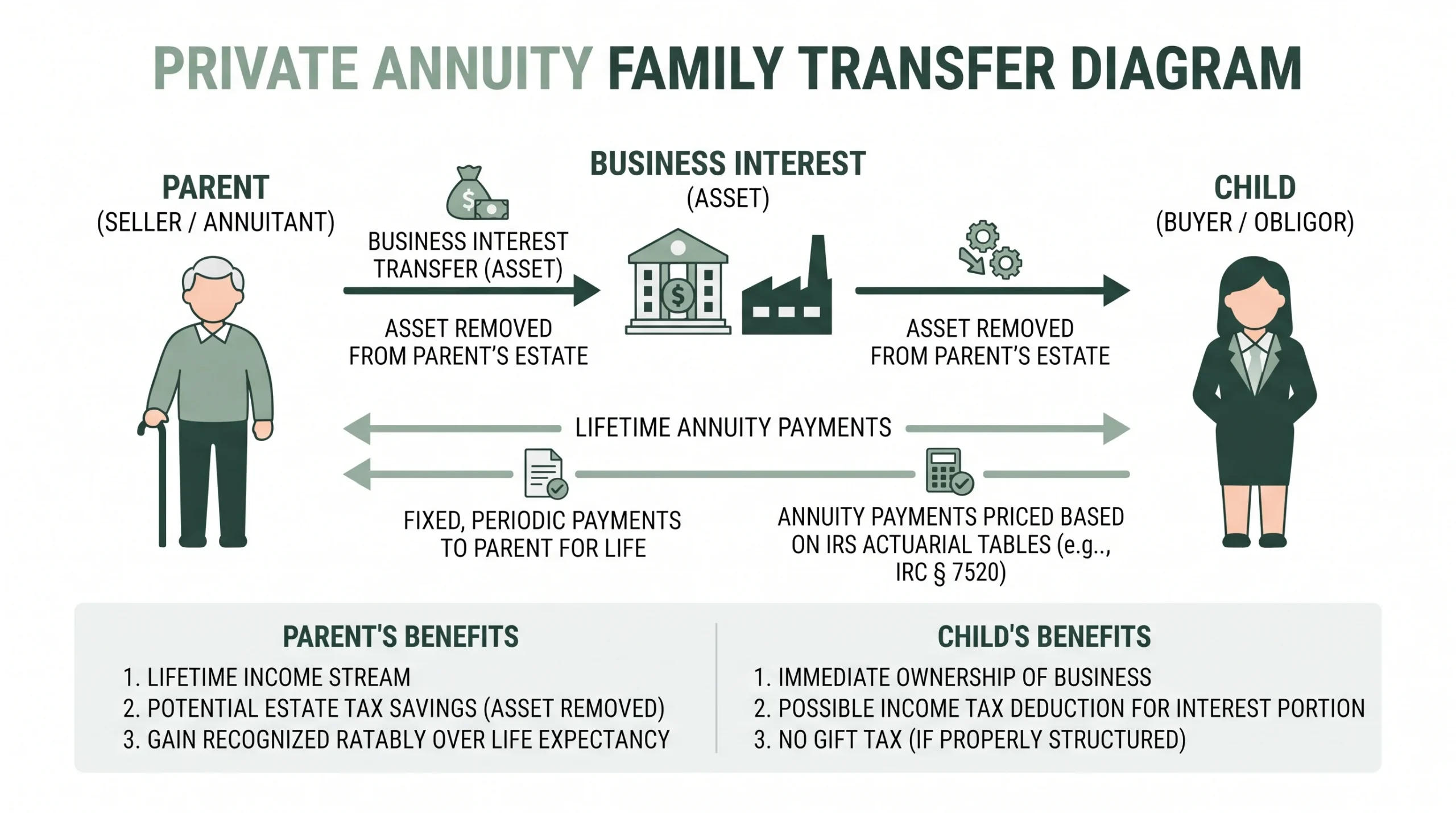
The mechanics are simple. A parent transfers a business interest to a child, or to a trust set up for the child. In exchange, the child signs an unsecured promise to pay the parent a fixed sum every year for the rest of the parent’s life. The payment is not tied to the asset and cannot be secured by it. If the payments were secured, the IRS would treat the deal as a closed sale, and the tax benefit would fall away.
The parent gives up the asset and its future growth. In return the parent gets income for life. The child gets the asset at a price fixed today. Because the payments end at death, any years the parent does not live are value that never leaves the child. That is the estate benefit, and it is why the pricing has to be clean.
What Are the Estate and Gift Tax Effects?
The estate effect is the main draw. Once the asset is sold for a full-value payment stream, it is no longer in the parent’s estate. Its later growth belongs to the child. The payments the parent receives are spent or consumed over time, so they tend to shrink the estate even further.
The gift question turns on price. If the payment stream is worth exactly the asset’s fair market value, there is no gift at all. If it is worth less, the difference is a taxable gift from parent to child. That gift is reported on Form 709. A clean valuation is what keeps the transfer off the gift side of the ledger. It is the same arm’s length test the IRS applies to every deal between family members.
How Are the Payments Taxed Under IRC Section 72?
Each payment the parent receives is split three ways under IRC Section 72. Part is a tax-free return of the parent’s basis in the asset. Part is capital gain, spread across the parent’s life expectancy. Part is ordinary interest income. The annuity rules in Section 72 govern how that split is figured each year.
The effect is that tax on the built-in gain is spread out rather than paid all at once. Section 7520 sets the rate used to value the stream, and Section 72 sets how the income tax falls on each payment that comes back. The two sections work together, and the valuation has to support both.
How Does a Private Annuity Compare to a SCIN?
A private annuity and a self-canceling installment note both bet on the seller’s life, but they pay out in different ways. A private annuity has no fixed term. The child pays for as long as the parent lives, and the payments stop at death whenever it comes. A SCIN has a fixed term. If the parent lives through it, the child finishes every payment, including a built-in risk premium.
There is a structural split too. A SCIN is usually secured debt the heirs can enforce. A private annuity must stay an unsecured promise. A SCIN prices a mortality premium on top of the note. A private annuity prices the whole payment stream off the actuarial tables, with no separate premium. You can see how Sofer Advisors approaches tax and estate reporting valuations for both structures.
Who Values a Private Annuity, and How Do the Options Compare?
Owners pick a valuation partner based on the size of the interest, the audit exposure, and the budget. Large national firms such as Alvarez & Marsal, Stout, and Kroll serve big public companies with broad advisory teams. Sofer Advisors focuses on defensible, partner-led valuations for closely held and middle-market businesses, with expert witness testimony in 11+ cases behind its reports and 180+ five-star Google reviews. The table below sets out the common options.
| Provider | Typical role | Best for |
|---|---|---|
| Specialized valuation firm (e.g. Sofer Advisors) | Values the asset and prices the payment stream as full and adequate consideration | Family and closely held transfers needing audit-ready support |
| Large national firm | Broad advisory plus valuation at enterprise scale | Large public companies with complex, multi-entity plans |
| Estate attorney | Drafts the annuity agreement and the transfer; does not value | Families needing the legal structure built and reviewed |
Sofer Advisors runs each engagement through a four-phase process it calls The Sofer Difference, moving from Discovery to Diligence to Analysis to Delivery. That structure keeps every payment figure tied to the tables and the facts behind it. It reflects the Heart of a Teacher approach, which means explaining the reasoning behind a number rather than just handing over a figure. For a transfer that stands up to review, an independent valuation supplies both the price and the record behind it.
Frequently Asked Questions
How do you value a private annuity?
You value a private annuity in two steps that must agree. First you set the asset’s fair market value on the transfer date, with discounts for lack of control and marketability where they apply. Then you price the lifetime payments so their present value equals that asset value, using IRS actuarial tables for life expectancy and the Section 7520 rate for the discount. Sofer Advisors documents both halves so the exchange reads as a fair sale.
What payments are required in a private annuity?
The child must pay the parent a fixed amount every year for the rest of the parent’s life, and those payments cannot be secured by the asset. The amount is set so the stream is worth the full value of the business interest on the transfer date. Payments run until the parent dies, however early or late that falls. Sofer Advisors calculates the required annual payment and ties it to the tables behind the number.
How is a private annuity different from a SCIN?
A private annuity has no fixed term and pays the parent for life, stopping at death whenever it comes. A self-canceling installment note has a fixed term and carries a mortality premium that cancels any balance if the seller dies first. A private annuity is an unsecured promise, while a SCIN is usually secured debt the heirs can enforce. Sofer Advisors values both structures so the pricing meets the fair market value standard the IRS expects.
Does a private annuity remove the asset from the estate?
Yes, when the pricing is genuinely arm’s length. Once the asset is sold for a payment stream worth its full fair market value, the asset and its future growth leave the parent’s estate. The payments received are then spent or consumed over the parent’s remaining years. If the stream is priced too low, part of the transfer is a gift instead. Sofer Advisors prices the stream so the removal holds up under IRS review.
What is the Section 7520 rate?
The Section 7520 rate is an interest rate the IRS publishes every month, equal to 120 percent of the federal midterm rate. It sets the discount rate used to value lifetime payments, annuities, and similar interests for gift and estate tax. A higher rate raises the required annual payment, and a lower rate reduces it. Sofer Advisors applies the correct month’s 7520 rate so the valuation matches the rate in force on the transfer date.
How are the payments taxed under IRC Section 72?
Under IRC Section 72, each payment the parent receives is divided into three parts. One part is a tax-free return of basis in the asset. One part is capital gain, spread across the parent’s life expectancy. The last part is ordinary interest income. This split spreads the tax on the built-in gain over many years rather than all at once. Sofer Advisors provides the underlying figures so the reporting lines up with the valuation used at transfer.
Is a private annuity reported on Form 709?
A private annuity priced at full fair market value is a sale, so no gift is reported. A gift return on Form 709 is needed only when the payment stream is worth less than the asset, which makes the shortfall a taxable gift from parent to child. A clean valuation is what keeps the deal off Form 709 entirely. Sofer Advisors prepares the fair market value support that backs whichever position the transfer takes.
What happens if the annuitant dies early or late?
If the parent dies early, the payments stop and the child keeps the asset for less than the projected cost, which is the planning upside. If the parent outlives the tables, the child keeps paying past the asset’s value, which is the planning risk. The valuation is set on the transfer date and does not change with the outcome. Sofer Advisors models both paths so owners understand the bet before they sign.
How much does a private annuity valuation cost?
Most private annuity valuations run from $7,500 to $25,000 and take about two to six weeks, depending on the business interest and the deadline. The range covers the asset valuation and the actuarial work that prices the payment stream as full consideration. A flat fee is quoted up front, so the cost is clear before the work starts. Request a free estimate from Sofer Advisors for your situation.
Related Case Studies
- SCIN Business Sale Valuation: A Guide to Self-Canceling Notes
- Valuing an Intra-Family Promissory Note for Estate Tax
- Installment Sale of a Business: Tax Deferral and Buyer Pushback
Executive Summary
A private annuity sells an asset for a stream of lifetime payments that stop at the parent’s death, so the asset and its future growth leave the estate. The price of that benefit is the payment stream, valued to equal the asset’s fair market value on the transfer date. Price the stream off IRS actuarial tables and the Section 7520 rate. A payment stream that matches full value keeps the deal a sale instead of a gift. The structure fits income-producing assets, such as a closely held business, that can fund the payments. Watch the moving parts: the promise must stay unsecured, the parent carries credit risk, and Section 72 governs how each payment is taxed. The first step is a fair market value of the asset and a payment stream backed by the tables.
What Should You Do Next?
Gather the asset’s financials, the parent’s age and health facts, and the draft annuity terms, since a clean file supports a defensible price. Confirm the current month’s Section 7520 rate before the agreement is signed, because that rate changes monthly. This guide was prepared by David Hern CPA ABV ASA, founder of Sofer Advisors, an Inc. 5000 firm specializing in neutral third-party valuations for tax and estate reporting. Schedule a free consultation to discuss your specific situation.
People Also Read
- How Family Limited Partnerships Are Valued for Gift and Estate Tax
- What Is a GRAT and How Does It Transfer Business Value to Heirs?
About the Author
This guide was prepared by David Hern CPA ABV ASA, founder of Sofer Advisors, a business valuation firm headquartered in Atlanta, GA serving clients across the United States. David holds dual accreditations as an Accredited Senior Appraiser (ASA) and is Accredited in Business Valuation (ABV), credentials recognized by the IRS, SEC, and FINRA. He also holds the Certified Exit Planning Advisor (CEPA) designation. With 15+ years of valuation experience, David has served as an expert witness in 11+ cases across multiple jurisdictions and built Sofer Advisors into an Inc. 5,000-recognized firm with 180+ five-star Google reviews. Its full W2 employee team maintains subscriptions to all major valuation databases and operates under a next business day response policy.
For professional business valuation services, visit soferadvisors.com/about-us/ or contact Sofer Advisors at soferadvisors.com/contact-us/.
This content is for informational purposes only and does not constitute professional valuation advice. Business valuation conclusions depend on specific facts and circumstances. Contact Sofer Advisors for guidance regarding your specific situation.









