


Last Updated: September 2026
A community property double step-up is a tax rule that resets the cost basis of a jointly owned business to full fair market value when the first spouse dies. Under IRC Section 1014, property passed at death takes a new basis equal to its value on the date of death. In a community property state, both spouses’ halves qualify, not just the half owned by the person who died. The result is a full reset that can erase years of built-in gain.
This matters most to owners of a business that has grown in value over time. A full step-up means the surviving spouse can sell later with little or no capital gains tax. It can also raise the basis used for depreciation. The size of the benefit depends on one thing above all: a credible value for the business on the date of death.
Sofer Advisors prepares date-of-death valuations that support these basis adjustments for families and their advisors. The firm produces defensible reports built to hold up if the IRS reviews the return. With 180+ five-star Google reviews and 11+ expert witness cases, its team explains each step in plain terms so owners and their advisors understand the number behind the basis.
Key Takeaways
- Full basis reset: both halves of a community property business step up to fair market value at the first spouse’s death, not just the decedent’s share.
- Nine states: the rule applies in Arizona, California, Idaho, Louisiana, Nevada, New Mexico, Texas, Washington, and Wisconsin.
- Valuation required: a formal, independent appraisal sets the date-of-death value that becomes the new basis.
- Capital gains saved: a full step-up can erase most or all built-in gain, cutting tax on a later sale.
- Documentation defends it: a detailed report is the primary evidence if the IRS questions the new basis.
Each of these points turns on the same requirement: an accurate value for the business on the date of death. The sections below explain the rule, the states it covers, and the valuation work that supports it.
What Is a Community Property Double Step-Up?
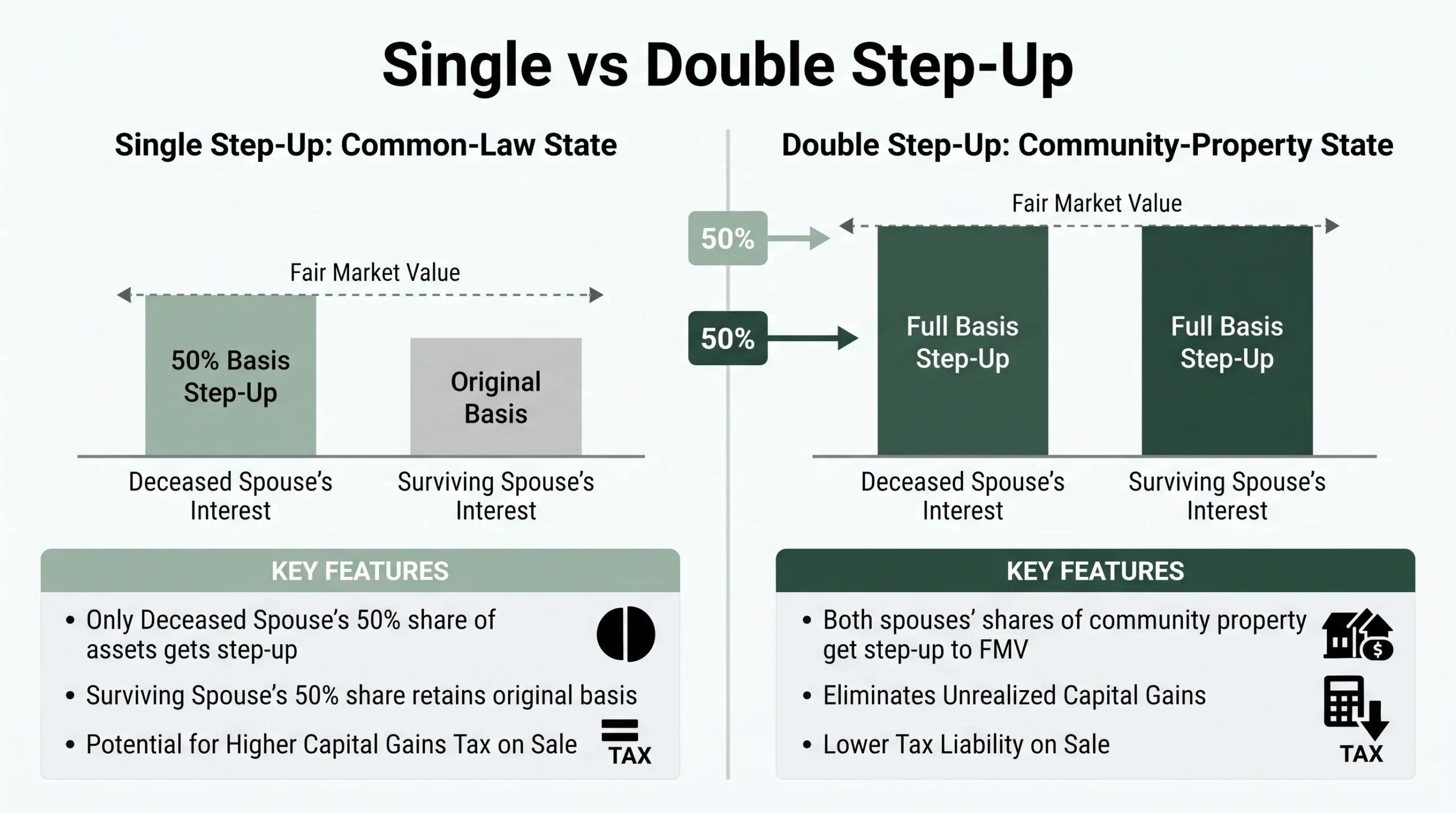
A community property double step-up is a basis rule under IRC Section 1014(b)(6) that resets both halves of a jointly owned asset to fair market value when the first spouse dies. In these states, most property earned during a marriage belongs equally to both spouses. When one spouse dies, the whole asset takes a new basis, not just the deceased spouse’s half. Built-in capital gains from prior years disappear. The surviving spouse then holds the business at a fresh, higher basis.
This differs sharply from common law states. There, only the deceased spouse’s half steps up. The surviving spouse keeps the old, lower basis on their own half. So a sale later can trigger a larger capital gains bill. The IRS confirms this treatment in Publication 551, which explains how basis works for inherited and community property.
Which States Allow the Double Step-Up?
Nine states allow the full double step-up: Arizona, California, Idaho, Louisiana, Nevada, New Mexico, Texas, Washington, and Wisconsin. In each, most assets a couple builds during marriage count as community property owned in equal halves. That shared ownership is what lets the whole asset reset at the first death. Where a business sits, and how it is titled, decides whether the full benefit applies.
A few other states offer an elective version. Alaska, Tennessee, South Dakota, Kentucky, and Florida let couples opt into community property treatment through a written agreement or trust. The rules and results vary by state. Because the details differ so much, owners should confirm their own state’s law before they rely on a full step-up in any plan.
Why Does a Valuation Matter for the Step-Up?
A formal valuation matters because it sets and documents the date-of-death value that becomes the new basis. Without a defensible report, the estate has no proof to justify the stepped-up figure. If the IRS finds the value unsupported, it can reject the step-up. That can leave the surviving spouse with a surprise tax bill on a later sale. A credible appraisal removes that risk.
The work must be independent and follow recognized standards. Sofer Advisors brands its method as The Sofer Difference, a four-step process of Discovery, Diligence, Analysis, and Delivery. Each engagement follows the same path, and the firm brings a Heart of a Teacher approach so clients see how the value was built. Reports are prepared to meet USPAP standards, the benchmark auditors expect. Rigorous method, not a rough estimate, is what protects the estate.
How Does the Double Step-Up Affect Your Taxes?
A double step-up resets the business to current fair market value, which erases the built-in gain on both spouses’ shares. The surviving spouse gains real flexibility. They can sell the business with little or no capital gains tax, because the new basis absorbs the old gain. If they keep running it, the higher basis can raise future depreciation and lower taxable income. The reset changes the whole tax picture for the years ahead.
One point often confuses. The double step-up is an income tax basis rule, not an estate tax break. The 2025 OBBBA law set a permanent federal estate and gift tax exemption of $15 million per person and $30 million per married couple, indexed for inflation, with no sunset. That exemption does not change how the basis step-up works. The two rules solve different problems, so plan for each on its own.
What Valuation Methods Set the Date-of-Death Value?
Appraisers set the date-of-death value using the income, market, and asset approaches, the same framework IRS Revenue Ruling 59-60 requires. Each approach views the business from a different angle. The analyst weighs them to reach one defensible conclusion of value. That figure becomes the stepped-up basis the estate reports. The choice of method depends on the business and its earnings history.
A stable firm with steady profits often leans on the income approach, such as a discounted cash flow model. A company in a crowded market may rely more on the market approach and comparable sales. Every choice gets documented so the report can answer questions later. A retrospective valuation, done after the death, uses only the facts known as of that date. A defensible report is built to survive that kind of review.
How Do You Choose a Valuation Firm?
Choose a firm that is independent, credentialed, and experienced in date-of-death work for tax reporting. National names like Alvarez & Marsal, Stout, and Kroll serve the largest corporate deals. Many family businesses need a firm that focuses on middle-market estate and tax valuations instead. The right partner coordinates with your attorney and CPA and stands behind the number if the IRS asks. The table below compares common options.
| Provider type | Best for | Standards focus |
| Independent valuation firm | Middle-market estate and tax basis work | USPAP and IRS Revenue Ruling 59-60 |
| National consulting firm | Large corporate and cross-border deals | Firm-wide review layers |
| Broker or informal estimate | Quick pricing, not tax defense | Little to no formal standard |
A broker’s rough estimate may help set a listing price, but it rarely holds up for tax reporting. An independent report follows the standards the American Society of Appraisers and the IRS expect, so it carries weight in an audit. For a full community interest, look for an appraiser accredited in business valuation. Sofer Advisors keeps its appraisal work separate from any sale, so the value reflects the real economics of the business, not a deal outcome. Owners can discuss tax and estate valuation needs before they file.
Frequently Asked Questions
What are common mistakes with a stepped-up basis?
Common mistakes include skipping a formal appraisal, using old tax filings as the value, or ignoring the rules that apply in community property states. Owners often assume a quick market estimate will satisfy the IRS. It usually will not. A qualified appraiser documents the date-of-death value with recognized methods, so the figure can stand up if tax authorities review the estate later.
How do you determine the stepped-up value of inherited property?
The value is set at the fair market value of the asset on the date of the owner’s death. For a private business or a unique asset, that usually calls for a professional valuation. An analyst applies standard methods to justify the figure to the IRS. The resulting report confirms the new basis for the surviving spouse, heirs, and their tax preparers.
What is the step-up basis loophole?
The term describes holding appreciated assets until death instead of selling them during life. When an asset passes through an estate, its basis resets to current fair market value. That reset can erase capital gains tax on the earlier growth. For a business, this interacts with succession and estate planning, so owners often review it with their tax and legal advisors before acting.
What assets do not receive a step-up at death?
Assets classed as income in respect of a decedent do not step up. Common examples are retirement accounts, unpaid commissions, and some deferred compensation. These stay subject to income tax because the gain was never taxed during the owner’s life. Sorting these items from assets that do qualify is a normal part of estate and basis planning for a business owner.
Does the double step-up apply to all assets in community property states?
No. The full double step-up applies to community property, where both halves reset when the first spouse dies. Separate property does not qualify the same way. It steps up only on the deceased spouse’s share. Whether a business counts as community or separate depends on how it was earned, titled, and held, so its character should be reviewed before the plan relies on a full reset.
What happens if a business is held in a trust?
Holding a business in a trust does not automatically block a community property step-up. The trust must keep the community property character of the asset. The specific terms of the trust agreement drive the tax result. Because structures vary widely, the trust language and titling should be reviewed against state law to confirm the intended treatment before a death occurs.
How long after death should you get a valuation?
There is no strict statutory deadline, but the appraisal must reflect fair market value as of the date of death. Waiting makes it harder to reconstruct the financial reality of the business at that point. Records fade and memories blur. Starting the valuation soon after the death keeps the data accurate and the analysis stronger, which makes the reported basis easier to defend.
How much does a community property step-up valuation cost?
A tax and estate business valuation typically ranges from $7,500 to $25,000. The fee depends on the size and complexity of the business, the asset classes involved, and the timeline. A single-owner company with clean records sits at the lower end. A larger firm with multiple entities or a rush schedule moves higher. The quote reflects the depth of analysis the report requires.
Can a valuation be done retroactively for a step-up?
Yes. A retrospective valuation sets the value as of a past date, usually the date of death. The analyst relies only on the facts and financials known at that time, not on later results. Standard appraisal methods still apply. A credible retrospective report can support the stepped-up basis even when the work happens well after the death occurred.
Related Case Studies
- Stepped-Up Basis at Death: What Business Owners Must Know
- Valuation of Closely Held Business for Estate Tax Purposes
- How Family Limited Partnerships Are Valued for Gift and Estate Tax
Executive Summary
In nine community property states, a jointly owned business gets a full basis step-up when the first spouse dies. Both halves reset to fair market value under IRC Section 1014(b)(6), not just the decedent’s share. That reset can erase built-in capital gains and cut the tax on a later sale. It can also raise the basis used for depreciation. The benefit rests on a credible date-of-death value, set with the income, market, and asset approaches under IRS Revenue Ruling 59-60. A defensible report, prepared to USPAP standards, is the primary evidence if the IRS reviews the new basis.
What Should You Do Next?
First, confirm your state’s law and check how the business is titled, since character decides whether the full step-up applies. Second, gather the records that support a date-of-death value: tax returns, financial statements, and ownership agreements. Third, engage an independent appraiser to set the fair market value that becomes the new basis, and coordinate that report with your attorney and CPA.
David Hern CPA ABV ASA, founder of Sofer Advisors, helps owners and their advisors build defensible, tax-compliant valuations for complex estate transitions. Schedule a consultation to discuss your specific situation.
People Also Read
- Cost Basis vs Fair Market Value: Key Differences Explained
- Fair Market Value for Estate Tax: What Executors Need
About the Author
This guide was prepared by David Hern, CPA, ABV, ASA, founder of Sofer Advisors, a business valuation firm headquartered in Atlanta, GA, serving clients across the United States. David holds dual accreditations as an Accredited Senior Appraiser (ASA) and is Accredited in Business Valuation (ABV), credentials recognized by the IRS, SEC, and FINRA. He also holds the Certified Exit Planning Advisor (CEPA) designation. With 15+ years of valuation experience, David has served as an expert witness in 11+ cases across multiple jurisdictions and built Sofer Advisors into an Inc. 5000-recognized firm with 180+ five-star Google reviews. Its full W2 employee team maintains subscriptions to all major valuation databases and operates under a next-business-day response policy.
For professional business valuation services, visit soferadvisors.com/about-us/ or contact Sofer Advisors at soferadvisors.com/contact-us/.
Disclaimer: This content is for informational purposes only and does not constitute professional valuation advice. Business valuation conclusions depend on specific facts and circumstances. Contact Sofer Advisors for guidance regarding your specific situation.









