


Last Updated: October 2026
A fair market value calculator is an online tool that multiplies one earnings figure by an industry number to guess what a business is worth. It feels precise. It is not. Fair market value is a legal standard the IRS defines, not a sum a form can produce. A real business value depends on facts no calculator collects.
The team at Sofer Advisors prepares these valuations for business owners, CPAs, and estate attorneys, backed by Inc. 5000 recognition in both 2024 and 2025 and expert witness testimony in 11+ cases. A calculator can give you a rough number in seconds. It cannot defend that number to the IRS, a court, or a buyer who tests every line.
This guide explains the fair market value standard, what a single-multiple calculator misses, what the three valuation approaches actually require, and where a rough multiple still helps. It also shows what to use instead when the number has to hold up.
Key Takeaways
- Value is a standard, not a sum: fair market value is a legal definition, so no calculator can produce it with one multiple.
- The IRS test is a willing buyer and seller: both informed, neither forced, with Revenue Ruling 59-60 setting the eight factors.
- Calculators skip what matters: they ignore normalization, company-specific risk, and discounts for control or marketability.
- Three approaches, real inputs: the asset, market, and income approaches each need data a form never collects.
- A rough multiple is a sanity check: it helps you gauge an offer, but tax, estate, and legal uses need a documented report.
Each point below builds on the one before it. The sections take them in order.
Why Can’t a Fair Market Value Calculator Value a Business?
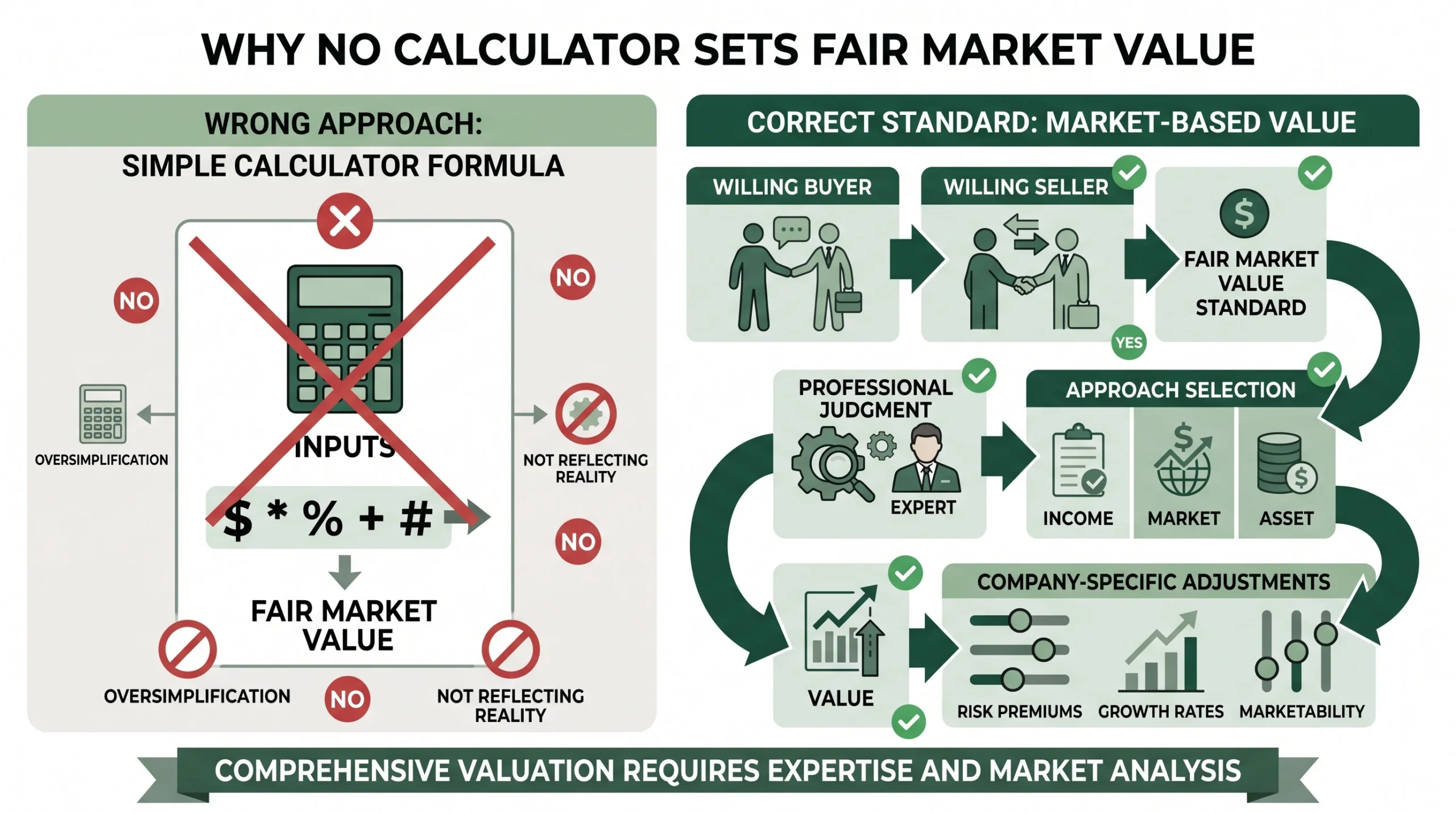
A fair market value calculator cannot value a business because it applies one multiple to one number and stops there. Business value depends on normalized earnings, risk, and facts no form collects. Fair market value is a legal standard, not a sum. The IRS defines it as the price a willing buyer and a willing seller would agree on, both informed and neither forced.
A calculator asks for revenue or profit, multiplies by an industry figure, and shows a number in seconds. That number ignores how the owner is paid, how steady the cash flow is, and how dependent the company is on one person. It cannot read a customer contract or test a growth claim. A real valuation starts where the calculator ends, with the facts behind the earnings and the risk attached to them.
What Is the Fair Market Value Standard?
Fair market value is the price at which property would change hands between a willing buyer and a willing seller. Both act with reasonable knowledge of the facts, and neither is under any compulsion to buy or sell. This is the standard the IRS uses for tax purposes. It describes hypothetical parties, not a specific buyer, so it rules out a strategic price one acquirer might pay.
The definition appears in the Treasury rules and in IRS Publication 561, which values donated property the same way. IRC Section 2031 fixes estate value on this basis. Revenue Ruling 59-60 then lists eight factors an appraiser weighs for a closely held company. These include the nature and history of the business, the economic outlook, book value, earning capacity, dividend-paying capacity, goodwill, prior stock sales, and the market price of comparable public companies. No formula assigns them fixed weights.
What Does a Single-Multiple Calculator Miss?
A single-multiple calculator misses four things that move value the most. It skips normalization, so owner salary and one-time costs stay buried in the earnings. It ignores company-specific risk, like customer concentration or owner dependence. It applies no discounts for a minority stake or a lack of marketability. And it never reads the facts, the contracts, leases, and claims a buyer checks first.
Start with normalization. A buyer does not pay for the current owner’s above-market salary or a one-time legal bill, so those come out before any multiple applies. Then risk. Two companies with the same profit are not worth the same if one leans on a single client. Discounts matter too. A 20 percent stake with no control and no ready buyer is worth less per share than the whole. You can see how Sofer Advisors handles this in its guide to calculating fair market value.
What Do the Three Valuation Approaches Require?
The three approaches are the asset approach, the market approach, and the income approach. The asset approach restates the balance sheet at current value. The market approach compares the business to similar companies that have sold. The income approach projects future cash flow and discounts it to today. Each needs inputs a calculator never gathers, and an appraiser weighs the results against the facts.
The market approach needs real transaction data from private databases, matched to size and industry, not a generic rule of thumb. The income approach needs a cash flow forecast and a discount rate built from market risk and company risk. The asset approach needs each asset and liability restated, which suits holding companies more than operating ones. An appraiser runs the methods that fit the purpose, then reconciles them into one supported number.
Sofer Advisors applies these approaches in its business valuation services for owners, CPAs, and attorneys who need a number that holds up under review.
When Is a Rough Multiple Actually Useful?
A rough multiple is useful as a sanity check, not as a defensible value. It gives an owner a ballpark before a sale, a rough feel for whether an offer is close, or a starting point for a conversation. It is fine for planning in your own head. It is not fine for the IRS, a court, a lender, or a buyer who will test every assumption behind it.
Think of the multiple as a thermometer, not a diagnosis. If a broker suggests four times earnings and your own math lands near there, the number is probably in the right range. That is worth knowing. But the moment the value feeds a tax return, a gift, a divorce, or a shareholder buyout, the rough figure fails. Those uses need a report that shows the data, the method, and the reasoning behind the result.
Who Values a Business, and How Do the Options Compare?
Owners choose a valuation partner based on the purpose, the audit exposure, and the budget. An online calculator gives a free estimate with no support. A large national firm serves big public companies with broad teams. A specialized valuation firm prices a closely held business and documents the result for the IRS or a court. The table below sets out the common options.
Large national firms such as Alvarez & Marsal, Stout, and Kroll serve big public companies with broad advisory teams. Sofer Advisors focuses on defensible, partner-led valuations for closely held and middle-market businesses, with 180+ five-star Google reviews behind its reports.
| Provider | Typical role | Best for |
|---|---|---|
| Online calculator | Applies one multiple to one earnings figure | A quick gut check with no filing attached |
| Specialized valuation firm (e.g. Sofer Advisors) | Prices the business and documents it as fair market value | Tax, estate, litigation, and transaction reports |
| Large national firm | Broad advisory plus valuation at enterprise scale | Large public companies with complex, multi-entity plans |
Sofer Advisors runs each engagement through a four-phase process it calls The Sofer Difference, moving from Discovery to Diligence to Analysis to Delivery. That structure ties every number to the facts behind it. It reflects the Heart of a Teacher approach, which means explaining why a value lands where it does rather than handing over a figure. A calculator can start the conversation. A documented valuation is what finishes it.
Frequently Asked Questions
Is there a fair market value calculator for a business?
There are free fair market value calculators online, but none produces a defensible business value. They apply one multiple to one earnings figure and skip normalization, risk, and discounts. The result is a rough guess, fine for a quick gut check and nothing more. For a tax filing, a sale, or a dispute, Sofer Advisors prepares a full valuation that documents the number and holds up under review.
How do I calculate the fair market value of a business?
You do not calculate it with one formula. You normalize earnings, remove the owner’s above-market pay and one-time items, then apply the asset, market, and income approaches and reconcile them. You weigh company-specific risk and any discounts for control or marketability. Sofer Advisors follows the eight factors in Revenue Ruling 59-60 to build a conclusion that reflects both the hard numbers and the facts behind them.
How does the IRS determine fair market value?
The IRS uses the willing buyer and willing seller standard, then applies Revenue Ruling 59-60 for closely held companies. That ruling lists eight factors, including the nature of the business, its earning capacity, its dividend-paying ability, and the value of comparable public companies. No single formula sets the answer. Sofer Advisors aligns every tax and estate report with these standards so the value survives an IRS review.
Why do online business valuation calculators fall short?
Online calculators fall short because they read only the numbers you type and nothing else. They cannot judge management depth, customer concentration, or how much the business depends on the owner. They apply no discounts and skip normalization, so the output can be far from a real sale price. Sofer Advisors examines these company-specific facts, which is the part of value a calculator will always miss.
What is a good fair market value for a business?
A good fair market value is one a willing buyer and willing seller would actually agree on, both informed and neither forced. It reflects true earning power, not the owner’s hoped-for price or the original cost. A number is only as good as the support behind it. Sofer Advisors grounds every conclusion in current market data and documented reasoning, so the value stands up when someone tests it.
What is the difference between fair market value and investment value?
Fair market value assumes a hypothetical, typical buyer. Investment value is the price one specific buyer would pay, often more, because of cost savings or a strategic fit. A calculator cannot tell the two apart, yet the IRS accepts only fair market value for tax purposes. Sofer Advisors measures fair market value for tax and estate work and models investment value separately when a client weighs a specific offer.
How much does a business fair market value assessment cost?
A standard business valuation runs from $7,500 to $25,000 and takes about four to eight weeks, depending on the company and the deadline. The range covers the analysis needed to document fair market value for the IRS or a court. A flat fee is quoted up front, so you know the cost before work starts. Sofer Advisors scopes the engagement first, then quotes a fixed price. Request a free estimate for your situation.
How often should a business update its fair market value?
Update the value whenever something material changes, such as a sale, a gift, an owner exit, or an estate event. Companies using equity compensation under Section 409A refresh the value at least every twelve months. A stale number invites a challenge when it matters most. Sofer Advisors helps owners track how operating changes move value over time, so the figure on file reflects the business as it stands today.
Can an EBITDA multiple estimate fair market value?
An EBITDA multiple can estimate a range, but it is a starting point, not a conclusion. The multiple itself depends on size, growth, risk, and industry, and the EBITDA must be normalized first. Used alone, it skips the income and asset approaches entirely. Sofer Advisors uses market multiples as one input, then checks them against the other approaches so the final fair market value rests on more than a single ratio.
Related Case Studies
- Applying IRS Revenue Ruling 59-60: 8 Factors in Every Valuation
- How Do You Determine What a Business Is Worth? Complete Guide
- Rule of Thumb Business Valuation: Uses and Limitations
Executive Summary
A fair market value calculator cannot value a business, because value is a legal standard rather than a single sum. The IRS defines fair market value as the price a willing buyer and willing seller would agree on, both informed and neither forced, and Revenue Ruling 59-60 sets eight factors behind it. A single-multiple tool skips normalization, risk, and discounts, and never reads the facts. The three valuation approaches each need inputs a calculator never gathers. A rough multiple works as a sanity check, but tax, estate, litigation, and sale decisions need a documented report. Sofer Advisors prepares that report and ties every number to the evidence.
What Should You Do Next?
Gather three to five years of financial statements, a current balance sheet, and any shareholder or buy-sell agreements, since a clean file supports a defensible value. Decide the purpose first, because a tax number and a sale number are measured differently. This guide was prepared by David Hern CPA ABV ASA, founder of Sofer Advisors, an Inc. 5000 firm that prepares neutral third-party valuations. See the full range of business valuation services, or schedule a free consultation through the contact page to discuss your situation.
People Also Read
- Cost Basis vs Fair Market Value: Key Differences Explained
- 409A Valuation vs Fair Market Value: Key Differences Explained
About the Author
This guide was prepared by David Hern CPA ABV ASA, founder of Sofer Advisors, a business valuation firm headquartered in Atlanta, GA serving clients across the United States. David holds dual accreditations as an Accredited Senior Appraiser (ASA) and is Accredited in Business Valuation (ABV), credentials recognized by the IRS, SEC, and FINRA. He also holds the Certified Exit Planning Advisor (CEPA) designation. With 15+ years of valuation experience, David has served as an expert witness in 11+ cases across multiple jurisdictions and built Sofer Advisors into an Inc. 5,000-recognized firm with 180+ five-star Google reviews. Its full W2 employee team maintains subscriptions to all major valuation databases and operates under a next business day response policy.
For professional business valuation services, visit soferadvisors.com/about-us/ or contact Sofer Advisors at soferadvisors.com/contact-us/.
This content is for informational purposes only and does not constitute professional valuation advice. Business valuation conclusions depend on specific facts and circumstances. Contact Sofer Advisors for guidance regarding your specific situation.