


Last Updated: November 2026
An oil and gas company is valued mainly on its reserves, the oil and gas still in the ground that it can produce and sell. Appraisers rely on the income approach. They forecast the cash those reserves will produce, then discount it to today’s dollars. The size and certainty of the reserves, the cost to extract them, and commodity prices all move the value.
The team at Sofer Advisors prepares these valuations for owners, CPAs, and attorneys across the United States.
This guide explains how reserves are classified, how a reserve-based discounted cash flow works, and how market comparables check the result.
Key Takeaways
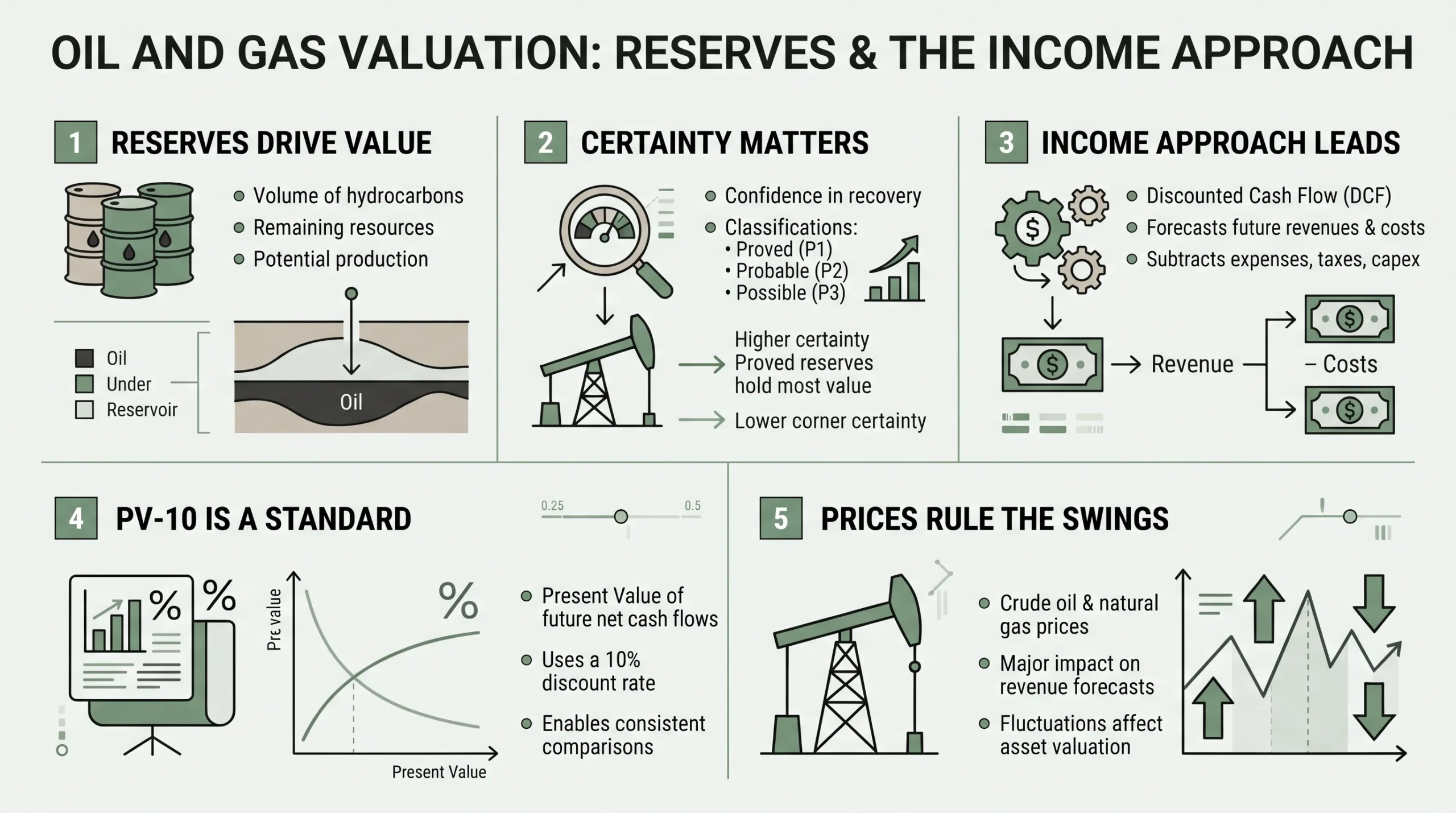
- Reserves drive value: The worth of an oil and gas company rests on the reserves it can produce and sell.
- Certainty matters: Reserves rank as proved, probable, or possible, based on how sure recovery is.
- Income approach leads: A discounted cash flow of future net revenue is the main method for these firms.
- PV-10 is a standard: It is the present value of future net revenue discounted at 10 percent, used in SEC filings.
- Prices rule the swings: Commodity price volatility is the single biggest driver of value.
Why is oil and gas valuation different?
Oil and gas companies sell a finite resource. Every barrel produced is one less barrel in the ground. So the asset shrinks as the business runs. Few other industries work this way.
Value also moves with commodity prices. Oil and gas prices can rise or fall sharply in a single year. That swings cash flow, and value swings with it. A field that earns a profit at one price can lose money at another.
The work is capital intensive too. Drilling and completing wells costs a lot up front. Output then declines over time along a fairly predictable curve. An appraiser must weigh those costs, the decline, and price risk together. That mix makes the valuation its own discipline.
How are oil and gas reserves classified?
Reserves are grouped by how certain their recovery is. The three main classes are proved, probable, and possible. Two frameworks set the rules. One is the SEC’s reserve reporting standard. The other is the Petroleum Resources Management System, known as PRMS. The PRMS is sponsored by the SPE, WPC, AAPG, and SPEE.
Proved reserves have reasonable certainty of recovery under current prices and conditions. They carry the most weight in a valuation. Proved reserves split into three subtypes:
- Proved developed producing, or PDP: flowing from existing wells right now.
- Proved developed non-producing, or PDNP: behind pipe or shut in, needing little new spending.
- Proved undeveloped, or PUD: needing new wells or major capital before they produce.
Probable reserves are less certain than proved. Still, they are more likely than not to be recovered. Possible reserves are the least certain of the three. In shorthand, 1P means proved. 2P means proved plus probable. 3P adds possible on top of those.
A reserve report ties this together. Qualified petroleum engineers prepare it. They estimate volumes, timing, and the certainty of each category. The engineers follow set technical standards when they classify each volume. That report is the backbone of the valuation. A valuation is only as sound as the reserve report behind it. So appraisers review its assumptions with care.
What is the income approach for oil and gas?
The income approach values the company by the cash its reserves will produce. It is the primary method for exploration and production firms. The logic is plain. Reserves hold value only when they are produced and sold. So the forecast of that future income sets the value.
An appraiser builds the forecast reserve by reserve. Producing reserves carry the most confidence and the highest weight. Undeveloped reserves need capital first, so the model discounts them more. Probable and possible reserves, if used at all, are risk-weighted down further. This risk-weighting by category is central to a credible result.
The approach also handles mixed assets well. A company may hold wells at different stages at once. Some flow today, while others wait on capital. The income model values each stream on its own terms. Then it sums them into one value. That flexibility is why the approach suits these firms.
How does a reserve-based DCF work?
A discounted cash flow, or DCF, turns the reserve report into a value. The steps follow a set order.
First, engineers project output with decline curves. These curves show how a well’s production falls over time. Second, the model applies a price deck. That is the set of forward prices for oil and gas across the forecast. Third, it adjusts for differentials. Local prices differ from benchmark prices by location and by quality.
Then come the costs. The model subtracts operating expenses, production taxes, and the capital needed to drill new wells. What remains is future net revenue. Last, the model discounts that revenue to present value. The discount rate reflects the risk of the reserves and the swing in prices.
Development timing shapes the result as well. Undeveloped reserves need wells drilled before they pay off. The model schedules that spending in the years it occurs. It then delays the matching revenue until the wells produce. Getting this timing right keeps the present value honest.
One figure recurs in this work. It is PV-10. PV-10 is the present value of estimated future net revenue discounted at 10 percent. It is widely used, and it appears in SEC disclosures. PV-10 is a non-GAAP measure. It relates to the SEC’s standardized measure, which also reflects income taxes.
Here is an illustrative example. Suppose a small field is expected to yield $2,000,000 in future net revenue over its life. Discounting that stream at 10 percent might bring it to roughly $1,400,000 today. These numbers are illustrative only. The method is the point. Forecast the net revenue, then discount it.
What market comparables cross-check the value?
Appraisers test the income result against the market. Comparables come from public companies and from deals between buyers and sellers. A few measures are common in this field:
- Dollars per flowing barrel, based on daily production.
- Dollars per barrel of oil equivalent, or BOE, of reserves.
- Dollars per acre, for undeveloped land.
- EV/EBITDAX, which adds exploration expense back to earnings.
These multiples give a quick read on scale and quality. They do not replace the income approach. Instead, they show whether its answer sits in a sensible range. When the two methods agree, the conclusion grows stronger.
A short table shows how the main measures line up:
| Measure | What it compares | Best use |
|---|---|---|
| Dollars per flowing barrel | Value against daily output | Producing companies |
| Dollars per BOE of reserves | Value against reserves in the ground | Reserve-heavy firms |
| Dollars per acre | Value against land held | Undeveloped acreage |
| EV/EBITDAX | Value against normalized earnings | Service and mixed firms |
Which approach fits which company?
Three approaches appear in this field. The right one depends on the company.
The income approach fits most producing exploration and production firms. Their value flows from reserves, and this method measures that flow directly. It is the usual primary approach for upstream businesses.
The market approach works as a cross-check for those same firms. It is also useful on its own for oilfield service companies. Those firms earn from drilling support, equipment, and maintenance. They do not own the reserves, so comparables often describe them better.
The asset approach fits distressed or holding companies. It values the tangible items, such as rigs, equipment, and land. Appraisers reach for it when production income is thin. It also fits a business that faces liquidation.
Many engagements use more than one approach. An appraiser may anchor on income and confirm it with the market. Agreement across methods makes the final number easier to defend.
Why does price volatility matter so much?
Commodity price volatility is the biggest driver of value. A price deck built today can look wrong in months. Higher prices lift net revenue. They can also pull marginal barrels into the proved column. Lower prices do the reverse. They can strand reserves that cost too much to produce.
Appraisers manage this in two ways. They use reasonable, supportable price decks rather than spot peaks. And they test a range of prices to see how value moves. That sensitivity analysis shows the swing. It also makes the final conclusion easier to defend.
Frequently Asked Questions
What are proved reserves?
Proved reserves are the volumes that can be recovered with reasonable certainty. That certainty rests on current prices, current costs, and known conditions. They carry the most weight in a valuation. Proved reserves split into producing, developed non-producing, and undeveloped categories.
What is PV-10?
PV-10 is the present value of estimated future net revenue from reserves, discounted at 10 percent. It is widely used in the industry and appears in SEC disclosures. PV-10 is a non-GAAP measure. It relates to the SEC’s standardized measure, which also reflects income taxes.
Why is the income approach preferred for oil and gas?
Reserves only produce value when they are extracted and sold. The income approach models that future stream of cash directly. It discounts the net revenue from reserves back to present value. For exploration and production firms, this is the primary method.
What is a price deck?
A price deck is the set of forward oil and gas prices used in the forecast. It sets the revenue side of the model year by year. Appraisers adjust it for differentials, which reflect local price and quality. A reasonable, supportable deck matters more than a single spot price.
What do decline curves do?
Decline curves estimate how a well’s production falls over its life. Engineers build them from the well’s history and from nearby wells. These curves set the volume side of the cash flow forecast. Without them, the model has no basis for future production.
What is EBITDAX and why is it used?
EBITDAX is earnings before interest, taxes, depreciation, amortization, and exploration expense. Firms account for exploration costs in different ways. Adding that expense back lets analysts compare them on even footing. The measure is common when benchmarking upstream and service companies.
How does a plugging and abandonment liability affect value?
Plugging and abandonment is the future cost to seal wells and restore the site. It is a real obligation that reduces net value. A model that ignores it will overstate the company’s worth. A careful valuation subtracts this cost from the value of the reserves.
Are probable and possible reserves ever included?
Proved reserves are the main focus of most valuations. Probable and possible reserves may enter a transaction analysis. Because they are less certain, they are risk-weighted down. Many valuations give them little or no credit.
What does BOE mean in a reserve report?
BOE stands for barrel of oil equivalent. It converts natural gas volumes into a comparable oil figure. The measure lets analysts combine oil and gas into one number. Many reserve and value multiples are quoted per BOE.
Related Case Studies
- Cost Approach vs Income Approach: Real Valuation Case Examples with Numbers
- Cost Approach vs Income Approach: Complete Guide
- Retail Company Valuation Multiples: Complete Guide 2026
Executive Summary
The worth of an oil and gas company rests on the reserves it can produce and sell. Reserves rank as proved, probable, or possible, based on how sure recovery is. A discounted cash flow of future net revenue is the main method for these firms. It is the present value of future net revenue discounted at 10 percent, used in SEC filings. Commodity price volatility is the single biggest driver of value.
What Should You Do Next?
Gather your latest reserve report, production history, and operating cost records before any valuation or sale. Those documents are the evidence a reserve-based model runs on. For a defensible valuation of your oil and gas assets, Sofer Advisors can help, with work led by David Hern CPA ABV ASA CVA. Schedule a consultation to discuss your situation.
People Also Read
- Technology Company Valuation Methods: A Complete Guide
- Cost Approach Valuation: When Replacement Cost Applies
About the Author
This guide was prepared by David Hern CPA ABV ASA CVA, founder of Sofer Advisors, a business valuation firm headquartered in Atlanta, GA serving clients across the United States. David holds accreditations as an Accredited Senior Appraiser (ASA) and is Accredited in Business Valuation (ABV), credentials recognized by the IRS, SEC, and FINRA, and is also a Certified Valuation Analyst (CVA). David has served as an expert witness in dozens of cases across multiple jurisdictions, and Sofer Advisors is an Inc. 5000 honoree in 2024 and 2025 with 240+ five-star Google reviews.
For professional business valuation services, visit soferadvisors.com/about-us/ or contact Sofer Advisors at soferadvisors.com/contact-us/.
Disclaimer: This content is for informational purposes only and does not constitute professional valuation advice. Business valuation conclusions depend on specific facts and circumstances. Contact Sofer Advisors for guidance regarding your specific situation.