


Last Updated: October 2026
No, goodwill is not a current asset. It is a non-current, intangible asset. It represents the premium a buyer paid in an acquisition above the fair value of the identifiable net assets. Because it cannot be converted to cash within a year, it does not belong with liquid items like cash or receivables. In some large acquisitions, goodwill is more than half of the total purchase price. That is why its placement matters. It sits firmly in the long-term section of the balance sheet.
The team at Sofer Advisors prepares purchase price allocations and goodwill valuations for owners, CPAs, and auditors, backed by Inc. 5000 recognition in both 2024 and 2025. Placing goodwill correctly matters for anyone reading the financials. The line between current assets and long-term intangibles like goodwill drives reporting accuracy.
Owners often struggle to sort assets when preparing for a sale or a tax event. This guide explains why goodwill is non-current and how it is recorded under ASC 805. It also shows how goodwill compares to other assets, and how ASC 350 impairment testing keeps its value honest.
Key Takeaways
- Not current: goodwill is a non-current intangible asset, since its benefits last well beyond one year.
- From an acquisition: it is created only in a purchase, as the price paid above the fair value of net identifiable assets.
- No amortization: goodwill has an indefinite life and is not amortized by public companies under ASC 350.
- Impairment testing: companies test it at least annually, and write it down if fair value falls below carrying value.
- Valuation needed: both the initial ASC 805 allocation and the yearly impairment test require a supported valuation.
Each point ties back to where goodwill sits on the balance sheet and why. The sections below examine each in detail.
Why Is Goodwill’s Classification Important to Understand?
Correct classification matters because US GAAP sets strict rules for where goodwill sits and how it is tested. ASC 805 governs how goodwill is first recorded in a business combination, as the residual of a purchase price allocation. ASC 350 then requires at least an annual impairment test instead of amortization for public companies. Misplacing goodwill among current assets can overstate liquidity. Skipping the ASC 350 test can distort key ratios and draw questions from an auditor who relies on the reported numbers.
Why Is Goodwill Not a Current Asset?
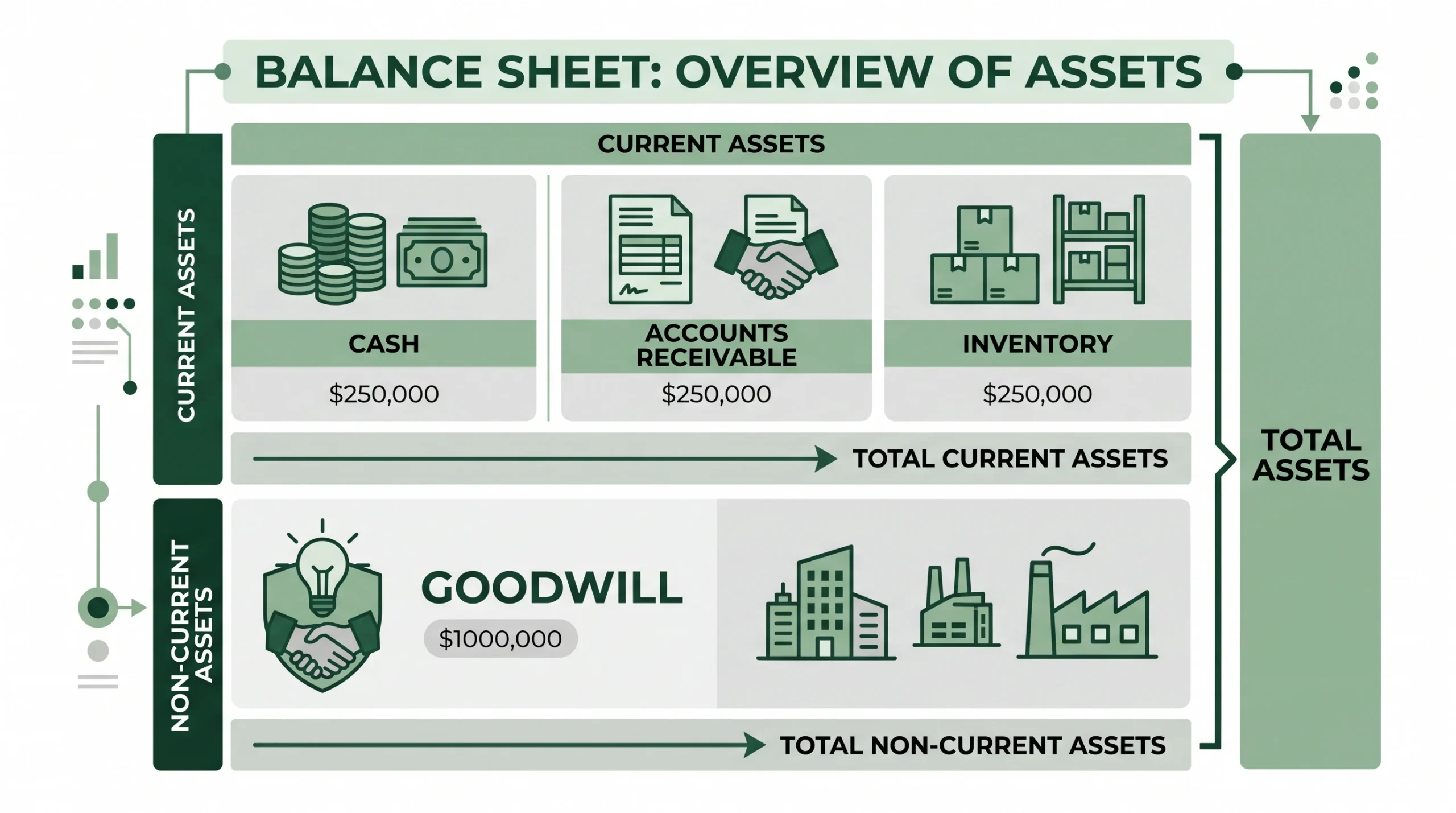
A current asset is one a company expects to turn into cash within a year, or one operating cycle. Cash, accounts receivable, and inventory all qualify. Goodwill does not. It cannot be sold on its own or collected like a receivable. Its benefits, such as brand value and customer loyalty, play out over many years.
So goodwill is a non-current asset. It does not move with the short-term business cycle. It stays on the balance sheet as a long-term item until an impairment reduces it. For an owner preparing for a transaction, this distinction matters. Goodwill is not a source of immediate liquidity. It reflects the premium paid for long-term future earning power, not working capital for daily operations. A buyer reading the balance sheet closely treats it very differently from cash or receivables. Goodwill cannot be used to cover short-term obligations.
How Is Goodwill Recorded on the Balance Sheet?
Goodwill is recorded in the non-current assets section, as an intangible asset, only after an acquisition. It represents the residual premium the buyer paid above the net fair value of the identifiable assets and liabilities acquired. Isolating that premium keeps the investment cost separate from the value of tangible items and specific intangibles.
The figure comes from a purchase price allocation under ASC 805. The acquirer subtracts the net fair value of the identifiable assets and liabilities from the total purchase price. Whatever amount remains is goodwill. This keeps the statements clear about what is tangible property versus the premium paid for future benefits. Once recorded, goodwill stays in the non-current section and faces annual impairment testing under ASC 350.
What Distinguishes Goodwill From Other Intangibles?
Goodwill is an unidentifiable intangible with an indefinite life. It has no physical form and no expiration date. Unlike patents or trademarks, it cannot be separated from the business or sold on its own. It represents residual value, like reputation and customer loyalty, that stays tied to the company as a whole.
Because its life is indefinite, goodwill is not amortized by public companies. Instead it is tested for impairment each year under ASC 350. Identifiable intangibles with finite lives, such as patents, are amortized over their useful lives. That systematic expense reflects the gradual use of a defined benefit. Goodwill has no such defined term, which is why it follows a different path.
How Is Goodwill Tested for Impairment?
Companies test goodwill by comparing a reporting unit’s fair value to its carrying amount, at least once a year. The test confirms the balance sheet still reflects the asset’s real value after the original allocation. If the carrying amount exceeds fair value, the company has a potential impairment to measure.
When the fair value falls below carrying value, the company records an impairment loss. The write-down lowers goodwill on the balance sheet and flows through the income statement as a charge. The test can begin with a qualitative screen before a full quantitative measurement. Either way, a credible fair value estimate is essential, since the charge is real and visible to investors. A large impairment can signal that a past acquisition underperformed, so the market often reacts to it. That is why the annual test is treated as a serious exercise, not a formality.
Getting a credible fair value for the annual test is easier with an independent valuation partner. Talk to a Sofer Advisors valuation specialist about your reporting units and testing approach.
What Factors Cause Goodwill Impairment?
Impairment happens when a reporting unit’s fair value drops below its carrying value. That signals the premium paid in the acquisition is no longer supported by performance. Common triggers include a sustained drop in share price, adverse regulatory change, or the loss of key personnel. Each points to weaker future benefits.
These triggers show that the economics behind the deal have eroded. A falling share price reflects market doubt about future profit. New regulation can raise costs or limit operations. Losing key people can disrupt the cash flow the acquisition assumed. When a trigger appears, the company runs a quantitative test to measure the decline. That keeps reporting accurate under ASC 350.
How Do Asset Types Compare on the Balance Sheet?
Assets are classified by liquidity and nature. GAAP requires companies to separate items by how quickly they produce cash or support operations. That lets a reader judge both short-term health and long-term standing. The table below contrasts goodwill with a typical current asset and an identifiable intangible.
| Feature | Goodwill | Accounts receivable | Patent |
|---|---|---|---|
| Asset type | Intangible, non-current | Current asset | Identifiable intangible, non-current |
| Balance sheet section | Non-current assets | Current assets | Non-current assets |
| Typical life | Indefinite | Under one year | Finite, legal or useful life |
| Accounting treatment | Tested for impairment | Lower of cost or net value | Amortized over useful life |
These classifications tell a story. A balance sheet heavy with current assets signals short-term strength. One with large goodwill points to a history of acquisitions and long-term market position. Reporting them separately gives investors and lenders a clear picture. They can see what the business owns today versus the value it acquired through growth.
Companies choose a valuation partner for ASC 805 allocation and ASC 350 testing based on scale and audit sensitivity. Larger national firms such as Alvarez & Marsal, Stout, and Kroll serve big public companies with broad advisory teams. Sofer Advisors focuses on defensible, partner-led valuations for closely held and middle-market businesses, with expert witness testimony in 11+ cases behind its reports. It works through a four-phase process it calls The Sofer Difference, moving from Discovery to Diligence to Analysis to Delivery, so each goodwill figure is backed by clear documentation.
How Does Goodwill Affect Financial Ratios?
Goodwill sits in total assets, so it shapes several ratios. A large goodwill balance raises total assets. That can lower return on assets, since the same earnings are spread over a bigger base. It can also affect the debt-to-assets ratio. Analysts know this and often look at the numbers both with and without goodwill.
Many lenders and investors compute tangible net worth. That measure strips goodwill and other intangibles out of equity. It shows what the business is worth in hard assets alone. A company built through acquisitions can show strong recorded equity but thin tangible net worth. Understanding this helps an owner anticipate how a bank or buyer will read the balance sheet. It also explains why a large impairment can shake confidence quickly. Walking an owner through that effect reflects the Heart of a Teacher approach, which focuses on the reasoning behind a number rather than the number alone.
Frequently Asked Questions
Is goodwill a current asset?
No. Goodwill is a non-current, intangible asset, not a current asset. It cannot be converted to cash within a year, so it does not belong with current items like cash, receivables, or inventory. Instead it sits in the long-term section of the balance sheet until an impairment reduces it. Sofer Advisors classifies and values goodwill correctly as part of a purchase price allocation or an annual impairment test.
Why is goodwill classified as non-current?
Because its economic benefits last well beyond one operating cycle. Goodwill reflects long-term value like brand strength and customer loyalty, not short-term liquidity. It stays on the balance sheet until an impairment reduces it, rather than turning over with daily operations like inventory or receivables. That long horizon is exactly why it is grouped with non-current assets. Sofer Advisors supports that classification with a documented fair value analysis an auditor can follow.
How is goodwill recorded on the balance sheet?
Goodwill is recorded in the non-current assets section, as an intangible, only after an acquisition. It is the residual of a purchase price allocation under ASC 805: the total price paid minus the net fair value of the identifiable assets and liabilities acquired. Whatever amount remains becomes goodwill. Sofer Advisors performs that allocation, carving out identifiable intangibles first so the residual goodwill figure is accurate and defensible.
Is goodwill amortized?
Not for public companies. Goodwill has an indefinite life, so instead of amortization it is tested for impairment each year under ASC 350. Private companies may elect to amortize it over up to 10 years under an accounting alternative. For tax purposes, acquired goodwill is generally amortized over 15 years. Sofer Advisors applies the right treatment for your reporting framework and documents the fair value behind each impairment test.
How is goodwill tested for impairment?
By comparing a reporting unit’s fair value to its carrying amount at least once a year. If the carrying value is higher, the company records an impairment loss for the difference. That charge reduces goodwill on the balance sheet and flows through the income statement. The test can start with a qualitative screen before a full quantitative measurement. Sofer Advisors provides the credible fair value estimate that each ASC 350 test depends on.
What causes goodwill impairment?
A reporting unit’s fair value falling below its carrying value. Common triggers include a sustained drop in share price, adverse regulatory change, or the loss of key personnel. Each signals that the future benefits behind the original acquisition have weakened. When a trigger appears, the company runs a quantitative test to measure the decline. Sofer Advisors evaluates these indicators and quantifies any impairment so the reporting stays accurate under ASC 350.
How does goodwill differ from accounts receivable?
Accounts receivable is a current asset expected to convert to cash within a year as customers pay. Goodwill is a non-current intangible that never converts to cash on its own and cannot be sold separately from the business. One supports working capital, while the other reflects the long-term premium paid in a deal. Sofer Advisors keeps that distinction clear when it values goodwill for financial reporting or a transaction.
How much does a goodwill valuation cost?
A goodwill valuation, prepared as part of a purchase price allocation or an annual impairment test, usually ranges from $7,500 to $25,000. The fee depends on the number of reporting units and the complexity of the business. A flat scope is quoted up front, so the cost is clear before work begins. Sofer Advisors sets the scope first, then quotes a fixed price. Request a free estimate for a range specific to your engagement.
Related Case Studies
- The Net Asset Value Method: Balance Sheet Over Earnings
- Goodwill Impairment Testing ASC 350: Complete Guide for 2025-2026
- Personal Goodwill vs Enterprise Goodwill: Tax & Divorce Guide
Executive Summary
Goodwill belongs in the non-current section of the balance sheet, never with current assets. Record it only after an acquisition, as the residual of a clean ASC 805 purchase price allocation, and carve out every identifiable asset first so goodwill is not overstated. Public companies do not amortize it; they test it for impairment at least once a year under ASC 350, while private companies may amortize over up to 10 years and tax rules spread it over 15 years. A goodwill valuation usually runs $7,500 to $25,000. Correct placement and disciplined testing keep the statements accurate and audit-ready.
What Should You Do Next?
Confirm that goodwill on your balance sheet came from an acquisition and sits in the non-current section, not among current assets. Gather the purchase agreement, the target’s financial statements, and a list of identifiable intangibles so the ASC 805 residual is accurate, then set a repeatable annual ASC 350 impairment test. This guide was prepared by David Hern CPA ABV ASA, founder of Sofer Advisors, an Inc. 5000 firm specializing in neutral third-party valuations for financial reporting. Schedule a free consultation to discuss your specific situation.
People Also Read
About the Author
This guide was prepared by David Hern CPA ABV ASA, founder of Sofer Advisors, a business valuation firm headquartered in Atlanta, GA serving clients across the United States. David holds dual accreditations as an Accredited Senior Appraiser (ASA) and is Accredited in Business Valuation (ABV), credentials recognized by the IRS, SEC, and FINRA. He also holds the Certified Exit Planning Advisor (CEPA) designation. With 15+ years of valuation experience, David has served as an expert witness in 11+ cases across multiple jurisdictions and built Sofer Advisors into an Inc. 5,000-recognized firm with 180+ five-star Google reviews. Its full W2 employee team maintains subscriptions to all major valuation databases and operates under a next business day response policy.
For professional business valuation services, visit soferadvisors.com/about-us/ or contact Sofer Advisors at soferadvisors.com/contact-us/.
This content is for informational purposes only and does not constitute professional valuation advice. Business valuation conclusions depend on specific facts and circumstances. Contact Sofer Advisors for guidance regarding your specific situation.









