


Last Updated: October 2026
Goodwill is an intangible asset. It represents the non-physical value behind a company’s earning power. Think brand reputation, customer loyalty, and workforce in place. What sets it apart is that it cannot be identified or sold on its own. It is tied to the business as a whole. In many acquisitions, goodwill is the single largest asset recorded. It can exceed half the purchase price. It appears on a balance sheet only after a business acquisition, never from internal growth alone.
The team at Sofer Advisors prepares the purchase price allocations that measure goodwill, backed by Inc. 5000 recognition in both 2024 and 2025. So it is an intangible asset, but a special kind. Most intangibles, like patents, can be separated and sold. Goodwill cannot. It is the residual value in a deal, the part of the price that no specific asset explains.
If your company has made an acquisition or is planning one, the stakes are real. How goodwill is classified and measured shapes your balance sheet, your earnings, and your audit for years. This guide explains how goodwill differs from other intangibles. It also covers how goodwill is calculated, how it is tested for impairment, and why correct classification matters.
Key Takeaways
- Intangible asset: goodwill is an intangible asset, but it is unidentifiable and cannot be sold separately.
- Created in a deal: it is recorded only after an acquisition, as the price paid above the fair value of net identifiable assets.
- No amortization: under ASC 350, public-company goodwill has an indefinite life and is tested for impairment, not amortized.
- Different from patents: identifiable intangibles like patents and trademarks can be separated and amortized; goodwill cannot.
- Classification matters: correct treatment under ASC 805 and ASC 350 protects the balance sheet and prevents restatements.
Each of these points flows from how goodwill is measured and tested, and the sections below work through them in order.
Why Is Classifying Goodwill Correctly So Important?
Correct classification protects the financial statements and keeps the company aligned with GAAP. Under ASC 805, goodwill is recognized as the residual in a business combination, after every identifiable asset is valued. Under ASC 350, it has an indefinite life, so it is not amortized. Instead it is tested for impairment at least once a year. Treating it like a finite-lived asset would misstate the income statement. For companies that report internationally, IAS 36 sets the parallel rule. Getting the classification wrong can force a restatement, disrupt tax planning, and draw audit findings. Auditors review both the original allocation and each year’s impairment test.
How Does Goodwill Differ From Other Intangibles?
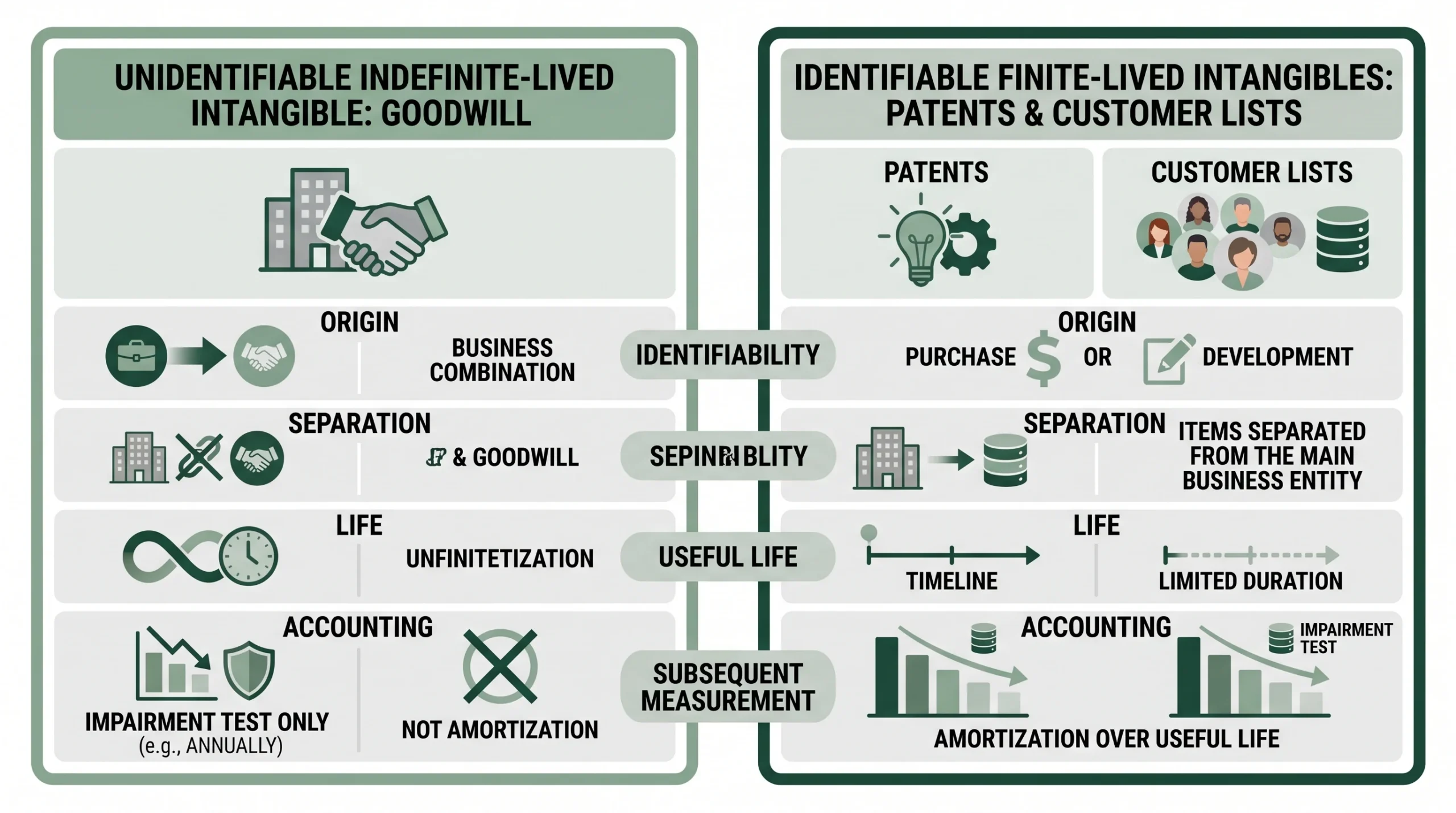
The key difference is separability. Goodwill cannot be separated from the business or sold on its own. Identifiable intangibles can. A patent, a trademark, or a customer list has clear boundaries and can be transferred to another owner. Goodwill has no such boundaries.
Goodwill also arises differently. It only appears when a buyer pays more than the fair value of the net identifiable assets. It is a residual, the figure that balances the transaction. Identifiable intangibles, by contrast, have their own measurable value and can exist apart from a deal. Because goodwill lacks physical form and legal separability, it is very different from specific intellectual property.
How Is Goodwill Calculated in an Acquisition?
Goodwill is the purchase price minus the fair value of the net identifiable assets and liabilities. It is the final step in a purchase price allocation, or PPA. Under ASC 805, it captures the premium paid for future benefits that no specific asset explains. The buyer then records it on the balance sheet.
The calculation requires a careful review of the target. The analyst identifies and values every tangible and intangible item first. Whatever the price exceeds those values becomes goodwill. Because goodwill is not amortized, it stays on the balance sheet. It then faces annual impairment testing under ASC 350. The quality of the PPA drives how much of the price lands in goodwill versus identifiable assets.
What Does Goodwill Impairment Mean Under ASC 350?
Impairment is a charge taken when a reporting unit’s carrying value exceeds its fair value. It happens when the unit’s economic outlook or earnings decline below the recorded amount. The company must then write the goodwill down. This keeps the balance sheet aligned with economic reality.
Companies test goodwill at least annually. The process can start with a qualitative screen, often called Step Zero. It asks whether it is more likely than not that fair value is below carrying value. If the screen suggests a decline, the company runs a quantitative test. That test compares the reporting unit’s fair value directly to its carrying amount and measures any loss.
How Do Goodwill and Identifiable Intangibles Compare?
The clearest way to see the difference is side by side. Identifiable intangibles have legal or economic boundaries; goodwill does not. That distinction decides whether an asset is amortized or tested for impairment. The table below lays out the contrast.
| Characteristic | Goodwill | Patents | Customer lists |
|---|---|---|---|
| Identifiable | No | Yes | Yes |
| Separable / sellable | No | Yes | Yes |
| Amortized for GAAP reporting | No (tested for impairment) | Yes, over useful life | Yes, over useful life |
| Valuation basis | Residual in a PPA | Cost or income approach | Income approach |
Applying these distinctions correctly protects a company from errors. Identifiable assets must be carved out of the purchase price so goodwill is not overstated. Assigning the right useful life to each identifiable asset matches expense to the period it helps earn. It also affects future periods, since amortizing identifiable assets reduces earnings while goodwill does not. Overstating goodwill can flatter near-term profit but raise the risk of a large impairment charge later. Getting the split right from the start avoids that surprise.
Can Personal Goodwill Affect a Business Sale?
Yes. Personal goodwill is value tied to an owner’s own reputation, relationships, and skills. It belongs to the person, not the company. Enterprise goodwill, by contrast, belongs to the business through its brand, systems, and market presence. Separating the two is a key step in many sales.
The distinction has real tax impact, especially in a C-corporation sale. When part of the price is allocated to personal goodwill, that amount flows directly to the owner. It can sidestep tax at the corporate level, followed by a second tax on the distribution. But the allocation needs a defensible, independent valuation to survive IRS scrutiny. Courts have recognized personal goodwill on the right facts. It usually applies where the owner holds the customer relationships personally and has no binding non-compete. A well-supported split can save meaningful tax, while a weak one invites a challenge. If a sale is on the table, talk to a Sofer Advisors valuation specialist about separating personal from enterprise goodwill.
How Do You Choose a Goodwill Valuation Provider?
Companies pick a provider based on deal size, audit sensitivity, and the complexity of the intangibles. Larger national firms such as Alvarez & Marsal, Stout, and Kroll serve big public companies with broad advisory teams. Sofer Advisors focuses on defensible, partner-led allocations and impairment tests for closely held and middle-market businesses. Its reports are backed by expert witness testimony in 11+ cases and 180+ five-star Google reviews. A goodwill figure sits on the balance sheet and faces annual testing. The provider must be able to defend every step.
Sofer Advisors works through a four-phase process it calls The Sofer Difference. It moves from Discovery to Diligence to Analysis to Delivery. That structure reflects the Heart of a Teacher approach. It explains the data behind each allocation, so management understands the goodwill figure rather than just receiving it. For a conclusion that holds up under audit, an independent valuation firm supplies both the analysis and the record behind it.
Frequently Asked Questions
Is goodwill an intangible asset?
Yes, but a special kind. Goodwill is an intangible asset that is unidentifiable and cannot be sold separately from the business. It represents value like brand reputation and customer loyalty. That value drives earning power but has no separate price tag. It appears on the balance sheet only after an acquisition, never from internal growth alone. Sofer Advisors measures goodwill as the residual in a purchase price allocation and documents how the figure was derived.
How is goodwill different from other intangibles?
Goodwill cannot be separated from the business, while patents, trademarks, and customer lists can. Those identifiable intangibles have clear legal or economic boundaries. They can be sold on their own, apart from any deal. Goodwill is a residual that only arises when a buyer pays more than the fair value of the net identifiable assets. It has no independent price. Sofer Advisors carves out every identifiable intangible first, so goodwill is not overstated and each asset is classified correctly.
How is goodwill calculated?
Subtract the fair value of the net identifiable assets and liabilities from the total purchase price. The remainder is goodwill. It is the last step in a purchase price allocation under ASC 805, after every identifiable asset has been valued. The premium a buyer pays for future benefits that no specific asset explains becomes goodwill on the balance sheet. Sofer Advisors prepares that allocation so the goodwill number rests on market evidence rather than estimate.
Is goodwill amortized?
Not for public companies under GAAP. It has an indefinite life and is tested for impairment at least annually under ASC 350. Private companies may elect an alternative to amortize it over up to 10 years. For tax, acquired goodwill is amortized over 15 years under IRC Section 197. So the answer depends on whether you mean public reporting, the private-company election, or the tax return. Sofer Advisors prepares the valuations that support each of these treatments.
What is goodwill impairment?
It is a charge taken when a reporting unit’s carrying value exceeds its fair value. The company writes the goodwill down to reflect the decline, which keeps the balance sheet aligned with economic reality. It is measured through an annual test under ASC 350. Sometimes it starts with a qualitative screen called Step Zero before any quantitative calculation. Sofer Advisors performs the fair value measurement that supports the impairment test and the amount of any write-down.
What is the difference between personal and enterprise goodwill?
Personal goodwill is tied to an individual owner’s reputation, relationships, and skills, and it belongs to the person. Enterprise goodwill belongs to the business through its brand, systems, and market presence. The split matters in a sale, especially for a C-corporation. Value allocated to personal goodwill can avoid a layer of corporate-level tax. The allocation must be supported by independent analysis. Sofer Advisors prepares the valuation that documents the split so the tax treatment matches the economics.
Can goodwill be sold separately from the business?
No. Goodwill is inseparable from the company it belongs to. It cannot be transferred on its own the way a patent or a customer list can. It has no boundaries apart from the business as a whole. It changes hands only when the entire business, or a reporting unit, is sold. That inseparability is the defining feature of goodwill. Sofer Advisors values goodwill in the context of the whole enterprise, since it cannot be isolated and sold alone.
Why does correct classification matter?
Because it drives whether an asset is amortized or tested for impairment, which changes reported earnings every year. Misclassifying goodwill can force a restatement, disrupt tax planning, and draw audit findings. Those findings worry investors and regulators. Correct treatment under ASC 805 and ASC 350 keeps the statements accurate and the company aligned with GAAP. The documentation has to hold up over time. Sofer Advisors prepares allocations and impairment tests that keep the classification defensible under audit.
How much does a goodwill valuation cost?
A goodwill valuation or purchase price allocation usually ranges from $7,500 to $25,000. The fee depends on the number of assets, the complexity of the business, and the purpose of the report, whether for financial reporting, an impairment test, or a sale. A flat scope is quoted up front, so the cost is clear before work begins. Sofer Advisors sets the scope first, then quotes a fixed price. Request a free estimate for a range specific to your engagement.
Related Case Studies
- Goodwill vs Intangible Assets: Key Differences Explained
- Intangible Asset Valuation: Methods for Measuring Hidden Value
- Goodwill Impairment Testing ASC 350: Complete Guide for 2025-2026
Executive Summary
Goodwill is an unidentifiable intangible asset that only appears after an acquisition, recorded as the price paid above the fair value of the net identifiable assets. Under ASC 805 it is the residual in a purchase price allocation, and under ASC 350 it has an indefinite life, so public companies test it for impairment at least annually rather than amortizing it. Private companies may elect to amortize over up to 10 years, and for tax, acquired goodwill amortizes over 15 years. Personal goodwill can be split from enterprise goodwill in a sale, with real tax consequences. Most valuations run $7,500 to $25,000. The first action is to gather the purchase agreement, the final price, and a list of identifiable intangibles.
What Should You Do Next?
Pull your purchase agreement and identify every tangible and intangible asset so goodwill is measured as a true residual, not a catch-all. Confirm whether you need an annual impairment test under ASC 350, and separate personal from enterprise goodwill if a sale is coming. This guide was prepared by David Hern CPA ABV ASA, founder of Sofer Advisors, an Inc. 5000 firm specializing in purchase price allocation and goodwill valuations. Schedule a free consultation to discuss your specific situation.
People Also Read
About the Author
This guide was prepared by David Hern CPA ABV ASA, founder of Sofer Advisors, a business valuation firm headquartered in Atlanta, GA serving clients across the United States. David holds dual accreditations as an Accredited Senior Appraiser (ASA) and is Accredited in Business Valuation (ABV), credentials recognized by the IRS, SEC, and FINRA. He also holds the Certified Exit Planning Advisor (CEPA) designation. With 15+ years of valuation experience, David has served as an expert witness in 11+ cases across multiple jurisdictions and built Sofer Advisors into an Inc. 5,000-recognized firm with 180+ five-star Google reviews. Its full W2 employee team maintains subscriptions to all major valuation databases and operates under a next business day response policy.
For professional business valuation services, visit soferadvisors.com/about-us/ or contact Sofer Advisors at soferadvisors.com/contact-us/.
This content is for informational purposes only and does not constitute professional valuation advice. Business valuation conclusions depend on specific facts and circumstances. Contact Sofer Advisors for guidance regarding your specific situation.









