


Last Updated: October 2026
An impairment triggering event is a change in facts or circumstances that suggests an asset or reporting unit may be worth less than its carrying amount on the balance sheet. It forces an interim test under US GAAP, outside the normal annual schedule. Long-lived assets fall under ASC 360. Goodwill falls under ASC 350. ASC 360 names a short list of warning signs, from a sharp market-price drop to steady operating losses. A triggering event does not prove a loss. It starts the clock on the work needed to find out.
Sofer Advisors values these assets for controllers, CFOs, and auditors, backed by Inc. 5000 recognition in both 2024 and 2025. Catching a trigger early protects the financial statements. Miss it, and a late write-down can force a restatement and draw hard questions from auditors or the SEC.
This guide explains what counts as a triggering event, how ASC 360 and ASC 350 differ, what happens after you spot one, and who does the valuation work.
Key Takeaways
- What a triggering event is: a change that makes it more likely an asset or reporting unit is carried above its real value, so a test is due.
- Two standards, two levels: ASC 360 tests long-lived assets at the asset group level, and ASC 350 tests goodwill at the reporting unit level.
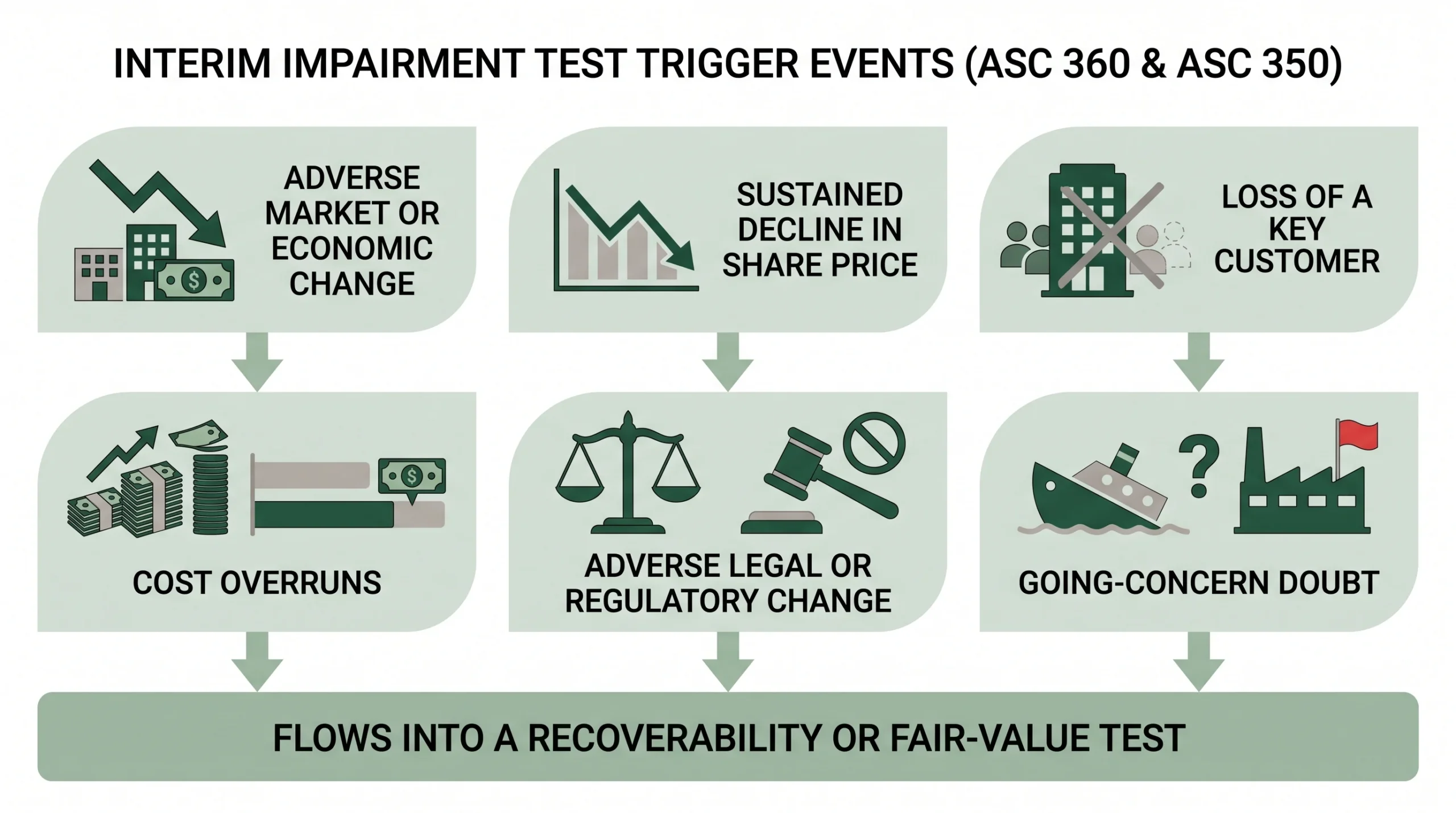
- Common triggers: a sustained stock-price decline, a lost key customer, cost overruns, adverse legal or market changes, and going-concern doubt.
- A trigger is not a loss: it starts a test, and a qualitative screen or a quantitative test then decides whether a charge is needed.
- Timing matters: the test is interim, run when the event happens, not saved for the annual date, and a material charge can require a Form 8-K.
The sections below take each one in order.
Why Do Impairment Triggering Events Matter?
Impairment triggering events matter because they decide when a company must test an asset early, before its annual date. Carrying an asset above its real worth overstates both the balance sheet and earnings. A triggering event is the signal that the recorded value may no longer hold. Spotting it on time keeps the financial statements accurate and keeps management out of a late, messy correction.
The stakes are highest for public companies. Investors, lenders, and auditors all rely on reported asset values. A sudden write-down later looks like a surprise, and a surprise invites scrutiny. Private companies face the same logic through their lenders and buyers. An early, documented review turns a potential restatement into a routine entry.
What Counts as an Impairment Triggering Event?
A triggering event is any change that makes it more likely the carrying amount of an asset or reporting unit is not recoverable. ASC 360-10-35-21 lists the main ones. They include a significant market-price drop, an adverse change in how an asset is used or its physical condition, new legal or regulatory limits, cost overruns on a project, and ongoing operating or cash-flow losses.
It helps to sort triggers into external and internal. External triggers come from outside the business. A recession, higher interest rates, a new competitor, or a regulatory change all qualify. Internal triggers come from inside. A lost key customer, a failed product line, the departure of key people, or a plan to sell an asset before the end of its useful life all count. The FASB Accounting Standards Codification frames these as events and circumstances, not a fixed checklist, so judgment matters.
How Do ASC 360 and ASC 350 Triggers Differ?
ASC 360 and ASC 350 split the work by asset type and by the level at which you test. ASC 360 covers long-lived assets, such as equipment, buildings, and finite-lived intangibles. You test those at the asset group level. ASC 350 covers goodwill and indefinite-lived intangibles. You test goodwill at the reporting unit level. The trigger lists read alike, but the unit of account differs.
An asset group is the lowest level of assets with cash flows that are largely independent of other assets. A reporting unit is an operating segment or one level below it. A factory line can fail an ASC 360 test while the wider reporting unit still passes its goodwill test. Order matters too. Under ASC 360, you test long-lived assets before goodwill, so any asset write-down lowers the carrying amount used in the goodwill test.
What Happens After You Spot a Triggering Event?
Once a triggering event appears, the company runs the test for that standard. For long-lived assets under ASC 360, you start with the recoverability test. You compare the asset group’s carrying amount to the undiscounted cash flows it is expected to produce. If those cash flows cover the carrying amount, no loss is recorded. If they fall short, you measure the loss.
If the asset group is not recoverable, the loss equals carrying amount minus fair value. Goodwill works differently. You may first run a qualitative screen, often called Step 0, to ask whether it is more likely than not that fair value is below carrying amount. If the answer is yes, or you skip the screen, you run one quantitative step. Since ASU 2017-04 removed the old second step, the goodwill loss is simply the reporting unit’s carrying amount minus its fair value, capped at the goodwill on its books.
How Does a Triggering Event Differ From the Annual Test?
The annual test runs on a set date, once a year, whether or not anything has gone wrong. A triggering event test runs in between, the moment a warning sign appears. Goodwill and indefinite-lived intangibles carry a required annual test. Long-lived assets under ASC 360 have no annual test at all. They are tested only when a triggering event occurs.
Management owns the test, usually the controller and CFO, often with an outside valuation specialist for the fair value work. The timing follows the event, not the calendar. If a quarter closes with a sustained stock-price decline below book value, that quarter is when you look. For public companies, a material charge also triggers a disclosure duty. Item 2.06 of Form 8-K requires a filing once a company concludes that a material impairment is needed.
Who Values the Impairment, and How Do the Options Compare?
Companies pick a valuation partner based on the size of the assets, the audit exposure, and whether the charge is material. Some run a quick internal screen. When a number has to hold up with auditors or the SEC, they bring in an independent specialist for the fair value measurement. The right choice matches the rigor of the work to the risk the event creates.
Large national firms such as Alvarez & Marsal, Stout, and Kroll serve big public companies with broad advisory teams. Sofer Advisors focuses on defensible, partner-led valuations for private and middle-market companies, with expert witness testimony in 11+ cases behind its reports and 180+ five-star Google reviews. An auditor cannot value the same asset it audits, so independence is not optional. The table below sets out the common options.
| Provider | Typical role | Best for |
|---|---|---|
| Specialized valuation firm (e.g. Sofer Advisors) | Documents the triggering event and measures fair value for ASC 360 and ASC 350 | Private and middle-market companies needing audit-ready support |
| Large national firm | Broad advisory plus valuation at enterprise scale | Large public companies with complex, multi-entity reporting |
| Internal finance team | Runs the early screen and gathers the data | First-pass reviews with no material charge in sight |
Sofer Advisors runs each engagement through a four-phase process it calls The Sofer Difference, moving from Discovery to Diligence to Analysis to Delivery. That order keeps every conclusion tied to the event, the cash flows, and the fair value behind it. It reflects the Heart of a Teacher approach, which means explaining the reasoning behind a number rather than handing over a figure. For a charge that will face an auditor, that record is as valuable as the result.
See how Sofer Advisors approaches impairment and financial reporting valuations when a triggering event puts a reported number in question.
Frequently Asked Questions
What are some examples of triggering events for goodwill impairment?
Common goodwill triggers include a sustained decline in the company’s share price below book value, the loss of key personnel, and adverse changes in the legal or regulatory climate. Others include a drop in industry market multiples, worse-than-expected cash flows, and a plan to sell or close a reporting unit. Any one can mean the fair value of a unit has fallen below its carrying amount. Sofer Advisors reviews these signals before an annual audit.
What triggers an impairment charge?
An impairment charge is triggered when an asset’s carrying amount is no longer recoverable and sits above its fair value. For goodwill under ASC 350, that means the fair value of a reporting unit has dropped below its carrying amount. For long-lived assets under ASC 360, it means the undiscounted cash flows fall short of the carrying amount, and fair value is lower still. Sofer Advisors measures fair value to size the charge.
What are the triggering events for Form 8-K?
A Form 8-K impairment filing is driven by Item 2.06, Material Impairments. A public company files once its board or management concludes that a material charge for an asset or goodwill impairment is required under US GAAP. The filing alerts investors before the next quarterly or annual report. It is a disclosure duty, not an accounting test, though the two are tied together. Sofer Advisors supplies the valuation analysis that supports the disclosure.
What is an example of impairment?
A clear example is a company that buys a competitor and records goodwill, then loses a major customer the deal was built around. Expected cash flows fall, and the fair value of that reporting unit drops below its carrying amount. The company records a goodwill impairment charge for the gap. A shuttered factory or an obsolete product line are long-lived-asset examples. Sofer Advisors quantifies the loss so the statements reflect current economics.
Does a triggering event always mean an impairment loss?
No. A triggering event starts a test; it does not decide the outcome. A company can run a qualitative screen and conclude a loss is not more likely than not, or run the quantitative test and find the asset still recoverable. The event simply forces the review and the record behind it. Sofer Advisors helps companies decide whether a full quantitative test is needed and documents the basis for that call.
How often should a company screen for triggering events?
Screening is continuous, not a once-a-year task. Management should watch for internal and external changes every quarter and whenever a major event hits, such as a lost contract or a market shock. Many companies build a short trigger review into each quarter-end close. That rhythm keeps the assessment current and the evidence fresh. Sofer Advisors recommends a documented, ongoing process so no trigger slips past a reporting date.
What is the difference between ASC 350 and ASC 360 triggers?
Both standards react to adverse events, but they test different things at different levels. ASC 350 governs goodwill and indefinite-lived intangibles, tested at the reporting unit level and also on an annual date. ASC 360 governs long-lived assets, tested at the asset group level and only when a triggering event occurs. The event lists are similar, yet the unit of account and the test mechanics differ. Sofer Advisors applies the right standard to each asset.
Who performs the impairment valuation?
Management is responsible for the impairment conclusion, usually led by the controller and CFO. For the fair value measurement, many companies engage an independent valuation specialist, since an auditor cannot value an asset it also audits. The specialist builds the cash flow and market analysis that supports the number. Internal teams often handle the early screen. Sofer Advisors serves as that independent specialist and documents the work for the audit file.
How much does impairment testing cost?
Impairment testing for financial reporting, covering ASC 350 and ASC 360, generally runs from $7,500 to $25,000 and takes about two to six weeks. The range depends on the number of reporting units or asset groups, the complexity of the cash flows, and the documentation the audit needs. A fixed fee is quoted up front, so the cost is clear before work starts. Request a free estimate at the Sofer Advisors contact page for your situation.
Related Case Studies
- ASC 350 Goodwill: Identifying a Triggering Event
- ASC 360 Triggering Events: When to Test Long-Lived Assets
- ASC 360 vs ASC 350: Which Impairment Standard Applies
Executive Summary
An impairment triggering event is a change in facts that suggests an asset is worth less than its carrying amount, and it forces a test outside the annual cycle. Long-lived assets fall under ASC 360 and are tested at the asset group level with a recoverability test built on undiscounted cash flows. Goodwill falls under ASC 350 and is tested at the reporting unit level in one quantitative step. Common triggers are a sustained stock-price decline, a lost key customer, cost overruns, adverse legal or market shifts, and going-concern doubt. A trigger starts a test, not an automatic loss. Catch it early, document the review, and a material charge may still require a Form 8-K.
What Should You Do Next?
Start by listing the events from the last quarter that could count as triggers, then match each asset or reporting unit to the right standard. Gather the cash flow forecasts and the market data a test will need, and set the valuation date to the event, not the calendar. This guide was prepared by David Hern CPA ABV ASA, founder of Sofer Advisors, an Inc. 5000 firm that provides independent business valuation services for financial reporting. Schedule a free consultation through our contact page to discuss your specific situation.
People Also Read
- Goodwill Impairment Testing ASC 350: Complete Guide for 2025-2026
- What Is Impairment Testing? Asset Value Assessment Guide
About the Author
This guide was prepared by David Hern CPA ABV ASA, founder of Sofer Advisors, a business valuation firm headquartered in Atlanta, GA serving clients across the United States. David holds dual accreditations as an Accredited Senior Appraiser (ASA) and is Accredited in Business Valuation (ABV), credentials recognized by the IRS, SEC, and FINRA. He also holds the Certified Exit Planning Advisor (CEPA) designation. With 15+ years of valuation experience, David has served as an expert witness in 11+ cases across multiple jurisdictions and built Sofer Advisors into an Inc. 5,000-recognized firm with 180+ five-star Google reviews. Its full W2 employee team maintains subscriptions to all major valuation databases and operates under a next business day response policy.
For professional business valuation services, visit soferadvisors.com/about-us/ or contact Sofer Advisors at soferadvisors.com/contact-us/.
This content is for informational purposes only and does not constitute professional valuation advice. Business valuation conclusions depend on specific facts and circumstances. Contact Sofer Advisors for guidance regarding your specific situation.









