


Last Updated: September 2026
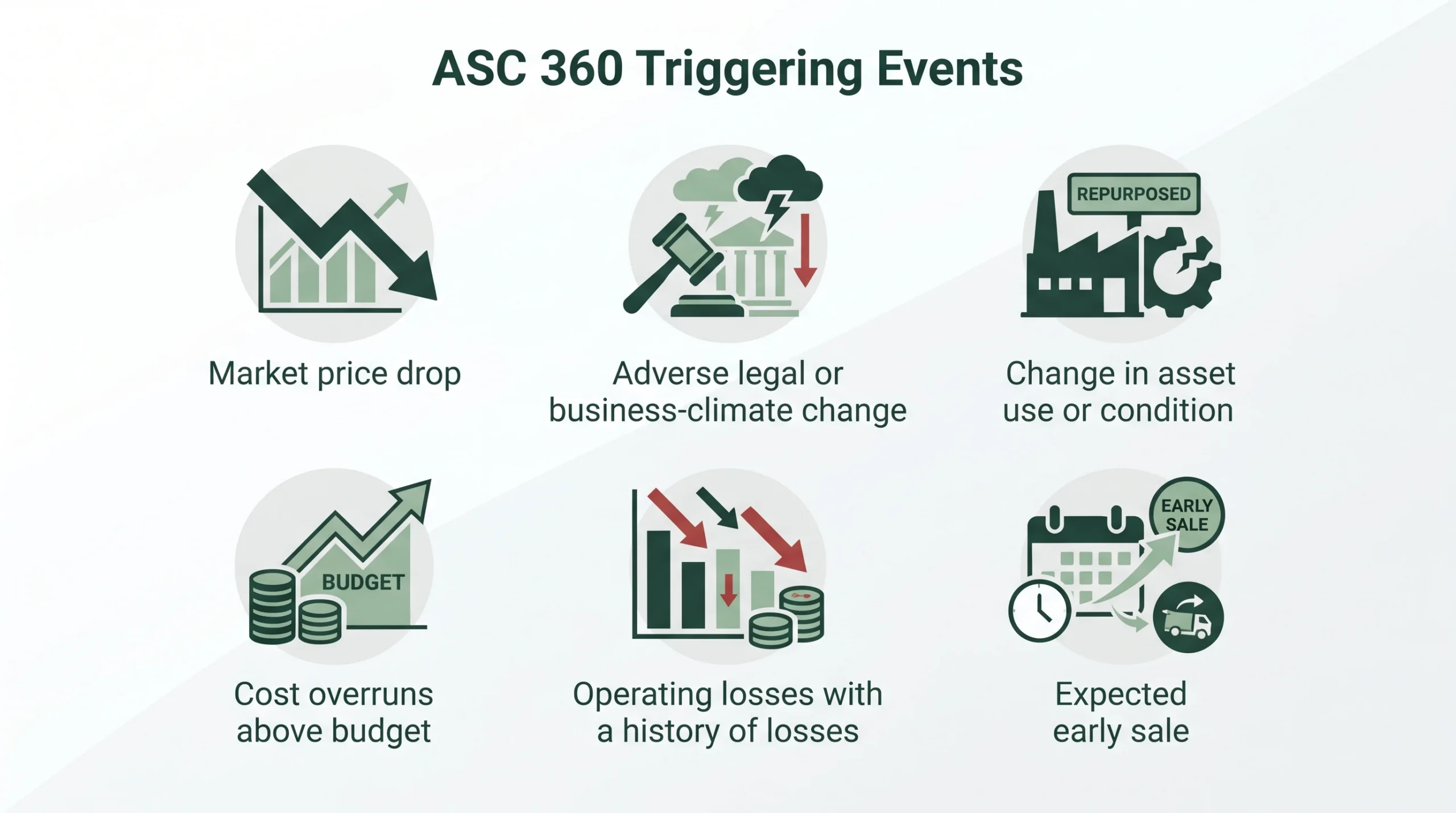
An ASC 360 triggering event is a sign that the book value of a company’s long-lived assets may no longer be recoverable. When one occurs, U.S. GAAP requires management to test those assets for impairment. ASC 360-10-35-21 lists six specific indicators, from a market price drop to operating losses paired with past losses. Unlike goodwill under ASC 350, the test is event-driven, with no fixed annual date.
Spotting a trigger early keeps financial statements accurate and audits clean. Miss one, and a company can overstate its assets and draw scrutiny from auditors or regulators. Finance leaders who track these signs can plan for a write-down before year-end and protect stakeholder confidence.
Sofer Advisors provides independent financial reporting valuations for companies that must test long-lived assets under ASC 360. Its full W2 team applies AICPA and USPAP standards and holds subscriptions to all major valuation databases. Its senior staff has testified as expert witnesses in 11+ cases across multiple states.
Key Takeaways
- Testing is event-driven: ASC 360 requires an impairment test only after a triggering event, not on a fixed annual schedule.
- Six indicators apply: the standard names six signs, split between external market shifts and internal operating problems.
- Scope is limited: ASC 360 covers property, plant, equipment, and finite-lived intangibles, but not goodwill.
- A two-step test follows: compare undiscounted cash flows to carrying value first, then measure any loss against fair value.
- Documentation matters: a dated assessment memo each period gives auditors a clear trail, even when no trigger is found.
Each indicator ties to how a company records asset value. The sections below cover the scope of the standard, the external and internal triggers, the two-step test, and how to document the review.
What are long-lived assets under ASC 360?
Long-lived assets under ASC 360 are tangible assets like property, plant, and equipment, plus finite-lived intangible assets that a company depreciates or amortizes. These assets are tested at the asset group level, the lowest level of cash flows largely independent of other assets. Goodwill and indefinite-lived intangibles fall outside ASC 360. They sit under ASC 350 instead. The split matters because each standard uses a different trigger and a different method.
Grouping assets correctly is the first step in any review. A single machine rarely earns cash on its own. It works as part of a plant or a product line. Testing at the right level keeps the result defensible and avoids a write-down on an asset that still earns its keep. For the goodwill side, see our goodwill impairment testing ASC 350 guide.
What are the external triggering events?
External triggering events are outside forces that signal an asset may be worth less than its book value. ASC 360-10-35-21 names two main external indicators. The first is a significant decrease in the market price of a long-lived asset. The second is a significant adverse change in legal factors or the business climate, such as a new regulation or an action by a regulator. Each one is objective evidence that current value may have dropped.
A falling market price often shows that buyers expect less future cash. New rules can cut an asset’s useful life or its output. The SEC watches how public filers handle these calls through its Office of the Chief Accountant. These shifts sit outside a leader’s control but still force a review.
What are the internal triggering events?
Internal triggering events come from inside the business and its own results. ASC 360-10-35-21 names four. The most common is a current-period operating or cash flow loss paired with a history of losses or a forecast of more. The others point to how the asset is used, what it cost to build, or a plan to sell it early. The four internal indicators are:
- A significant adverse change in how an asset is used or in its physical condition, such as idling a plant or retiring a line
- An accumulation of construction or acquisition costs well above the amount first expected
- A current-period operating or cash flow loss combined with a history of losses or a projection of continued losses
- A current expectation that the asset will be sold or disposed of well before the end of its useful life
Any one of these signs can stand on its own. A single loss year may not force a test if the outlook is strong. A loss year on top of past losses usually does. Management must act on the sign, not wait for the next audit.
What happens after a triggering event is found?
A two-step recoverability test begins once a triggering event is found. Step one compares the carrying value of the asset group to its undiscounted future cash flows. If those cash flows are greater than the carrying value, no impairment is recorded. If the carrying value is higher, the test moves to step two. Step two measures the asset group at fair value. The impairment loss equals the carrying value minus that fair value.
Fair value in step two rests on accepted valuation methods and market data. Auditors then test those estimates under standards such as PCAOB AS 2501 on accounting estimates and fair value. Sofer Advisors supports this work with defensible financial reporting valuation that stands up to review. A clear, dated memo each period rounds out the file. It lists the factors weighed, explains the impairment call, and gives auditors a reliable trail even when no trigger is found.
How does ASC 360 differ from ASC 350?
ASC 360 tests long-lived assets only after a triggering event, while ASC 350 tests goodwill and indefinite-lived intangibles at least once a year. ASC 360 relies on the six indicators to start a review. ASC 350 sets a calendar date and adds an optional qualitative screen, often called step zero. That screen lets a company skip a full test when impairment is unlikely. ASC 360 offers no such screen. Its process starts only after a confirmed trigger. The table below sets the two standards side by side.
| Aspect | ASC 360 | ASC 350 |
| Assets covered | Property, plant, equipment, finite-lived intangibles | Goodwill and indefinite-lived intangibles |
| Testing trigger | Event-driven, on a triggering event | At least annual, plus on a trigger |
| Tested at | Asset group level | Reporting unit level |
| Qualitative screen | None | Optional step zero |
The two standards often work together. A downturn can trip a trigger under ASC 360 and cut goodwill value under ASC 350 in the same period. Sorting each asset into the right standard keeps a report clean and stops a company from testing the wrong asset at the wrong level.
Which firm should value your long-lived assets?
The right firm depends on the size of the filer and the complexity of the assets. Large enterprises and distressed cases often turn to national names like Alvarez & Marsal, Stout, and Kroll. Middle-market companies usually want senior involvement on every engagement. An independent firm gives an audit-ready opinion without a broker’s or lender’s conflicts. The table below compares common options.
| Provider | Focus | Best for |
| Sofer Advisors | Independent, senior-led financial reporting valuation | Middle-market companies needing audit-ready ASC 360 support |
| Alvarez & Marsal | Global restructuring and valuation advisory | Large enterprises and distressed situations |
| Stout | Broad valuation and disputes advisory | Large and upper-middle-market filers |
| Kroll | Data-heavy valuation and cost of capital | Large enterprises and advisory firms |
An independent firm follows standards like USPAP so the number holds up in an audit or a dispute. The Sofer Difference structures each engagement in four stages: Discovery, Diligence, Analysis, and Delivery. That order keeps the work transparent from start to finish. A Heart of a Teacher approach then walks your team through the findings, so leaders can explain the result with confidence.
Impairment work rewards early review and clear records. The questions below cover what finance teams ask most.
Frequently Asked Questions
What are the triggering events for an impairment test under ASC 360?
Triggering events under ASC 360 are external and internal signs that an asset’s carrying amount may not be recoverable. External signs include a significant drop in market price and an adverse change in legal factors or the business climate. Internal signs include a change in how an asset is used, cost overruns, operating losses paired with a history of losses, and a plan to sell the asset early. Any one of the six can force a test.
What triggers an impairment charge?
An impairment charge is triggered when an asset group’s carrying amount is not recoverable through its undiscounted future cash flows. The two-step test confirms this. If those cash flows fall short of carrying value, the asset moves to a fair value measurement. The charge equals the carrying amount minus fair value. A trigger alone does not create a charge. It only starts the test that may lead to one.
What is ASC Topic 360?
ASC Topic 360 is the U.S. GAAP standard that governs the impairment and disposal of long-lived assets. It covers property, plant, equipment, and finite-lived intangible assets. The standard sets out when to test those assets, how to run the two-step recoverability test, and how to measure any loss. It is issued by the FASB and applies to both public and private companies that follow U.S. GAAP.
How often should a company test for ASC 360 triggering events?
There is no fixed interval for ASC 360 testing. A company must evaluate whether a triggering event has occurred whenever conditions change in a way that suggests an asset may not be recoverable. Many teams review the indicators each reporting period as a matter of routine. That habit keeps the file current and gives auditors evidence that the company watched conditions throughout the year rather than after the fact.
What are some examples of triggering events for goodwill impairment?
Goodwill triggers fall under ASC 350, not ASC 360. Common examples include a sustained drop in industry performance, rising competition, or a decline in a reporting unit’s financial results. The loss of key staff or a plan to sell part of the business can also count. Unlike long-lived assets, goodwill is tested at least once a year, so a trigger simply adds an off-cycle test to the annual one.
Can a triggering event be ignored if it is considered temporary?
No. Accounting standards do not let a company skip a triggering event just because management views it as short-lived. If an indicator exists, a formal recoverability test must confirm the asset’s value still holds. The analysis can then weigh whether current conditions pose a real risk or a passing swing. That judgment belongs in the test and its documentation, not in a decision to bypass the review.
What is the difference between an asset group and a reporting unit?
An asset group is the lowest level of cash flows largely independent of other assets, and it is the level at which ASC 360 tests long-lived assets. A reporting unit is an operating segment or one level below it, and it is where ASC 350 tests goodwill. The two levels rarely match. Testing an asset at the wrong level is a frequent error that can distort a result and draw auditor questions.
Does a decline in stock price automatically trigger an impairment test?
A decline in stock price does not automatically force a test, but it often signals that investors expect lower future cash flows. Management must weigh whether the drop points to a deeper problem in an asset group or reporting unit. A brief dip in a volatile market may not rise to a trigger. A sustained fall below book value usually does and calls for a closer look.
How much does ASC 360 impairment testing from Sofer Advisors cost?
Impairment testing under ASC 350 and ASC 360 from Sofer Advisors typically ranges from $7,500 to $25,000, with a timeline of two to six weeks. The final fee depends on the number of asset groups, the quality of the underlying data, and the reporting deadline. To scope an engagement for your assets, contact the team with your financials and a summary of the assets under review.
Related Case Studies
- Purchase Price Allocation ASC 805 and IFRS 3: Complete Guide for Business Leaders
- ASC 820 Fair Value Measurement: Hierarchy Levels Explained
- Impairment Testing: Sofer Advisors’ Complete Guide
Executive Summary
ASC 360 requires an impairment test for long-lived assets only after a triggering event, not on a set annual date. ASC 360-10-35-21 lists six indicators: a market price drop, an adverse change in legal factors or business climate, a change in asset use or condition, cost overruns, operating losses with a history of losses, and an expected early sale. When a trigger appears, a two-step test compares undiscounted cash flows to carrying value, then measures any loss against fair value. Testing runs at the asset group level, and a dated memo each period keeps the file audit-ready. Impairment testing from Sofer Advisors typically runs $7,500 to $25,000 over two to six weeks.
What Should You Do Next?
Review your long-lived assets for any of the six ASC 360 indicators this period, starting with operating losses, idled assets, and planned disposals. Confirm each asset group is set at the right level, then compare its carrying value to current undiscounted cash flow projections. If the carrying value looks high, plan a formal recoverability test before your next audit and write a dated memo of what you find.
David Hern CPA ABV ASA, founder of Sofer Advisors, leads independent financial reporting valuations for companies facing ASC 360 and ASC 350 questions. Schedule a consultation to discuss your specific situation.
People Also Read
- Goodwill Impairment Testing ASC 350: Complete Guide for 2025-2026
- What is Impairment Testing? Asset Value Assessment Guide
About the Author
This guide was prepared by David Hern CPA ABV ASA, founder of Sofer Advisors, a business valuation firm headquartered in Atlanta, GA serving clients across the United States. David holds dual accreditations as an Accredited Senior Appraiser (ASA) and is Accredited in Business Valuation (ABV), credentials recognized by the IRS, SEC, and FINRA. He also holds the Certified Exit Planning Advisor (CEPA) designation. With 15+ years of valuation experience, David has served as an expert witness in 11+ cases across multiple jurisdictions and built Sofer Advisors into an Inc. 5000-recognized firm with 180+ five-star Google reviews. Its full W2 employee team maintains subscriptions to all major valuation databases and operates under a next business day response policy.
For professional business valuation services, visit soferadvisors.com/about-us/ or contact Sofer Advisors at soferadvisors.com/contact-us/.
Disclaimer: This content is for informational purposes only and does not constitute professional valuation advice. Business valuation conclusions depend on specific facts and circumstances. Contact Sofer Advisors for guidance regarding your specific situation.









