


Last Updated: August 2026
A plumbing company valuation is the process of setting a fair market value on a plumbing or home-services business. Appraisers weigh yearly profit, service contracts, crew stability, and the trucks and tools on the books. Recent home-services M&A benchmarks place plumbing deals in a 2.4x to 6.5x EBITDA range, while most small owner-run shops trade near 2.0x to 3.5x earnings. Sofer Advisors turns those raw numbers into a figure that holds up for a sale, a tax filing, or a dispute.
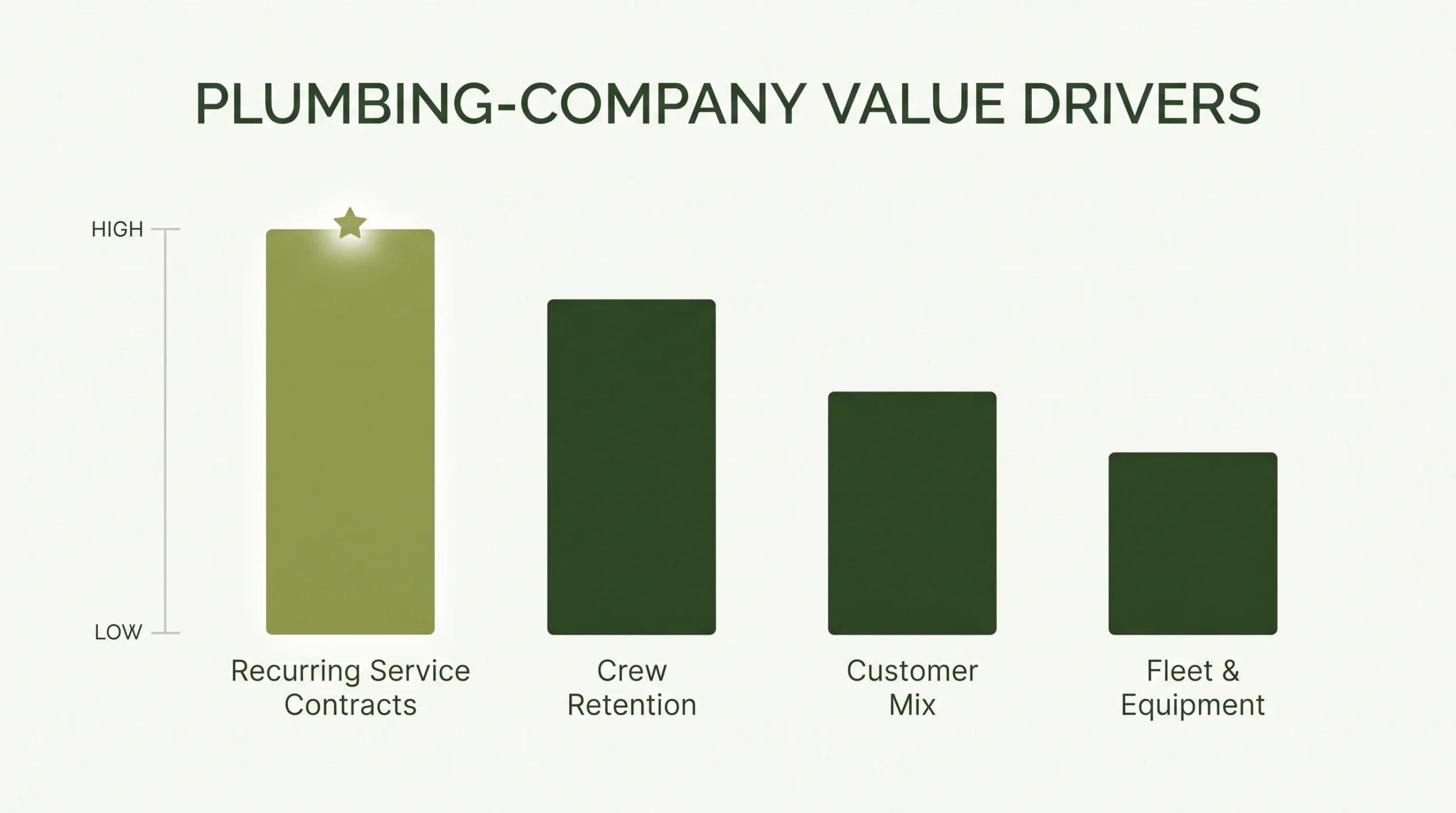
Why does this matter? For most owners, a plumbing company is both a livelihood and a retirement plan, so its value carries real weight. Recurring service contracts, a stable crew, and a well-kept fleet drive the number up. Owners usually need a valuation before a sale, a partner buyout, an estate plan, or a bank loan.
Key Takeaways
- Earnings multiples: Small plumbing shops often sell for 2.0x to 3.5x Seller’s Discretionary Earnings. Larger firms use an EBITDA multiple.
- Recurring revenue: Service and maintenance contracts give steady cash flow. They lower risk and raise the value.
- Crew risk: When one owner or a few key technicians drive the work, buyers cut the price.
- Assets valued apart: Vans, cameras, and tools are priced at fair market value, then added to the earnings-based value.
- Standard of value: A defensible fair market value follows IRS Revenue Ruling 59-60 and AICPA SSVS.
Each point ties earnings to risk and to the assets on hand. The sections below show how a pro builds the number. They also show how to defend it for a buyer, the IRS, or a court.
What multiples value a plumbing company?
A plumbing business is most often valued on a multiple of its earnings. Small, owner-run shops use Seller’s Discretionary Earnings, or SDE. That figure is the profit plus the owner’s pay and personal add-backs. Most small shops trade for 2.0x to 3.5x SDE. Larger contractors with a real management team use an EBITDA multiple instead, which usually falls near 3.0x to 5.0x.
The multiple is not fixed. Profit size, growth, and risk all move it up or down. A firm with strong commercial contracts and low turnover earns the high end. A shaky, owner-dependent shop earns the low end. The EBITDA multiple by industry reflects how buyers price trade businesses against real deal evidence. Private equity has bought nearly 800 mechanical, electrical, and plumbing firms since 2022, per plumbing M&A data, which keeps demand for well-run shops high. So the same profit can support two very different prices.
How does crew and technician risk affect value?
Crew risk lowers value when the work depends too much on the owner or a few senior techs. Buyers call this key person risk. If one person holds the customer ties or the hard technical skills, their exit could sink earnings. That doubt shows up as a discount on the multiple. High technician turnover sends the same warning. It tells a buyer the team may not stay through the sale.
Owners can cut this risk. Cross-train more than one crew to handle the same jobs. Write standard operating procedures so no skill lives in one head. Build a team of W-2 employees rather than lean on subcontractors. Non-compete and non-solicitation terms help protect the client base too. Each step moves the business from owner-led to team-led. That shift is one of the clearest ways to lift the final number, and it reflects the Heart of a Teacher approach the firm brings to every job.
What is a fair price for a plumbing business?
A fair price is the fair market value of the company. That is the price a willing buyer and a willing seller would agree on. Under IRS Revenue Ruling 59-60, neither side is forced to act, and both know the key facts. Industry multiples give a starting point. A fair price needs more than a rule of thumb.
A formal appraisal adjusts the base figure for the real business. It weighs the brand, the mix of recurring contracts, and the age of the fleet. It also normalizes past results to strip out one-time and personal costs. This shows the true earning power of the shop. A generic multiple skips all of that. So it often misses the price by a wide margin, high or low.
Which valuation methods fit plumbers best?
Three methods apply to a plumbing company, and the right one depends on the goal. The market approach uses sale prices of similar shops. The income approach discounts future cash flow to today. The asset approach adds up the fair market value of the trucks, tools, and inventory. Most trade deals lean on the market approach, backed by the asset value of the gear.
| Method | What it measures | Best fit for | Common metric |
|---|---|---|---|
| Market approach | Value from comparable sales | Shops with clear deal comps | SDE or EBITDA multiple |
| Income approach | Present value of future cash flow | Firms with steady, forecastable revenue | Discounted cash flow |
| Asset approach | Fair market value of the assets | Truck and equipment heavy shops | Adjusted net asset value |
The choice is not one against the other. A strong report often uses two methods and reconciles them into one figure. A shop with steady maintenance contracts may lean on the income approach. A newer, asset-heavy operation may lean on the asset approach. The purpose, whether a sale, a tax filing, or a partner buyout, sets the standard of value. Matching the method to that purpose is what makes the result hold up under review by the IRS or a court.
How do contracts and customer mix shape value?
Value rises when revenue is tied to recurring contracts, not one-off jobs. Deals with property managers, HOAs, or commercial sites bring steady, forecastable cash flow. That lowers the risk a buyer sees, so it supports a higher multiple. A shop built on emergency residential calls looks riskier. Those jobs pay well but arrive at random.
Customer mix matters just as much. When one client is more than 10 to 15 percent of revenue, a buyer worries about losing it. That customer concentration draws a discount. A broad, stable client base does the opposite. Sofer Advisors tracks these metrics to show how much of the value rests on a few accounts. Even a shop with strong cash flow can see its price capped by thin contract variety.
How are trucks and equipment valued?
Vans, drain cameras, and specialty tools are valued apart from the cash flow. An appraiser sets each at its fair market value or orderly liquidation value. Most deals follow a simple frame: the buyer pays for the earnings of the business, plus the assets. So a clean, current list of the fleet and gear matters. It should note the condition and the useful life left on each piece.
The team reviews each asset on its own, so wear and age show up in the final numbers. Good records also prevent nasty surprises during due diligence, when a buyer checks every claim. Real estate is handled apart from the operating value. If the owner holds the building, it is appraised as its own asset. That keeps property costs from distorting the operating multiple and gives a clear read on the core earning power of the shop.
Frequently Asked Questions
How much is the average plumbing business worth?
Most small plumbing shops sell for 2.0x to 3.5x Seller’s Discretionary Earnings, plus the value of the fleet and tools. The range moves with revenue size, growth, and contract mix. Firms with long commercial accounts and low turnover reach the high end. Residential-only shops with heavy owner reliance sit lower. A formal review shows where a given business lands.
What is a good EBITDA multiple for a plumbing company?
For many small to mid-sized plumbing firms, the EBITDA multiple falls near 3.0x to 5.0x. Strong management, a modern fleet, and steady customers push it toward the top. High owner dependence and choppy earnings pull it down. The multiple is a result, not a guess. It reflects how much risk a buyer sees in the earnings and how easily they transfer.
How does crew turnover affect the sale price?
High technician turnover signals weak internal stability, and buyers price that in. If skilled staff leave often, a new owner faces lost jobs and hiring costs. That raises the risk and cuts the multiple. Shops that retain crews, document their work, and cross-train see less of this discount. Stable staffing is one of the first things a careful buyer checks.
Does owning the real estate raise the value?
Owning the building can raise your total holdings, but it is valued apart from the operating business. An appraiser prices the property as its own asset. This keeps rent and property costs from clouding the true earning power of the shop. A buyer may purchase the business and lease the building, or buy both. Separating the two gives each side a clear, fair figure.
How do I raise my plumbing company’s value before selling?
Focus on recurring commercial maintenance contracts, since steady cash flow lowers buyer risk. Retain and cross-train your technicians so the work does not rest on a few people. Keep every truck and tool well maintained and documented. Reduce owner dependence with written procedures and a real management layer. Each move makes the shop easier to transfer, which shows up as a higher multiple.
Is a plumbing business a good investment?
A plumbing business is often seen as stable, because the work is essential in any economy. Demand for skilled trade work stays high, and recurring service contracts add steady income. That profile draws private equity and strategic buyers. The best long-term shops move from owner-led to team-led, with documented systems. Those firms carry less risk and tend to hold their value through a sale.
How long does a plumbing valuation take?
A standard plumbing company valuation usually takes four to eight weeks. The timing depends on how fast financial records arrive and how complex the balance sheet is. The work runs through discovery, diligence, analysis, and delivery of the final report. A clean set of statements speeds the review. The team sets the pace to meet your tax deadline or deal timeline.
How much does a business valuation from Sofer Advisors cost?
A full business valuation from Sofer Advisors usually runs $7,500 to $25,000. The price depends on the complexity and scope of the work. Simpler jobs for internal planning or tax fall toward the lower end. Deals, litigation support, and multi-entity structures need deeper analysis, so they sit higher. Contact the team for a fee quote matched to your specific situation.
Related Case Studies
- How to Value a Commercial Cleaning Company for Sale
- Construction and Contractor Multiples: 2026 by Trade
- How to Value an Engineering or Architecture Firm
Executive Summary
A plumbing company valuation sets a fair market value on a home-services business. Most small shops trade near 2.0x to 3.5x SDE, while larger contractors use an EBITDA multiple near 3.0x to 5.0x. Recurring contracts raise the price, and crew or owner dependence lowers it. Trucks, cameras, and tools are valued apart at fair market value, then added to the earnings-based figure. A strong report reconciles the market, income, and asset approaches. It must hold up under IRS Revenue Ruling 59-60, USPAP, and AICPA SSVS. Sofer Advisors builds each conclusion on current deal data so it survives review.
What Should You Do Next?
Start by gathering three years of financial statements and a current list of your fleet and tools. Then confirm the purpose of the work, since a sale, a tax filing, and a partner buyout each set a different standard of value. Finally, match the method to that purpose rather than a generic rule of thumb.
For a plumbing valuation you can stand behind, work with David Hern CPA ABV ASA. His team has given expert witness testimony in 11+ cases across Georgia, Florida, California, and New Mexico. Large firms like Alvarez and Marsal or Big 4 valuation practices focus on enterprise clients, and unlike solo practitioners, this full W2 team of 14 backs every conclusion with proof. The Sofer Difference runs each job through Discovery, Diligence, Analysis, and Delivery. Schedule a consultation to discuss the value of your plumbing business.
People Also Read
- Owner Compensation Normalization: Why Salary Affects Sale Value
- Customer Concentration: Why It Cuts Sale Price 10 to 30 Percent
About the Author
This guide was prepared by David Hern CPA ABV ASA, founder of Sofer Advisors, a business valuation firm headquartered in Atlanta, GA serving clients across the United States. David holds dual accreditations as an Accredited Senior Appraiser (ASA) and is Accredited in Business Valuation (ABV), credentials recognized by the IRS, SEC, and FINRA. He also holds the Certified Exit Planning Advisor (CEPA) designation. With 15+ years of valuation experience, David has served as an expert witness in 11+ cases across multiple jurisdictions and built Sofer Advisors into an Inc. 5000-recognized firm with 180+ five-star Google reviews. Its full W2 employee team maintains subscriptions to all major valuation databases and operates under a next business day response policy. For professional business valuation services, visit soferadvisors.com/about-us/ or contact Sofer Advisors at soferadvisors.com/contact-us/.
Disclaimer: This content is for informational purposes only and does not constitute professional valuation advice. Business valuation conclusions depend on specific facts and circumstances. Contact Sofer Advisors for guidance regarding your specific situation.









