


Last Updated: August 2026
A business valuation typically costs 7,500 to 25,000 dollars for a full conclusion of value. The final fee tracks three things: the purpose of the work, the size of the company, and the report type. In practice, fees rise with the complexity of the work, not with company size alone. Sofer Advisors scopes each job to the level of proof it must meet.
That range matters because the wrong report type either wastes money or leaves you with a number no bank, auditor, or court will accept. Fees track the purpose behind the work, and a tax or court engagement demands far more defense than an internal study. A planning review and a litigation opinion can value the same business yet cost thousands apart, so knowing what you actually need protects your budget.
Key Takeaways
- Typical range: A full business valuation runs 7,500 to 25,000 dollars. Purpose and complexity set the exact fee.
- Report type matters: A calculation engagement costs less than a conclusion of value. The added proof drives the gap.
- Purpose sets scrutiny: Tax, litigation, and deal work need more defense. Internal planning needs less.
- Specialty reports differ: A 409A runs 2,500 to 9,000 dollars. A purchase price allocation runs 15,000 to 50,000.
- Standards protect you: USPAP, AICPA SSVS, and IRS Revenue Ruling 59-60 keep a report defensible. Free tools do not.
These points explain why one fee quote can differ so much from the next. The sections below break down each cost driver. They show what you pay for and why the number moves.
What does a business valuation cost in 2026?
Most business valuations cost between 2,500 and 50,000 dollars. The range is wide because the word covers many different jobs. A stock option report is not a deal opinion. A full conclusion of value for a court case sits near the top. The table below shows typical 2026 ranges by engagement type. These are illustrative figures, not a quote for your work.
| Engagement type | Typical 2026 fee | What it supports |
|---|---|---|
| Calculation engagement | Lower end of each range | Internal planning, early talks |
| 409A valuation | $2,500 to $9,000 | Stock option grants, safe harbor |
| Full business valuation (conclusion of value) | $7,500 to $25,000 | Tax, litigation, most deals |
| Purchase price allocation (ASC 805) | $15,000 to $50,000 | Financial reporting after a deal |
The table sorts fees by depth of work, not by company size. A small firm in a dispute can cost more than a larger firm doing routine planning. The reason is proof. A report headed for the IRS or a judge must show its method at every step. That review takes senior time and careful writing. Sofer Advisors prices each job to the scrutiny it must survive. So owners pay for the rigor they truly need, and not a dollar past it.
What drives the price of a valuation?
Three factors drive the price: the purpose, the company, and the report. Purpose sets how much defense the work needs. A gift tax filing faces the IRS. A shareholder dispute faces opposing counsel. The company itself adds cost when its books are complex. Many entities, odd assets, or messy records all take more hours. The standard of value then frames the whole analysis from the start.
Purpose is the biggest single lever. Work for litigation support or a sale needs a deeper file than a planning study. When a report faces a judge or a buyer, the analyst must defend every input. The company profile matters next. A single-location service firm with clean books is quick to review. A multi-entity group with real estate, goodwill, and mixed revenue is not. The valuation approach adds the last layer. An income approach with a full discounted cash flow model takes more time than a simple market approach. Each choice pushes the fair market value estimate through more testing, and each test costs time.
How does the report type change the fee?
The report type is often the largest swing in price. The AICPA SSVS defines two kinds of work. A calculation engagement is limited in scope. The analyst and the client agree on the methods up front, and the file sta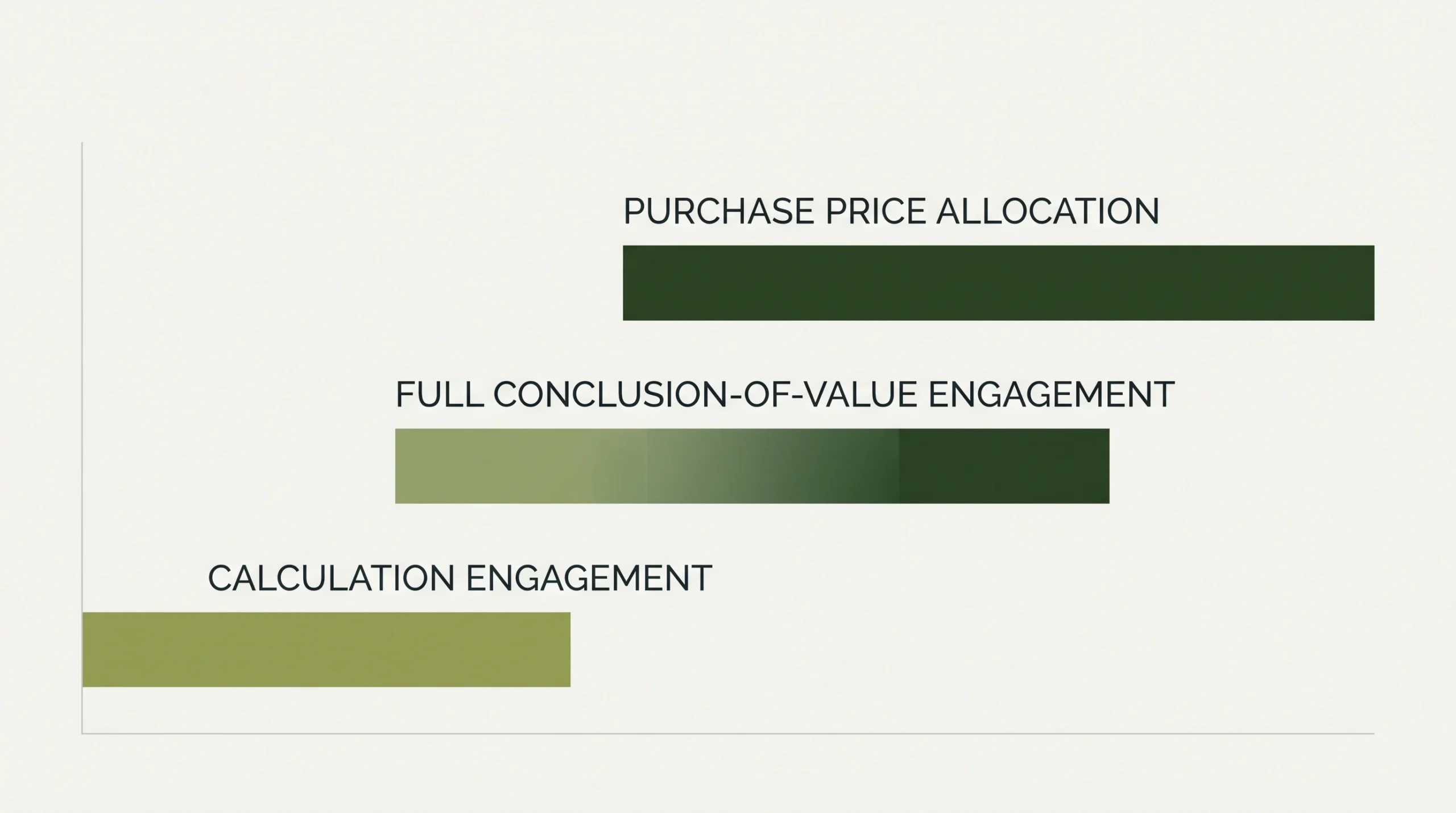 ys lean. A conclusion of value is the full job. Here the analyst weighs every fitting method, gathers more proof, and reaches an independent opinion. That deeper work is why a conclusion of value costs more.
Most owners need a conclusion of value for anything official. Tax filings, litigation, and most deals all demand it. The report must meet USPAP and AICPA SSVS standards and hold up under review. A calculation engagement fits early planning or a first look at a range. It carries no formal opinion, so it does not survive an audit or a court. Sofer Advisors helps each owner match the report to the goal. The wrong choice either wastes money or leaves a report too thin to use.
How much does a 409A valuation cost?
A 409A valuation typically costs 2,500 to 9,000 dollars. It sets the fair market value of common stock for option grants. Startups and growth companies use it to price equity for new hires. The report supports safe harbor treatment under IRC Section 409A. That safe harbor shields the company and its staff from later tax penalties. The fee is lower than a full valuation because the scope is narrower.
The price still moves with the facts. A simple cap table with one class of stock is fast to model. Warrants, preferred rounds, and liquidation preferences all add work. A late-stage company with a complex structure sits at the top of the range. Most 409A reports also need a yearly refresh, or a new one after each priced round. Owners should plan for that repeat cost, not just the first study.
What does a purchase price allocation cost?
A purchase price allocation typically costs 15,000 to 50,000 dollars. It runs under ASC 805 after a company buys another business. The analyst splits the purchase price across the assets acquired. That means valuing intangibles like customer lists, technology, and trade names. Whatever is left over becomes goodwill on the balance sheet. Auditors then test each figure, so the work must be tight.
This engagement sits at the top of the fee range for good reason. It blends the income, market, and asset approaches in one file. Each intangible needs its own model and its own set of assumptions. The report also has to satisfy an outside auditor, not just an owner. That extra layer of review raises both the hours and the level of proof. Sofer Advisors builds each allocation to survive that audit the first time through.
Why do standards raise the cost, and why is it worth it?
Standards raise the cost because they demand documented, testable work. A real valuation follows USPAP, AICPA SSVS, and IRS Revenue Ruling 59-60. Each rule forces the analyst to show the method, the data, and the logic. A free online calculator skips all of that. It applies a generic EBITDA multiple to your revenue and stops. The number looks clean, but it cannot back a tax filing, a deal, or a dispute.
This is where the fee earns its keep. The Sofer Difference is a four-phase process: Discovery, Diligence, Analysis, and Delivery. Each phase adds proof to the file so the conclusion holds up under review. The firm brings the Heart of a Teacher to every job, showing owners the math rather than just the answer. Large shops such as Alvarez and Marsal or Kroll aim that rigor at enterprise clients. Sofer Advisors brings the same senior-level standard to middle-market owners. And unlike a solo practitioner, its full W2 team of 14 backs every conclusion with database evidence and a next business day response.
Frequently Asked Questions
How much does a business valuation from Sofer Advisors cost?
A full business valuation runs 7,500 to 25,000 dollars. The exact fee depends on the purpose and how complex your books are. Simpler planning or tax work falls toward the lower end. Deals and litigation need deeper analysis, so they sit higher. Specialty reports differ, with a 409A from 2,500 dollars. Contact Sofer Advisors for a quote matched to your situation.
Can I get a business valuation for free?
Free online calculators give a rough number, not a real valuation. They apply a generic multiple and ignore your risk, growth, and normalized earnings. That output does not meet AICPA SSVS or USPAP standards. So a bank, the IRS, or a court will not accept it. A formal engagement needs independent review of your financial statements. Sofer Advisors offers a first conversation to point you to the right path.
How long does a business valuation take?
A standard business valuation usually takes four to eight weeks. The clock depends on the complexity of the company and how ready your records are. The work moves through Discovery, Diligence, Analysis, and Delivery. Clean books and quick answers shorten the timeline. A rush job can sometimes be arranged for a deal, often at a premium. Good document prep is the fastest way to keep the schedule tight.
What credentials should a valuation expert have?
Look for the ABV or the ASA credential. Accredited in Business Valuation comes from the AICPA. Accredited Senior Appraiser comes from the American Society of Appraisers. Both prove the analyst has met strict testing and ethics rules. The IRS, SEC, and FINRA recognize these marks. David Hern CPA ABV ASA holds both, so his reports carry weight with reviewers, auditors, and courts alike.
Does the valuation fee depend on the company’s value?
No. A fair fee is based on time, scope, and complexity, not a percent of value. Tying the fee to the result would create a clear conflict of interest. That conflict would undercut the independence the standards require. Most credentialed firms charge a flat or hourly rate set by the work. Sofer Advisors quotes each job on scope, so the conclusion stays neutral and defensible.
Is a business valuation a tax-deductible expense?
It depends on why you ordered the report. A valuation for the normal operation of a business is often a deductible professional fee. One tied to buying or selling a capital asset may need to be capitalized instead. That cost then attaches to the asset rather than the current year. Rules vary by filing, so confirm the treatment with your tax advisor before you deduct.
What is the difference between a calculation and a conclusion of value?
A calculation engagement is limited. The analyst and client agree on the methods, and the file stays lean. It carries no formal opinion, so it fits early planning only. A conclusion of value is the full job. The analyst weighs every fitting method and reaches an independent opinion. It meets USPAP and AICPA SSVS standards, and it holds up in tax, deal, or court settings.
Why do online calculators cost so little?
They cost little because they do almost no work. A calculator applies one industry multiple to your revenue or profit, the kind published in the BizBuySell industry valuation multiples tables. It never reviews your books, your risk, or your enterprise value drivers. There is no analyst, no diligence, and no signed opinion behind the figure. That is fine for idle curiosity. It fails the moment a real buyer, auditor, or judge asks how the number was built.
Related Case Studies
- How to Defend a Business Valuation in an IRS Audit
- Why Independence Matters in Valuation: AICPA, ASA, Court Standards
- Qualified Appraiser IRS Requirements: A Guide to Section 170 and 6695A
Executive Summary
A business valuation typically costs 2,500 to 50,000 dollars, and the job you order sets where you land. A 409A runs 2,500 to 9,000 dollars. A full conclusion of value runs 7,500 to 25,000. A purchase price allocation under ASC 805 runs 15,000 to 50,000. The fee tracks purpose, company complexity, and report type. A calculation engagement costs less than a conclusion of value because it skips full diligence. Standards like USPAP, AICPA SSVS, and IRS Revenue Ruling 59-60 keep the report defensible. Sofer Advisors, an Inc. 5000 firm with 180+ five-star Google reviews, scopes each job to the scrutiny it must survive.
What Should You Do Next?
Start by naming the purpose of your valuation, since it drives the whole fee. Gather your financial statements, tax returns, and current cap table before you call. Clean records shorten the Discovery phase and lower the hours you pay for.
For a fee quote and a report you can stand behind, work with David Hern CPA ABV ASA. His team has given expert witness testimony in 11+ cases across Georgia, Florida, California, and New Mexico. Schedule a consultation to discuss the right engagement for your goals.
People Also Read
- Fairness Opinions for Related-Party Transactions: When Required
- Forensic Accounting in Business Valuation: When You Need Both
About the Author
This guide was prepared by David Hern CPA ABV ASA, founder of Sofer Advisors, a business valuation firm headquartered in Atlanta, GA serving clients across the United States. David holds dual accreditations as an Accredited Senior Appraiser (ASA) and is Accredited in Business Valuation (ABV), credentials recognized by the IRS, SEC, and FINRA. He also holds the Certified Exit Planning Advisor (CEPA) designation. With 15+ years of valuation experience, David has served as an expert witness in 11+ cases across multiple jurisdictions and built Sofer Advisors into an Inc. 5000-recognized firm with 180+ five-star Google reviews. Its full W2 employee team maintains subscriptions to all major valuation databases and operates under a next business day response policy. For professional business valuation services, visit soferadvisors.com/about-us/ or contact Sofer Advisors at soferadvisors.com/contact-us/.
Disclaimer: This content is for informational purposes only and does not constitute professional valuation advice. Business valuation conclusions depend on specific facts and circumstances. Contact Sofer Advisors for guidance regarding your specific situation.