


Last Updated: October 2026
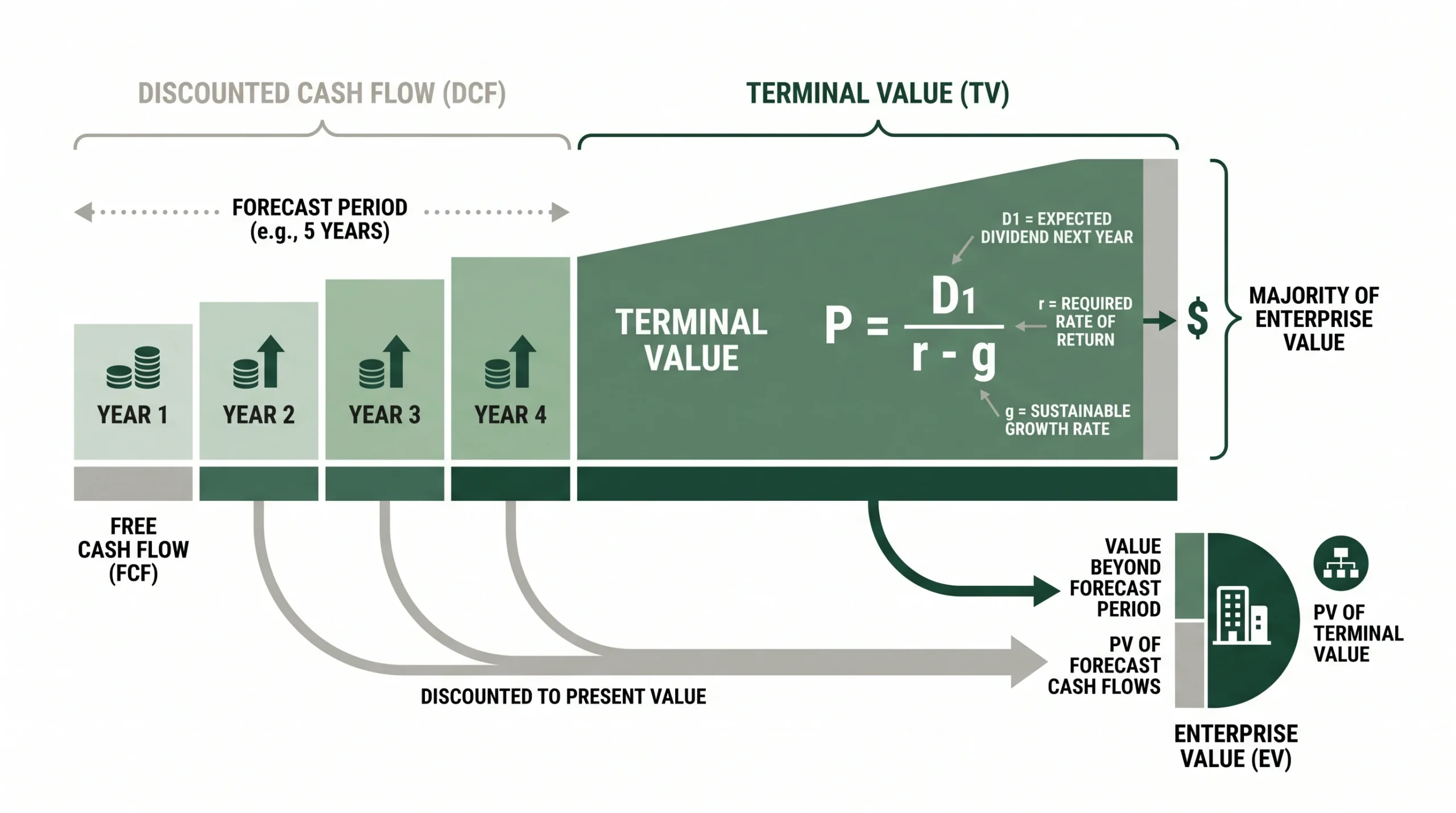
The Gordon Growth Method estimates the value of a business from a stream of cash flows that grow at a constant rate forever. It links three inputs through one formula, P = D1 / (r – g): the expected dividend, the required return, and the steady growth rate. Analysts use it most often to set the terminal value in a discounted cash flow model, which can account for 60 to 80 percent of the total value. It works only when a company has reached stable, predictable maturity.
The team at Sofer Advisors applies this method inside DCF valuations for owners, investors, and their advisors, backed by Inc. 5000 recognition in both 2024 and 2025. The formula is simple, but the assumptions behind it are strict. Because the result is highly sensitive to its inputs, a small change in the growth rate can swing the answer sharply.
This guide explains the formula, how it sets terminal value, its key assumptions and limits, how to estimate the growth rate, and how the method compares to other models. A worked example shows just how much a single input can move the result.
Key Takeaways
- The formula: P = D1 / (r – g), the present value of cash flows growing at a constant rate.
- Terminal value: in a DCF, the method values all cash flows beyond the forecast period.
- Core assumption: cash flows grow at a constant rate forever, and that rate is below the required return.
- High sensitivity: small changes in growth or discount rate move the result sharply, so inputs must be supported.
- Best fit: mature, stable, dividend-paying firms; a poor fit for growth-stage or non-dividend companies.
Each point ties back to the single formula at the center of the method. The sections below examine each in detail.
Why Is the Gordon Growth Method Important to Understand?
The method matters because it usually drives most of a valuation’s result, so reviewers and standards treat it with care. Revenue Ruling 59-60 directs an appraiser to weigh a company’s earning capacity and future outlook, which the income approach captures through models like this one. The Uniform Standards of Professional Appraisal Practice (USPAP) and the AICPA Statement on Standards for Valuation Services require that every input, especially the discount rate and the growth rate, be supported and documented. A terminal value built on an unsupported growth rate is the first thing a reviewer or the IRS challenges.
What Is the Gordon Growth Method Formula?
The formula is P = D1 / (r – g). P is the value, D1 is the expected dividend next period, r is the required rate of return, and g is the constant growth rate. To find D1, take the current dividend, D0, and grow it by one period: D1 = D0 times (1 + g). The numerator is a single expected payment for the next period.
The method capitalizes that one payment into perpetuity. The calculation only works when r is greater than g. If g equals or exceeds r, the denominator is zero or negative, and the result approaches infinity or turns meaningless. So the analyst must pick a growth rate that is sustainable for the long run. That single choice drives the entire result more than any other input.
How Is It Used to Calculate Terminal Value?
In a multi-stage DCF, the method sets the terminal value. The analyst first projects free cash flow for several explicit years. Then the Gordon Growth formula is applied to the final year’s cash flow, treated as a payment growing at a perpetual rate. That gives the value of everything beyond the forecast.
The terminal value is then discounted back to the present and added to the discounted explicit cash flows. The total is the enterprise value. This matters because most of a company’s value sits beyond a five or ten year forecast. The perpetual growth rate is usually tied to long-run economic or inflation expectations. A realistic rate keeps the terminal value grounded rather than inflated. Since the terminal value usually drives most of the result, this one assumption deserves the most scrutiny in the entire model.
What Are the Key Assumptions?
The model rests on a few firm assumptions. The business is a going concern that will operate indefinitely. It pays cash flows that grow at a constant rate forever. The required return, r, stays constant and is always greater than the growth rate, g. Those constraints define where the model can be used.
They also limit it. The method fits mature, stable companies with reliable distributions. Large utilities and established consumer staples often qualify. It fits poorly for growth companies, cyclical firms, or businesses that pay no dividends. For those, constant perpetual growth is unrealistic. Forcing the model onto the wrong company produces a value that does not reflect the real financial dynamics.
What Are the Main Limitations?
The biggest limitation is input sensitivity. Small changes in the growth rate or the required return produce very different values. Because the two inputs sit so close together in the denominator, a minor error can distort the whole result. That makes supportable assumptions essential.
The constant-growth assumption is also rarely realistic. Most companies move through growth cycles, not a steady, endless climb. The method cannot value a business that pays no dividends, and it struggles with early-stage, high-growth companies. It also focuses only on distributions and ignores value from earnings reinvested at a high return. For these reasons, analysts usually pair it with other methods rather than relying on it alone.
How Do You Estimate the Growth Rate?
The growth rate, g, is the input that matters most, so it deserves care. The analyst looks at the company’s historical growth, its industry outlook, and long-run economic forecasts. A common anchor is expected long-term nominal GDP growth, since no company can outgrow the whole economy forever.
The rate must be one the business can truly sustain at maturity. A rate above long-run GDP implies the company eventually becomes larger than the economy, which is impossible. So analysts keep the perpetual rate modest and grounded. Documenting how the rate was chosen is as important as the number itself. An unsupported growth rate is the first thing a reviewer challenges.
Choosing a defensible growth rate and discount rate is easier with an experienced valuation analyst reviewing the model. Talk to a Sofer Advisors valuation specialist about the inputs behind your terminal value.
How Does It Compare to Other Models?
The Gordon Growth Method is a simple, dividend-based absolute valuation model for stable firms. A multi-stage DCF offers more flexibility for companies with changing growth phases. Relative valuation uses market multiples to compare a company to its peers. The Walter Model ties equity value to the relationship between payouts and the internal return. The table below sorts them.
| Model | Best used for | Key assumption |
|---|---|---|
| Gordon Growth Method | Mature, stable, dividend-paying firms | Constant growth into perpetuity |
| Multi-stage DCF | Companies with distinct growth phases | Growth stabilizes to a long-term rate |
| Relative valuation | Firms with good public or deal comparables | Peers are truly comparable |
| Walter Model | Theoretical and academic comparisons | Investment and financing policy stay constant |
The right choice depends on the company. A high-growth technology startup lacks the stable dividend history the Gordon model needs, so a multi-stage DCF fits better. An expert usually runs more than one method, such as a DCF and a comparable company analysis, to triangulate a defensible range rather than lean on a single formula.
Providers of these analyses range widely in scale. Larger national firms such as Alvarez & Marsal, Stout, and Kroll serve big public companies with broad advisory teams. Sofer Advisors focuses on defensible, partner-led DCF and terminal value work for closely held and middle-market businesses, with expert witness testimony in 11+ cases behind its reports. It works through a four-phase process it calls The Sofer Difference, moving from Discovery to Diligence to Analysis to Delivery, so each input can be traced back to its support.
A Worked Example
A simple example shows how the formula behaves. Suppose a company’s final forecast year produces $1,000,000 in free cash flow. The analyst expects a 2.5 percent perpetual growth rate and uses a 10 percent required return. The next year’s cash flow is $1,025,000, which is $1,000,000 grown by 2.5 percent.
The terminal value is $1,025,000 divided by (0.10 minus 0.025), or 0.075. That equals about $13,666,667. Now change the growth rate to 3.5 percent. The denominator drops to 0.065, and the terminal value jumps to roughly $15,923,000. A single percentage point of growth moved the value by over $2,000,000. That is the sensitivity the model is known for, and it is why the growth rate must be defensible. Walking an owner through that math reflects the Heart of a Teacher approach, which explains why a number moves rather than just presenting the final figure.
Frequently Asked Questions
What is the Gordon Growth Model?
The Gordon Growth Model is a valuation formula that finds the value of a business by assuming its cash flows grow at a constant rate forever. It equals the present value of all future cash flows discounted at the required return. Analysts use it most often to set the terminal value inside a discounted cash flow model. Sofer Advisors applies it as one input in a broader DCF, then cross-checks the result against a market multiple.
What is the Gordon equation and how does it work?
The Gordon equation is P = D1 / (r – g). It divides the next expected dividend, D1, by the difference between the required return and the growth rate. That division capitalizes a growing cash flow stream into a single present value today. It only works when r is greater than g, otherwise the result is meaningless. Sofer Advisors confirms that constraint holds before relying on the formula in any valuation.
What are the limitations of the model?
The model is highly sensitive to the gap between the discount rate and the growth rate, so a small error moves the value sharply. It assumes constant growth forever, which rarely holds for a real company. It also cannot value a firm that pays no dividend at all. For these reasons, analysts vet the growth assumption closely and pair it with other methods. Sofer Advisors never lets a single formula carry a valuation on its own.
Why must the required return be greater than the growth rate?
Because the denominator, r minus g, must be positive to produce a finite, logical value. If g equals or exceeds r, the result is undefined or negative, which has no meaning for business value. Keeping r above g also forces a sustainable growth assumption, since no company can outgrow its own cost of capital forever. Sofer Advisors tests this relationship in every DCF before accepting the terminal value.
Can the model be used for a company that pays no dividends?
Not directly, because the model is built for dividend-paying stocks. Analysts sometimes substitute free cash flow for the dividend, which extends the logic to companies that retain earnings. But if a business generates no cash available to owners at all, the model loses its input entirely. A market approach or a multi-stage DCF is usually a better fit. Sofer Advisors selects the method that matches each company’s actual cash profile.
How do you estimate the constant growth rate?
Look at the company’s historical growth, its industry outlook, and long-run macro forecasts such as nominal GDP. The rate must be one the business can truly sustain at maturity, and it should never exceed long-run economic growth. A rate above GDP implies the company eventually becomes larger than the whole economy, which is impossible. Sofer Advisors anchors the perpetual growth rate to documented market data so a reviewer can trace it.
How is the Gordon model different from the Walter model?
The Gordon model focuses on constant dividend growth in perpetuity to set a value. The Walter model instead looks at how the payout ratio and the internal return on reinvested funds drive share value. The Gordon approach is far more common for practical terminal value work, while the Walter model is mostly academic. Sofer Advisors relies on the Gordon method for terminal value and reserves the Walter model for theoretical comparison.
How much does a DCF and terminal value analysis cost?
A business valuation using a DCF with a terminal value usually ranges from $7,500 to $25,000. The fee depends on the complexity of the forecast, the number of scenarios, and the purpose of the report. A flat scope is quoted up front, so the cost is clear before work begins. Sofer Advisors sets the scope first, then quotes a fixed price. Request a free estimate for a range specific to your engagement.
Related Case Studies
- The Gordon Growth Model: Terminal Value in a DCF
- Terminal Value Formula: How to Calculate It in a DCF
- Cost Basis vs Fair Market Value: Key Differences Explained
Executive Summary
The Gordon Growth Method is a clean way to capture long-term value, but only for the right company and the right inputs. Confirm the business is mature and stable before applying P = D1 / (r – g). Keep the required return above a sustainable growth rate, and anchor that rate to long-run GDP. In a typical DCF, the terminal value drives 60 to 80 percent of the total, so test it against a market multiple of the final-year cash flow. A one point change in growth can move the value by millions. Most DCF valuations that use this method run $7,500 to $25,000.
What Should You Do Next?
Confirm your company is mature and generates stable, predictable cash flow before you lean on this method. Build a supportable cost of capital, choose a perpetual growth rate anchored to long-run GDP, and then stress-test the terminal value against a market multiple. This guide was prepared by David Hern CPA ABV ASA, founder of Sofer Advisors, an Inc. 5000 firm specializing in neutral third-party DCF and terminal value analyses. Schedule a free consultation to discuss your specific situation.
People Also Read
About the Author
This guide was prepared by David Hern CPA ABV ASA, founder of Sofer Advisors, a business valuation firm headquartered in Atlanta, GA serving clients across the United States. David holds dual accreditations as an Accredited Senior Appraiser (ASA) and is Accredited in Business Valuation (ABV), credentials recognized by the IRS, SEC, and FINRA. He also holds the Certified Exit Planning Advisor (CEPA) designation. With 15+ years of valuation experience, David has served as an expert witness in 11+ cases across multiple jurisdictions and built Sofer Advisors into an Inc. 5,000-recognized firm with 180+ five-star Google reviews. Its full W2 employee team maintains subscriptions to all major valuation databases and operates under a next business day response policy.
For professional business valuation services, visit soferadvisors.com/about-us/ or contact Sofer Advisors at soferadvisors.com/contact-us/.
This content is for informational purposes only and does not constitute professional valuation advice. Business valuation conclusions depend on specific facts and circumstances. Contact Sofer Advisors for guidance regarding your specific situation.









