


Last Updated: September 2026
A fairness opinion in a going-private or squeeze-out merger is an independent opinion that the consideration paid to shareholders is fair, from a financial point of view, to the minority. A special committee of independent directors hires a financial advisor to give it. These deals carry a built-in conflict, because a shareholder who controls more than half the vote sits on both sides of the table. That conflict is why courts look so closely at both the price and the process.
The opinion does not set the price or bless the legal terms. It tells the board and the minority whether the number holds up against real market evidence. In a going-private deal, a public company leaves the stock market. In a squeeze-out, the controller forces the minority to sell for cash. Both put director duties under close review.
Sofer Advisors gives independent, court-ready opinions for conflicted transactions. The firm brings a Heart of a Teacher approach, turning dense deal law into plain guidance, and its work has held up in 11+ expert witness cases across several states. Boards use that neutral read to protect the minority and themselves.
Key Takeaways
- The conflict drives everything: in a going-private or squeeze-out deal, a controlling shareholder sits on both sides, so courts watch the price and the process.
- Entire fairness is the default: Delaware reviews most controller squeeze-outs under this demanding standard, which asks for a fair price and fair dealing.
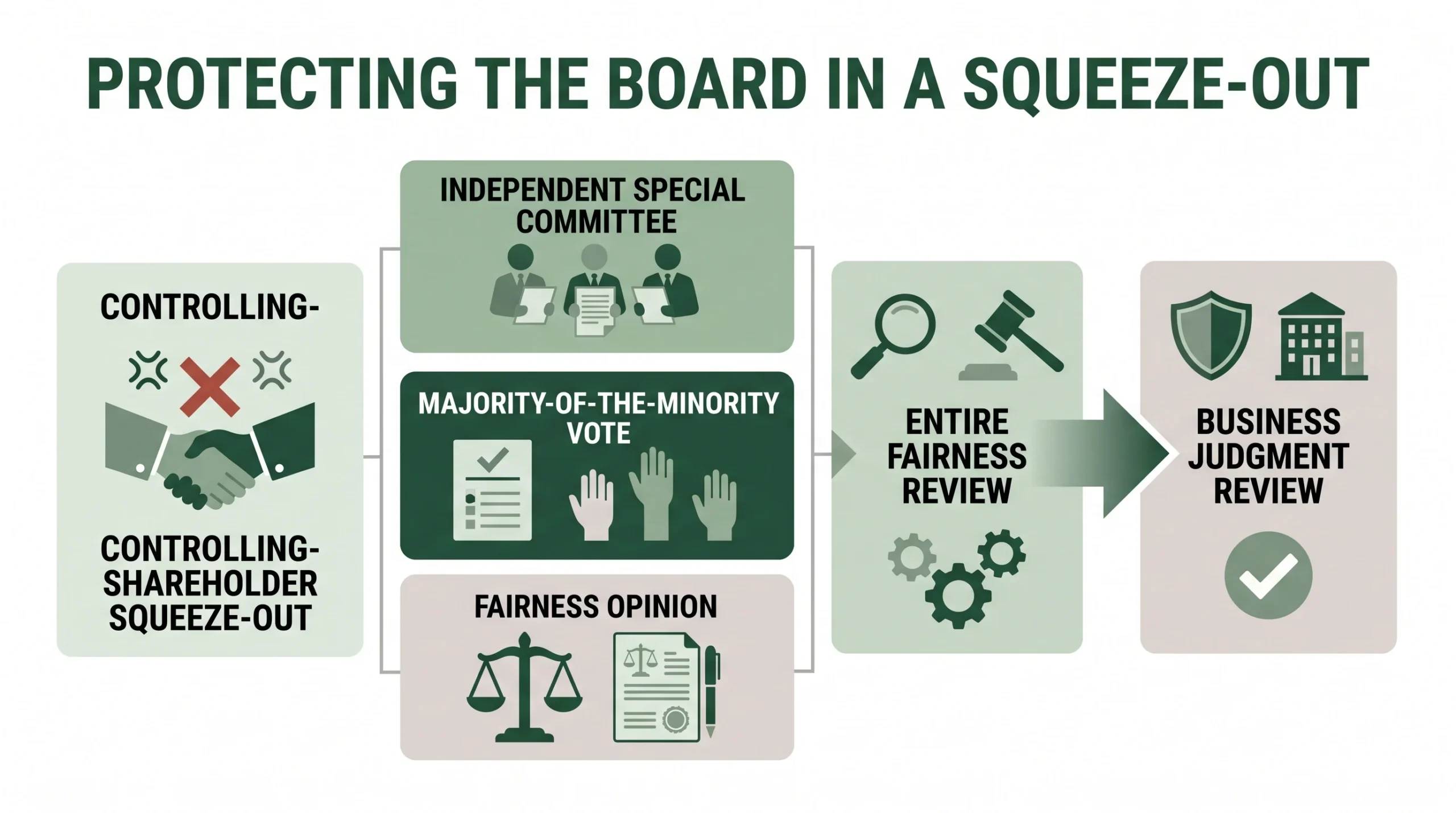
- Two protections can ease review: an independent special committee plus a majority-of-the-minority vote can move a deal toward business judgment review under the MFW framework.
- Independence is the point: the special committee, not the controller, should hire the advisor, and the fee should not depend on the deal closing.
- Disclosure is separate: SEC Rule 13e-3 forces detailed Schedule 13E-3 disclosure on top of state-law duties.
The sections below explain each point.
What is a fairness opinion in a squeeze-out merger?
A fairness opinion is an independent opinion that the consideration in a deal is fair, from a financial point of view, to a stated group, usually the minority or public shareholders. In a going-private merger, a public company is taken private, often by a controlling shareholder or a private equity sponsor. In a squeeze-out, also called a freeze-out, a controlling shareholder forces the minority to give up their shares for cash. The opinion checks whether the payout matches the evidence.
The document reads as a short letter backed by a full analysis. The advisor tests the offer against comparable deals, trading multiples, and a discounted cash flow model, then states whether the price is fair. A fairness opinion is not a valuation report. It answers one narrow question about the deal on the table. Our guide to a fairness opinion in M&A covers the standard version. This article covers the harder case, where the buyer already controls the company.
When does a board need a fairness opinion to go private?
A board needs a fairness opinion whenever a controlling shareholder stands on both sides of the deal. No federal statute forces one in every merger. Still, in a going-private or squeeze-out deal the conflict is direct, so a special committee almost always asks for one. The opinion becomes part of the record that shows the directors acted with care before the shareholders voted.
Think about who benefits. The controller wants to pay as little as possible, while the minority wants the highest price. The same group influences both sides, so the risk of an unfair number is real. A fairness opinion gives the independent directors a neutral read they can point to later. Boards weigh this against the control premium a buyer pays for full ownership, since paying for control is normal while shortchanging the minority is not. When a controller buys out a squeezed-out minority stake, the price should reflect fair value.
How does entire fairness review raise the stakes?
Entire fairness is the most demanding standard a court can apply to a merger, and Delaware applies it to most controlling-shareholder squeeze-outs. Under it, the directors must prove both a fair price and fair dealing, which covers the timing, structure, and negotiation of the deal. The burden sits with the defendants, not the challenger, a hard place to stand without a strong process.
There is a path to a softer standard. Delaware’s MFW framework lets a controller earn business judgment review, which is far easier to meet. To get there, the deal must use two protections from the start. First, an independent and empowered special committee must negotiate and be free to say no. Second, the deal must be approved by an informed, uncoerced vote of a majority of the minority shares. Miss either one and entire fairness returns. A fairness opinion supports the committee under both paths. These rules are specific to Delaware and turn on the facts, so a board should confirm the current standard with its own counsel. Most of this case law comes from the Delaware Court of Chancery. A court-tested record also depends on defensible valuation methods that hold up under cross-examination.
What does SEC Rule 13e-3 require in a going-private deal?
SEC Rule 13e-3 requires the company and its affiliates to file detailed disclosure when a public company goes private. The filing, made on Schedule 13E-3, must state whether the deal is fair to unaffiliated shareholders and explain the basis for that view. If the board received a fairness opinion, the company must describe it and often file it. The rule is about transparency, not a promise that the price is right.
The disclosure lists the reasons behind the deal, the alternatives the board weighed, and the reports it relied on. Shareholders read this before they decide, and a fairness opinion is a common part of that record. The federal rule sits on top of state-law duties, so a controller may face both SEC disclosure under Rule 13e-3 and a Delaware fairness claim. The advisor that signs the opinion has its own duties too. Under FINRA Rule 5150, a member firm that issues a fairness opinion must disclose conflicts and describe how it prepared the work. Because securities rules change, a board should confirm the current filing duties with securities counsel.
Who should prepare the fairness opinion?
The opinion should come from an independent financial advisor with no stake in whether the deal closes. A special committee, not the controller, should hire that advisor and direct the work. Independence is the point, because a fee tied to closing would taint the neutral read. The choice turns on independence, method, and fit.
Boards often weigh national advisory firms such as Alvarez & Marsal, Stout, and Kroll against independent valuation firms. All can build the model. The gap shows up in conflicts and in who stands behind the number if it is challenged. The table below compares the common options.
| Advisor type | Role in a going-private deal | Conflict risk |
| Sofer Advisors | Independent opinion for the special committee | Low; flat fee, not tied to closing |
| National advisory firm | Opinion plus broad deal support | Moderate; may hold other deal roles |
| Sell-side deal banker | Markets and closes the transaction | High; success fee rises with the price |
A banker who earns more when the deal closes is not the neutral voice a conflicted merger needs. An independent firm keeps the opinion separate from any deal fee, so the committee gets a clean read. The Sofer Difference runs across four phases: Discovery, Diligence, Analysis, and Delivery, which keeps the work consistent and easy to defend. An independent firm can also connect the opinion to broader transactional advisory work. A solvency opinion sometimes runs alongside it when the deal adds debt.
What are the limits of a fairness opinion?
A fairness opinion has clear limits, and a board should know them. It speaks only to financial fairness, not to whether the deal is legal or wise. It is not a valuation report, and it does not guarantee the best price. It also does not replace legal advice on fiduciary duties or securities rules. Directors still must run a fair process.
The opinion sits at one moment in time and rests on the data available then, so if the facts change, the conclusion can change. It also assumes the numbers management gave are reasonable. A careful advisor tests them, but the opinion is not an audit. So it is one input, not the whole defense. Boards pair it with independent counsel, a real special committee, and honest disclosure. Together, these steps show the care entire fairness demands.
The questions below cover what boards and shareholders ask most.
Frequently Asked Questions
When is a fairness opinion needed for a going-private or squeeze-out merger?
A fairness opinion is needed whenever a controlling shareholder sits on both sides of the deal. No law forces one in every merger, but the conflict in a going-private or squeeze-out deal makes it standard practice. A special committee usually requests it to show the directors tested the price and acted with care.
What is a fairness opinion used for in a controlling-shareholder squeeze-out?
It gives the independent directors and the minority a neutral view of whether the cash offer is fair, from a financial point of view. In a squeeze-out, the controller forces the minority to sell, so the price is the main fight. The opinion tests that price against market evidence and becomes part of the record the board discloses.
Who writes the fairness opinion in a going-private deal?
An independent financial advisor writes it, hired by the special committee rather than by the controlling shareholder. Independence matters because a fee tied to closing would bias the result. The advisor builds the analysis, signs a short opinion letter, and stands behind the number if the deal is later challenged.
How does entire-fairness review apply to a squeeze-out merger?
In Delaware, courts review most controlling-shareholder squeeze-outs under the entire fairness standard. Directors must show both a fair price and fair dealing, and the burden sits with them. A deal can earn easier business judgment review only if it uses an independent special committee and a majority-of-the-minority vote from the start. These rules depend on the state and the facts, so confirm them with counsel.
How does a fairness opinion protect directors in a going-private transaction?
It shows the directors tested the price with an independent expert before they approved the deal. That evidence supports a fair process, which is half of what entire fairness requires. Paired with a real special committee and full disclosure, it helps directors show they met their fiduciary duties.
What is the difference between a going-private and a squeeze-out merger?
A going-private deal takes a public company off the stock market, often through a controlling shareholder or a private equity sponsor. A squeeze-out, also called a freeze-out, forces the remaining minority to give up their shares for cash. The two often overlap, since a controller taking a company private squeezes out the public holders in the same deal.
Does SEC Rule 13e-3 require a fairness opinion?
Rule 13e-3 does not require a fairness opinion by name, but it demands heavy disclosure in a going-private deal. The company files Schedule 13E-3 and must state whether the deal is fair to unaffiliated shareholders and why. If the board received a fairness opinion, the filing must describe it. Confirm the current duties with securities counsel.
Is a fairness opinion the same as a valuation report?
No. A fairness opinion answers one narrow question: is the deal price fair, from a financial point of view, to a stated group? A valuation report estimates the value of a business or an interest for its own sake. The opinion relies on valuation methods but does not replace a full report.
How much does a fairness opinion cost?
A fairness or solvency opinion from Sofer Advisors typically runs $15,000 to $40,000, with a timeline of four to eight weeks. The final fee depends on deal size, the complexity of the capital structure, and how fast the board needs it. For a quote tied to your transaction, contact us with the deal terms and financials.
Related Case Studies
- Shareholder Dispute Valuation: Resolving Business Partner Conflicts
- Business Valuation for Partner Buyout: Complete Transition Guide
- Management Buyout Process: Steps, Financing and Valuation
Executive Summary
A fairness opinion in a going-private or squeeze-out merger is an independent opinion that the price is fair, from a financial point of view, to the minority. These deals carry a built-in conflict, because a shareholder who controls more than half the vote sits on both sides. Delaware reviews most of them under the entire fairness standard, which asks for both a fair price and fair dealing. A deal can earn easier review only by using an independent special committee and a majority-of-the-minority vote under the MFW framework. Going-private deals also trigger SEC Rule 13e-3 disclosure on Schedule 13E-3. The opinion, obtained by the special committee from an independent advisor, supports a fair process. Fees run $15,000 to $40,000.
What Should You Do Next?
If your board faces a going-private or squeeze-out deal, form an independent special committee before any price is discussed. Give that committee its own counsel and its own financial advisor, and keep the opinion free of any fee tied to closing. Line up the majority-of-the-minority vote and the Schedule 13E-3 disclosure early, so the record shows a fair process.
David Hern CPA ABV ASA, founder of Sofer Advisors, provides independent fairness opinions for boards and special committees. Schedule a consultation to discuss your transaction.
People Also Read
- Business Valuation for Mergers: Buy-Side vs Sell-Side
- Buy Sell Agreement vs Shareholder Agreement: Key Differences
About the Author
This guide was prepared by David Hern CPA ABV ASA, founder of Sofer Advisors, a business valuation firm headquartered in Atlanta, GA serving clients across the United States. David holds dual accreditations as an Accredited Senior Appraiser (ASA) and is Accredited in Business Valuation (ABV), credentials recognized by the IRS, SEC, and FINRA. He also holds the Certified Exit Planning Advisor (CEPA) designation. With 15+ years of valuation experience, David has served as an expert witness in 11+ cases across multiple jurisdictions and built Sofer Advisors into an Inc. 5000-recognized firm with 180+ five-star Google reviews. Its full W2 employee team maintains subscriptions to all major valuation databases and operates under a next business day response policy.
For professional business valuation services, visit soferadvisors.com/about-us/ or contact Sofer Advisors at soferadvisors.com/contact-us/.
Disclaimer: This content is for informational purposes only and does not constitute professional valuation advice. Business valuation conclusions depend on specific facts and circumstances. Contact Sofer Advisors for guidance regarding your specific situation.









