


Last Updated: September 2026
A discount for lack of marketability, or DLOM, lowers the value of a private business interest. Unlike a public stock, a stake in a closely held company cannot be sold quickly for cash. The IRS Discount for Lack of Marketability Job Aid notes such discounts often fall in a wide band, from about 10 to 40 percent. In divorce and shareholder litigation, that same discount draws close review.
This review turns on one question: which standard of value applies. In a tax appraisal, the standard is usually fair market value, which allows a DLOM. In many divorce and shareholder cases, the standard is fair value, which often does not allow a DLOM. Sofer Advisors prepares court-defensible valuations that show when a marketability discount fits. Its senior team has testified as an expert witness in 11+ cases across several states.
Business owners, shareholders, and family law attorneys meet this issue when a marriage or a partnership ends. Knowing how courts weigh a DLOM helps you build a stronger position and avoid a number a judge may strike.
Key Takeaways
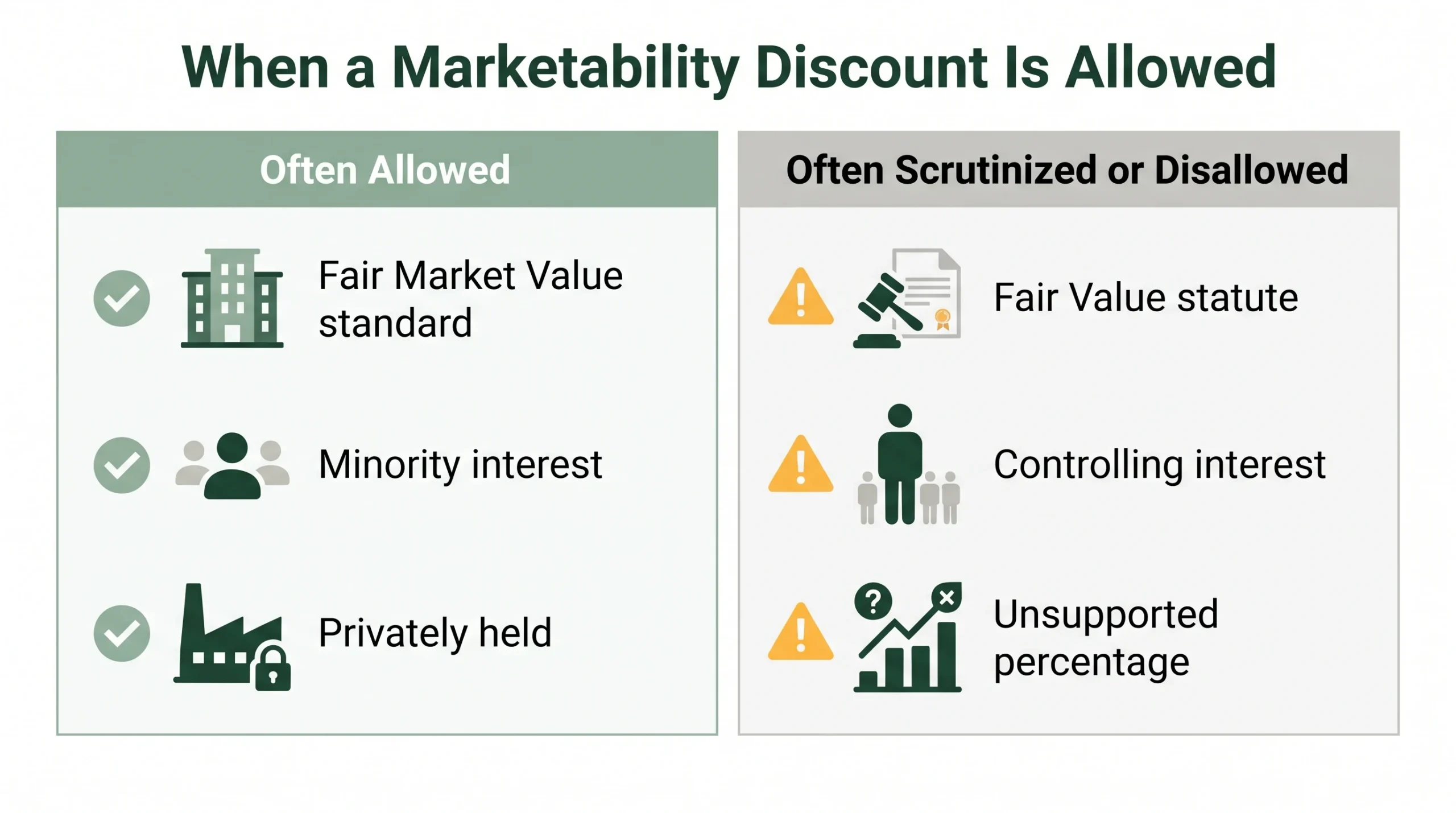
- Standard of value drives everything: fair market value usually allows a DLOM, while fair value, used in many divorce and shareholder cases, often does not.
- State law and facts govern: treatment varies by state and by case, so a marketability discount is never automatic in a courtroom.
- Control matters: courts and many appraisers question a DLOM on a controlling interest, since a control owner can direct a sale or set payouts.
- The method is tested: judges probe the studies and models behind the percentage, and an unsupported rule-of-thumb figure invites exclusion.
- DLOM is not DLOC: a marketability discount and a minority discount solve different problems and must be defended on separate grounds.
Each of these factors shapes whether a discount survives in court. The sections below look at each one in turn.
What is a DLOM in litigation valuation?
A DLOM in litigation valuation is a reduction applied because a private interest lacks a ready market. It is the same core idea used in tax and estate work, but courts test it far more closely. The discount reflects the time, cost, and risk of turning a closely held stake into cash.
A DLOM addresses marketability, meaning how fast and cheaply an interest can be sold. A minority discount, or DLOC, addresses control, meaning how little say a small owner has. The two are separate, and each must rest on its own facts. Our guide to valuation discounts for DLOC and DLOM explains how they differ. Mixing them up is costly, since a judge can strike a discount not tied to the right cause.
Why do courts scrutinize the DLOM?
Courts scrutinize the DLOM because it can cut a value by a third or more, and because its size often rests on judgment. In a dispute, one side wants a large discount and the other wants none. A judge must decide which position the evidence supports.
Fairness sits at the center of the review. When an owner is forced out, or a marital estate is split, a steep discount can shift real money from one party to another. Many judges resist a discount that punishes a person who did not choose to sell. USPAP and the AICPA Forensic and Valuation Services standards require support for every adjustment, and IRS Revenue Ruling 59-60 guides how private interests are appraised.
Does fair value bar a marketability discount?
Often, yes. Many state statutes for dissenting and oppressed shareholders, and many divorce courts, use fair value rather than fair market value. Fair value frequently does not allow a marketability or minority discount. The view is that a forced-out owner or a marital estate should not be penalized for a sale they did not seek. Treatment varies by state and by case.
The gap between the two standards is the pivotal driver of most DLOM fights. Fair market value assumes a willing buyer and seller, so a discount for illiquidity fits. Fair value often rejects discounts to protect the party being bought out. This is a legal question that varies by state, so consult counsel. Sofer Advisors coordinates with attorneys through its conflict resolution valuation services so the appraisal matches the court’s standard.
| Standard of value | Where it is used | Marketability discount |
| Fair market value | Estate, gift, and income tax appraisals | Usually allowed |
| Fair value | Many dissenting and oppressed shareholder cases | Often not allowed |
| Divorce standard (varies) | Marital dissolution, set by each state | Depends on state and facts |
The takeaway is that the discount is not a fixed number you plug in. It depends on the legal standard the court adopts, and that standard changes from one state and one case to the next. An appraiser who applies a DLOM without asking which standard governs risks a report the judge sets aside. The safer path is to define the standard early, with counsel, then build the discount, or leave it out, to fit that standard and the record.
Can you apply a DLOM to a controlling interest?
Usually a controlling interest carries little or no DLOM. A control owner can force a sale or set distributions, so the interest is far more marketable than a small stake. Courts and many appraisers reject or shrink a discount here. Some experts still argue for a limited discount to reflect the time and cost of an actual sale.
The discount exists because a holder cannot quickly turn the interest into cash. A controlling owner faces much less of that problem, since the same person can trigger the sale. This is why a control premium and a DLOM pull in opposite directions, a point our article on the control premium in business valuation explains. In litigation, a full DLOM on a majority stake invites a sharp challenge, and often a reduction or outright rejection.
How is the DLOM amount proven in court?
The DLOM amount is proven with data, not a hunch. Appraisers draw on restricted stock studies, pre-IPO studies, and option-based models to set the figure. Each source has strengths and limits, and the expert must tie the chosen number to the specific company. Courts probe that link hard, since a weak method is the easiest part of a report to attack.
The common methods for supporting a DLOM include:
- Restricted stock studies: compare public shares that carry sale limits against freely traded shares to measure the price gap.
- Pre-IPO studies: compare private sale prices before a public offering with the later public price.
- Option-based models: use the cost of a protective put, or the quantitative marketability discount model, to estimate the discount.
Each method must be matched to the facts, since a study built on tiny startups says little about a mature firm. A credible report explains why the chosen studies fit, adjusts for size and risk, and shows the math. The IRS Discount for Lack of Marketability Job Aid reviews these methods and warns against a single blanket percentage. When an expert cannot connect the figure to the company, courts often cut the discount or exclude it.
Which valuation firm is best for a dispute?
The best choice for a dispute is an independent firm that testifies well and defends its methods. Owners weigh national firms, regional shops, and specialist valuation practices. Large national practices such as Alvarez & Marsal, Stout, and Kroll handle the biggest matters, while a focused firm gives senior attention to a middle-market case.
| Provider type | Litigation focus | Best fit |
| Independent valuation firm | Court-defensible opinion with senior testimony | Middle-market divorce and shareholder disputes |
| National firm (Alvarez & Marsal, Stout, Kroll) | Large, complex matters | Enterprise-scale cases |
| Solo appraiser | Lower cost, limited bench | Simple, low-stakes matters |
What matters most in court is method and independence. The Sofer Difference is a four-phase process, Discovery, Diligence, Analysis, and Delivery, that documents every judgment so an opposing expert cannot pick it apart. A Heart of a Teacher approach turns a dense discount analysis into plain language a judge can follow. Sofer Advisors backs that work with a full W2 team of 14, subscriptions to all major valuation databases, and 180+ five-star Google reviews, so the number holds up in court.
A marketability discount can move a dispute value by a wide margin, so its support must be clear. The questions below cover what owners and their counsel ask most.
Frequently Asked Questions
What does DLOM mean in valuation?
DLOM stands for discount for lack of marketability. It is a reduction in value applied because a private business interest cannot be sold quickly or cheaply for cash the way a public stock can. The discount reflects the time, cost, and risk of finding a buyer for a closely held stake. Its size depends on the company, the interest, and the standard of value that applies to the matter.
Do courts allow a marketability discount in divorce?
It depends on the state and the facts. Some divorce courts allow a DLOM, while others limit or reject it when the standard of value is fair value or when the interest is a controlling one. The result varies widely across jurisdictions, so no single answer fits every case. A family law attorney should confirm how local law treats the discount before an appraiser applies it.
How is a business valued in a divorce settlement?
A business in a divorce is valued under the standard of value the state sets, using the income, market, or asset approach. The appraiser normalizes earnings, selects methods, and then decides whether discounts for marketability or control apply under that standard. Because the outcome affects the marital estate, courts expect a supported, neutral report. The specific facts and the governing law shape the final conclusion.
How do you compute DLOM?
You compute a DLOM by drawing on empirical data rather than a fixed rule. Appraisers use restricted stock studies, pre-IPO studies, and option-based models such as the quantitative marketability discount model. Each is adjusted for the company size, financial health, and expected time to sell. The expert then selects a supported percentage and explains why it fits the interest. A number without this backing is easy to challenge in court.
What is the difference between fair value and fair market value?
Fair market value is the price a willing buyer and seller would agree on with full knowledge and no pressure, and it usually permits a DLOM. Fair value is a legal standard set by statute or case law for many shareholder and divorce matters, and it often bars marketability and minority discounts. The choice between them is a legal question that varies by state, so counsel should confirm which one governs.
Does a DLOM apply to a majority owner?
Usually a DLOM has little or no place on a controlling interest. A majority owner can direct a sale, set distributions, or take the company to market, so the interest is far more marketable than a small stake. Some appraisers argue for a small discount to reflect the time and cost of a sale. In litigation, a large DLOM on a controlling interest tends to draw a strong challenge.
What is the difference between a DLOM and a minority discount?
A DLOM addresses marketability, meaning how fast and cheaply an interest can be sold. A minority discount, or DLOC, addresses control, meaning how little influence a small owner holds over the company. They arise from different problems and are measured with different data. An appraiser may apply one, both, or neither, and each must be supported on its own terms to survive review in a dispute.
Can a court reject an expert’s DLOM entirely?
Yes. A court can reduce a DLOM or throw it out when the figure lacks study support, ignores the standard of value, or applies to a controlling interest without a sound basis. Judges also weigh how well the expert explains the method under cross-examination. A discount tied to strong data and the right legal standard has a much better chance of holding up than a rule-of-thumb number.
How much does a litigation business valuation cost?
A litigation business valuation from Sofer Advisors runs $7,500 to $25,000, with a four to eight week timeline, based on the size of the company and the complexity of the matter. Expert Witness Services, such as deposition and trial testimony, are billed hourly and quoted separately. For a fee tied to your matter, request a valuation estimate with your financials and case details.
Related Case Studies
- Shareholder Dispute Valuation: Resolving Georgia Business Partner Conflicts
- Minority Oppression: Valuing a Squeezed-Out Shareholder Stake
- Business Divorce in Georgia: Fair Distribution and Valuation
Executive Summary
A DLOM lowers the value of a private interest because it cannot be sold fast for cash, with real-world discounts often in a 10 to 40 percent band. The pivotal driver in litigation is the standard of value. Fair market value usually allows a DLOM, while fair value, used in many shareholder and divorce cases, often does not. Courts also question a DLOM on a controlling interest and reject figures that lack study support. State law and the specific facts govern the result.
What Should You Do Next?
Confirm the standard of value with your attorney first, since it decides whether a DLOM applies. Gather three years of financial statements, ownership records, and any buy-sell agreement so the appraiser can test both control and marketability. Then engage an independent valuation expert early, so the discount rests on data the court will accept.
David Hern CPA ABV ASA, founder of Sofer Advisors, provides court-defensible valuations for divorce and shareholder disputes across the United States. Schedule a consultation to discuss your matter by visiting the contact page.
People Also Read
- Divorce Business Valuation Georgia: What Business Owners Need to Know
- Minority Interest and Marketability Discounts Guide
About the Author
This guide was prepared by David Hern CPA ABV ASA, founder of Sofer Advisors, a business valuation firm headquartered in Atlanta, GA serving clients across the United States. David holds dual accreditations as an Accredited Senior Appraiser (ASA) and is Accredited in Business Valuation (ABV), credentials recognized by the IRS, SEC, and FINRA. He also holds the Certified Exit Planning Advisor (CEPA) designation. With 15+ years of valuation experience, David has served as an expert witness in 11+ cases across multiple jurisdictions and built Sofer Advisors into an Inc. 5000-recognized firm with 180+ five-star Google reviews. Its full W2 employee team maintains subscriptions to all major valuation databases and operates under a next business day response policy.
For professional business valuation services, visit soferadvisors.com/about-us/ or contact Sofer Advisors at soferadvisors.com/contact-us/.
Disclaimer: This content is for informational purposes only and does not constitute professional valuation advice. Business valuation conclusions depend on specific facts and circumstances. Contact Sofer Advisors for guidance regarding your specific situation.









