


Last Updated: September 2026
Discounting damages to present value and prejudgment interest are the two back-end adjustments that turn a raw loss estimate into a final award. An economic damages model splits the loss into a past period and a future period. Future losses are discounted to present value, and past losses may earn prejudgment interest. These two steps can move an award by double digits.
The loss estimate gets most of the attention, yet the rate work often decides the number. A small change in the discount rate can swing a future-loss figure by a wide margin. The interest rate, and whether it is simple or compound, is set by statute and varies by state.
Sofer Advisors builds economic damages models for litigation counsel nationwide. Its team has given expert witness testimony in 11+ cases and holds dual ABV and ASA credentials recognized by the IRS, SEC, and FINRA.
Key Takeaways
- Split the loss in two: a past period runs from the harm to trial, and a future period covers losses after trial.
- Discount future losses: a dollar received later is worth less than a dollar today, so future losses are reduced to present value.
- Pick a defensible rate: the discount rate can range from a low risk-free Treasury rate to a higher risk-adjusted rate that reflects how risky the lost cash flow was.
- Add interest to past losses: prejudgment interest repays the plaintiff for the time value of money they went without before judgment.
- Never double count: the discount rate on future losses and the interest on past losses must line up and not overlap.
Each step rests on a rate, and each rate is open to challenge. The sections below cover the mechanics and the points courts review most.
How does a damages model split past and future losses?
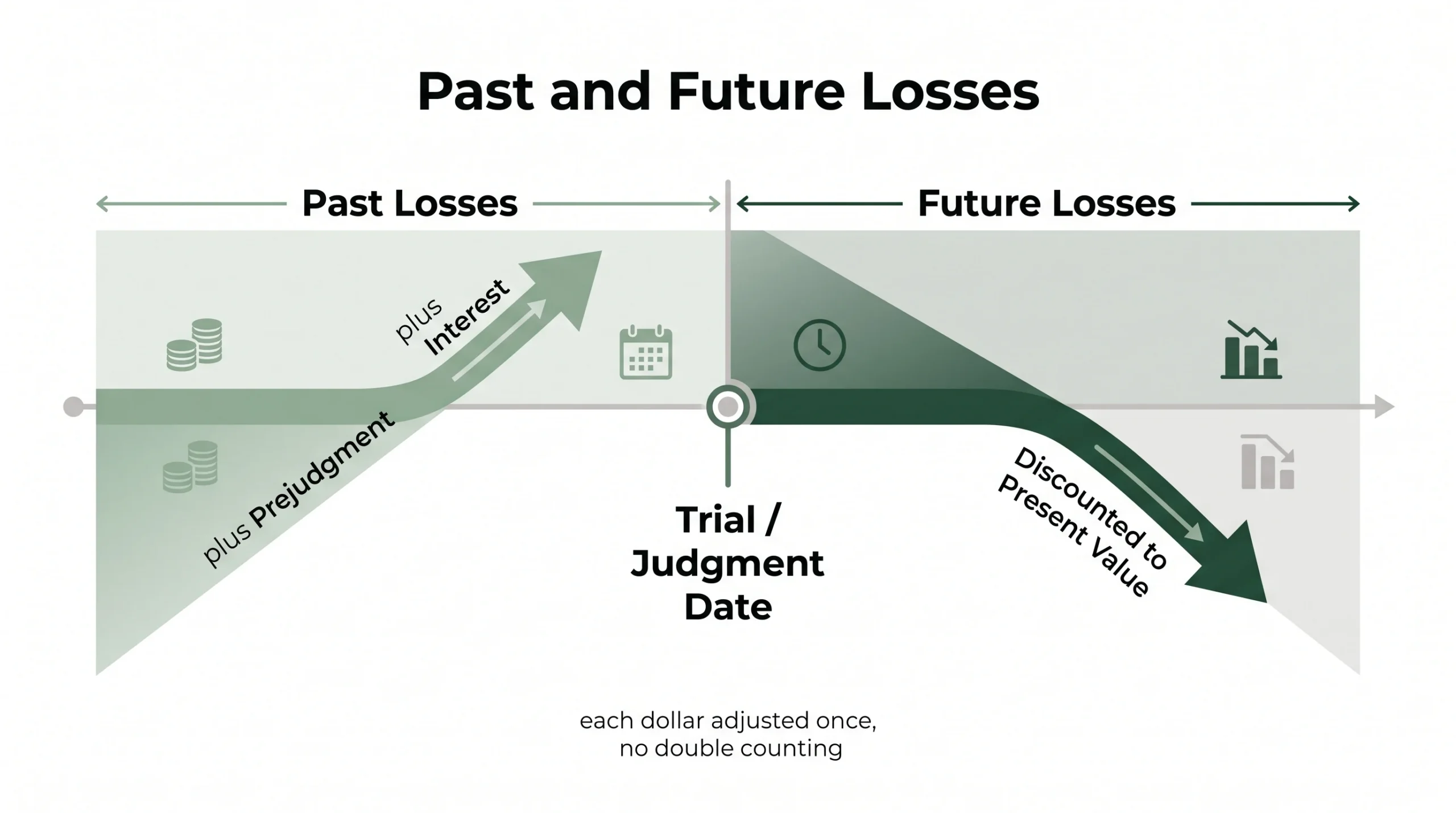
A damages model splits the loss at the trial date. The past period runs from the date of the harm to the trial or judgment date, and the future period covers losses expected after that date. Past losses have already happened, so they may carry interest for the time that has passed. Future losses have not happened yet, so they are reduced to present value.
The date of the harm is when the wrongful act first caused the loss. From that date to trial, the plaintiff was already out of pocket; after trial, the loss is still a forecast. Our guide to lost profits damages covers how the loss is measured before these rate steps apply. Drawing the line at the correct date keeps the two adjustments from overlapping.
Why are future damages discounted to present value?
Future damages are discounted to present value because a dollar received years from now is worth less than a dollar today. If the full future loss is paid at trial, that money can be invested and grow, so without discounting the plaintiff would be overpaid. Discounting reduces each future year to what it is worth on the judgment date.
The expert projects the lost cash flow year by year, then divides each year by a discount factor that grows with time, so later years are reduced more. Adding the reduced years together gives the present value of the future stream, the same logic used in a discounted cash flow analysis. The size of the reduction depends on the discount rate, the next choice to defend.
How do you choose a discount rate for lost profits?
The discount rate is chosen to match the risk of the lost cash flow, and it sits on a spectrum. At the low end is a risk-free rate, such as a Treasury yield, for nearly certain income. At the high end is a risk-adjusted rate for an uncertain stream. Courts review this choice closely, because a lower rate raises the award and a higher rate lowers it. Some jurisdictions specify or cap the rate.
Two experts can look at the same loss and pick different rates in good faith. Plaintiffs often argue for a lower rate, while the defense argues for a higher rate tied to business risk. The Federal Reserve H.15 selected interest rates release is a common source for a low-end Treasury anchor. The table below shows the spectrum.
| Rate choice | Reflects | Effect on award |
| Risk-free Treasury rate | Near-certain lost income | Higher award |
| Company cost of capital | Normal business risk | Moderate award |
| Higher risk-adjusted rate | Uncertain, unproven stream | Lower award |
No single rate fits every case. A stable, contracted stream supports a lower rate, while a new venture with no track record supports a higher one. The expert must tie the rate to the facts and to accepted method, not to a target result. A rate that matches the risk of the cash flow is easier to defend. Standards bodies such as NACVA publish guidance experts follow when they document this choice.
What is prejudgment interest on past damages?
Prejudgment interest is money added to past losses to repay the plaintiff for the time value of money they went without. It covers the gap between the date of the harm and the date of judgment. During that time, the plaintiff could not use or invest the funds they were owed. The rate, and whether it is simple or compound, is set by statute or the court and changes from state to state.
Prejudgment interest is a legal question as much as a financial one. A statute or the court sets the rate, and the rules differ across states. Some states use a fixed statutory rate. Others tie it to a market benchmark, and some allow compound interest while others allow only simple interest. Because these rules vary, the expert models the interest but leaves the legal choice to counsel and the court. This content explains the concept and does not give legal advice.
How do courts prevent double counting of interest?
Courts prevent double counting by keeping the two adjustments separate. Future losses are discounted to present value, and past losses may earn prejudgment interest. A single dollar of loss should never be both discounted and given interest for the same period. If the periods overlap, the award is inflated. The expert draws a clean line at the trial date so each dollar is adjusted once.
| Loss period | Timeframe | Adjustment | Direction |
| Past losses | Harm date to trial | Prejudgment interest may apply | Increases value |
| Future losses | After trial | Discount to present value | Decreases value |
The two adjustments pull in opposite directions, so the split has to be exact. If an expert applies interest past the trial date or discounts a loss that already happened, the same time value gets counted twice. A clear timeline, with the trial date marked, is the simplest defense.
Which firm should value and defend your damages?
Litigation counsel choose among independent valuation firms and large advisory practices. All can build a damages model, but court experience and independence set them apart. Large firms like Alvarez & Marsal, Stout, and Kroll serve the biggest matters. An independent firm gives senior attention on every file, with rate work and testimony that hold up in court.
The Sofer Difference follows four steps. Discovery frames the loss and the two periods. Diligence tests the records behind the cash flow. Analysis sets the discount rate and models the interest. Delivery puts the work into a report and testimony counsel can use. A Heart of a Teacher approach means the expert explains each rate in plain terms, so a judge or jury can follow it. Reports meet USPAP standards.
| Provider type | Focus | Court readiness |
| Sofer Advisors | Independent damages model and testimony | High; 11+ expert witness cases |
| National advisory firm | Large, complex matters | High; enterprise focus |
| Solo practitioner | Lower-cost single opinions | Varies by case |
A litigation damages engagement is priced like a Standard Business Valuation, which runs $7,500 to $25,000 and takes four to eight weeks. Expert Witness Services, such as deposition and trial testimony, are billed hourly and quoted separately. Sofer Advisors handles these matters through its conflict resolution practice. The fee is quoted up front, so it stays independent of the outcome.
The questions below cover what counsel and owners ask most about these two adjustments.
Frequently Asked Questions
Are lost-profits damages reduced to present value?
Future lost profits are reduced to present value, but past lost profits are not. Losses expected after trial are discounted, because money paid later is worth less than money paid now. Losses that already happened before trial are not discounted. Instead, those past losses may carry prejudgment interest. Keeping the two periods apart is what makes the award accurate.
How do you discount future lost profits to present value?
To discount future lost profits, an expert projects the lost cash flow for each future year. Each year is then divided by a discount factor that grows with time. The factor is built from a chosen discount rate. Later years are reduced more than nearer years. Adding the reduced years together gives the present value of the future loss, so the discount rate drives the result.
What discount rate applies to lost-profits damages?
The discount rate for lost profits sits on a spectrum. A low risk-free rate, such as a Treasury yield, fits a near-certain stream of income. A higher risk-adjusted rate fits a risky or unproven stream. Some jurisdictions specify or cap the rate, so the choice is partly a legal question. Courts review it closely because it moves the award.
What is prejudgment interest on past damages?
Prejudgment interest is an amount added to past losses to repay the plaintiff for the time value of money they went without. It covers the span between the date of the harm and the date of judgment. The rate, and whether it is simple or compound, is set by statute or the court, and the rules vary from state to state.
How do you calculate lost-profits damages with present value and interest?
You first measure the lost cash flow, then split it at the trial date. Past losses, from the harm to trial, may receive prejudgment interest at the statutory rate. Future losses, after trial, are discounted to present value, and the two adjusted totals are added together for the award. The key rule is to adjust each dollar once, so no loss is both discounted and given interest for the same period.
Is prejudgment interest simple or compound?
Whether prejudgment interest is simple or compound depends on the governing statute or the court. Some jurisdictions allow only simple interest, which accrues on the original amount. Others allow compound interest, which accrues on interest already earned and produces a larger figure over time. Because the rule varies by state, the expert models the interest while counsel and the court decide the rate and method that apply.
Does present value discounting apply to past losses?
Present value discounting does not apply to past losses. Discounting reduces future amounts to reflect that money paid later is worth less than money paid now. Past losses already happened, so there is nothing to discount forward. Past losses are instead handled with prejudgment interest, which moves the value in the opposite direction. This is why the trial date split matters.
Can the discount rate and prejudgment interest overlap?
The discount rate and prejudgment interest should never overlap. Each covers a different period: prejudgment interest covers the past, from the harm to trial, and the discount rate covers the future, after trial. If both touch the same span of time, the same dollar is counted twice and the award is inflated. A clear timeline with the trial date marked keeps the two adjustments apart.
How much does an economic damages valuation from Sofer Advisors cost?
An economic damages valuation from Sofer Advisors is priced like a Standard Business Valuation, which runs $7,500 to $25,000 and takes four to eight weeks. Expert Witness Services, such as deposition and trial testimony, are billed hourly and quoted separately. The fee depends on the size of the loss and the depth of the records. To get a quote for your matter, contact us with the case details.
Related Case Studies
- How to Calculate Damages from a Breached Business Contract
- Lost Business Value: A Damages Theory When Lost Profits Fall Short
- Lost Business Opportunity Damages: A Theory Beyond Lost Profits
Executive Summary
An economic damages model splits the loss at the trial date. Past losses may carry prejudgment interest set by statute, which can be simple or compound and varies by state. Future losses are discounted to present value using a rate that runs from a low Treasury yield to a higher risk-adjusted rate, a choice courts review closely. The two adjustments must never overlap, so each dollar is counted once. Counsel who fix the periods, the rate, and the method early build a number that holds up in court.
What Should You Do Next?
Start by fixing the date of the harm and the trial date, since that split drives every later step. Next, decide with counsel whether the future losses call for a risk-free or a risk-adjusted rate, and confirm the statutory rate and method for prejudgment interest in your jurisdiction. Then have an independent expert build the model so no dollar is both discounted and given interest for the same period.
David Hern CPA ABV ASA, founder of Sofer Advisors, builds court-ready damages models for litigation counsel. Schedule a consultation to discuss your case.
People Also Read
- Economic Damages Expert Witness: When Litigators Hire One
- Expert Witness Business Valuation Georgia: What Attorneys Need to Know
About the Author
This guide was prepared by David Hern CPA ABV ASA, founder of Sofer Advisors, a business valuation firm headquartered in Atlanta, GA serving clients across the United States. David holds dual accreditations as an Accredited Senior Appraiser (ASA) and is Accredited in Business Valuation (ABV), credentials recognized by the IRS, SEC, and FINRA. He also holds the Certified Exit Planning Advisor (CEPA) designation. With 15+ years of valuation experience, David has served as an expert witness in 11+ cases across multiple jurisdictions and built Sofer Advisors into an Inc. 5000-recognized firm with 180+ five-star Google reviews. Its full W2 employee team maintains subscriptions to all major valuation databases and operates under a next business day response policy.
For professional business valuation services, visit soferadvisors.com/about-us/ or contact Sofer Advisors at soferadvisors.com/contact-us/.
Disclaimer: This content is for informational purposes only and does not constitute professional valuation advice. Business valuation conclusions depend on specific facts and circumstances. Contact Sofer Advisors for guidance regarding your specific situation.









