


Last Updated: June 2026
This article is for business litigation attorneys, commercial dispute plaintiffs, and valuation professionals who need a clear framework for applying the lost business value theory. After reading it, you will understand the legal standard, the methods courts accept, and the key differences that shape which damages model fits your case.
Lost business value damages is a litigation theory that measures the lasting drop in a company’s enterprise value caused by a harmful event. It applies when a business suffers lasting harm that a simple revenue projection cannot fully capture. Courts and expert witnesses use this theory in commercial disputes, breach of contract cases, and tortious interference claims where the going concern is destroyed or badly hurt.
Business owners, attorneys, and financial experts often miss when lost profits fall short. When a wrongful act wipes out customer relationships, destroys a brand, or forces a business to close, a simple income stream projection may miss years of compounded harm. Sofer Advisors, headquartered in Atlanta, GA, regularly serves as a damages expert in these situations. We help legal teams quantify harm that pure profit projections cannot capture.
Key Takeaways
- Two Distinct Theories – Lost profits and lost business value are separate damages theories, and courts in all 50 states recognize both under common law.
- Going Concern Destruction – Lost business value applies when a wrongful act permanently eliminates a large portion of projected cash flow, making enterprise value the better measure.
- Three Accepted Methods – Courts most often accept the income approach (DCF), the market approach (comparable deals), and the asset approach for lost business value damages.
- Daubert Standards Apply – Appraisers testifying on business damages must meet Daubert reliability standards, requiring a method consistent with USPAP and AICPA FVS guidelines.
- Double Recovery Risk – Combining lost profits and lost business value in the same claim creates a double count that courts will strike down, so choosing the right theory early is critical.
Each of these points connects to a different phase of the damages analysis. The sections below examine each in detail, from the legal standard to the valuation mechanics courts expect.
What Is Lost Business Value as a Damages Theory?
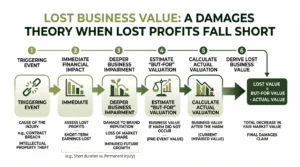
Lost business value is a damages theory that treats the entire enterprise as the injured asset. It asks: what was the company worth before the wrongful act, and what is it worth after? The difference is the damages figure. This framework fits best when a business loses its core value driver – a key customer, a proprietary process, or its ability to operate as a going concern.
Courts have accepted this theory in breach of contract disputes, tortious interference claims, and trade secret cases. The American Society of Appraisers and AICPA Forensic and Valuation Services both publish guidance on applying business valuation methods in litigation contexts. Credentialed appraisers follow USPAP Standards Rule 10, which requires independence and a documented method.
The theory covers partial harm too – not just complete destruction. A manufacturing firm that loses its sole-source supplier contract may keep operating at a fraction of prior capacity. Quantifying the before-and-after enterprise value gap requires a full business valuation using the income, market, or asset approach.
Why Do Lost Profits Sometimes Fall Short?
Lost profits work well when a business keeps operating and can trace discrete revenue gaps to the defendant’s conduct. The formula is direct: project what the business would have earned but for the harm, subtract actual earnings, and arrive at a damages number. It works for bounded, time-limited harms.
The problem arises when harm is not bounded. Three scenarios where lost profits routinely understate damages:
- The business closes before trial, eliminating any ongoing profit stream to measure.
- The harm destroys competitive position for good, so future profits will never recover.
- A key intangible asset – goodwill, a trade secret, or a franchise relationship – is lost forever, reducing the EBITDA multiple at which the business would sell.
Courts in Georgia, Florida, and Texas have recognized that lost profits cannot fully compensate a plaintiff when the going concern is destroyed. The right expert shows the jury exactly how much enterprise value disappeared – not just the cash flow shortfall.
How Do Appraisers Calculate the Before-and-After Value?
The before-and-after method is the core engine of lost business value damages. We find the fair market value of the business just before the harmful event. Then we find the value as of the date the harm was complete. The difference is the damages figure.
Building the “before” value requires standard appraisal rigor. We analyze three to five years of historical financials, normalize earnings for owner pay and one-time items, and select an appropriate income approach or market approach model. The discount rate in the DCF reflects the risk profile before the harmful event – not the elevated risk the defendant’s conduct introduced.
The “after” value is where complexity grows. If the business closed, the after value may be zero or a liquidation figure. If it keeps running at lower capacity, we model post-harm cash flows. We separate the defendant’s conduct from market conditions or industry downturns that may have cut value independently. That causation analysis is often the most contested part of any damages report.
What Methods Do Courts Accept for Business Value Damages?
Courts do not accept every valuation method in a damages context. Under Daubert or Frye, judges require the method to be generally accepted and reliably applied to the case facts. Three approaches consistently pass that test.
The income approach uses projected cash flows discounted to present value. It directly measures the economic benefit stream for going concern businesses. The market approach derives a multiple from comparable deal data. Data sources like Pratt’s Stats, DealStats, and BIZCOMPS provide comparables courts recognize as reliable.
| Method | Best Use Case | Key Data Source | Output Basis |
|---|---|---|---|
| Income (DCF) | Ongoing business with projectable cash flows | Company financials, industry data | Discounted cash flow value |
| Market (Comparables) | Sale or partial sale scenarios | DealStats, Pratt’s Stats, BIZCOMPS | EBITDA or revenue multiple |
| Asset (Cost) | Capital-intensive or distressed businesses | Appraisals of individual assets | Net asset value |
| Excess Earnings | Professional services with personal goodwill | Normalized earnings + assets | Hybrid income and asset |
A well-prepared expert leads with one primary method and uses a second as a cross-check. A dual-method analysis with documented assumptions is more defensible than a single method alone.
When Does Lost Business Value Beat Lost Profits?
Choosing the right damages theory is a strategic decision. Attorneys and experts must make it early. Lost business value is the stronger theory in three specific situations.
Complete business destruction is the clearest case. When a defendant forces a company to shut down, a lost profits model captures only the post-harm period up to trial. A business value model captures the entire going concern, including terminal value – the present value of all future cash flows.
Permanent goodwill loss is the second situation. When a defendant destroys goodwill, the lost profits approach misses the multiple compression that results. Third, when harm predates discovery – as in cases of diverted customers or stolen intellectual property – a lost profits analysis covering only the post-discovery period misses the full damage window.
David Hern CPA ABV ASA brings a Heart of a Teacher approach to each damages project. That is The Sofer Difference: complex before-and-after models translated into plain-language testimony that judges and juries can follow.
How Do Courts Handle Double Recovery Challenges?
The most common defense attack is the double recovery argument. A defendant will argue that a plaintiff cannot claim both lost profits through the damages period and the full going concern value as of the event date. Doing so counts the same future cash flows twice.
The overlap is real. A plaintiff who claims lost profits for years one through five has already captured those cash flows. If that same plaintiff also claims the full going concern value, the DCF model includes those same cash flows again. That creates a double count courts in most jurisdictions will not allow.
Experienced damages experts handle this in one of two ways. The first is to choose one theory only – business value for destroyed companies, lost profits for surviving ones. The second is to offset: present business value damages but credit back actual profits earned after the event. This net-of-actual-profits method is accepted in many jurisdictions.
Frequently Asked Questions
What is the difference between lost profits and lost business value?
Lost profits measure the income a business failed to earn over a set period because of a defendant’s wrongful act. Lost business value measures the lasting drop in the enterprise’s worth. Courts treat them as separate theories. Lost profits apply when harm is temporary. Lost business value applies when the going concern is permanently damaged – such as when a company closes or loses a core asset it cannot rebuild.
How much does a lost business value damages analysis from Sofer Advisors cost?
A litigation damages analysis typically ranges from $7,500 to $25,000 depending on complexity, record volume, and whether a trial appearance is required. Engagements involving both a before-value and after-value analysis fall toward the higher end. Rush work is available at a 25-50% premium. Contact us to review scope and confirm timing. Schedule a free consultation to receive a scoped estimate for your case and timeline.
Can lost business value be claimed for a partially damaged business?
Yes. A business does not need to be fully destroyed to support a lost business value claim. Courts accept partial destruction claims where the enterprise survives at a lasting lower value. A company that loses its primary distribution contract may keep operating at 60% of prior capacity, reducing its EBITDA multiple and sale value. We quantify the before-and-after gap. The difference is the compensable damages – provided causation is established.
What is the Daubert standard and how does it apply to damages experts?
Daubert is a federal evidence standard requiring courts to screen expert testimony. A business damages expert must show that the valuation method is reliably applied, generally accepted, and grounded in enough facts from the case record. Appraisers who deviate from USPAP or AICPA standards without documented justification are open to exclusion motions. Credentials like ABV and ASA help establish baseline reliability. Workpaper quality and logical structure decide admissibility.
How long does a lost business value analysis take to complete?
A standard before-and-after business value damages analysis takes four to eight weeks from when financial records are received. Complex cases involving multiple entities, disputed financials, or comparables research from private deal databases can run eight to twelve weeks. Rush timelines are available at a premium. Starting the work early in the litigation is always wise. Discovery often surfaces more records that require changes to the final model.
What financial records are needed for a lost business value analysis?
We typically need three to five years of tax returns and financial statements for both the pre-harm and post-harm periods. Supporting papers include accounts receivable aging reports, customer concentration schedules, key contracts, and any internal projections prepared before the harmful event. In goodwill destruction cases, brand metrics and customer retention rates are also useful. The more complete the record, the more defensible the final opinion becomes under cross-examination.
Does lost business value apply in divorce cases?
Yes. In marital dissolution proceedings, courts apply a similar before-and-after framework to find the value of a business as marital property. The valuation date, treatment of personal goodwill versus enterprise goodwill, and the standard of value vary by jurisdiction. Georgia separates personal goodwill from enterprise goodwill when dividing business interests in divorce. An appraiser who understands both the litigation context and state law is essential.
What is the role of a discount rate in a lost business value analysis?
The discount rate in a DCF-based business value analysis reflects the risk tied to projected cash flows. In a damages context, we use the pre-harm risk profile to value the business “but for” the defendant’s conduct. Using a post-harm elevated risk rate would understate damages. It embeds the defendant’s wrongdoing into the baseline. Documented support for the chosen rate is an essential part of the damages report.
Related Case Studies
- Powersports Dealership Business Value Success Story
- Shareholder Dispute Valuation Atlanta Resolving Georgia Business Partner Conflicts
- Expert Witness Business Valuation Georgia What Attorneys Need To Know
Executive Summary
Lost business value damages is a well-established litigation theory. It applies when a wrongful act permanently reduces or destroys a company’s enterprise worth – particularly in cases of complete business destruction, permanent goodwill loss, or long-running covert misconduct. We build a before-and-after value model using the income, market, and asset approaches, following USPAP and AICPA standards to meet Daubert requirements. Choosing the right theory early and retaining a credentialed expert are the most critical steps.
What Should You Do Next?
If lost profits may not capture the full harm, map the specific injury to the right damages theory before discovery closes. Gather three to five years of pre-event financial records. Document the causal link between the defendant’s conduct and the drop in enterprise value. Retain a qualified expert early so the method is locked before competing experts can shape the narrative.
David Hern CPA ABV ASA has served as an expert witness in 11+ cases across multiple jurisdictions. Schedule a consultation to discuss your damages analysis needs.
People Also Read
About the Author
This guide was prepared by David Hern CPA ABV ASA, founder of Sofer Advisors – a business valuation firm headquartered in Atlanta, GA serving clients across the United States. David holds dual accreditations as an Accredited Senior Appraiser (ASA) and is Accredited in Business Valuation (ABV), credentials recognized by the IRS, SEC, and FINRA. He also holds the Certified Exit Planning Advisor (CEPA) designation. With 15+ years of valuation experience, David has served as an expert witness in 11+ cases across multiple jurisdictions and built Sofer Advisors into an Inc. 5000-recognized firm with 180+ five-star Google reviews. The firm’s full W2 employee team maintains subscriptions to all major valuation databases and operates under a next business day response policy.
For professional business valuation services, visit soferadvisors.com or schedule a consultation.
This content is for informational purposes only and does not constitute professional valuation advice. Business valuation conclusions depend on specific facts and circumstances. Contact Sofer Advisors for guidance regarding your specific situation.









