


Last Updated: September 2026
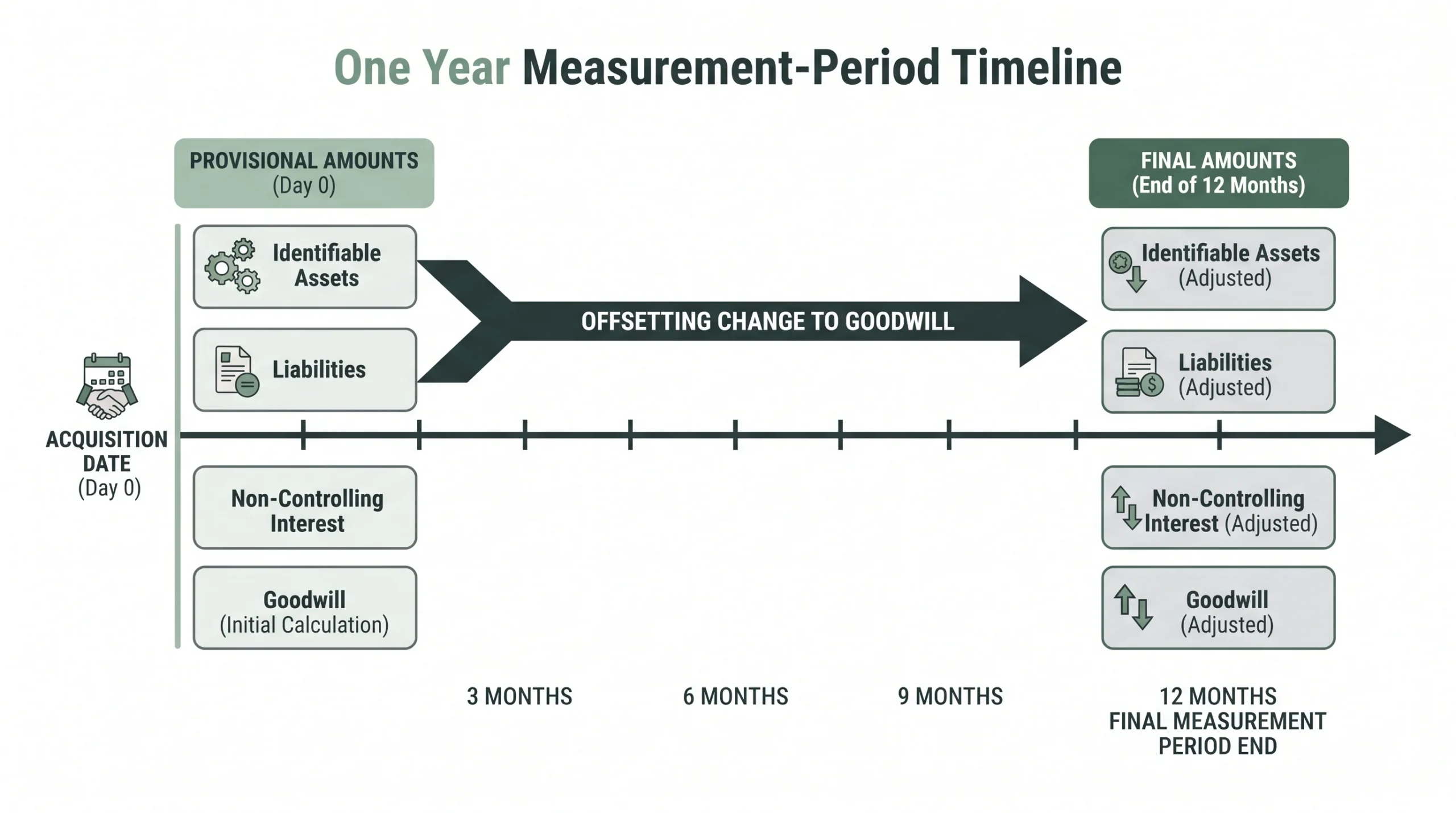
An ASC 805 measurement period adjustment is a change to the provisional amounts recorded in a business combination. It happens when new facts about the acquisition date come to light. The window stays open for up to one year from the closing. During that time, an acquirer can refine early fair value estimates. The change is not a guess about the future. It reflects what was already true on the day the deal closed.
These adjustments matter because a purchase price allocation is rarely final on day one. Appraisals, tax figures, and legal claims often need more time. The one-year window gives buyers room to get the numbers right. It also keeps financial statements honest. When handled well, the final figures show the real economics of the deal.
Sofer Advisors provides independent financial reporting valuations for business owners, CFOs, and their CPAs. It applies a Heart of a Teacher approach, so clients see why each figure changes. Its valuation professionals hold dual ABV and ASA credentials. They support financial statements that must stand up to an audit.
Key Takeaways
- One-year limit: the window to adjust provisional amounts closes one year after the acquisition date.
- Backward-looking facts: a valid change relies on conditions that existed at closing, not on later events.
- Goodwill offset: most adjustments raise or lower goodwill by an equal, offsetting amount.
- Not an error fix: these changes differ from ASC 250 error corrections, which restate prior statements.
- Footnote disclosure: companies must report the nature and amount of each material adjustment in the notes.
Each rule below shapes how a buyer records and reports these changes. The sections that follow explain the window, the criteria, the accounting, and the disclosures in plain terms.
What is the ASC 805 measurement period?
The measurement period is the time after a deal closes when a buyer can still adjust provisional amounts. It cannot run longer than one year from the acquisition date. It starts on the closing date. It ends when the buyer has all the facts it needs about that date, or learns that no more facts are coming. Until then, the buyer can refine early estimates for the assets and liabilities it acquired. Once the window closes, that flexibility ends.
After the one year is up, the buyer must treat any new finding in a different way. It can no longer adjust goodwill for that item. For a full walkthrough of the initial allocation, see our purchase price allocation guide. That work sets the provisional amounts this period later refines.
What qualifies as a measurement period adjustment?
A change qualifies only if it reflects new information about facts that existed on the acquisition date. The buyer must have been seeking that information at closing. A common case is a fair value estimate that was still open. If better data arrives within the year, the buyer updates the figure. The update must tie back to conditions at the deal date. It cannot rest on something that happened later.
Post-close events are different. A customer that leaves after the deal is a new event, not old news. That loss does not change the original allocation. A mistake in applying the rules is different too. That falls under ASC 250, which we cover further down.
How are these adjustments recorded?
The buyer records these changes retrospectively, as if the accounting were complete on the acquisition date. In plain terms, the buyer fixes the values as though it knew the facts all along. Most changes flow to goodwill. If an acquired asset is worth more than first booked, goodwill drops by the same amount. If the asset is worth less, goodwill rises. The total consideration stays the same.
The buyer also updates depreciation and amortization tied to the new values. It books that catch-up in the current period. A clear audit trail supports each entry. The SEC staff view confirms that a combination of two or more businesses should follow ASC 805, which keeps the treatment consistent across filers.
What are common examples of these adjustments?
Common examples share one trait: they refine data that was present but not yet final at closing. Most involve fair value work that takes time to complete. The frequent ones include:
- Finalizing the fair value of intangibles, such as customer lists or trade names
- Settling a pre-acquisition lawsuit for an amount that differs from the first estimate
- Adjusting deferred tax assets and liabilities as the tax picture becomes clear
- Completing appraisals of property, plant, and equipment
- Refining contingent consideration based on conditions that existed at closing
Each item ties back to the acquisition date. The buyer is not reacting to new market moves. It is finishing work that was already underway. Inventory is another area where early figures often shift, a point the AICPA raises in its ASC 805 guidance. All of these updates must wrap up inside the one-year window. After that, the same facts get very different treatment.
How does this differ from an error correction?
A measurement period adjustment fixes provisional amounts using new facts about the deal date. An error correction under ASC 250 fixes a mistake. Errors come from bad math, an oversight, or a misuse of the rules. The two follow different paths. One adjusts goodwill in the current period. The other restates prior financial statements. Telling them apart early saves a lot of rework.
| Factor | Measurement Period Adjustment (ASC 805) | Error Correction (ASC 250) |
| Basis | New facts about conditions at the deal date | A mistake, oversight, or misuse of the rules |
| Timing | Within one year of the acquisition date | Whenever the mistake is found |
| Accounting | Adjust goodwill and related accounts now | Restate prior financial statements |
| Example | Finalizing an open fair value estimate | Using the wrong formula for a discount rate |
The line between the two is not always obvious. A discount rate shows why. If the rate was updated with better data inside the window, it is an adjustment. If the rate was wrong because of a flawed formula, it is an error. The cause drives the treatment. Getting this right keeps a clean audit and avoids a restatement that can worry lenders and investors.
What are the disclosure requirements?
ASC 805 requires clear footnote disclosures for any material adjustment booked in the current period. The buyer must show the amount for each line item that changed. It must explain why the change happened. This keeps investors and auditors informed. The notes should tie each revision back to the acquisition date. They should also show the effect on goodwill and other assets.
Weak disclosure is a common audit problem. Missing detail can slow a close and raise hard questions. Strong notes do the opposite. They give a clean record of what changed and why. That record protects the integrity of the financial statements and the trust of every reader.
How do you choose a valuation specialist?
An independent valuation specialist sets the fair values that drive these adjustments. The right partner is objective and stands behind the work in an audit. Large firms like Alvarez & Marsal, Stout, and Kroll serve the biggest deals. Middle-market companies often want senior attention and faster answers. The choice shapes how well the numbers hold up under review.
Sofer Advisors keeps the valuation independent from any deal broker, so owners get a neutral number. Its process, The Sofer Difference, runs in four phases: Discovery, Diligence, Analysis, and Delivery. That structure supports financial reporting valuation work that auditors can trace end to end. For ASC 805 engagements, that clarity is the difference between a smooth close and a drawn-out review.
These rules reward careful, well-documented work. The questions below cover what owners and finance teams ask most.
Frequently Asked Questions
Can you give an example of a prior period adjustment?
A prior period adjustment usually corrects an error in an earlier year’s financial statements. Examples include a missed asset purchase or a miscalculation of depreciation. The company fixes it by restating the opening balance of retained earnings. This differs from a measurement period adjustment, which refines provisional deal values using facts that existed at the acquisition date rather than correcting a past mistake.
Are adjusting entries recorded at the end of the accounting period?
Yes. Adjusting entries are typically recorded at the end of each accounting period. They align the books with the matching principle. Common examples include accrued expenses, unearned revenue, and prepaid items that daily bookkeeping has not yet captured. These routine entries are separate from ASC 805 measurement period adjustments, which deal only with finalizing the accounting for a business combination.
When should prior period errors be corrected?
Prior period errors should be corrected as soon as they are found, no matter when they occurred. If the error is material, the company restates the comparative financial statements to show the correct figures. This falls under ASC 250, not ASC 805. The goal is to give readers accurate historical data and a clear view of the corrected balances.
How are measurement period adjustments recorded under ASC 805?
They are recorded retrospectively, as if the accounting had been complete on the acquisition date. The buyer updates the provisional amounts and offsets the change against goodwill. If an acquired asset rises in value, goodwill falls by the same amount. The buyer also revises related depreciation or amortization in the current period. All of this must happen within one year of closing.
What is the maximum length of a measurement period under ASC 805?
The maximum length is one year from the acquisition date. The window can close sooner if the buyer gathers all the facts it needs, or learns that no more facts are coming. Once the year passes, the buyer can no longer adjust provisional amounts for new information about the deal date. Later findings must be treated as an error or a change in estimate.
Does a change in an asset’s fair value after the acquisition date qualify for an adjustment?
No. A change in fair value that happens after the acquisition date does not qualify. It reflects a new event, not old facts about the deal date. For example, market swings or a lost customer after closing are new events. Those do not change the original purchase price allocation. Only refinements tied to conditions at closing count as measurement period adjustments.
What happens if new information is discovered after the measurement period ends?
Once the one-year window closes, new information about the deal date can no longer adjust goodwill. The company must treat it as an error correction or a change in accounting estimate. Under ASC 250, a material error may require restating prior financial statements. This is why finishing the valuation work inside the window matters so much for a clean audit.
What role does a valuation specialist play in the measurement period?
A valuation specialist sets the fair values of the assets and liabilities acquired in the deal. This work drives the provisional amounts and any later refinements. The specialist also helps separate new facts about the deal date from later market events. That distinction is central to valid ASC 805 reporting. Independent analysis lowers the risk of a future restatement or an audit dispute.
How much does a purchase price allocation (ASC 805) from Sofer Advisors cost?
A purchase price allocation engagement generally ranges from $15,000 to $50,000. The final fee depends on deal size, the number of intangible assets, and the reporting timeline. Sofer Advisors scopes each ASC 805 project to meet audit and financial reporting needs. For a quote tied to your transaction, schedule a consultation with your deal details.
Related Case Studies
- What is PPA in Accounting? Purchase Price Allocation Explained
- Calculating Goodwill in an Acquisition: Formula Explained
- Intangible Asset Valuation: Methods for Measuring Hidden Value
Executive Summary
ASC 805 gives a buyer up to one year after closing to finalize the provisional amounts in a business combination. Valid measurement period adjustments reflect new facts about conditions that existed on the acquisition date, not later events. Most changes offset goodwill dollar for dollar, with a current-period catch-up for depreciation and amortization. After the one-year window, new findings become error corrections or changes in estimate under ASC 250. Companies must disclose each material adjustment in the footnotes. Sofer Advisors delivers independent ASC 805 valuations, typically priced from $15,000 to $50,000, that support a clean audit and a defensible purchase price allocation.
What Should You Do Next?
First, pull together the documents that show the state of the business on the acquisition date. Second, confirm that any new finding ties back to facts that existed at closing, not to later events. Third, watch the one-year deadline closely, since a missed window forces a harder restatement path.
David Hern CPA ABV ASA, founder of Sofer Advisors, helps finance teams finalize purchase price allocations under ASC 805. Schedule a consultation to discuss your specific situation.
People Also Read
- Purchase Price Allocation ASC 805 and IFRS 3: Complete Guide for Business Leaders
- Goodwill Impairment Testing ASC 350: Complete Guide for 2025-2026
About the Author
This guide was prepared by David Hern CPA ABV ASA, founder of Sofer Advisors, a business valuation firm headquartered in Atlanta, GA serving clients across the United States. David holds dual accreditations as an Accredited Senior Appraiser (ASA) and is Accredited in Business Valuation (ABV), credentials recognized by the IRS, SEC, and FINRA. He also holds the Certified Exit Planning Advisor (CEPA) designation. With 15+ years of valuation experience, David has served as an expert witness in 11+ cases across multiple jurisdictions and built Sofer Advisors into an Inc. 5000-recognized firm with 180+ five-star Google reviews. Its full W2 employee team maintains subscriptions to all major valuation databases and operates under a next business day response policy.
For professional business valuation services, visit soferadvisors.com/about-us/ or contact Sofer Advisors at soferadvisors.com/contact-us/.
Disclaimer: This content is for informational purposes only and does not constitute professional valuation advice. Business valuation conclusions depend on specific facts and circumstances. Contact Sofer Advisors for guidance regarding your specific situation.









