


Last Updated: September 2026
A database valuation is the work of measuring what an acquired customer database is worth as a separate intangible asset. Under ASC 805, a buyer must record the assets it gains in a deal at fair value. A customer database, sometimes called a subscriber list, often holds real value that sits apart from goodwill. In many software, media, and services deals, the customer database is one of the largest intangible assets in the purchase price allocation, at times 20% or more of the price paid.
This asset matters because the fair value assigned to it drives future amortization and reported earnings. Get the number wrong, and the buyer misstates its financials for years. The right figure is not a guess. It follows a set process that isolates the cash flow the existing customers produce, then adjusts for how fast those customers leave.
Sofer Advisors provides independent purchase price allocation work for buyers and their auditors across the United States. The firm applies established accounting standards to complex deals, and its senior staff has testified as an expert witness in 11+ cases across Georgia, Florida, California, and New Mexico. It works with a Heart of a Teacher approach, so clients understand each figure in the report.
Key Takeaways
- Separately identifiable: a customer database is recorded apart from goodwill when it can be sold or licensed, or when it arises from a contract.
- Income approach leads: the multi-period excess earnings method is the primary way to value customer-related intangibles.
- Attrition sets the life: the rate at which customers leave shapes both the cash flow and the useful life used for amortization.
- Contributory asset charges: the model subtracts fair returns on the other assets that help the database earn, so only its own cash flow remains.
- Fair value is not sale price: what the data would fetch from a broker can differ from its fair value in a purchase price allocation.
These points shape how a buyer records the deal and how much it amortizes each year. The sections below show how each one works in practice.
What is a database valuation under ASC 805?
A database valuation under ASC 805 measures the fair value of an acquired customer database at the deal date. The purchase price allocation, or PPA, splits the price a buyer pays across the assets it gets. Our purchase price allocation guide covers the full process, and this article is the database-specific deep dive. Cash, equipment, and inventory are easy to price. Intangible assets like a customer database take more work. The buyer must show the database meets the test for a separate asset, then value it with an accepted method. This step feeds the buyer’s balance sheet and its future expense.
Is an acquired customer database a separately identifiable intangible?
Yes, an acquired customer database is a separately identifiable intangible when it meets one of two tests. The FASB business combinations guidance recognizes an intangible apart from goodwill when it is either separable or based on a contract or legal right. Separable means the buyer could sell, license, or exchange the database, even alongside a related contract. A subscriber list a company can sell or lease meets this test. Contractual-legal means the asset comes from a contract, such as signed subscription agreements. If the seller is barred by law or contract from selling a customer list, that list may fail the test and fall into goodwill instead. This line matters, because it decides whether the database gets its own value and its own amortization.
Which method values an acquired customer database?
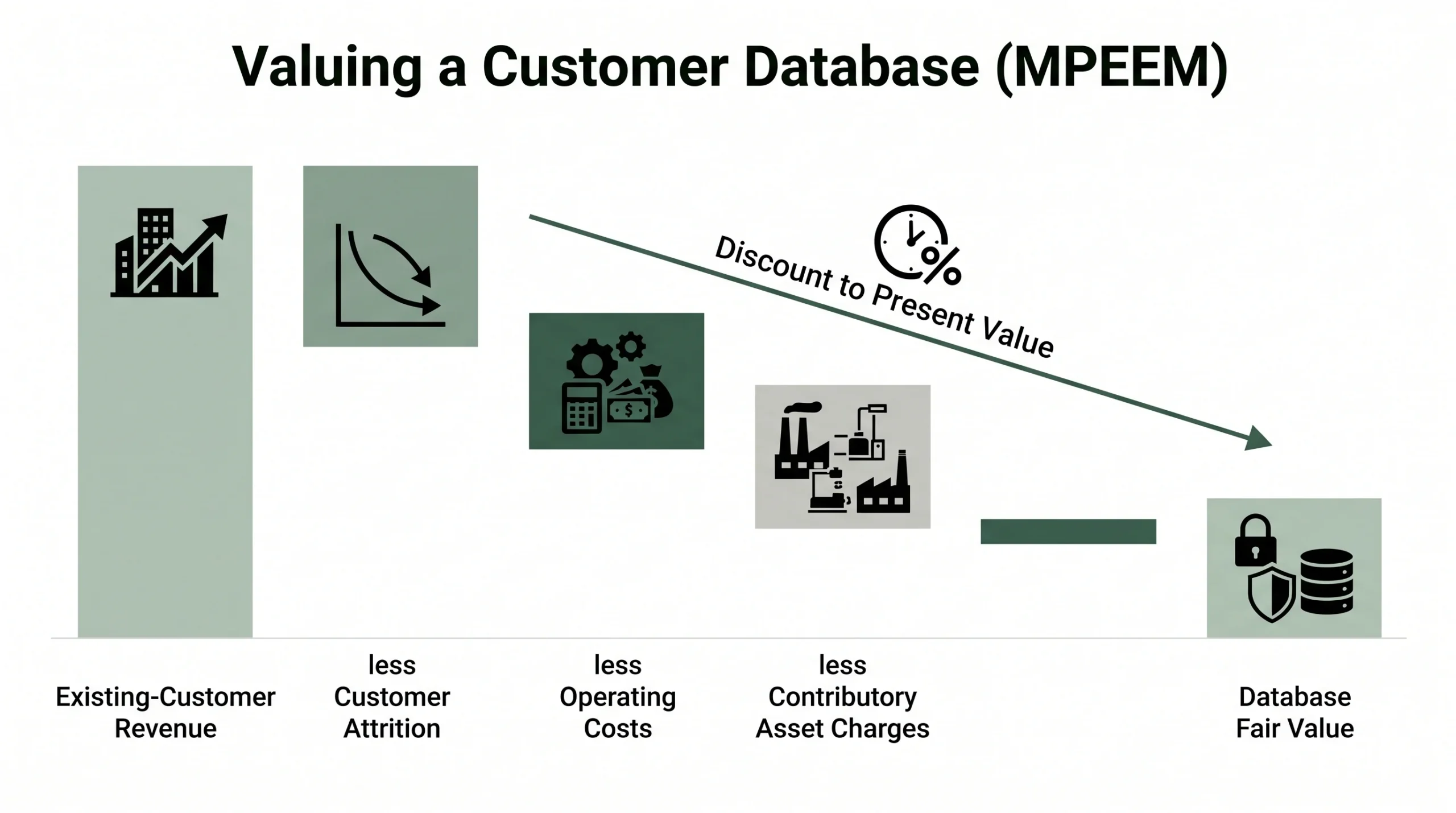
The income approach values an acquired customer database, most often through the multi-period excess earnings method (MPEEM). It works in clear steps. First, project the revenue that comes only from the customers who exist at the deal date. Second, apply an attrition rate so the base shrinks each year as customers leave. Third, subtract the operating costs tied to that revenue. Fourth, subtract contributory asset charges, which are fair returns on the other assets that help produce the cash flow, such as working capital, fixed assets, and the trade name. What remains is the excess earnings the database alone creates. Fifth, discount those earnings to present value. Sofer Advisors builds this model for each engagement, so the value ties back to the specific customer base.
| Step | What it does | Effect on value |
| Project customer revenue | Counts revenue from existing customers only | Sets the starting cash flow |
| Apply attrition rate | Shrinks the base each year | Lowers later-year cash flow |
| Subtract direct costs | Removes the cost to serve | Yields operating income |
| Subtract contributory asset charges | Removes returns on other assets | Isolates database earnings |
| Discount to present value | Applies a risk-based rate | Produces fair value |
In some facts, appraisers use the distributor method, a simpler form of MPEEM, or the cost approach, which measures what it would cost to rebuild the list. The with-and-without method is another option when the database’s effect can be modeled by comparing the business with it and without it. Guidance from the AICPA Forensic and Valuation Services team supports this income-based work. Our intangible asset valuation guide compares these methods so buyers can see which fits their deal.
How does customer attrition set the useful life?
Customer attrition, the rate at which customers leave, sets both the cash flow decay and the useful life of the database. Appraisers study the seller’s history to find how many customers renew each year. A subscription business may lose 10% of its base a year, while a business with weak loyalty may lose far more. That rate does two jobs. It reduces the cash flow in the model each year, and it points to how long the database will keep earning. A base that decays fast has a short useful life, and a loyal base lasts longer. The buyer amortizes the database over that life, which flows into reported earnings and into tax and financial reporting figures. A steady, well-documented rate keeps the value defensible if an auditor or the IRS reviews it.
How is a database different from goodwill and workforce?
A customer database differs from goodwill because it can be identified and measured on its own. Goodwill is the amount left after every identifiable asset is valued and removed from the price. It cannot be sold on its own, but a customer database often can. An assembled workforce, the trained team a buyer gains, is also not recorded as a separate asset under ASC 805, so its value stays inside goodwill. The database sits apart from both: it is specific, measurable, and tied to real customer cash flow. Our goodwill versus intangible assets guide draws the full line. Keeping the database out of goodwill gives the buyer a clearer balance sheet and a real basis for amortization.
Which firm should value your acquired database?
Buyers choose among independent valuation firms, Big Four practices, and large advisory groups. All can produce a number, but their focus and cost differ. Large firms like Alvarez & Marsal, Stout, and Kroll serve the biggest deals and price to match. An independent firm gives a defensible opinion built to accepted standards, often with more senior attention on each file. The table below compares the options.
| Provider type | Service focus | Typical fit |
| Sofer Advisors | Independent PPA and intangible valuation | Middle-market deals |
| Big Four practice | Large-cap, audit-linked valuation | Enterprise deals |
| Large advisory group | Broad transaction support | Complex, high-volume deals |
An independent report meets the standards auditors expect and holds up under review. Appraisers also follow the Uniform Standards of Professional Appraisal Practice when they build the value. That process, which the firm calls The Sofer Difference, moves through four phases: Discovery, Diligence, Analysis, and Delivery. Sofer Advisors keeps the valuation work independent, so the value reflects the real economics of the customer base, not a target number set to fit a deal.
An acquired database rewards careful method and clear support. The questions below cover what buyers ask most.
Frequently Asked Questions
How do you value a database?
You value a database with the income approach, which turns the cash flow from existing customers into a present-day figure. The most common method is the multi-period excess earnings method. It projects customer revenue, applies an attrition rate, then subtracts costs and contributory asset charges. The remaining earnings are discounted to present value. The output is the fair value of the database as a separate intangible asset in the purchase price allocation.
What is the value of customer data?
The value of customer data is the present value of the future cash flow those customers are likely to produce. It is not the price a data broker might pay, and it is not the cost to collect the records. For financial reporting, fair value rests on the earnings the current customers generate, adjusted for how many are expected to leave each year. That is why two databases of the same size can hold very different value.
Is a customer list an intangible asset?
Yes, a customer list is an intangible asset when it can be sold or licensed, or when it arises from a contract. Under ASC 805, a buyer records it apart from goodwill once it meets one of these tests. A list the seller is barred from selling may not qualify and can fall into goodwill instead. Most subscriber lists that change hands in a deal do meet the test and receive their own value.
How is a customer list amortized?
A customer list is amortized over its useful life, which the attrition rate helps set. If customers leave slowly, the life is longer, and if they leave fast, it is shorter. Many buyers amortize in a pattern that matches the cash flow decay, so more expense falls in the early years. The amortization then flows through the income statement each period and reduces reported earnings until the asset is fully expensed.
Which method is used to value a customer database?
The multi-period excess earnings method is the primary method for a customer database. It isolates the cash flow tied only to existing customers and removes returns on the assets that support them. The distributor method, a simpler form, fits some facts. The cost approach and the with-and-without method serve as alternatives when the earnings cannot be traced cleanly to the database itself. The facts of each deal decide which method fits best.
What useful life is assigned to a customer database?
The useful life reflects how long the acquired customers are expected to keep buying. Appraisers study renewal and churn history to estimate it. A loyal subscriber base may support a life of eight to twelve years, while a base with high turnover may support only three to five. The attrition rate drives this estimate, so it must be built on real data rather than a round assumption pulled from a rule of thumb.
How is customer attrition estimated?
Customer attrition is estimated from the seller’s own records. Appraisers track how many customers renew or repeat each year over several years, then set a rate that reflects that pattern. Some analyses use a constant rate, while others let the rate change as newer customers behave differently from long-held ones. A well-documented rate is key, since it drives both the cash flow in the model and the useful life used for amortization.
How does a customer database differ from goodwill?
A customer database can be identified and measured on its own, while goodwill cannot. Goodwill is the amount left after every identifiable asset is valued and removed from the price. A database ties to specific customer cash flow and can often be sold or licensed. That is why it is recorded separately, given its own fair value, and amortized, rather than buried inside the goodwill line on the balance sheet.
How much does a purchase price allocation from Sofer Advisors cost?
A purchase price allocation that includes a customer database valuation typically runs $15,000 to $50,000. Cost depends on the number of intangible assets, the size of the customer base, and the depth of the analysis. Larger deals with several intangibles reach the higher end of that range. For a quote tied to your deal, request an estimate with your deal terms and customer data.
Related Case Studies
- Customer Concentration: Why It Cuts Sale Price 10 to 30 Percent
- ASC 820 Fair Value Measurement: Hierarchy Levels Explained
- Goodwill Amortization vs Impairment: Key Differences
Executive Summary
An acquired customer database is often one of the largest intangible assets in a business combination. Under ASC 805, a buyer records it apart from goodwill when it can be sold or licensed, or when it comes from a contract. The income approach values it, most often through the multi-period excess earnings method: project the cash flow from existing customers, apply an attrition rate, subtract costs and contributory asset charges, then discount to present value. That attrition rate also sets the useful life, which can run three to twelve years. A model built to accepted standards holds up with auditors and the IRS.
What Should You Do Next?
Start by pulling the seller’s customer records for the last three to five years, including renewal and churn history. Next, list the other assets that help serve those customers, since the model must charge for them. Then have an independent appraiser build the excess earnings model before you finalize the purchase price allocation, so the value is ready when the auditors ask.
David Hern CPA ABV ASA, founder of Sofer Advisors, leads independent purchase price allocation and intangible valuation work for buyers and their auditors. Schedule a consultation to discuss your deal.
People Also Read
- Goodwill vs Intangible Assets: Key Differences Explained
- Difference Between Book Value and Fair Value Explained
About the Author
This guide was prepared by David Hern, CPA ABV ASA, founder of Sofer Advisors, a business valuation firm headquartered in Atlanta, GA, serving clients across the United States. David holds dual accreditations as an Accredited Senior Appraiser (ASA) and is Accredited in Business Valuation (ABV), credentials recognized by the IRS, SEC, and FINRA. He also holds the Certified Exit Planning Advisor (CEPA) designation. With 15+ years of valuation experience, David has served as an expert witness in 11+ cases across multiple jurisdictions and built Sofer Advisors into an Inc. 5000-recognized firm with 180+ five-star Google reviews. Its full W2 employee team maintains subscriptions to all major valuation databases and operates under a next-business-day response policy.
For professional business valuation services, visit soferadvisors.com/about-us/ or contact Sofer Advisors at soferadvisors.com/contact-us/.
Disclaimer: This content is for informational purposes only and does not constitute professional valuation advice. Business valuation conclusions depend on specific facts and circumstances. Contact Sofer Advisors for guidance regarding your specific situation.









