


Last Updated: July 2026
A childcare daycare valuation finds the economic worth of an early childhood education business. It weighs profit, assets, market position, and intangible factors. By reading enrollment density, local licensing limits, and past cash flow, analysts set a defensible figure for tax, transition planning, or a partner dispute. Owners use that number to see where they stand as demand and regulation shift.
Sofer Advisors provides this analysis with a focus on clarity and technical accuracy. With seven years of history and 180+ five-star Google reviews, it applies professional standards to every project. Its method relies on independent data, so owners understand the real finances of their daycare when planning ahead.
Running an early childhood business means facing unique pressures, from wage inflation to compliance costs. Knowing your worth lets you weigh a sale, an equity raise, or a tax filing on solid ground. The process gives owners a logical base for the next step, not a guess without evidence.
Key Takeaways
- Earnings, not revenue: value rests on SDE or EBITDA, with multiples that usually run 3.5x to 5.5x.
- Separate the real estate: when the owner holds the property, the business and the building are appraised on their own.
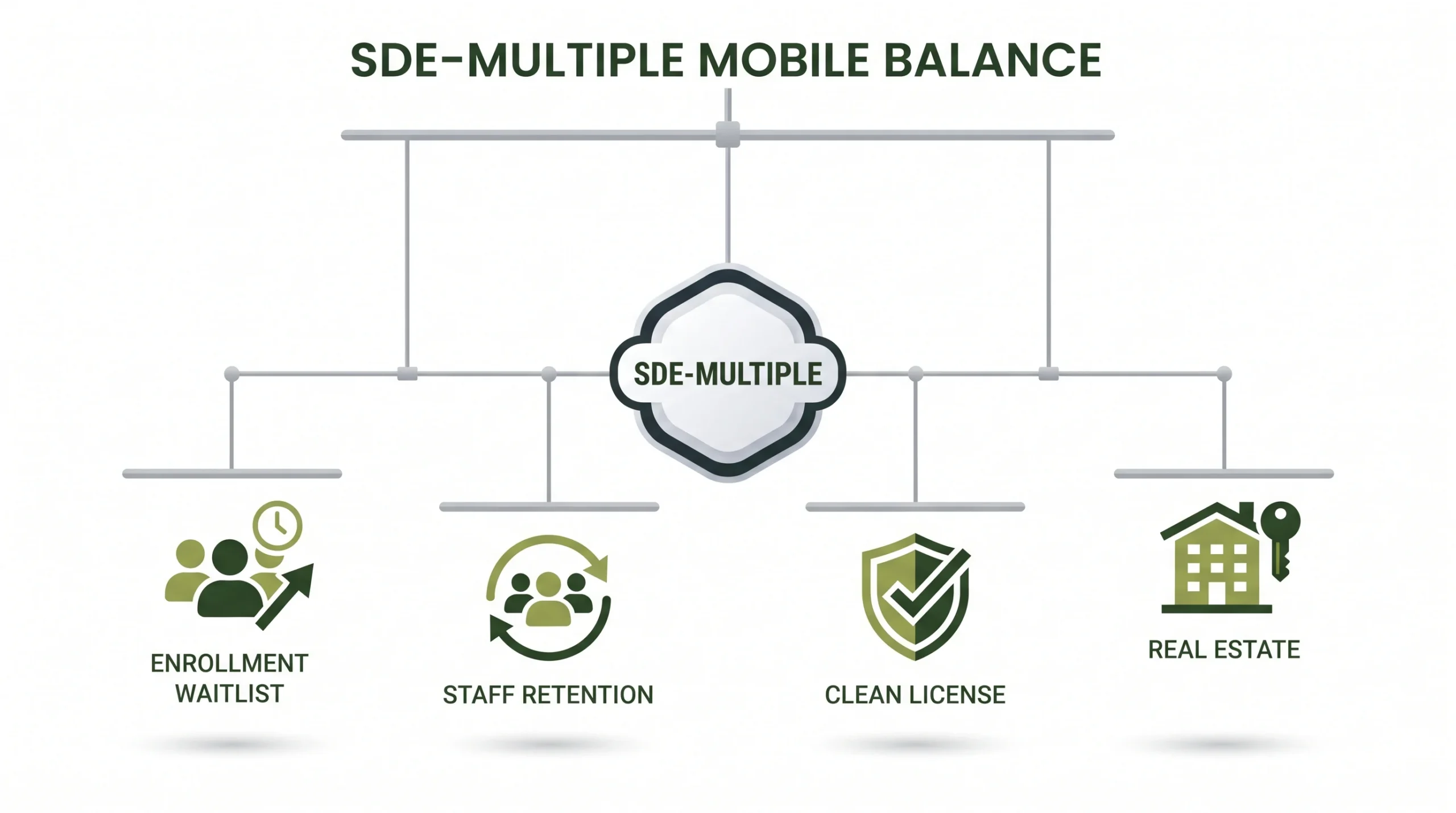
- Name the intangibles: a long waitlist, high staff retention, and a clean license history all raise value.
- Use proven methods: the market and income approaches are the primary ways experts set center value.
- Get a certified report: a formal, independent opinion holds up for a sale, a buyout, or tax planning.
A clear valuation comes from seeing how cash flow, license stability, and market capacity combine into one figure. The sections below take each of these in turn.
What key metrics drive a daycare’s value?
The main financial drivers are Seller’s Discretionary Earnings (SDE) or EBITDA. Appraisers use these to gauge the cash flow a future owner would enjoy. Beyond profit, operational metrics matter too: licensed capacity, enrollment rate, and staff-to-child ratios. Those ratios drive labor cost and compliance, and both hit the bottom line.
A high utilization rate means the center runs near its licensed capacity. That signals strong local demand. Appraisers compare it to total capacity to see how well the center fills its spots. If tuition sits low for the area but enrollment is full, there may be room to raise rates. Data from Business Valuation Resources (BVR) shows that steady revenue is a primary marker of stability during a valuation.
Staff retention is another focus. High turnover forces spending on hiring and training, which cuts earnings. Steady staff-to-child ratios keep the quality of care parents expect. When those ratios hold, they reflect a well-run center with less future risk. These details help owners prepare for a change in ownership.
Which valuation methods apply to childcare businesses?
The most reliable methods are the income approach and the market approach. The income approach looks at future cash flow, discounting expected earnings to present value. The market approach sets value by comparing the center to similar ones that recently sold. Our guide to small business valuation walks through how these fit together.
Under the market approach, experts usually apply a multiple of SDE. SDE is the total financial benefit the business gives an owner. Analysts reference data from Business Valuation Resources (BVR / DealStats) to find accurate multiples for centers with similar profiles. The asset approach, which values the center by its tangible items, is rarely used for a profitable daycare. It is mostly reserved for liquidations or cases where physical assets outweigh earnings.
How do you calculate a daycare’s SDE or EBITDA?
To find SDE, you start with net income and add back items that benefit the owner. These add-backs include the owner’s salary, benefits, and costs that fall outside normal operations. Removing these discretionary expenses gives a normalized earnings figure that better shows the center’s true cash flow.
Typical add-backs for a daycare include one-time repairs to the facility or playground. If the center paid for a new roof or major equipment that will last years, you can exclude that cost from normalized earnings. Other adjustments cover personal vehicle use, family members on payroll who do not do core work, and one-time professional fees. This normalized picture lets buyers compare the daycare to other businesses on objective terms.
What is a good EBITDA multiple for a daycare center?
A typical multiple for a daycare center runs 3.5x to 5.5x of Seller’s Discretionary Earnings. Larger multi-site operations often shift to EBITDA multiples as they move toward institutional buyers. Sofer Advisors reviews specific operational drivers to see where a center sits within, or above, that range.
Centers with a long, stable history earn higher multiples because they carry lower risk. A proprietary curriculum keeps quality consistent across sites, which adds value for buyers. Owning the real estate in a high-demand area also pushes value toward the top end. These assets give predictable cash flow and hold up through economic cycles.
Request a valuation estimate to see where your center lands with a specialist reviewing your numbers.
Does owning the real estate affect daycare value?
Yes. Owning the real estate separates the operation from the property. When the facility sits on owned land, the business enterprise value and the property value are two distinct assets. Each needs its own appraisal. Experts run a formal real estate appraisal for the land and buildings. At the same time, they compute the enterprise value of the ongoing childcare operation.
For the valuation, the analyst adjusts the financials to include a hypothetical rent expense at fair market rent. That shows the real cost of operating if the owner did not own the building. A buyer may take both the business and the property, or buy only the business and sign a long-term lease. That choice shapes the deal structure and the financing. A clear split between the two assets stays necessary for accurate reporting.
What intangible assets increase daycare value?
The key intangibles are brand reputation, the enrollment waitlist, and staff stability. A strong local reputation supports steady revenue growth. A long waitlist buffers against temporary dips in attendance. A high teacher retention rate signals that operations will hold after a transfer. Buyers read all of these as lower risk. The most common value-lifting intangibles are:
- A long enrollment waitlist and strong local brand
- High teacher and staff retention
- A clean state licensing and inspection history
- A proprietary curriculum and set operating processes
A favorable licensing history strengthens perceived value further. Future owners check reviews and licensing records for compliance with quality standards. Established processes and a proprietary curriculum limit the need for quick changes. Together these often justify higher multiples. Many owners use business valuation services to quantify these before entering sale talks.
Which valuation provider is best for a daycare?
The right provider depends on how you will use the report. A broker’s opinion of value suits marketing a center or setting an asking price. It usually lacks the formal rigor the IRS or a court requires. Large advisory practices like Alvarez & Marsal, Stout, and Kroll serve big multi-site and private equity deals. For tax or legal use, a certified valuation is what holds up. The table below compares the options.
| Provider type | Specialization | Best for |
| Sofer Advisors | Certified valuations for tax, litigation, and deals; USPAP and ASA standards | SBA loans, IRS compliance, divorce, or complex M&A |
| Childcare business broker | Broker’s opinion of value for listing purposes | Sellers wanting a quick estimate to list a center |
| M&A advisory firm | Market-based assessment to prep a transaction | Multi-site owners or PE groups planning a sale |
Choosing well means matching the report to its use. A broker’s opinion is fine for setting an asking price, but it rarely meets IRS or court standards. When tax reporting or legal review is in play, a certified valuation withstands challenge under the Uniform Standards of Professional Appraisal Practice (USPAP). Qualified advisors hold designations like the Accredited Senior Appraiser (ASA) or Accredited in Business Valuation (ABV), and they back every conclusion with independent evidence. Knowing these tiers helps owners spend on the report that fits their goal and avoid rework later.
Daycare valuation rewards clean records and the right method. The questions below cover what owners ask most.
Frequently Asked Questions
How do you determine the value of a daycare?
Appraisers usually blend the income, market, and asset approaches. They read historical cash flow through SDE or EBITDA and benchmark it against industry multiples. The review weighs operational assets like location, licensing, and student retention alongside the financials. Sofer Advisors runs a balanced analysis that reflects both current earnings and long-term growth potential.
Is a business worth three times profit?
Many small businesses are loosely described as worth about three times profit, but childcare centers often break from that. Multiples here usually run 3.5x to 5.5x earnings, based on size, scalability, and demand. A simple profit multiple misses owner compensation and operating scale. Sofer Advisors uses market-derived transaction data to find the multiplier that fits your center.
How much is the daycare industry worth?
The industry’s worth reflects total capacity and the steadiness of tuition revenue across the sector. Industry research shows steady growth driven by rising demand for early childhood education. An individual center’s value ties to its share of that demand and how well it keeps utilization high. Sofer Advisors tracks these trends so each valuation stays current with the wider market.
What documents are needed for a daycare valuation?
You need three to five years of financial statements, including profit and loss reports and balance sheets. Analysts also request tax returns, license documentation, current enrollment rosters, and lease or property records. These let the appraiser verify revenue quality and expenses. Sofer Advisors runs a detailed discovery phase so all documents are gathered before the analysis begins.
How long does it take to value a childcare center?
A standard childcare valuation usually takes four to eight weeks. That window allows a full review of financial records and the synthesis of market data into a formal report. Timelines vary with the quality of the documents and the complexity of the structure. Sofer Advisors keeps the work moving through a structured diligence process for a timely, accurate delivery.
Can a new daycare with no profit history be valued?
Yes. A startup or a center with no profit history can be valued through an asset-based approach or a forecast-based income method. With no earnings history, analysts project future cash flow from capacity and local demand. The result leans more on intangibles like the business model and location. Sofer Advisors uses these projection models to give newer owners a clear read on potential.
How much does the physical condition of the facility matter?
Physical condition matters directly, because deferred maintenance points to future capital spending for a new owner. An appraiser checks whether the building meets current safety and licensing standards for children. Poor condition can lower the multiple due to expected upgrade costs. Sofer Advisors assesses facility utility and safety compliance so the report captures those risks.
Is a franchise daycare worth more than an independent one?
Franchise daycares often earn higher valuations, because they offer a proven brand, a set curriculum, and operational support. Those lower the risk versus an independent center with no such backing. That value is partly offset by ongoing franchise fees and territory limits. Sofer Advisors factors these franchise terms into the enterprise value it reports.
How much does a childcare business valuation from Sofer Advisors cost?
A childcare valuation from Sofer Advisors runs $10,000 to $30,000, based on its published engagement data, with multi-site work reaching the higher end. Cost reflects the effort to analyze financials, assess comparables, and prepare a defensible report. For a quote tied to your center, request a valuation estimate with your financials and enrollment data.
Related Case Studies
- Franchise Valuation Considerations for Business Owners
- Dental Practice Valuation: An Owner’s Guide
- Selling a Business in Georgia: A Complete Exit Planning Guide
Executive Summary
A childcare valuation turns on earnings, not top-line revenue, so analysts start from SDE or EBITDA and apply a multiple that usually runs 3.5x to 5.5x. Owned real estate is appraised separately from the operating business, with a fair market rent added back to show true cost. Intangibles, a long waitlist, steady staff, a clean license history, and a proprietary curriculum, push the multiple higher. For a sale, a partner buyout, or tax reporting, a certified valuation under USPAP holds up where a broker’s opinion will not. To prepare, gather three to five years of financials, tax returns, license records, and enrollment rosters.
What Should You Do Next?
Pull three to five years of financials, your license records, and current enrollment rosters, then decide the report’s purpose, since it sets the standard of value. If you own the building, arrange for a separate real estate appraisal. A certified valuation can then combine the pieces into a defensible number for your sale, buyout, or tax filing.
David Hern CPA ABV ASA, founder of Sofer Advisors, guides childcare owners through high-stakes financial events. Schedule a free consultation to discuss your situation.
People Also Read
About the Author
This guide was prepared by David Hern CPA ABV ASA, founder of Sofer Advisors, a business valuation firm headquartered in Atlanta, GA serving clients across the United States. David holds dual accreditations as an Accredited Senior Appraiser (ASA) and is Accredited in Business Valuation (ABV), credentials recognized by the IRS, SEC, and FINRA. He also holds the Certified Exit Planning Advisor (CEPA) designation. With 15+ years of valuation experience, David has served as an expert witness in 11+ cases across multiple jurisdictions and built Sofer Advisors into an Inc. 5000-recognized firm with 180+ five-star Google reviews. Its full W2 employee team maintains subscriptions to all major valuation databases and operates under a next business day response policy.
For professional business valuation services, visit soferadvisors.com/about-us/ or contact Sofer Advisors at soferadvisors.com/contact-us/.
Disclaimer: This content is for informational purposes only and does not constitute professional valuation advice. Business valuation conclusions depend on specific facts and circumstances. Contact Sofer Advisors for guidance regarding your specific situation.









