


Last Updated: October 2026
An earnout is a derivative. Under ASC 805, it gets remeasured every period, and buyers routinely underestimate that drag. Contingent consideration is the buyer’s promise to pay a seller more if the business hits future targets. The buyer books it at fair value on the acquisition date. If it sits as a liability, that value is trued up each quarter through earnings.
The team at Sofer Advisors values these earnouts for buyers, CFOs, and audit committees, backed by Inc. 5,000 recognition and 180+ five-star Google reviews. Its reports have held up in 11+ expert witness cases across multiple jurisdictions.
This guide explains what contingent consideration means, how ASC 805 recognizes it, and how to classify and remeasure it. It also covers the estimation methods, the Level 3 disclosures, and the way the tax rules part company with the books.
Key Takeaways
- What it is: contingent consideration is extra payment a buyer owes only if the target hits future goals, recorded at fair value under ASC 805.
- Classify first: a liability is remeasured every period through earnings, while equity is fixed and never remeasured.
- The drag is real: each remeasurement of a liability can swing reported profit without any cash changing hands.
- Methods fit the payout: use probability-weighted scenarios for simple earnouts and option-pricing or Monte Carlo for nonlinear ones.
- It feeds goodwill: the acquisition-date value is part of total consideration, so a wrong estimate misstates goodwill from day one.
Each piece ties into the opening balance sheet and the quarters that follow. The sections below take them one at a time.
Why Is Contingent Consideration Fair Value Important to Understand?
Fair value here decides how much cost shows up now and how much volatility shows up later. Get the acquisition-date number wrong and goodwill is wrong with it. Price the remeasurement poorly and every quarter brings a surprise in earnings. Buyers often treat an earnout as a soft, far-off maybe. In accounting terms it is a live liability that moves with the business. The SEC and auditors expect a model, not a guess. A clear valuation keeps the opening balance sheet right and makes each later swing easy to explain.
How Does ASC 805 Define and Recognize Contingent Consideration?
ASC 805 governs how a buyer records a business combination. Contingent consideration is one piece of the price. It is extra payment the buyer owes only if the target hits agreed goals, such as a revenue or EBITDA threshold. The buyer measures it at fair value on the acquisition date and books it right away, not when the cash eventually moves.
That acquisition-date value flows into the total consideration transferred. Subtract the fair value of the net identifiable assets, and what remains is goodwill. So the earnout estimate is not a footnote. It shapes goodwill from the first day. A thin estimate understates the deal cost. A padded one inflates goodwill and invites an impairment hit later. The number has to reflect the real odds of payout and the time value of money.
Is an Earnout a Liability or Equity?
Classification sets everything that follows. The test is how the earnout settles. If the buyer owes cash, or a share count that floats with value, the earnout is a liability. If it settles in a fixed number of shares, it usually sits in equity.
The difference is large. A liability is remeasured to fair value every period, and each change runs through earnings. That is the drag buyers miss. A run of good news can mean a rising liability and a non-cash charge against profit. Equity, by contrast, is locked at the acquisition-date amount and never touched again. Because the two paths diverge so sharply, the classification call deserves care before the ink dries.
See how Sofer Advisors handles financial reporting valuations for buyers who need an earnout measured and defended. A clean model at closing saves painful restatements later.
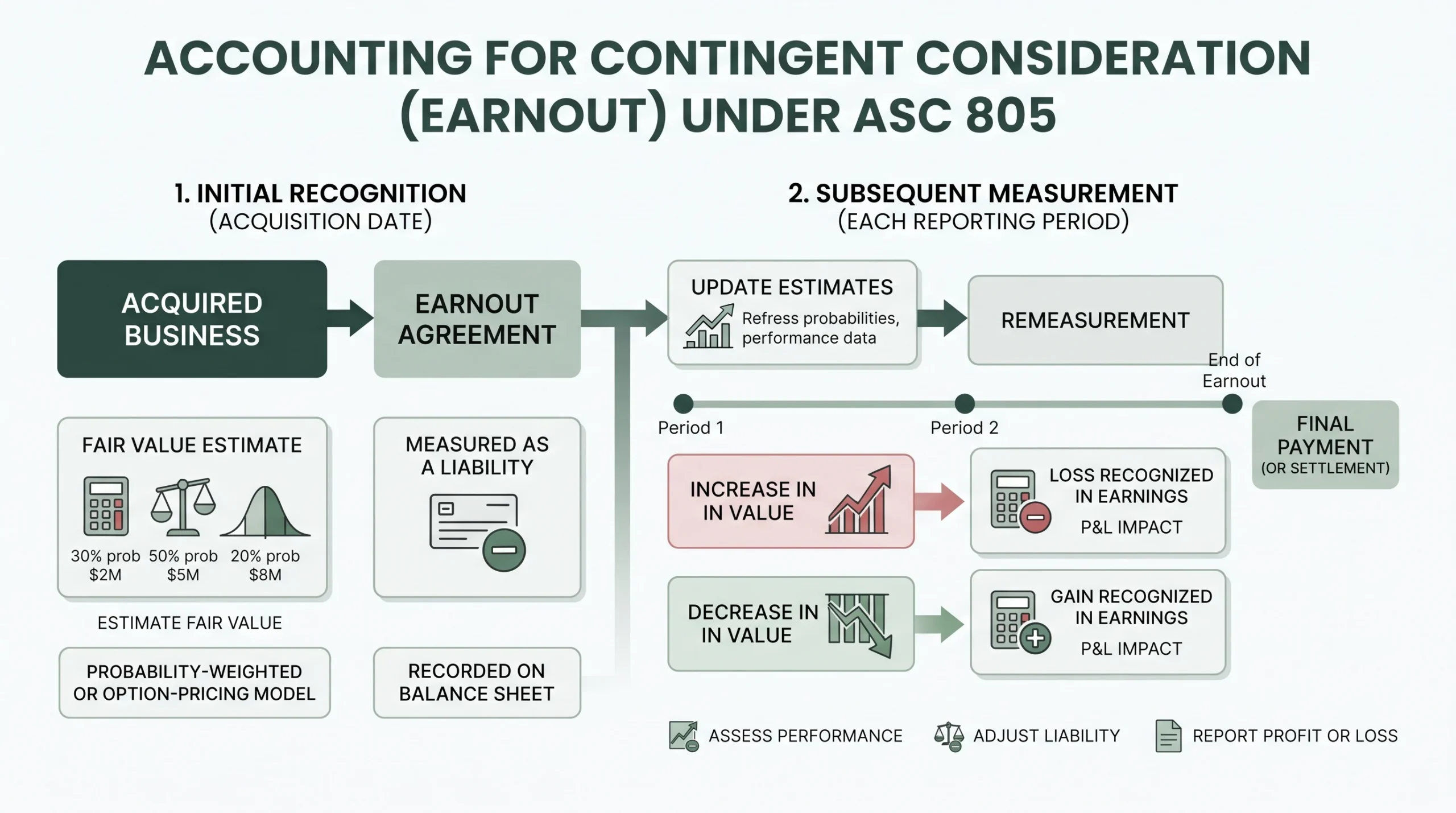
How Do You Estimate an Earnout’s Fair Value?
Two broad methods do most of the work. The scenario-based, or probability-weighted, method fits earnouts with a few clear outcomes. You lay out each payout, weight it by its odds, discount it, and add the pieces. It is plain and easy for an auditor to follow.
The option-pricing approach, often run as a Monte Carlo simulation, fits earnouts that behave in a nonlinear way. Think caps, floors, or tiers, where the payout curve bends. A simulation runs the business metric along many paths and prices the payout on each one. The average, discounted to today, gives the fair value. Both methods need honest inputs: a credible forecast, a volatility estimate, and a discount rate that matches the risk of the metric.
What Happens at Each Remeasurement?
For a liability-classified earnout, the work does not stop at closing. At every reporting date, you revisit the forecast, the odds, and the discount rate, then reset the liability to fair value. The change lands in earnings for that period.
This is where the drag bites. If the target gets more likely, the liability grows and profit takes a non-cash hit. If prospects dim, the liability shrinks and a gain appears. Neither swing involves real cash yet, so leaders have to explain paper movements to boards and analysts. Equity-classified amounts skip this step. They stay put.
How Does the Tax Treatment Differ?
The tax rules do not follow the book model. In a taxable asset deal, the buyer spreads the purchase price across the assets under Section 1060 and reports the split on Form 8594. Contingent payments get added to basis as they become fixed, not marked to market each quarter.
There is no earnings drag on the tax side, because tax does not remeasure the obligation. Instead, timing and interest drive the result. When an earnout defers payment without stated interest, Section 483 can impute interest on the deferred part, which changes how much is principal and how much is ordinary income. Book and tax can run apart for years, so track both.
What Must You Disclose?
Disclosure is where a weak model gets exposed. ASC 805 wants the arrangement described, the amount recognized, and the range of possible outcomes. Because the key inputs cannot be observed in a market, they fall under Level 3 of the ASC 820 fair value hierarchy.
That means you show the valuation technique, the significant assumptions, and a roll-forward of the liability from one period to the next. Readers can then see what moved and why. A tidy model makes this short. A guess makes it painful.
Who Measures Earnouts, and How Do the Options Compare?
Buyers pick a valuation partner based on deal size, audit exposure, and budget. Large national firms such as Stout, Kroll, and Alvarez & Marsal serve big public filers with broad teams. Sofer Advisors focuses on defensible, partner-led measurements for private and middle-market buyers who still answer to auditors and the SEC.
| Provider | Typical role | Best for |
|---|---|---|
| Specialized valuation firm (e.g. Sofer Advisors) | Builds and documents the earnout model as audit support | Private and middle-market buyers needing audit-ready work |
| Large national firm | Broad advisory plus valuation at enterprise scale | Large public filers with complex, multi-entity deals |
| Internal finance team | Tracks the earnout and books the entries | Routine updates once the model is set |
Sofer Advisors runs each engagement through a four-phase process it calls The Sofer Difference, moving from Discovery to Diligence to Analysis to Delivery. That structure keeps every input tied to the deal and the forecast behind it. It reflects the Heart of a Teacher approach, which means explaining why a number moves, not just handing over a figure. For an earnout that survives audit, an independent model supplies both the value and the trail of evidence behind it.
Frequently Asked Questions
How do you account for contingent consideration?
Under ASC 805, the buyer records contingent consideration at fair value on the acquisition date. You first classify it as a liability or as equity, based on how the deal settles. A liability is remeasured each period through earnings, while equity stays fixed. The initial amount becomes part of the purchase price and feeds goodwill. Sofer Advisors runs that fair value work so the entry holds up under audit.
Can you give an example of an earnout?
A common earnout works like this. A buyer acquires a software company and agrees to pay the seller an extra 5 million dollars if revenue passes a set target within two years. The payment hinges on future performance, so it is contingent consideration. The buyer books its fair value at closing, then updates it as results come in. Sofer Advisors models these payouts so the recorded value reflects the real odds.
What does contingent consideration mean?
Contingent consideration is a buyer’s promise to pay a seller more after a deal closes, but only if certain future events happen. Those events are usually revenue, earnings, or milestone targets. It bridges a price gap when the two sides disagree on what the business will do next. Accounting treats it as part of the purchase price. Sofer Advisors quantifies that promise so your balance sheet shows the full cost of the acquisition.
Is contingent consideration classified as a liability or equity?
It depends on how the arrangement settles. If the buyer must hand over cash or a variable number of shares, it is a liability. If it settles in a fixed number of shares, it usually counts as equity. The split matters because a liability is remeasured every period, while equity is not. Sofer Advisors reviews the deal terms with your auditors so the classification is right from day one.
How often is contingent consideration remeasured?
A liability-classified earnout is remeasured at every reporting date until it is settled. Each period, you update the odds of hitting the targets and the discount rate, then run the change through earnings. Equity-classified amounts are not remeasured at all. That is why the first classification call carries so much weight. Sofer Advisors supports these quarterly updates so your disclosures stay current and defensible through the life of the earnout.
How does an earnout affect goodwill?
The acquisition-date fair value of the earnout is part of the total consideration transferred. That total, less the fair value of the net assets acquired, sets goodwill. A larger earnout value lifts goodwill at closing. Later remeasurements, though, hit earnings and do not change goodwill. Sofer Advisors ties the earnout figure to the rest of the purchase price allocation so goodwill is stated correctly on the opening balance sheet.
What disclosures does ASC 805 require for contingent consideration?
ASC 805 asks you to describe the arrangement, the amount recognized, and the range of possible payouts. Because these inputs are unobservable, you also report them as Level 3 under ASC 820, with the key assumptions and a roll-forward of the liability. Auditors and the SEC read these closely. Sofer Advisors drafts the supporting analysis so your fair value disclosures match the model behind the number.
How much does a contingent consideration valuation cost?
Most contingent consideration valuations run from 15,000 to 50,000 dollars and take about six to twelve weeks, depending on the earnout terms and the modeling depth. A simple scenario model sits at the low end, while a Monte Carlo build costs more. A fixed fee is quoted up front, so the price is clear before work starts. Sofer Advisors scopes the engagement first, then quotes it. Request a free estimate for your deal.
Related Case Studies
- Purchase Price Allocation ASC 805 and IFRS 3: Complete Guide for Business Leaders
- ASC 820 Fair Value Measurement: Hierarchy Levels Explained
- ASC 805 Measurement Period Adjustments Explained
Executive Summary
An earnout is contingent consideration, and ASC 805 makes the buyer record it at fair value on the acquisition date. Classify it first: a liability is remeasured every period through earnings, while equity is left alone. That remeasurement is the drag buyers underestimate. Use a probability-weighted model for simple payouts and a Monte Carlo build for nonlinear ones. The acquisition-date value feeds goodwill, Level 3 disclosures explain it, and the tax rules follow a separate path. Start with a credible forecast and a discount rate that fits the risk.
What Should You Do Next?
Pull together the purchase agreement, the earnout terms, and your latest forecast, since a clean file supports a credible model. Confirm how the earnout settles before you lock the classification. This guide was prepared by David Hern CPA ABV ASA, founder of Sofer Advisors, an Inc. 5,000 firm specializing in neutral third-party valuations for financial reporting. Schedule a free consultation to discuss your specific situation.
People Also Read
About the Author
This guide was prepared by David Hern CPA ABV ASA, founder of Sofer Advisors, a business valuation firm headquartered in Atlanta, GA serving clients across the United States. David holds dual accreditations as an Accredited Senior Appraiser (ASA) and is Accredited in Business Valuation (ABV), credentials recognized by the IRS, SEC, and FINRA. He also holds the Certified Exit Planning Advisor (CEPA) designation. With 15+ years of valuation experience, David has served as an expert witness in 11+ cases across multiple jurisdictions and built Sofer Advisors into an Inc. 5,000-recognized firm with 180+ five-star Google reviews. Its full W2 employee team maintains subscriptions to all major valuation databases and operates under a next business day response policy.
For professional business valuation services, visit soferadvisors.com/about-us/ or contact Sofer Advisors at soferadvisors.com/contact-us/.
This content is for informational purposes only and does not constitute professional valuation advice. Business valuation conclusions depend on specific facts and circumstances. Contact Sofer Advisors for guidance regarding your specific situation.









