


Last Updated: October 2026
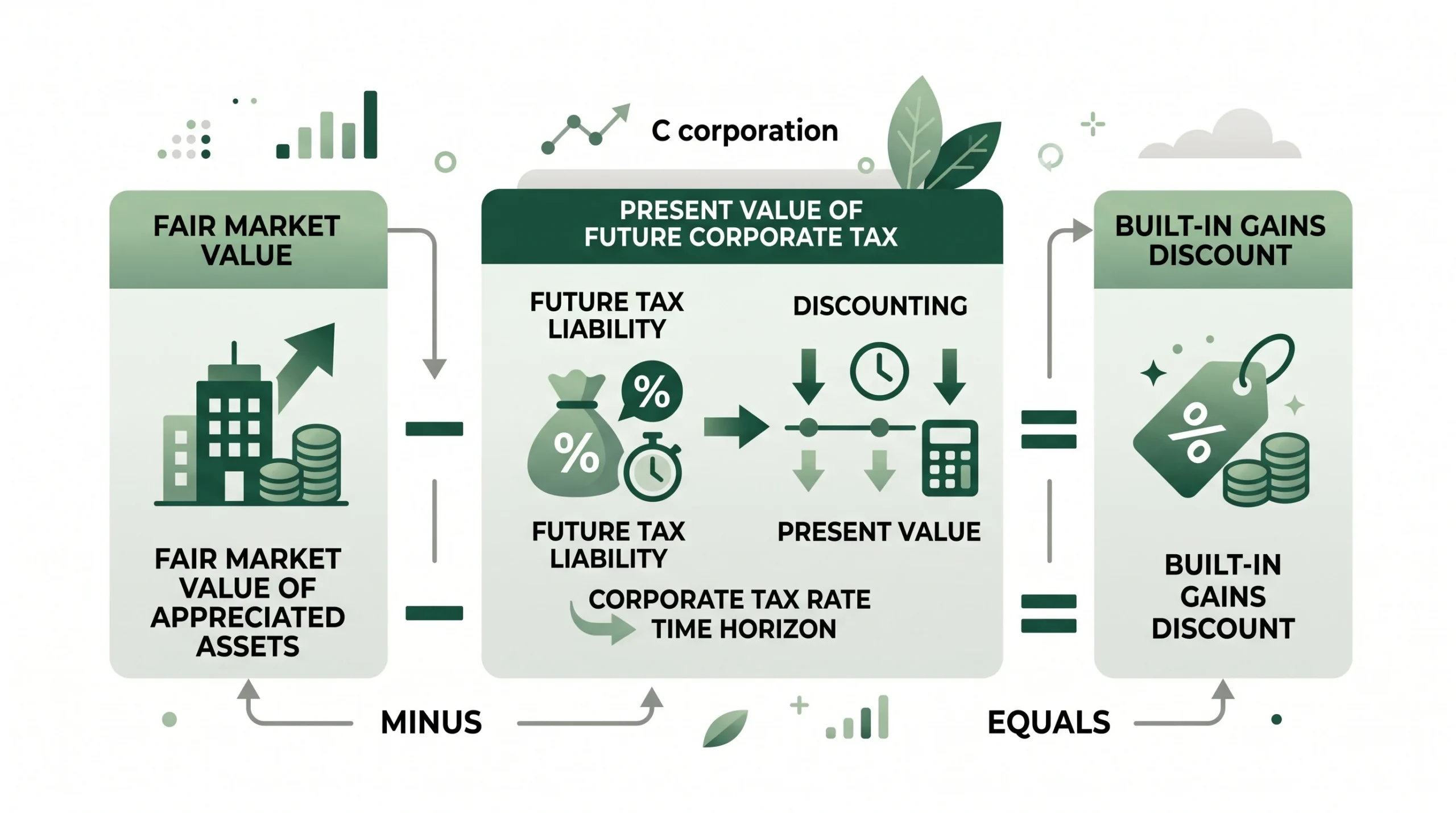
A built-in gains tax discount adjusts a C corporation’s value for the corporate tax that would be due when its appreciated assets are sold. The adjustment lowers fair market value by the estimated tax on the unrealized gain. Analysts apply the 21 percent federal corporate tax rate to the gap between an asset’s fair market value and its adjusted tax basis. The result reflects a real cost a buyer would inherit at closing.
The team at Sofer Advisors prepares C corporation and estate tax valuations for owners, executors, and their advisors, backed by Inc. 5000 recognition in both 2024 and 2025. The discount matters because a C corporation faces double taxation. Without it, a valuation can overstate the cash a buyer would actually receive.
This guide explains why the built-in gains tax, or BIG tax, is a valuation issue, when the discount applies, how it is calculated, and the tax court cases that support it. It also covers how C and S corporations differ, and how the discount compares to other common valuation adjustments.
Key Takeaways
- Double taxation: the discount reflects a C corp’s future tax on appreciated assets, which lowers fair market value.
- Context matters: it mainly applies in gift and estate valuations, less so in deals with an asset-style basis step-up.
- Present value: courts prefer a present value of the future tax over a dollar-for-dollar reduction.
- Case support: decisions like Estate of Davis confirm the discount applies even when no sale is imminent.
- Entity structure: S corporations are pass-through and generally need no permanent discount, unlike C corporations.
Each point connects to the wider gift and estate tax framework. The sections below examine each in detail.
Why Is the Built-In Gains Tax Discount Important to Understand?
The discount is important because the IRS and the tax courts expect the future tax to be measured, not assumed away. Revenue Ruling 59-60 directs an appraiser to weigh every factor a willing buyer would consider, and the corporate tax on appreciated assets is one of them. IRC Section 1374 governs the built-in gains tax for companies that convert from C to S status, setting a five-year recognition period. Under the fair market value standard used for gift and estate filings, a defensible discount can lower reported value, while an unsupported one invites a challenge.
What Creates the Built-In Gains Tax Liability?
The liability comes from double taxation. A C corporation that holds appreciated assets will owe corporate tax on the gain when it sells them. That tax reduces the net proceeds available to shareholders. The value of the company is therefore lower on an after-tax basis.
A hypothetical buyer sees this clearly. The buyer inherits the company’s low tax basis in the assets. So the buyer will eventually pay the tax on the built-in gain. To account for that, the buyer lowers the offer price. The discount captures this economic reality. The valuation must quantify the liability so fair market value reflects the true after-tax position for a buyer.
When Does the BIG Tax Discount Apply?
The discount applies most clearly in gift and estate tax valuations. Those use the fair market value standard, which assumes a willing buyer aware of all relevant facts. A buyer in that setting would weigh the future tax liability as part of the price. So the discount is appropriate.
Strategic M&A deals can differ. Buyers often structure a purchase to get a tax basis step-up. With an IRC Section 338 election, a stock deal is treated as an asset purchase for tax. The buyer then gets a stepped-up basis, and the seller’s built-in gain becomes less relevant to the price. The analyst must identify which scenario applies before deciding on the adjustment.
How Is the BIG Tax Discount Calculated?
The discount is the present value of the tax that would arise if the entity sold its assets at fair market value. Courts and the IRS focus on present value, because the tax is rarely an immediate cost. The analyst models when the assets might be sold and discounts the future tax back to today.
This takes discipline. The analyst estimates each asset’s tax basis and the corporate rate expected at a hypothetical sale. Because the tax is often deferred for years, its present value is well below the nominal amount. The older dollar-for-dollar method, which ignores the time value of money, is now largely rejected by the tax courts. That careful, assumption-by-assumption work reflects the Heart of a Teacher approach, which explains the reasoning behind a number rather than simply asserting it.
Knowing which standard applies and how to measure the tax is easier with a qualified advisor reviewing your facts. Talk to a Sofer Advisors valuation specialist about the approach that fits your assets.
What Tax Court Cases Guide the Discount?
Several cases shape the discount. In Estate of Davis v. Commissioner, the court allowed a built-in gains tax discount under the willing-buyer, willing-seller standard. It found that a buyer of closely held stock would factor in the corporate tax on appreciated assets, even with no imminent sale planned. That established the discount as legitimate.
Later cases refined the math. Estate of Dunn and Estate of Jelke rejected both extremes. A zero discount was unrealistic, but so was the full, undiscounted tax. These rulings pushed analysts toward a present value calculation that reflects a real holding period. Together they confirm the discount is a genuine economic burden a buyer would price in.
How Do S Corps and C Corps Differ on BIG Tax?
S corporations are pass-through entities. They generally pay no corporate-level tax, so a permanent built-in gains discount does not apply. Income flows directly to shareholders, so the double taxation of a C corporation is absent. Valuation for an S corp focuses on net cash flow to owners without a corporate tax offset.
There is one key exception. A company that converts from C to S becomes subject to the Section 1374 built-in gains tax on assets sold within a five-year recognition period. The tax applies to appreciation that existed before the conversion. If the business sells those assets during the window, it pays tax at the top corporate rate. That can require a temporary valuation adjustment until the five years pass.
How Is the BIG Discount Different From Other Discounts?
The BIG discount is an entity-level adjustment. It lowers the value of the whole corporation for the future tax on its assets. Other common discounts work at the shareholder level. A discount for lack of control and a discount for lack of marketability apply to a specific ownership interest, not the company’s tax status.
The table below sorts them out. A minority owner may lack the power to direct the company, which supports a control discount. Private shares with no public market support a marketability discount. These are measured from transaction data and apply after the entity value is set. The BIG discount comes first, at the asset level.
| Discount | What it adjusts for | Level |
|---|---|---|
| Built-in gains (BIG) | Future corporate tax on appreciated assets | Entity level |
| Lack of control (DLOC) | A minority owner’s inability to direct policy | Shareholder level |
| Lack of marketability (DLOM) | No ready public market for private shares | Shareholder level |
Providers of this analysis vary in scale. Larger national firms such as Alvarez & Marsal, Stout, and Kroll serve big public companies with broad advisory teams. Sofer Advisors focuses on defensible, partner-led valuations for closely held and middle-market businesses, with expert witness testimony in 11+ cases behind its reports. It works through a four-phase process it calls The Sofer Difference, moving from Discovery to Diligence to Analysis to Delivery, so each discount is grounded in documented assumptions a reviewer can follow.
Why Does the Asset Mix Matter?
The asset mix decides whether the discount even applies. The built-in gain lives in appreciated assets. A company whose value sits in operating cash flow, not in appreciated property, may have little built-in gain to discount. A holding company full of appreciated real estate or marketable securities is the opposite case.
So the analyst examines each asset class. Depreciated or recently bought assets carry little gain. Long-held land, buildings, or stock can carry large gains. The analyst compares each asset’s fair market value to its tax basis to find the embedded gain. Summing those embedded gains gives the base for the entire tax calculation. A clear asset-by-asset listing is what makes the discount defensible.
What Records Does the Analysis Need?
The analysis starts with a fixed asset and investment register. It must show each asset’s original cost, accumulated depreciation, and current fair market value. That reveals the built-in gain in each item. Without it, the tax base cannot be measured.
Several other records help. Prior tax returns confirm the adjusted basis and any depreciation taken. Appraisals or market data support the current fair market value of real estate and securities. The corporate structure and any plan to convert to an S corporation affect the timing. Assembling these before the valuation keeps the holding-period and basis assumptions grounded. That documentation is exactly what a reviewer tests.
Frequently Asked Questions
What is the built-in gains (BIG) tax?
The built-in gains tax is the corporate-level income tax a C corporation owes when it sells assets that have appreciated above their tax basis. The liability exists even when no sale is planned, because a buyer inherits it with the assets. In a valuation, the analyst accounts for its present value so fair market value reflects the real after-tax position. Sofer Advisors measures that liability asset by asset for a defensible estate or gift tax report.
Why is a BIG tax discount applied to C corp valuations?
A buyer of C corporation stock inherits the company’s low tax basis and will eventually owe the corporate tax on its appreciated assets. To reflect that future burden, the buyer lowers the price, so the valuation must capture it. A present value analysis of the tax shows how much a willing buyer would deduct from the offer. Sofer Advisors quantifies that deduction with an asset-by-asset listing that holds up under IRS review.
Is the BIG tax discount the same as capital gains tax?
No. The built-in gains tax is a corporate-level income tax owed by the entity when it sells appreciated assets. Capital gains tax is a separate investor-level tax paid by shareholders on their own gains. The BIG discount addresses the corporate liability that reduces the cash available to owners after an asset sale. Sofer Advisors keeps the two layers distinct so the valuation measures only the tax a buyer would truly inherit.
When does the BIG discount apply?
It applies most clearly in gift and estate tax valuations under the fair market value standard, where a willing buyer would price in the future tax. It is far less relevant in M&A deals where a Section 338 election gives the buyer a stepped-up basis. The analyst must identify the scenario before applying any adjustment. Sofer Advisors reviews the purpose and structure of each engagement first, then applies the discount only where it fits.
How is the BIG discount calculated?
The analyst finds the present value of the tax that would arise if the entity sold its assets at fair market value. That means estimating each asset’s tax basis, the likely holding period, and the corporate rate at a hypothetical sale, then discounting the future tax to today. The dollar-for-dollar method is largely rejected by the courts. Sofer Advisors builds the present value model asset by asset and documents every assumption behind it.
Do S corporations need a BIG tax discount?
Generally no, because S corporations are pass-through entities that pay no corporate-level tax, so the permanent discount does not apply. The exception is a company that converted from C to S, which faces the Section 1374 built-in gains tax on pre-conversion gains for five years. That can call for a temporary adjustment. Sofer Advisors checks the conversion date and the five-year window before deciding whether any discount belongs in an S corp valuation.
What court cases support the discount?
Estate of Davis allowed the discount under the willing-buyer standard, even with no imminent sale planned. Estate of Dunn and Estate of Jelke then rejected both a zero discount and the full undiscounted tax, pointing analysts toward a present value approach tied to a realistic holding period. Together they anchor the method the courts now expect. Sofer Advisors grounds every built-in gains discount in this line of precedent so the conclusion is defensible.
How much does a valuation with a BIG discount cost?
A business valuation that includes a built-in gains analysis usually ranges from $7,500 to $25,000. The fee depends on the number of appreciated assets, the complexity, and the purpose of the report. A flat scope is quoted up front, so the cost is clear before work begins. Sofer Advisors sets the scope first, then quotes a fixed price. Request a free estimate for a range specific to your engagement.
Related Case Studies
- Built-In Gains Tax: S-Corp Conversions at Sale
- Tax-Affecting S-Corp Earnings: Gross, Kessler, and Today’s View
- Personal Goodwill vs Enterprise Goodwill: Tax & Divorce Guide
Executive Summary
The built-in gains tax discount reflects a real cost a buyer of a C corporation would face on its appreciated assets. Confirm the entity is a C corp and the valuation uses fair market value. Identify each appreciated asset and its adjusted tax basis, then measure the embedded gain. Apply the 21 percent corporate rate, model a realistic holding period, and discount the future tax to present value rather than using a flat dollar-for-dollar figure. Ground the result in Estate of Davis, Dunn, and Jelke. Most engagements that include this analysis run $7,500 to $25,000. A well-supported discount can lower estate or gift tax meaningfully.
What Should You Do Next?
Review which of your appreciated assets carry a built-in gain and gather a fixed asset and investment schedule showing each item’s cost, depreciation, and current fair market value. Confirm the entity’s tax status and any plan to convert to an S corporation, since that affects the five-year window. This guide was prepared by David Hern CPA ABV ASA, founder of Sofer Advisors, an Inc. 5000 firm specializing in neutral third-party valuations for estate, gift, and corporate tax matters. Schedule a free consultation to discuss your specific situation.
People Also Read
About the Author
This guide was prepared by David Hern CPA ABV ASA, founder of Sofer Advisors, a business valuation firm headquartered in Atlanta, GA serving clients across the United States. David holds dual accreditations as an Accredited Senior Appraiser (ASA) and is Accredited in Business Valuation (ABV), credentials recognized by the IRS, SEC, and FINRA. He also holds the Certified Exit Planning Advisor (CEPA) designation. With 15+ years of valuation experience, David has served as an expert witness in 11+ cases across multiple jurisdictions and built Sofer Advisors into an Inc. 5,000-recognized firm with 180+ five-star Google reviews. Its full W2 employee team maintains subscriptions to all major valuation databases and operates under a next business day response policy.
For professional business valuation services, visit soferadvisors.com/about-us/ or contact Sofer Advisors at soferadvisors.com/contact-us/.
This content is for informational purposes only and does not constitute professional valuation advice. Business valuation conclusions depend on specific facts and circumstances. Contact Sofer Advisors for guidance regarding your specific situation.









