
Last Updated: August 2026
Most small businesses sell for about 2 to 3 times their seller’s discretionary earnings. Larger companies sell for a multiple of EBITDA, often 4 to 7 times profit. A multiple is a simple ratio that turns one year of earnings into a price. In 2025 the median small business sold for $350,000, according to the BizBuySell Insight Report. That price is only a starting point. Your industry, size, and growth then move the number up or down.
The multiple matters because it does most of the work in a sale. A one point change can shift the price by six figures. That is why Sofer Advisors treats the multiple as a measured result, not a rule of thumb. Buyers pay more for proven, low-risk earnings. The safer your profit looks, the higher the multiple you can support.
Key Takeaways
- Small firms use SDE: Businesses under about $2 million in value usually sell on a multiple of the seller’s discretionary earnings. The range often runs 2x to 3x.
- Larger firms use EBITDA: Companies with a management team sell on EBITDA. Lower middle-market deals often close near 4x to 7x.
- Industry sets the base: Tech and healthcare tend to earn higher multiples. Retail and trade services tend to sit lower.
- Your risk moves the number: Growth, recurring revenue, and low owner dependence push the multiple up. Concentration and thin margins pull it down.
- Rules of thumb are rough: A broad multiple is a screen, not a valuation. A defensible price rests on real deal data.
These points connect price to risk. The sections below show the current 2026 ranges, how the two main multiples differ, and what raises or lowers your own number.
What multiple do businesses sell for in 2026?
Most small businesses sell for 2 to 3 times SDE, and larger firms for 4 to 7 times EBITDA. Market data backs this up. The BizBuySell Insight Report put the average small business cash flow multiple near 2.6x in 2025, with a median sale price of $350,000. For bigger private companies, the DealStats Value Index showed a median of 3.5x EBITDA in late 2025. Both figures cooled from the highs of 2024.
These numbers are medians, so half of the deals land above and half below. Size explains much of the spread. A firm earning $200,000 rarely draws the same buyers as one earning $3 million. Bigger companies feel safer, so they earn a fuller multiple. Where your business sits in this range depends on the drivers we cover next.
How do SDE and EBITDA multiples differ?
SDE and EBITDA measure profit in two different ways. SDE, or seller’s discretionary earnings, adds the owner’s salary and perks back to net income. It fits main street firms where one owner runs the show. EBITDA strips out interest, taxes, depreciation, and amortization, but not owner pay. It fits larger firms that already pay a manager to run daily work.
The cutoff sits near $1 million to $2 million of value. Below that line, buyers price on SDE. Above it, they price on EBITDA. The shift matters because the two figures are not the same size. SDE is usually larger, since it includes owner pay, so its multiples look smaller. Reading an adjusted EBITDA figure against an SDE multiple is a common and costly mistake.
What multiple do businesses sell for by industry?
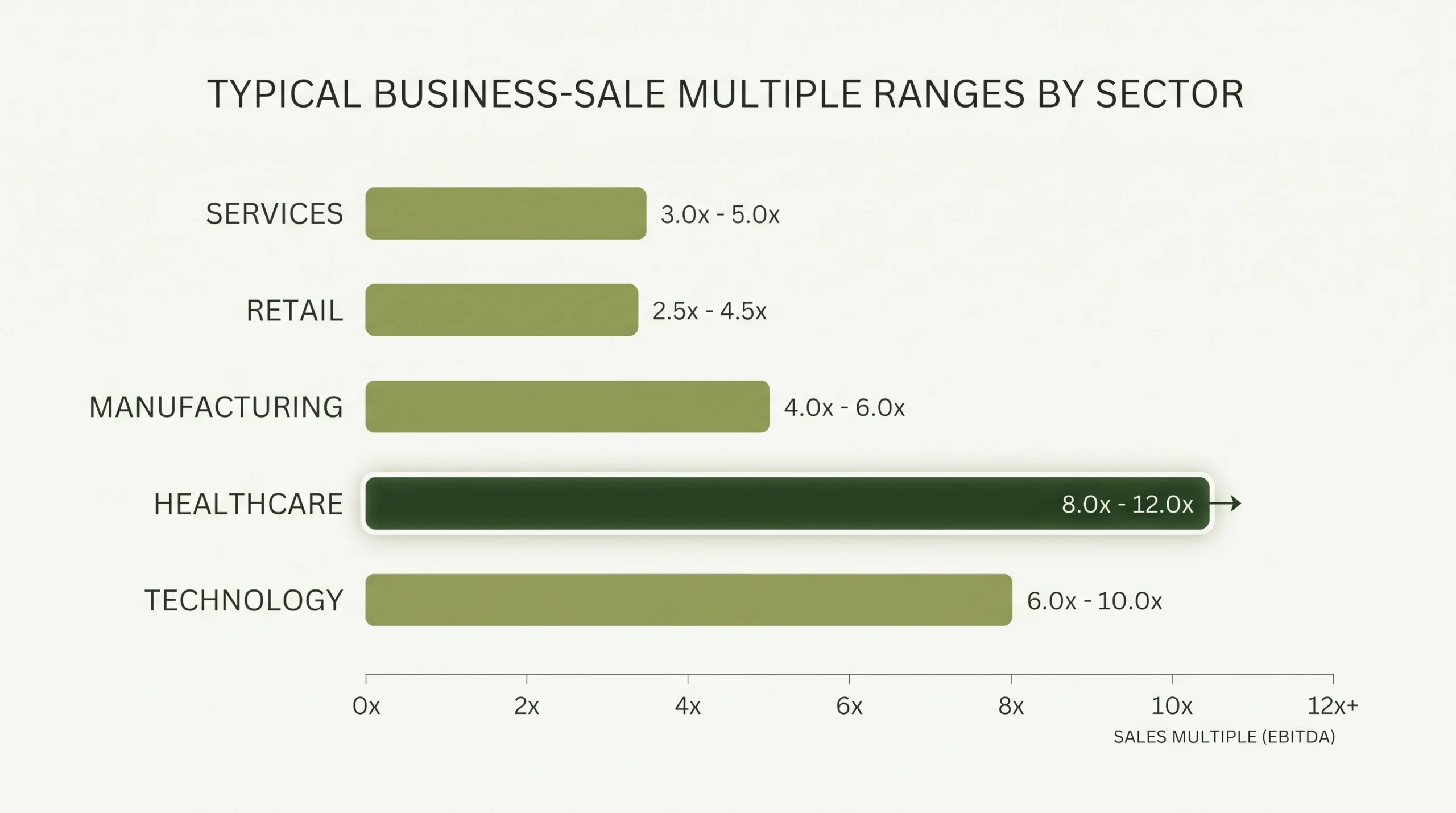
Multiples differ by industry because risk and growth differ by industry. A software firm with recurring contracts is safer than a shop that depends on foot traffic. Buyers pay for that safety. Capital needs matter too. A factory ties up cash in equipment, which trims its multiple. A service firm needs little to grow, so its earnings convert more easily to value.
The table below shows common 2026 ranges. Treat them as a guide, not a quote.
| Industry | Usual basis | Common multiple range |
|---|---|---|
| Home and trade services | SDE | 2x to 3.5x |
| Retail and e-commerce | SDE | 2x to 3x |
| Manufacturing | EBITDA | 4x to 6x |
| Healthcare practices | SDE or EBITDA | 3x to 6x |
| Technology and SaaS | EBITDA or revenue | 6x to 10x or more |
| Professional services | SDE | 2.5x to 4x |
Ranges this wide prove a point. The industry sets the neighborhood, but the specific business sets the address. Two retail shops with equal sales can sell at very different prices. One may have loyal repeat buyers and clean books. The other may lean on a single supplier and one big client. That is why a valuation prices each firm against real deals in its own sector.
What moves a business up or down its range?
Your place in the range depends on how a buyer reads your risk. Steady, growing, low-risk earnings earn a higher multiple. Shaky or owner-bound earnings earn a lower one. Size helps as well, since larger firms draw more buyers and more competition. The purpose of the sale also plays a part, because a strategic buyer may pay more than a financial one.
A few drivers move the number most:
- Growth: A firm growing 20 percent a year earns a premium over a flat one.
- Recurring revenue: Contracts and repeat sales make future profit look sure.
- Owner dependence: If the business cannot run without you, buyers discount it.
- Customer concentration: One client at 40 percent of sales is a clear risk.
Each factor ties back to one question a buyer asks. Will next year’s profit really arrive? Clean records, a capable team, and a broad client base all answer yes. The stronger that answer, the closer you move to the top of your range. Sofer Advisors weighs these drivers during the analysis phase of every engagement.
Why are rule-of-thumb multiples only a starting point?
A rule of thumb is a screen, not an answer. “Three times profit” or “one times revenue” can point you to a rough figure in seconds. It cannot capture your margins, your growth, or your risk. It also ignores the difference between enterprise value and the cash you take home. Debt, cash, and working capital all adjust the final equity value at closing.
Standards exist for a reason. A price for a sale, a tax filing, or a court case must hold up under review. IRS Revenue Ruling 59-60 and the AICPA Statement on Standards for Valuation Services both call for evidence, not shortcuts. David Hern CPA ABV ASA built the firm’s process, The Sofer Difference, around that idea. Its four phases, Discovery, Diligence, Analysis, and Delivery, turn a rough guess into a defensible number.
Where do valuators find real sale multiples?
Valuators pull multiples from paid databases of closed private deals. These records show what buyers actually paid, not what sellers hoped to get. DealStats and similar sources report price against SDE, EBITDA, and revenue by industry and size. Public articles quote broad averages. A real valuation needs the specific comparables that fit your business.
This is where senior expertise counts. Large firms such as Alvarez and Marsal or Kroll bring that rigor to enterprise clients. Sofer Advisors brings the same standard to middle-market and main street owners. Unlike a solo practitioner, it backs each conclusion with a full W2 team of 14 and subscriptions to every major deal database. This reflects the Heart of a Teacher approach, since the firm shows owners the evidence behind the price, not just the price.
Frequently Asked Questions
How much is a business worth with $1 million in sales?
Sales alone do not set value. A business with $1 million in revenue could sell for $200,000 or well over $1 million. It depends on profit, not top-line sales. A firm with thin margins may earn little, so its price stays low. A high-margin firm with the same sales earns more, so buyers pay more. The firm prices the earnings behind the revenue, not the revenue itself.
Is a business worth 3 times profit?
Three times profit is a common shorthand, but it is rarely exact. Some firms sell below 3x, and strong ones sell well above it. The real multiple turns on risk, growth, and how much the business needs the owner. A steady firm with recurring revenue often earns more. A shaky one earns less. The firm tests whether 3x is too high or too low for your case.
What is a good EBITDA multiple to sell a business?
A good EBITDA multiple depends on your size, industry, and growth. Lower middle-market firms often close between 4x and 6x. Larger or faster-growing companies can reach higher. Recent DealStats data put the private company median near 3.5x in late 2025. The firm compares your business to real deals in your sector to find a range you can defend.
Do smaller businesses sell for lower multiples?
Yes, smaller firms usually sell for lower multiples. They carry more risk, since one owner or one client can make or break them. Larger firms have real management, wider customer bases, and steadier cash flow. Buyers pay more for that safety. A strong team and clean records can narrow the gap. The firm shows owners where their size discount comes from.
How does revenue growth affect a sale multiple?
Growth is one of the strongest drivers of a higher multiple. A buyer pays for future profit, and growth signals more of it ahead. A firm growing fast with steady margins can earn a real premium. A flat or falling firm earns less. The trend must look durable, not like a one-year spike. The firm builds growth trends into every valuation it prepares.
What is the difference between an SDE and EBITDA multiple?
SDE adds the owner’s salary and perks back to profit. It suits small firms where the owner works in the business daily. EBITDA leaves owner pay out and suits larger firms with a hired manager. SDE is usually the bigger number, so its multiples look smaller. Comparing an SDE multiple to an EBITDA multiple gives a false result. The firm picks the metric that fits your scale.
Does customer concentration lower my multiple?
Yes, heavy customer concentration lowers most multiples. If one client drives 30 or 40 percent of sales, losing it would hurt badly. Buyers see that risk and discount the price. A broad, loyal customer base does the opposite and supports a fuller multiple. Reducing concentration before a sale can lift your value. The firm flags this risk early in the analysis phase.
How much does a business valuation from Sofer Advisors cost?
Business valuations from Sofer Advisors typically run from $7,500 to $25,000. The price depends on the complexity of your finances and the purpose of the report. Simpler jobs for planning or tax filings sit toward the lower end. Deals and litigation support need deeper work, so they run higher. Contact the firm for a fee quote matched to your situation. It responds by the next business day.
Related Case Studies
- EBITDA Add-Backs: What Buyers Accept and What They Reject
- Precedent Transaction Analysis: Deal Comps
- Owner Compensation Normalization: Why Salary Affects Sale Value
Executive Summary
Most small businesses sell for 2 to 3 times SDE, and larger firms for 4 to 7 times EBITDA. In 2025 the median small business sold for $350,000 at about 2.6x cash flow, per BizBuySell. Private company EBITDA multiples sat near 3.5x in late 2025, per DealStats. Industry sets the base range, from about 2x for retail to 10x or more for software. Growth, recurring revenue, low owner dependence, and a broad client base move a firm toward the top. Rule-of-thumb multiples are only a screen. A defensible price under IRS Revenue Ruling 59-60 and AICPA standards rests on real deal data.
What Should You Do Next?
Start by cleaning up your financial records so a buyer can see true earnings. Then confirm the purpose of your valuation, since a sale, a tax filing, and a dispute each demand different evidence. Finally, benchmark your multiple against real deals in your sector, not a generic rule.
For a price you can stand behind, work with David Hern CPA ABV ASA. His team has given expert witness testimony in 11+ cases across Georgia, Florida, California, and New Mexico, and holds 180+ five-star Google reviews. Schedule a consultation to discuss the multiple that fits your business.
People Also Read
- Mid-Market M&A Due Diligence Checklist: 14 Categories Buyers Review
- Customer Concentration: Why It Cuts Sale Price 10 to 30 Percent
About the Author
This guide was prepared by David Hern CPA ABV ASA, founder of Sofer Advisors, a business valuation firm headquartered in Atlanta, GA serving clients across the United States. David holds dual accreditations as an Accredited Senior Appraiser (ASA) and is Accredited in Business Valuation (ABV), credentials recognized by the IRS, SEC, and FINRA. He also holds the Certified Exit Planning Advisor (CEPA) designation. With 15+ years of valuation experience, David has served as an expert witness in 11+ cases across multiple jurisdictions and built Sofer Advisors into an Inc. 5000-recognized firm with 180+ five-star Google reviews. Its full W2 employee team maintains subscriptions to all major valuation databases and operates under a next business day response policy. For professional business valuation services, visit soferadvisors.com/about-us/ or contact Sofer Advisors at soferadvisors.com/contact-us/.
Disclaimer: This content is for informational purposes only and does not constitute professional valuation advice. Business valuation conclusions depend on specific facts and circumstances. Contact Sofer Advisors for guidance regarding your specific situation.