
Last Updated: July 2026
A multi-unit restaurant group valuation finds the worth of a company that runs several restaurant locations, which may mix different concepts, brands, and service models. It takes an understanding of venue-specific cash flow, lease structures, and brand performance. Sofer Advisors provides these valuations for tax, legal, and transaction needs.
With seven years of experience, Sofer Advisors delivers reports that address the complexity of valuing multi-unit entities. It holds 180+ five-star Google reviews and has completed 11+ expert-witness cases across Georgia, Florida, California, and New Mexico. Its full W2 team provides timely, defensible results for owners navigating complex tax or legal settings.
Owners who run several locations often struggle to estimate value, because site performance varies and central administrative costs blur the picture. This analysis shows how each location contributes to total enterprise value. Bringing clarity to these metrics is a key part of the educational approach Sofer Advisors takes.
Key Takeaways
- EBITDA multiples: multi-unit groups generally trade at EBITDA multiples of 3x to 5x, not a percentage of sales.
- Segment mixed concepts: a group with quick-service and fine dining needs a segmented analysis, since one multiple is inaccurate.
- Value real estate apart: property interests are valued separately, and a favorable lease is a real intangible asset.
- Focus on unit metrics: Average Unit Volume and four-wall EBITDA give a clearer read than total revenue.
- Normalize the financials: adjust for owner perks and one-time costs to find true earning power.
These components frame the worth of your restaurant group. The sections below apply them across tax reporting and partnership transitions.
What are the core restaurant valuation methods?
The primary methods are the income approach, the market approach, and the asset approach. The income approach often uses a discounted cash flow or capitalized earnings to map future growth. The market approach sets value by reviewing EBITDA multiples from comparable sales. For smaller groups, an appraiser analyzes Seller’s Discretionary Earnings (SDE) to reflect total owner benefit. Larger multi-unit groups shift to EBITDA multiples to account for their scale. Our guide to how much a restaurant is worth covers the basics.
A blend of these methods gives the most defensible value for a professional group. The mix captures both future earning potential and current market sentiment. An appraiser tests these inputs against standards so the report withstands scrutiny from tax authorities or buyers. Our guide to calculating restaurant value walks through the steps.
How do mixed concepts impact valuation?
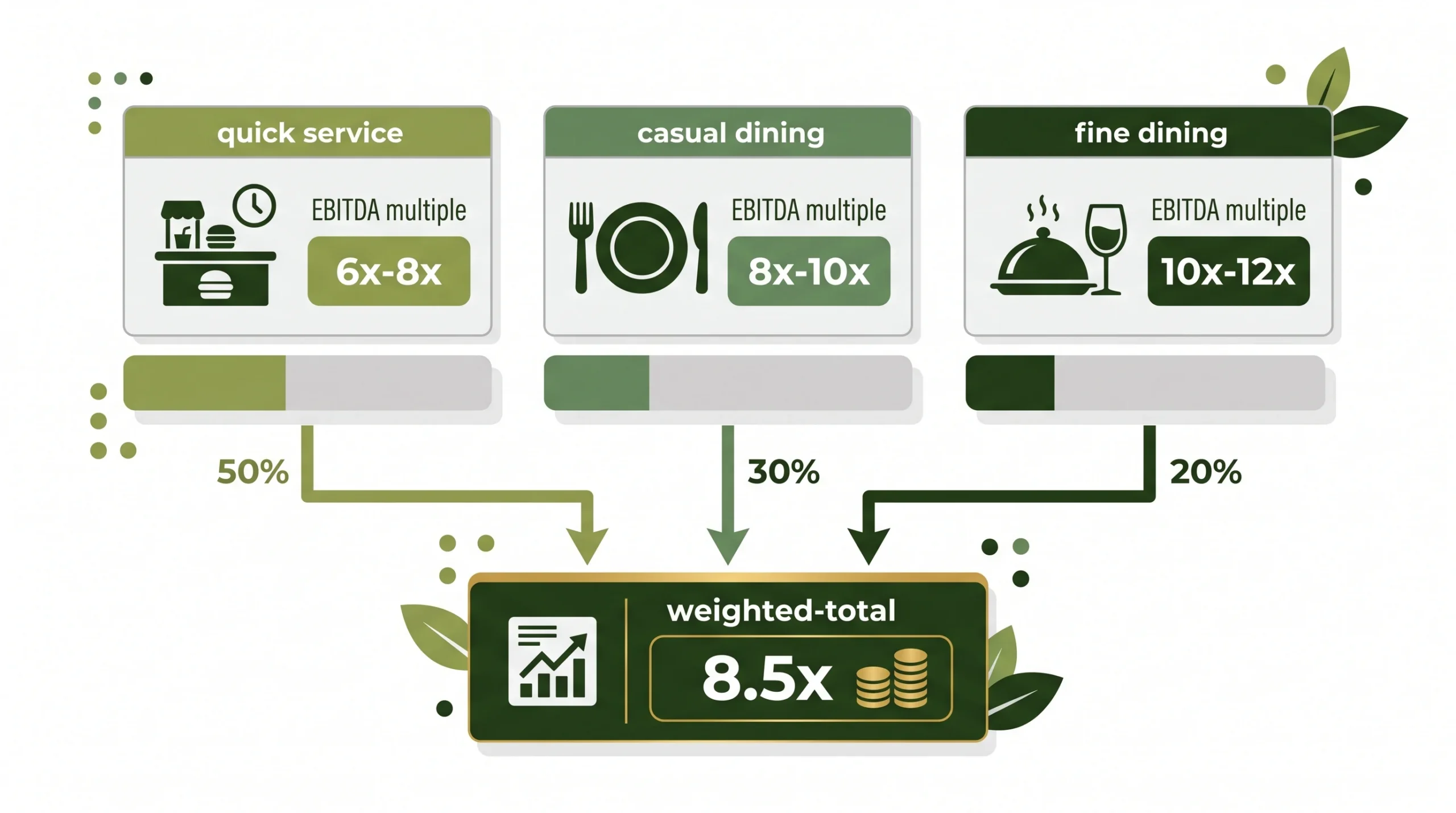
Mixed concepts impact a valuation because each business line carries a unique risk profile, growth potential, and market multiple. An appraiser cannot apply a single earnings multiple to a diverse group. They must run a segmented analysis for each brand to weigh brand strength and unit-level economics. This produces a weighted average value that reflects the specific contribution and risk of each segment. By isolating a high-growth quick-service chain from a stable fine-dining venue, the analysis guards against errors from blending non-comparable models.
This work uses property performance data, such as that in Business Valuation Resources data sets. When segments run different margins or capital needs, treating them as one leads to inaccurate pricing. Sofer Advisors keeps this focus on accuracy through a rigorous process, so every factor gets proper weight. Understanding these internal variances gives a clear picture of total enterprise value.
What key metrics drive restaurant group value?
The key metrics are Average Unit Volume (AUV), store-level EBITDA, prime costs, and lease status. Appraisers examine AUV to gauge the revenue pull of a single location, which signals brand strength and demand. High revenue must pair with efficiency to produce a value that reflects future earnings.
Strong four-wall EBITDA shows the profit from store operations before corporate taxes or overhead. Owners must keep tight control of prime costs, which are food and labor, to hold margins within standard ranges for their category. Data from the IBBA Market Pulse Survey confirms that operational discipline often decides whether a buyer sees a stable investment. Long-term leases give buyers security by protecting the footprint against future rent hikes or displacement.
How are real estate and leases treated in the valuation?
Real estate interests are valued separately from the business, so each asset class gets an accurate read. If a group owns its properties, the value of land and buildings is added to enterprise value. If it operates in leased space, the lease terms are examined as either an intangible asset or a liability. Appraisers adjust the financials to a fair market rent for an accurate comparison against peers.
This normalization identifies the impact of below-market leases, which lower occupancy costs versus the market. These create hidden value that is quantified and added to the operating value. Above-market leases, by contrast, act as a burden and reduce value. This split between the operating entity and its footprint is a core part of the analysis. Deciding whether real estate creates value or debt stays central to a precise, defensible conclusion.
What are common financial adjustments for restaurants?
Common adjustments normalize the financials by adding back discretionary owner expenses, removing one-time costs, and accounting for deferred capital spending. These remove distortions from the profit and loss statement to reveal true earning power. The work happens during the diligence and analysis phases, which are essential for an accurate SDE or EBITDA. The main adjustments are:
- Above- or below-market owner salary, adjusted to a replacement manager’s wage
- Discretionary owner expenses like personal travel, vehicles, or entertainment
- One-time costs such as legal fees or grand-opening marketing
- Deferred capital spending, like delayed kitchen equipment upgrades
Deferred capital spending matters because failing to replace aging equipment creates a future burden for a buyer. Documenting these items ensures the valuation reflects the ongoing capital needs of the group. A clear read on true cash flow allows more accurate projections, in line with standard practice. Our guide to EBITDA add-backs shows which a buyer will accept.
Which risks uniquely affect a restaurant group’s worth?
Key risks include heavy dependency on a specific chef or owner, geographic concentration in one struggling market, volatile food prices, and labor pressure. An appraiser quantifies these within the discount rate or the chosen multiple. A group with stores across several healthy regions carries less risk than one tied to a single local area.
Strong oversight systems reduce key-person risk around a celebrity chef, which raises value to a buyer. Thin margins leave less room to absorb rapid jumps in supply cost or wages. Data from the IBBA Market Pulse Survey shows that specialized operators with diversified supply chains often earn higher multiples. Sofer Advisors accounts for these shifts so every valuation reflects current market realities.
Which valuation provider is best for a restaurant group?
The right provider depends on the goal: a lender or tax authority needs a formal, defensible report, while an operational consultant suits internal performance work. National firms like Alvarez & Marsal, Stout, and Kroll serve the largest groups, and an M&A advisor focuses on maximizing a sale price. The table below compares the options.
| Provider type | Primary service | Approach |
| Sofer Advisors | Business valuation for tax, deals, and litigation | Neutral, third-party analysis under USPAP and AICPA standards |
| Restaurant consultant | Operational improvement and growth planning | Strategy focused on operations, not a formal valuation |
| M&A advisor | Capital raising and exit strategy | Advisory aimed at maximizing sale price |
The right partner depends on the immediate goal. A lender or tax authority requires a formal, defensible report, while an operational consultant is better for internal improvement. Sofer Advisors provides independent reports governed by established professional standards, which is necessary for tax reporting and legal proceedings. Strategy-focused groups give advice on performance and growth, but they usually do not provide the certified, defensible valuations required for external reporting. Aligning your requirement with the advisor’s scope gives you the most relevant document.
Restaurant group valuation rewards segmented analysis and clean four-wall data. The questions below cover what owners ask most.
Frequently Asked Questions
How do you value a restaurant group?
Valuing a restaurant group uses an income or market approach that combines property interests, operating earnings, and brand value. Appraisers reach a defensible conclusion by normalizing the financials, adjusting for market-rate rent, and setting EBITDA multiples by unit-level performance. Because each group has unique footprints and concepts, Sofer Advisors evaluates brand strength and historical performance so the report captures total enterprise value.
What is the 30/30/30 rule for restaurants?
The 30/30/30 rule is a benchmark for controlling prime costs in a healthy restaurant. Owners aim to keep food cost, labor cost, and combined overhead each at or below 30 percent of revenue. Any deviation directly affects EBITDA, which is the base for valuation multiples. Sofer Advisors examines these ratios to see whether the group performs in line with industry standards.
How much is a business worth with $500,000 in sales?
A restaurant with $500,000 in annual sales has no fixed value from that figure alone. Its worth comes from the discretionary earnings or EBITDA left after operating expenses, which varies with management efficiency. For smaller hospitality entities, a valuation often uses a multiple of SDE rather than total sales. Sofer Advisors assesses the specific margin profile to reach a value based on true cash flow.
How do mixed concepts impact the valuation of a restaurant group?
Mixed concepts force an appraiser to run a segmented analysis rather than one broad multiple. Because a quick-service location and a full-service venue carry different margins and risk, they must be valued as distinct components. This avoids the common error of overvaluing a stable, low-margin concept with a growth brand’s higher multiple. Sofer Advisors uses segmented modeling to prevent such inaccuracies.
What key metrics drive the value of a multi-unit restaurant group?
Four-wall EBITDA, Average Unit Volume, and prime cost ratios are the primary drivers. These reveal the internal efficiency of individual locations and the sustainability of the group’s profit model. Investors also look for operational consistency across the portfolio to justify higher multiples. Sofer Advisors focuses on these indicators to build a defensible case for current value.
How are real estate and leases treated in a restaurant valuation?
Real estate and leases are handled by separating property value from the operating value of the business. If the group leases, the appraiser adjusts for fair market rent so the financials compare accurately against peers. A below-market lease adds hidden value; an above-market one is a burden. Sofer Advisors performs this normalization consistently to preserve accuracy.
What are common financial adjustments needed to value a restaurant?
Adjustments typically add back owner-specific perks and remove one-time expenses that do not reflect normal operations. Examples include personal vehicle use, irregular legal fees, or grand-opening costs that distort profit. An appraiser must also account for deferred capital spending, like outdated kitchen equipment, to reflect real replacement costs. Sofer Advisors includes these in every engagement so the report shows true earning power.
What risks can lower a restaurant group’s valuation?
Risks include excessive lease liabilities, poor prime cost control, and heavy reliance on a single high-traffic location. A lack of management depth or skipped equipment maintenance also presents a downside to buyers. Tax authorities and lenders view these as threats to future cash flow. Sofer Advisors documents these factors clearly so the valuation reflects the real economic challenges.
How much does a restaurant group valuation from Sofer Advisors cost?
A restaurant group valuation from Sofer Advisors runs $5,000 to $20,000, based on its published engagement data, with complex unit mixes and heavy normalization reaching the higher end. Cost depends on the number of concepts, the unit mix, and the time for financial normalization. For a quote tied to your group, request a valuation estimate with your unit financials and lease terms.
Related Case Studies
- Franchise Business Valuation: An Atlanta Market Guide
- How to Value a Subway Franchise: A Complete Guide
- EBITDA Add-Backs: What Buyers Accept and What They Reject
Executive Summary
A multi-unit restaurant group is valued on EBITDA multiples, usually 3x to 5x, not a percentage of sales, and a group with mixed concepts needs a segmented analysis rather than one blended multiple. Analysts weigh Average Unit Volume, four-wall EBITDA, and prime costs at the store level, then value the real estate separately, treating a below-market lease as hidden value and an above-market one as a burden. Normalizing for owner salary, personal perks, one-time costs, and deferred capital spending reveals true earning power. Chef or owner dependency, geographic concentration, and volatile food and labor costs raise risk. To prepare, gather unit-level financials, lease terms, and a schedule of deferred equipment needs.
What Should You Do Next?
Gather unit-level profit and loss statements, all lease terms, and a schedule of deferred equipment needs, then separate the property from the operating business. Normalize for owner perks and one-time costs so each concept shows its true earnings. An independent valuation can then segment the group and combine the parts into a defensible whole.
David Hern CPA ABV ASA, founder of Sofer Advisors, provides neutral, defensible valuations for multi-unit and mixed-concept restaurant groups. Schedule a free consultation to discuss your situation.
People Also Read
- Working Capital Peg: How It Sets and Often Decides Final Price
- How to Value a Business Based on Cash Flow: An Expert Guide
About the Author
This guide was prepared by David Hern CPA ABV ASA, founder of Sofer Advisors, a business valuation firm headquartered in Atlanta, GA serving clients across the United States. David holds dual accreditations as an Accredited Senior Appraiser (ASA) and is Accredited in Business Valuation (ABV), credentials recognized by the IRS, SEC, and FINRA. He also holds the Certified Exit Planning Advisor (CEPA) designation. With 15+ years of valuation experience, David has served as an expert witness in 11+ cases across multiple jurisdictions and built Sofer Advisors into an Inc. 5000-recognized firm with 180+ five-star Google reviews. Its full W2 employee team maintains subscriptions to all major valuation databases and operates under a next business day response policy.
For professional business valuation services, visit soferadvisors.com/about-us/ or contact Sofer Advisors at soferadvisors.com/contact-us/.
Disclaimer: This content is for informational purposes only and does not constitute professional valuation advice. Business valuation conclusions depend on specific facts and circumstances. Contact Sofer Advisors for guidance regarding your specific situation.