
Last Updated: August 2026
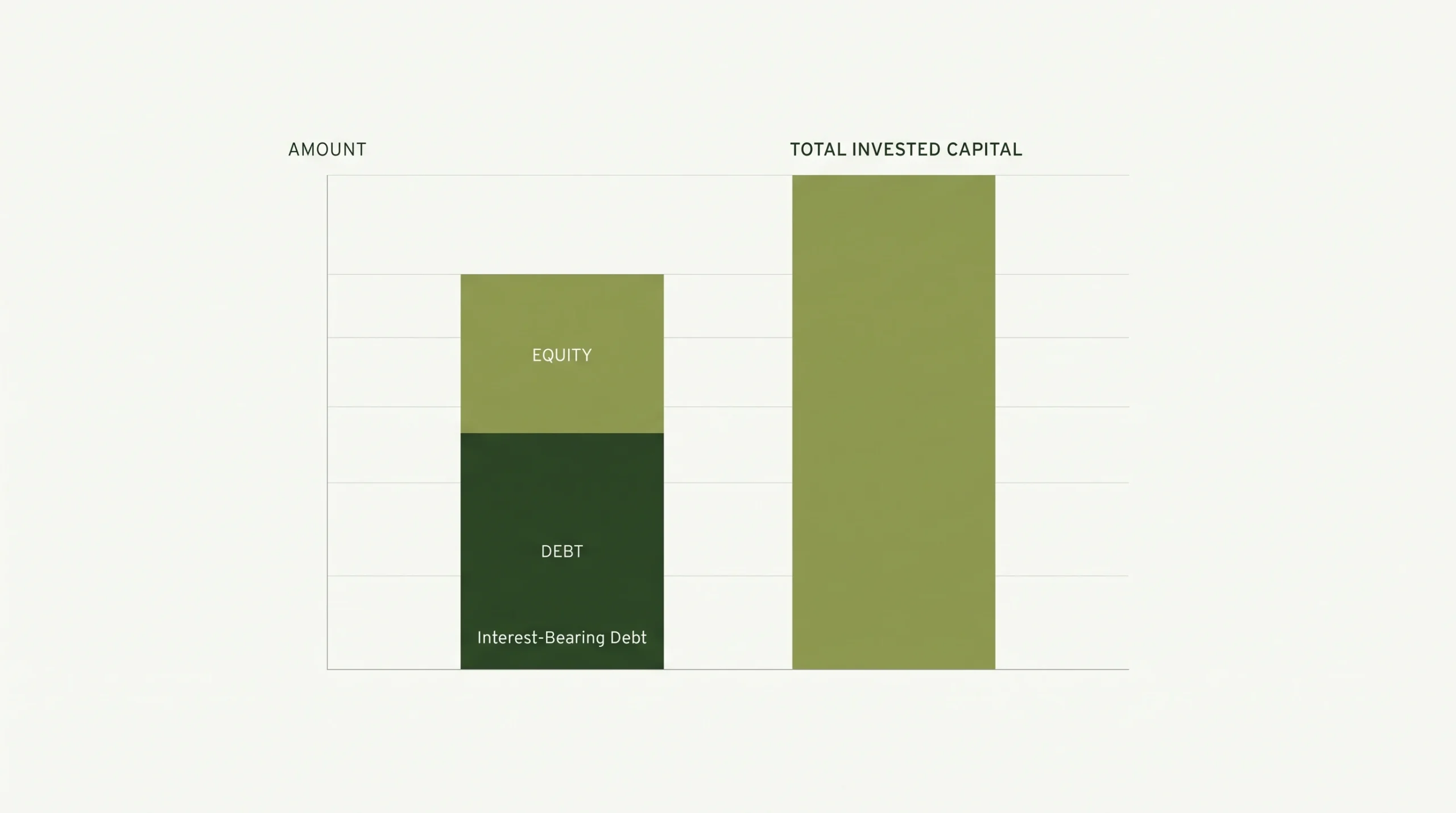
Invested capital is the total money that funds a company. It equals total equity plus all interest-bearing debt. The figure shows the money that lenders and owners keep at work. Appraisers use it to build the market value of invested capital, or MVIC. Deal databases such as DealStats record most private sales as MVIC, not as an equity price. Sofer Advisors treats this total as the base for most private-company value work.
Getting this base right matters because nearly every market multiple and return measure builds on it. Use equity value where invested capital belongs, and the multiple no longer matches the earnings beneath it. That single mismatch can distort a deal price, a tax filing, or a lending decision. Knowing which figure applies keeps the rest of the analysis honest.
Key Takeaways
- Definition: Invested capital is total equity plus all interest-bearing debt.
- Two views: You can build it from operating assets or from funding sources.
- Link to MVIC: It forms the market value of invested capital, a whole-company figure.
- Not equity value: It counts debt too, so it sits above equity value.
- Multiple base: Market multiples like MVIC/EBITDA divide this total by earnings.
These points tie funding to value. The sections below show how to calculate the figure, how it links to MVIC and enterprise value, and when a valuator puts it to work.
How do you calculate invested capital?
You can find invested capital in two ways, and standard references like the Corporate Finance Institute lay out both. The financing view adds total debt to total equity, then strips out excess cash. The operating view sums the assets that run the business. That set includes net working capital, plant and equipment, goodwill, and other operating assets. Both paths should reach the same total. Analysts pick the side with cleaner data.
The financing view starts on the right side of the balance sheet. It asks how the company raised its money. The operating view starts on the left. It asks where that money now sits. One mislabeled account can split the totals apart. So the team ties them back together before trusting either number. Under AICPA SSVS, the method must match the facts of the job. That care keeps the base clean for every ratio built on it.
What is the market value of invested capital?
The market value of invested capital, or MVIC, is the whole-company price. It equals the market value of equity plus the market value of debt. MVIC counts every claim on the business, not just the owners’ share, and it sits very close to enterprise value, with the gap being just the surplus cash that enterprise value nets out. Most private deal prices use this basis.
MVIC answers a plain question. What is the entire operation worth to all funders? A buyer cares about that figure because the debt comes along too. Completed sales in databases such as DealStats are reported on this whole-company footing. So appraisers match a company against MVIC-based deals, not equity prices. Enterprise value works much the same. It measures the core operating business, free of idle cash. Sofer Advisors walks owners through each layer so the final price makes sense.
Invested capital versus equity value: what is the difference?
Invested capital is not the same as equity value. Equity value is the owners’ slice after all debt is paid, whereas invested capital adds that debt straight back in, so it sits above equity value whenever a company carries debt. The two answer different questions. One is the owner’s stake. The other is the whole capital structure.
Mixing the two causes real errors. A multiple built on MVIC must never touch equity earnings, because debt changes the size of the claim and thus the value you land on. The table below sorts the main measures. It shows what each one counts and where each one fits when you gauge how much a whole business is worth.
| Measure | What it counts | Count debt? | Common use |
|---|---|---|---|
| Equity value | Owners’ share after debt | No | Return on equity, share price |
| Invested capital | Equity plus interest-bearing debt | Yes | Return on invested capital, ROIC |
| Enterprise value / MVIC | Whole operating business | Yes | Market multiples, deal pricing |
Each measure has a proper home. Return on equity tests the owners’ slice alone. Return on invested capital, or ROIC, tests the full pool of funding. Deal multiples lean on MVIC because a buyer prices the whole business. Sofer Advisors picks the measure that matches the standard of value in play. Fair market value for a tax filing and fair value for financial reporting can call for different treatment. That choice, made early, keeps every later figure steady and easy to defend.
When is invested capital used?
Invested capital shows up most in market multiples. The best known is MVIC/EBITDA. You take the whole-company price and divide it by earnings before interest, taxes, depreciation, and amortization. Because MVIC and EBITDA both sit above the debt line, the pair matches cleanly. Other multiples use revenue or cash flow the same way. Each one turns a market fact into a value for your company.
This method fits the market approach to value. An appraiser gathers sales of similar firms, and each sale gives an MVIC and an earnings figure, so it yields a multiple. The team then applies a fitting EBITDA multiple to your normalized earnings. The result is an enterprise value. Invested capital also feeds the income approach, where it sets the reinvestment a firm needs to grow, which in turn shapes free cash flow to the firm. IRS Revenue Ruling 59-60 lists the market approach among the methods a valuator should weigh.
What adjustments are made to invested capital?
Adjustments strip out items that do not run the business. The goal is a clean base for ROIC. Analysts remove non-operating assets, such as stakes in other firms. They also pull out excess cash beyond daily needs. Leaving these in would pad the base and hide true results. A clean figure lets you compare firms fairly.
Lease accounting adds another step. Under ASC 842, firms must record operating leases on the balance sheet. The team adds the present value of those leases to the capital base. This puts a company that rents its space on the same footing as one that owns. Normalized earnings get the same care. One-time gains and owner perks come out first. This is the Heart of a Teacher approach in practice: show the owner why each item stays in or comes out.
Where do valuators find invested-capital data?
Valuators pull pricing data from private-deal databases. DealStats records thousands of sales, each on an MVIC basis. The Kroll Cost of Capital Navigator supplies risk and return inputs. Together they let an appraiser price a private company against real market evidence. Public finance sites explain the ideas. They cannot support a tax filing or a court case.
There is a wide gap between a rough estimate and a defensible number. This is where The Sofer Difference matters. It runs in four phases: Discovery, Diligence, Analysis, and Delivery. Each phase leaves a clear trail an auditor can follow. Large firms such as Alvarez and Marsal and Kroll aim at enterprise clients. Sofer Advisors brings that senior-level rigor to middle-market owners. Unlike a solo practitioner, it backs every conclusion with proof. The firm keeps a full W2 team of 14 and holds 180+ five-star Google reviews. It also answers by the next business day.
Frequently Asked Questions
Is invested capital the same as equity?
No. Equity is only the owners’ share after every debt is paid. Invested capital adds all interest-bearing debt back to that equity. So it shows the full pool of long-term funding at work. A company with heavy borrowing can hold a large invested-capital figure yet a small equity value. The team maps both on your balance sheet so the split is clear.
Do you include cash in invested capital?
Most analysts leave out excess cash. That balance often sits idle and does not run the business. Counting it would pad the base and lower reported ROIC. The team keeps only the cash a firm needs each day. During diligence, we split working cash from surplus reserves. This keeps the capital figure tied to the working side of the business.
What is the difference between invested capital and total assets?
Total assets list every resource a company owns. Invested capital counts only the long-term money from lenders and owners. Some items, such as trade payables, fund the business without a capital cost. Those drop out of invested capital but stay in total assets. This is why return on assets and ROIC can point in different directions for the same firm.
How does invested capital relate to enterprise value?
They are close cousins. Enterprise value measures the core business, with surplus cash netted out. The market value of invested capital covers the same whole-company claim. In practice the two figures sit near each other. Both rise above equity value because they include debt. We use whichever frame fits the multiple and the standard of value in play.
What is MVIC/EBITDA used for?
MVIC/EBITDA is a market multiple. It divides the whole-company price by earnings before interest, taxes, depreciation, and amortization. Because both parts sit above the debt line, the ratio compares firms fairly. Appraisers pull it from sales of similar private companies. They then apply a fitting multiple to your normalized earnings to reach an enterprise value.
Can invested capital be negative?
It can, though the case is rare. A firm may hold cash and non-operating assets larger than its debt and equity funding. That can push the net figure below zero. It often points to very light capital needs or lots of idle cash. Sofer Advisors reviews these balance sheets closely to tell real efficiency from an odd structure.
How does goodwill affect invested capital?
Goodwill stays in invested capital. It records the premium paid over tangible book value in past deals. Keeping it in means ROIC reflects the full price of growth by purchase. Strip it out, and the return would look better than the cash actually spent. The team tracks goodwill so returns show the true cost of past deals.
Which formula is better, the operating or financing approach?
Neither wins on its own. Both aim at the same total, so the choice rests on data quality. The operating view suits clean asset records. The financing view suits clear debt and equity detail. The team picks the path with less noise for your books. We often run both and match them before trusting the base.
How much does a business valuation from Sofer Advisors cost?
Business valuations from Sofer Advisors often run 7,500 to 25,000 dollars. The range depends on the complexity and scope of the work. Simple jobs for planning or a tax filing sit near the lower end. Deals and litigation support need deeper analysis, so they fall higher. Contact the firm for a fee quote matched to your situation.
Related Case Studies
- Guideline Public Company Method: Comp Sets
- Debt Capacity: How Much Leverage a Business Supports
- Levered vs Unlevered Beta in Private Valuation
Executive Summary
Invested capital is total equity plus all interest-bearing debt. It forms the market value of invested capital, or MVIC, a whole-company figure that sits close to enterprise value. Appraisers divide MVIC by earnings to build multiples such as MVIC/EBITDA. The measure differs from equity value, which counts only the owners’ share. Clean adjustments matter: analysts remove excess cash and non-operating assets, then add leases under ASC 842. Sound work follows IRS Revenue Ruling 59-60 and AICPA SSVS. David Hern CPA ABV ASA and the Sofer Advisors team price each base against DealStats market evidence. Valuations run 7,500 to 25,000 dollars.
What Should You Do Next?
Start by splitting your funding into interest-bearing debt and equity. Then pull out excess cash and non-operating assets so the base reflects real operations. Finally, decide whether you need MVIC, enterprise value, or equity value for your purpose.
For a base you can defend, work with David Hern CPA ABV ASA. His team has given expert witness testimony in 11+ cases across Georgia, Florida, California, and New Mexico. Schedule a consultation to map the right value base for your business.
People Also Read
About the Author
This guide was prepared by David Hern CPA ABV ASA, founder of Sofer Advisors, a business valuation firm headquartered in Atlanta, GA serving clients across the United States. David holds dual accreditations as an Accredited Senior Appraiser (ASA) and is Accredited in Business Valuation (ABV), credentials recognized by the IRS, SEC, and FINRA. He also holds the Certified Exit Planning Advisor (CEPA) designation. With 15+ years of valuation experience, David has served as an expert witness in 11+ cases across multiple jurisdictions and built Sofer Advisors into an Inc. 5000-recognized firm with 180+ five-star Google reviews. Its full W2 employee team maintains subscriptions to all major valuation databases and operates under a next business day response policy. For professional business valuation services, visit soferadvisors.com/about-us/ or contact Sofer Advisors at soferadvisors.com/contact-us/.
Disclaimer: This content is for informational purposes only and does not constitute professional valuation advice. Business valuation conclusions depend on specific facts and circumstances. Contact Sofer Advisors for guidance regarding your specific situation.