


Last Updated: September 2026
An undivided fractional interest discount lowers the value of a partial stake in a co-owned asset. It reflects two problems. A part owner cannot control the asset alone. A part owner also cannot sell the share with ease. Appraisers size the discount using market sales and partition costs. Most discounts fall between 15% and 35%. The exact figure depends on the facts of each case.
This discount matters most for estate and gift tax. When an owner dies, the estate reports each asset at fair market value. A fractional stake is worth less than a clean share of the whole. The federal estate and gift tax exemption is now permanent at $15 million per person, or $30 million per married couple, under the 2025 OBBBA law. A sound discount can still lower the taxable estate.
Sofer Advisors prepares these valuations for owners, attorneys, and CPAs. The Atlanta firm holds 180+ five-star Google reviews and has testified in 11+ expert witness cases. Its team explains the math in plain terms, a Heart of a Teacher approach. Each report ties the discount to real evidence, so it can stand up to IRS review.
Key Takeaways
- What it is: a downward adjustment that reduces the taxable value of a co-owned asset for estate and gift tax.
- What drives it: the discount for lack of control (DLOC) and the discount for lack of marketability (DLOM).
- Typical range: often 15% to 35%, but each case is sized on its own facts, not a fixed rule.
- IRS scrutiny: the agency challenges thin or aggressive discounts, so the evidence must be strong.
- Common assets: real estate held as a tenancy in common, plus other illiquid, co-owned holdings.
Each of these factors depends on the asset and its governing documents. The sections below explain how each one works.
How does a fractional interest discount work?
A fractional interest discount works by pricing the burdens of partial ownership. Two parts drive it. The discount for lack of control, or DLOC, reflects that a part owner cannot act alone. The discount for lack of marketability, or DLOM, reflects that no easy market exists for a partial share. Together, they pull the value below a simple pro rata number.
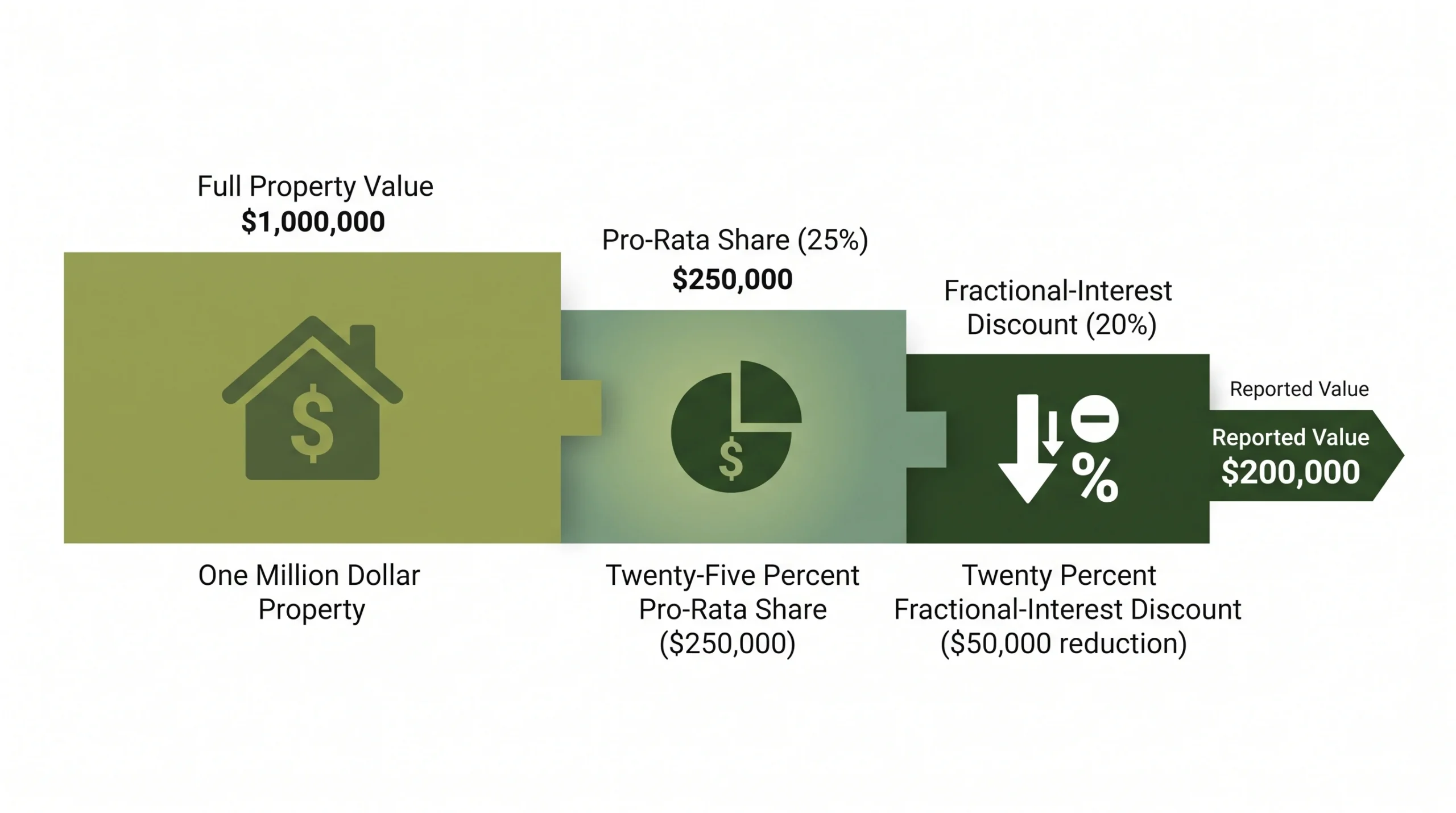
A short example helps. Say a property is worth $1 million. A 25% stake is not worth a flat $250,000. A buyer would pay less for the limits that come with a minority share. The buyer cannot force a sale or a refinance. The buyer cannot pick the tenants or the timing.
Partition cost sets much of the size. Partition is the legal step to force a split or a sale of the asset. It brings lawyers, court time, and delay. Appraisers add up those costs. They also weigh the loss from a rushed sale. That total, tested against real deals, becomes the discount. The result is a fair market value for the exact interest being transferred, not the whole asset.
Which assets qualify for this discount?
Co-owned, hard-to-sell assets qualify for this discount. Real estate held as a tenancy in common is the most common case. Each owner holds a share of the whole, not a marked-off piece of land. That share is hard to sell on its own. A buyer inherits every limitation that comes with shared title.
Other assets follow the same logic. A family vacation home split among siblings is one. A commercial building held by several investors is another. Interests in a family limited partnership (FLP) qualify as well. Art, timberland, and farmland can qualify too. The shared trait is joint title with limits on selling a single share. Under the Uniform Standards of Professional Appraisal Practice (USPAP), the appraiser must back the discount with market evidence, not a guess.
How does the IRS view these discounts?
The IRS views these discounts with care and often challenges them. When a return claims a discount, the agency checks the proof. The burden of proof falls on the taxpayer, not the IRS. A clear, well-supported report is the best defense. A vague one invites a fight.
Tax courts have accepted fair discounts for decades. The key is facts, not opinion. Cases like Estate of Bonner show that courts reward reports that show the math. Estate tax filings that skip this proof draw an audit. A weak discount can be cut or denied. That can add tax, interest, and penalties. IRS Revenue Ruling 59-60 sets the fair market value standard that every report should follow. A credentialed appraiser gives the number the weight it would not have alone.
What factors set the discount size?
The discount size depends on the owner’s rights, the number of co-owners, and the cost to split the asset. More owners make a sale harder to agree on. Fewer rights make the share less appealing to a buyer. Higher partition costs point to a larger discount. Each fact is weighed on its own.
A buy-sell agreement can shrink the discount. It gives an owner a clear way to cash out. Without one, an owner may need a partition action to exit. That path costs money and takes many months. Appraisers price that cost and delay. State law and the operating agreement also shape the result. A tight agreement can limit the discount, while a loose one can widen it.
How is a fractional interest discount calculated?
Appraisers calculate the discount by modeling a forced sale of the partial share. The main tool is the cost-to-partition method. It adds up the cost and delay of splitting or selling the asset. That total becomes the base for the discount. The result is then tested against the market.
The model counts legal fees, appraisal fees, and broker commissions. It also adds a price cut for a rushed sale. Next, appraisers check the figure against real deals. Databases hold prices from past fractional interest sales. This benchmark keeps the number grounded in fact. Our guide to minority interest and marketability discounts covers the same tools.
Estate returns need a report that a reviewer can follow line by line. For estate and gift filings, Sofer Advisors ties each number to tax reporting valuation evidence. The team shows the partition math, the market comps, and the source for each input. That paper trail is what turns a discount into a defensible figure. It also gives the executor and the attorney a clear record if the IRS asks questions.
What are the risks of claiming this discount?
The main risk is an IRS audit that cuts or denies the discount. That can raise estate tax and add interest and penalties. Aggressive or thin discounts draw the most scrutiny. The taxpayer must then defend every number. A strong report lowers this risk from the start.
A credentialed expert makes the difference. Look for a CPA with an ABV, or an appraiser with an ASA. The report should show the rationale, the evidence, and the method. It should tie back to American Society of Appraisers standards and Revenue Ruling 59-60. A disciplined valuation process moves through discovery, diligence, analysis, and delivery. That structure keeps each report clear and easy to defend.
The way an asset is held also shapes the discount. The table below compares common structures and the firms that value them.
| Structure or provider | Best suited for | Discount driver | Key point |
| Tenancy in common (TIC) | Direct property co-ownership | Lack of control and partition cost | Simple to form, but costly to exit |
| Family limited partnership | Gifting several assets at once | Terms of the partnership deed | Discount tied to the agreement |
| Sofer Advisors | Estate and gift tax filings | Evidence-based appraisal report | Built to withstand IRS review |
| Large firms (Kroll, Stout) | Large or complex portfolios | Enterprise-level analysis | Aimed at big corporate work |
Each choice carries a trade-off. A tenancy in common is easy to set up, yet a split can trigger costly partition. A family limited partnership adds structure, so the discount rests on the deed. Large firms like Kroll, Stout, and Alvarez & Marsal serve enterprise clients. Sofer Advisors focuses on middle-market owners who need senior attention and a report that holds up. The right pick depends on the asset, the goal, and the tax deadline ahead.
A defensible discount rests on evidence, not opinion. The questions below cover what owners and advisors ask most.
Frequently Asked Questions
What does undivided fractional interest mean?
An undivided fractional interest is a partial ownership stake in an asset. Each owner holds a right to use and benefit from the whole property. No owner holds a marked-off piece, such as one room or one acre. Instead, each holds a percentage of the entire asset. A qualified appraiser reviews the rights tied to that interest to see how control limits affect its value.
What is a fractional interest discount in real estate?
A fractional interest discount in real estate is a downward adjustment to the value of a partial stake. It reflects the burdens of co-ownership. Those include limited control, weak liquidity, and the cost of a partition action. The discount shows what a buyer would really pay for the share. A qualified appraiser sizes it from the legal and market limits a buyer would face.
What are the downsides of fractional ownership?
The main downsides are a loss of control, limited liquidity, and the cost of settling disputes. A part owner cannot sell or refinance the whole asset alone. Exiting the position may require a costly partition action. Selling the share on the open market is hard. A qualified appraiser studies these risks so the valuation reflects the real limits of holding a minority share.
What is undivided ownership of an estate with an interest exclusive from other owners?
This describes a setup like a tenancy in common. An owner holds a set percentage of a property while sharing access to the whole. The percentage is exclusive to that owner, but the use is shared. Each owner’s power is limited by the rights of the others. A qualified appraiser weighs these overlapping rights to set the right discount for the lack of control.
How much does a fractional interest valuation cost?
A fractional interest valuation runs $7,500 to $25,000. The fee depends on the asset mix, the number of owners, and the depth of analysis. A single property costs less than a portfolio of holdings. Most reports take four to eight weeks. For a quote tied to your estate, schedule a consultation with your deeds and agreements.
What is the difference between a fractional interest and a minority interest?
A fractional interest is a stake in a tangible asset, such as real estate. A minority interest is a partial stake in a business entity, such as shares in a company. Both suffer from a lack of control. The valuation method differs by asset type and legal form. A qualified appraiser values both, keeping the discounts for lack of control and marketability defensible.
Can you apply a fractional interest discount to a partnership interest?
Yes. A discount often applies to a partnership interest. The partnership deed usually limits an owner’s right to transfer shares or manage the entity. Those limits cut the marketability and control of the interest. That makes it worth less than a direct share of the assets. A qualified appraiser reviews the deed and state law to confirm how each limit supports the discount.
What documents are needed for a fractional interest valuation?
You need the property deed, title reports, and any partnership or operating agreement. You also need financial records for the asset over the last three to five years. Records of past sales, appraisals, or disputes help set a baseline. The appraiser reviews these during the diligence phase. Together, they form the evidence base for a compliant and defensible report.
How long does a fractional interest valuation take?
A fractional interest valuation usually takes four to eight weeks from the start of the work. That window allows property research, review of comparable deals, and drafting of the report. Complex assets or many owners can add time. A qualified appraiser sets the timeline to fit tax deadlines. That way, owners have the report well before a filing or a transfer is due.
Related Case Studies
- Valuation Discounts (DLOC and DLOM) on Estate and Gift Tax Returns
- How Family Limited Partnerships Are Valued for Gift and Estate Tax
- Minority Interest and Marketability Discounts Guide
Executive Summary
An undivided fractional interest discount lowers the estate tax value of a partial stake in a co-owned asset. Two forces drive it: a lack of control (DLOC) and a lack of marketability (DLOM). Appraisers size it from partition costs and real market deals, often landing at 15% to 35%. The IRS challenges thin or unsupported discounts, and the burden of proof sits with the taxpayer. A report tied to Revenue Ruling 59-60 and USPAP is the best defense. Gather deeds, agreements, and three to five years of records, then get an independent valuation before you file.
What Should You Do Next?
Start by gathering the governing documents, such as the deed, the operating agreement, or the partnership deed. Next, pull three to five years of financial records and a full list of the underlying assets. Then confirm your filing deadline, so the report is ready in time. These steps give the appraiser the evidence needed to size a defensible discount.
David Hern CPA ABV ASA, founder of Sofer Advisors, helps owners and their advisors prepare defensible reports that fit current tax rules. The Inc. 5000 firm focuses on neutral, third-party valuations for tax reporting, gift planning, and dispute work. Schedule a consultation to discuss your situation.
People Also Read
- Valuation of Closely Held Business for Estate Tax Purposes
- Fair Market Value for Estate Tax: What Executors Need
About the Author
This guide was prepared by David Hern CPA ABV ASA, founder of Sofer Advisors, a business valuation firm headquartered in Atlanta, GA serving clients across the United States. David holds dual accreditations as an Accredited Senior Appraiser (ASA) and is Accredited in Business Valuation (ABV), credentials recognized by the IRS, SEC, and FINRA. He also holds the Certified Exit Planning Advisor (CEPA) designation. With 15+ years of valuation experience, David has served as an expert witness in 11+ cases across multiple jurisdictions and built Sofer Advisors into an Inc. 5000-recognized firm with 180+ five-star Google reviews. Its full W2 employee team maintains subscriptions to all major valuation databases and operates under a next business day response policy.
For professional business valuation services, visit soferadvisors.com/about-us/ or contact Sofer Advisors at soferadvisors.com/contact-us/.
Disclaimer: This content is for informational purposes only and does not constitute professional valuation advice. Business valuation conclusions depend on specific facts and circumstances. Contact Sofer Advisors for guidance regarding your specific situation.









