


Last Updated: September 2026
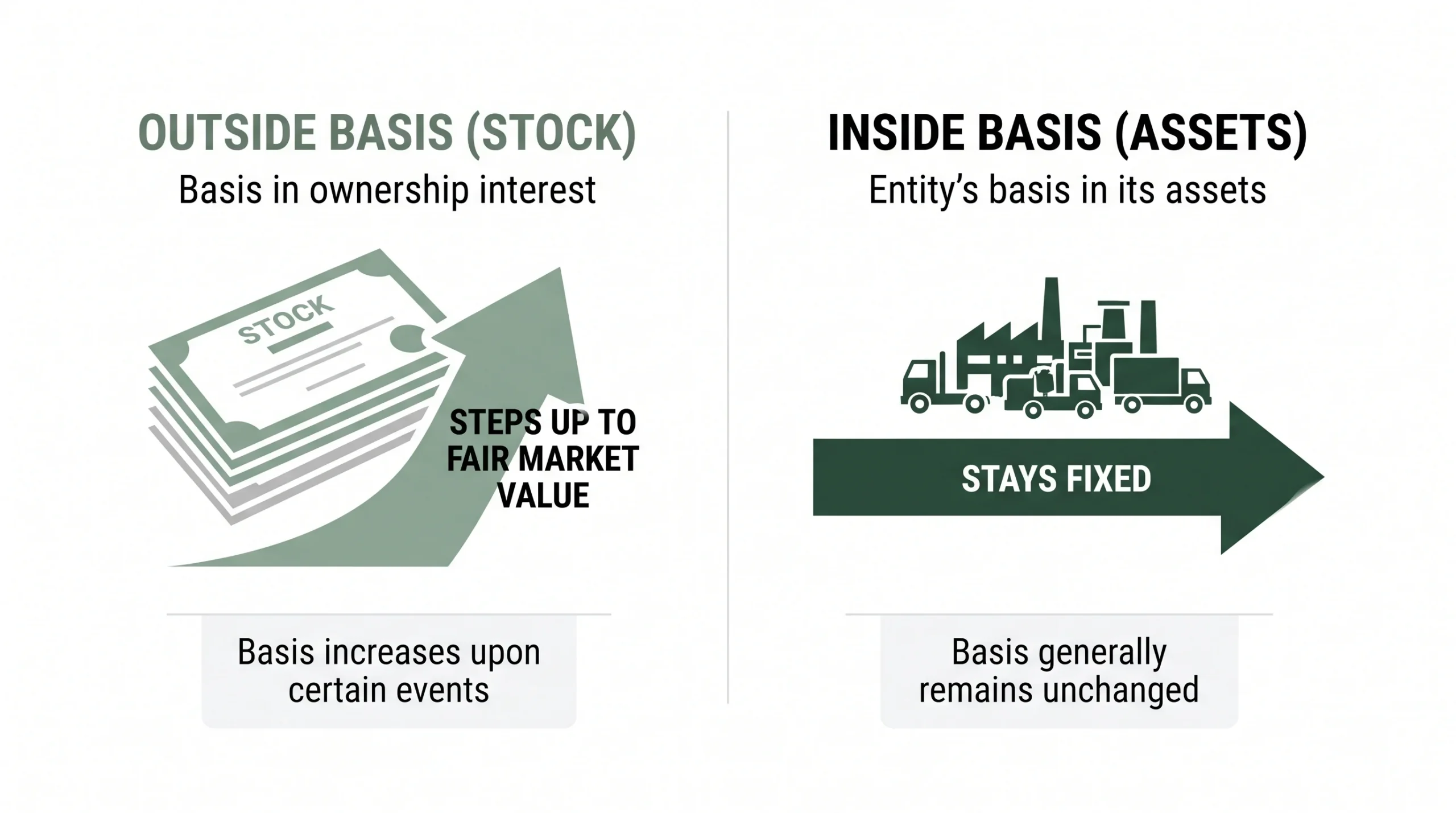
An S corp step-up in basis at death resets the tax cost of a decedent’s stock to its fair market value on the date of death. This rule lives in Internal Revenue Code Section 1014. It applies to the stock, which advisors call the outside basis. It does not touch the company’s own assets, which they call the inside basis. That single gap surprises many families. It can leave heirs with a tax bill even after a full step-up on the shares.
This matters most during estate settlement. Heirs inherit stock, not the underlying assets. So the assets keep their old, low tax basis inside the company. A later asset sale can trigger a large gain that flows straight to the heirs. Clear planning and a defensible valuation help families see this risk before it becomes a bill.
Sofer Advisors is a business valuation firm based in Atlanta, GA, that serves clients across the United States. It prepares neutral, third-party reports for estate, gift, and tax matters. Each report follows recognized standards and holds up under IRS review.
Key Takeaways
- Stock steps up, assets do not: Only the S corp stock receives a basis step-up at death. The company’s inside asset basis stays the same.
- The hidden tax trap: Heirs can owe tax on a corporate asset sale. The low inside basis holds a built-in gain that passes through to them.
- No Section 754 fix: An S corp cannot make the inside basis election that partnerships use. The historical asset basis stays locked in place.
- Valuation is required: A formal appraisal sets the fair market value of the stock for the estate tax return. It supports the stepped-up outside basis.
- Planning reduces the pain: Life insurance, buy-sell agreements, and entity choices can fund or lower the future tax. Early action gives heirs more room.
These rules shape the money heirs keep after a shareholder passes away. The sections below explain how the basis works and how a valuation supports the estate.
What is a step-up in basis at death?
A step-up in basis resets the tax cost of an inherited asset to its fair market value on the date of death. The rule sits in Section 1014 of the tax code. It spares the heir from tax on the growth that built up while the prior owner held the asset. Only gains after the date of death remain taxable. For public stock, the value is easy to find. For a private company, it takes a formal appraisal.
This reset protects heirs from decades of pre-death appreciation. The IRS explains the basis of assets and points to the value at the date of transfer for inherited property. A private business interest has no public price, so an appraiser must build the value with market and income methods. Our guide on the stepped-up basis at death covers the broad rule. The S corp version carries one sharp twist.
Why is there no inside basis step-up for an S corp?
An S corp gets no inside basis step-up because the law treats the company as separate from its owners. When a shareholder dies, the stock steps up to fair market value. That is the outside basis, and it belongs to the heir. The company’s assets do not move at all. The corporation still owns the same property at the same old basis. The death of an owner is not a taxable event for the company, so nothing resets inside.
A partnership can handle this better. It may make a Section 754 election and adjust the inside basis of its assets to match the new outside basis. An S corp has no such election, so it keeps the historical cost basis in its property. If the business later sells an appreciated asset, it must report the full gain. That gain passes through to the shareholders and lands on their personal returns.
How is an heir’s S corp stock basis set?
An heir’s starting basis equals the fair market value of the stock on the date of death. This is the stepped-up outside basis. A formal valuation fixes that number for the tax return. Without a defensible value, later gain or loss figures can be wrong. The starting point drives every calculation that follows.
After that, the heir adjusts the basis for how the company runs. Basis goes up when the S corp passes through income, and it goes down when the company makes distributions. The heir also tracks the capital account to see how profits and losses shift the total investment. Our guide on how S corp owner basis is tracked shows why these entries matter at a future sale.
What are the tax risks for heirs?
The main risk shows up when the stock has a high outside basis, but the assets keep a low inside basis. A later asset sale creates a gain inside the company. That gain passes through to the heir, who owes the tax. The bill can arrive even when no cash reaches the heir. This mismatch is the built-in gain problem estate planners watch for.
Consider a simple example. An S corp holds land with a tax basis of $100,000 and a fair market value of $1,000,000. The owner dies, and the heir receives stock with a stepped-up basis of $1,000,000. If the company sells the land for $1,000,000, it reports a gain of $900,000. That gain flows to the heir. If the company keeps the cash, the heir still pays the tax out of pocket. Planning is the only way to soften that squeeze.
Can you plan around the missing inside basis step-up?
Yes, owners can plan around it with the right tools in place before death. The goal is liquidity, so heirs are not forced to sell in a hurry. A well-drafted buy-sell agreement sets clear terms for how ownership moves. Life insurance can supply cash to cover the tax or fund a buyout. The common moves are:
- Fund a buy-sell agreement with life insurance to give heirs ready cash.
- Review whether selling certain assets before death makes sense for the family.
- Study a possible switch to a partnership or LLC to reach a Section 754 election.
Each option carries its own tax and legal trade-offs, so owners should weigh them with their CPA and attorney. A change in entity type can trigger its own tax cost. Early estate planning stays the best defense against unrealized gains. When owners act years ahead, they have more room to shape the outcome.
What role does a valuation play?
A valuation sets the fair market value of the S corp stock for the estate tax return. The IRS wants firm support for that number on Form 706, the estate tax return. A formal report follows Revenue Ruling 59-60 and applies USPAP standards so the value holds up. It gives heirs a defensible basis for the stepped-up stock and guides buy-sell pricing. Sofer Advisors applies these rules to every estate file.
The numbers still matter even when no estate tax is due. Federal law now sets a permanent estate tax exemption of $15 million per person, or $30 million for a married couple, under the 2025 tax act with no sunset. Many estates owe zero estate tax yet still face income tax when the company sells appreciated assets. National firms such as Alvarez & Marsal, Stout, and Kroll handle the largest engagements, while Sofer Advisors focuses on middle-market owners who want senior attention on every file. That focus has earned 180+ five-star Google reviews and a next-business-day response policy.
| Provider type | Main focus | Best fit |
| Independent valuation firm | Neutral, defensible fair market value for the estate | Owners who need an IRS-ready number |
| Generalist CPA | Tax filing and general compliance | Routine returns without a complex interest |
| Estate attorney | Legal structure, trusts, and buy-sell terms | Drafting and enforcing the plan |
Each role supports the others when an estate is settled well. An independent appraiser supplies the value discounts that general formulas often miss, such as adjustments for lack of control and lack of marketability. The attorney makes the documents enforceable, and the tax preparer files the return. The Sofer Difference brings these threads together through a clear four-step process: Discovery, Diligence, Analysis, and Delivery. The team works with the heart of a Teacher, so owners understand every number, not just the final figure.
Frequently Asked Questions
Does an S corp get a step-up in basis at death?
An S corp receives a step-up in the outside basis of the stock the heir inherits, but not in the inside basis of its assets. The shares reset to fair market value on the date of death. The company’s own tax basis in its property stays fixed. This split is the source of the built-in gain trap that heirs face when the business later sells appreciated assets.
What happens to an S corp when the owner dies?
When an S corp owner dies, the stock transfers to the heirs or the estate, and that stock steps up to fair market value under Section 1014. The event usually calls for a formal valuation to fix the value for the IRS. The company keeps operating, and its inside asset basis does not change. An independent report supports the tax filing during the ownership transfer.
What are common mistakes with stepped-up basis?
A frequent mistake is assuming the outside basis step-up also lifts the inside basis of the company’s assets. It does not, and that error can lead to a surprise tax on a later asset sale. Other slips include using a rough guess instead of a supported fair market value, or skipping valuation discounts. A standard, well-documented method helps prevent these costly oversights.
What is the 5 year rule for an S corp?
There is no single five-year rule for basis step-ups. The phrase usually points to the built-in gains period an S corp tracks after it converts from a C corp. If the company sells covered assets within that window, it may owe a corporate-level tax on gains that existed before the switch. Reviewing the company’s history flags any built-in gains exposure before a report is finished.
What is the difference between inside basis and outside basis?
Inside basis is the tax basis the corporation holds in its own assets, such as equipment or real estate. Outside basis is the shareholder’s tax basis in the stock. At death, the inside basis of an S corp stays the same, while the outside basis steps up to fair market value. Both figures need review to see the full tax picture of the entity and its owners.
Can an heir sell inherited S corp stock without paying taxes?
An heir may sell inherited S corp stock free of capital gains tax if the sale price is at or below the stepped-up basis set on the date of death. Any price above that basis creates a taxable gain on the difference. Because the basis ties to fair market value at death, a professional valuation helps the heir figure any gain correctly and avoid surprises.
How does a buy-sell agreement affect the stepped-up basis?
A buy-sell agreement often sets a method for pricing the stock, which can serve as evidence of fair market value for the IRS. If the price comes from an arm’s-length process, it helps support the stepped-up basis the heirs use. An independent valuation that lines up with the agreement strengthens the position and reduces the chance of a later dispute over the number.
How is the fair market value of S corp stock determined?
Fair market value is the price a willing buyer and willing seller would accept, each with full knowledge and no pressure, as defined by Revenue Ruling 59-60. An appraiser studies the company’s earnings, market position, and industry conditions, then applies income and market methods. A thorough analysis gives heirs and executors a defensible value that reflects the real economics of the business.
How much does a business valuation for estate tax cost?
A standard business valuation for estate tax purposes usually runs from $7,500 to $25,000. The final fee depends on the size and complexity of the company and the timeline for the work. Most engagements take about 4 to 8 weeks to finish. The report includes the detailed analysis needed to satisfy IRS tax reporting rules and support the stepped-up basis.
Related Case Studies
- Valuation of Closely Held Business for Estate Tax Purposes
- Fair Market Value for Estate Tax: What Executors Need
- How Family Limited Partnerships Are Valued for Gift and Estate Tax
Executive Summary
At death, an S corp owner’s stock steps up to fair market value under Section 1014, but the company’s assets do not. That outside basis step-up leaves the inside basis untouched, unlike a partnership that can elect Section 754 relief. A later sale of an appreciated asset then passes a built-in gain to the heir, who owes the tax even without cash in hand. A formal valuation fixes the stock value for Form 706 and supports the stepped-up basis. Owners who plan early with life insurance and clear agreements protect their heirs. Sofer Advisors prepares these estate valuations, priced from $7,500 to $25,000.
What Should You Do Next?
Gather three years of financial statements, the entity’s organizing documents, and any buy-sell agreements. Confirm the current inside basis of major assets so you can measure the built-in gain your heirs might face. Then talk with your CPA and attorney about life insurance or an entity change well before it is needed.
David Hern CPA ABV ASA, founder of Sofer Advisors, provides neutral, defensible valuations for estate and tax planning. Schedule a consultation to discuss your situation.
People Also Read
- Cost Basis vs Fair Market Value: Key Differences Explained
- Asset Sale vs Stock Sale: Tax and Deal Structure Guide
About the Author
This guide was prepared by David Hern, CPA, ABV, ASA, founder of Sofer Advisors, a business valuation firm headquartered in Atlanta, GA, serving clients across the United States. David holds dual accreditations as an Accredited Senior Appraiser (ASA) and is Accredited in Business Valuation (ABV), credentials recognized by the IRS, SEC, and FINRA. He also holds the Certified Exit Planning Advisor (CEPA) designation. With 15+ years of valuation experience, David has served as an expert witness in 11+ cases across multiple jurisdictions and built Sofer Advisors into an Inc. 5000-recognized firm with 180+ five-star Google reviews. Its full W2 employee team maintains subscriptions to all major valuation databases and operates under a next-business-day response policy.
For professional business valuation services, visit soferadvisors.com/about-us/ or contact Sofer Advisors at soferadvisors.com/contact-us/.
Disclaimer: This content is for informational purposes only and does not constitute professional valuation advice. Business valuation conclusions depend on specific facts and circumstances. Contact Sofer Advisors for guidance regarding your specific situation.









