


Last Updated: August 2026
A capitalization rate is the return an investor expects on one steady period of a company’s income. Divide the income by the rate to get the value. Cost of capital data from the Kroll Cost of Capital Navigator shows a wide range. Cap rates run from about 8 percent for stable, low-risk firms to more than 25 percent for smaller, riskier ones. A small shift in the rate moves the final number sharply. For that reason, Sofer Advisors treats the cap rate as one of the biggest calls in any job.
What sits behind the rate is risk. Customer concentration, owner reliance, thin margins, and an unsteady industry all push it higher, while steady results and long contracts pull it lower. Because the rate divides into earnings to set value, even a one point move can swing the final number by six figures. That is why the choice of rate must rest on current market evidence, not a generic benchmark.
Key Takeaways
- Definition: A cap rate is one period of net operating income divided by the asset’s value. It is shown as a percent return.
- Inverse to value: A lower rate means lower risk and a higher business value. A higher rate does the opposite.
- Income approach tool: The rate drives the Capitalization of Earnings Method. It fits mature firms with steady earnings.
- No universal number: A sound rate depends on industry, company size, growth, and risk. No fixed benchmark applies.
- Different from a discount rate: A cap rate values one period. A discount rate values many future periods of cash flow.
These points show how income ties to risk. The sections below explain how pros build the rate. They also show how to apply it and defend it for a deal, tax filing, or dispute.
How is the capitalization rate calculated?
You find a cap rate by dividing net operating income (NOI) by the current market value of the asset. Written out, that is Cap Rate = NOI / Value. To get NOI, start with gross revenue, then subtract operating costs before interest, taxes, depreciation, and amortization. When the goal is value, appraisers flip the formula. They divide expected earnings by a fitting rate to solve for value itself.
Good results depend on clean inputs. One mislabeled expense changes NOI and shifts the answer. That is why adjusted earnings matter as much as the rate. The firm recasts past statements to strip out one-time items and owner costs, then applies a rate backed by market evidence. This reflects the Heart of a Teacher approach the firm brings to every job: show the owner the math, not just the answer.
What does a cap rate tell you about risk?
A cap rate is a direct read on risk. A low rate means the market sees stable, safe earnings. It then assigns a higher value. A high rate signals doubt and pushes value down. The rate shows how sure a buyer is that next year’s income will really arrive. That is why two firms with equal earnings can carry very different values.
Specific factors move the rate. Heavy reliance on a few customers raises it, as do a single owner, thin recurring revenue, and a volatile industry. Steady past results, a broad client base, and lasting contracts lower it. Sofer Advisors measures these drivers with databases such as DealStats and the Kroll Cost of Capital Navigator. So the final rate reflects the real business, not a generic average.
What is a good capitalization rate?
No single cap rate is right for every company. The correct rate depends on the industry. It is also sized to the firm’s own risk. A mature, well-run firm with steady cash flow may support a rate of 8 to 12 percent. A smaller, high-growth, or shaky company often needs 20 to 30 percent or more. That higher rate covers uncertain earnings. The higher the rate, the harder future income is discounted, and the lower the value.
Picking the rate means matching it to the risk. It must also fit the purpose of the work and the assets involved. A rate chosen for internal planning will not survive IRS or court review without evidence. Sofer Advisors builds each rate against current market data. So the answer holds up under review.
How do cap rates and discount rates differ?
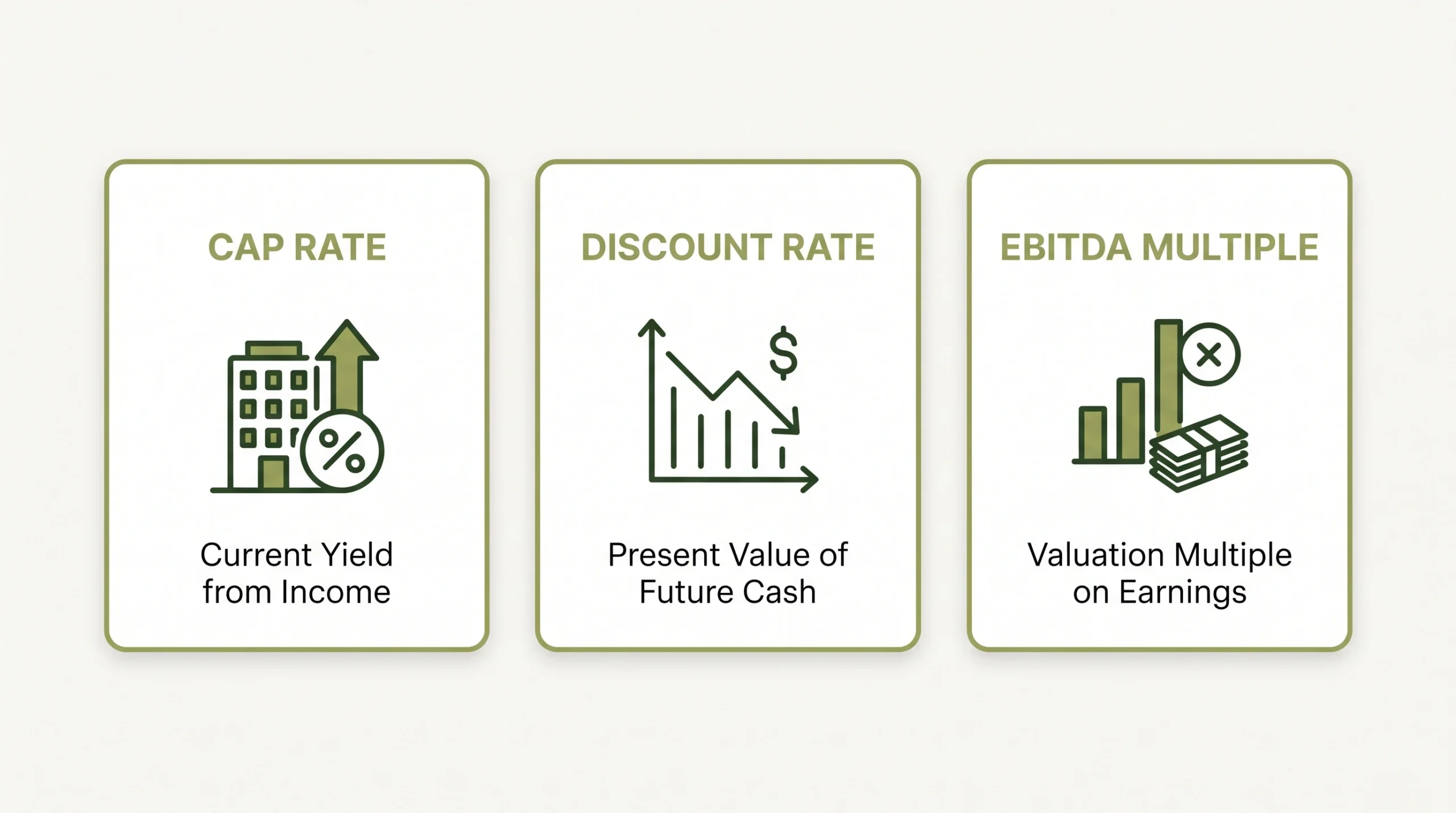
A cap rate and a discount rate differ in the span of time they measure. A cap rate applies to one steady period of earnings. A discount rate applies to a full stream of future cash flows in a discounted cash flow analysis. The two connect through the Gordon Growth Model. There, the cap rate equals the discount rate minus the long-term growth rate. That link keeps a terminal value in step with the growth and risk assumptions used elsewhere in the model.
| Metric | What it measures | Time horizon | Formula | Best suited to |
|---|---|---|---|---|
| Capitalization rate | Return on one stabilized period | Single period | NOI / Value | Mature, stable earnings |
| Discount rate | Return across future periods | Multi-period | Used to discount cash flows in a DCF | Growing or variable cash flows |
| EBITDA multiple | Value relative to earnings | Market-implied | Value / EBITDA | Benchmarking against comparable sales |
Grasping this prevents a common error. You should not use a single-period rate on a company whose earnings are still climbing. For growing firms, a discount rate and a clear projection give a more defensible answer. The method must fit the company, not the other way around.
Which valuation method uses a cap rate?
The cap rate is the engine of the Capitalization of Earnings Method. That method sits within the income approach. It takes one period of adjusted economic benefit. Then it divides that by a rate that reflects both growth and risk. The result is an enterprise value without multi-year projections. It suits stable, mature firms. Their results are steady enough to show with a single figure.
The work starts with normalization. An analyst adjusts past results to remove one-time items and personal expenses. This shows the true earning power of the business. That figure is then divided by a market-backed cap rate to reach value. The approach is a preferred standard under IRS Revenue Ruling 59-60. It yields a clear, defensible number that owners and reviewers can follow.
Where do valuators find cap rate data?
Valuators develop a cap rate in one of two ways. They build it or they observe it. The build-up method starts with a risk-free rate, then adds premiums for equity risk, company size, industry, and company-specific risk. The inputs come from the Kroll Cost of Capital Navigator. The market method instead studies completed private deals. It shows how buyers priced similar companies. The data comes from databases such as DealStats, and the process must meet the USPAP standards set by The Appraisal Foundation.
There is a real gap between broad market context and a specific, defensible answer. One is a general reference. The other is a valuation that survives audit. Public finance sites explain the idea. But they cannot support a tax filing, court case, or deal. This is where The Sofer Difference matters. It is a four-phase process of Discovery, Diligence, Analysis, and Delivery that yields an audit-ready report. Large firms such as Alvarez and Marsal or Kroll focus on enterprise clients. Sofer Advisors brings that same senior-level rigor to middle-market owners. And unlike solo practitioners, it backs every conclusion with proof. The firm has a full W2 team of 14 and subscriptions to all major valuation databases.
Frequently Asked Questions
What does a 7.5% cap rate mean?
A 7.5 percent cap rate means the yearly income equals 7.5 percent of the asset’s value. So every 100 dollars of value gives 7.50 dollars of income each year. The figure points to a fairly low level of risk. The firm reviews whether a rate at that level fits the company’s earnings stability and industry.
Is 6% a good cap rate?
Whether 6 percent is a good cap rate depends on your industry, company size, and current interest rates. Six percent may fit a large, stable, highly liquid business. Yet it is often too low for a smaller or high-growth company. There, earnings are less certain. Our team tests the rate against your industry benchmarks. This confirms it accounts for the real risks in your operation.
What does a 12% cap rate mean?
A 12 percent cap rate implies an expected 12 percent yearly return. That return is based on income relative to value. It usually signals a moderate risk profile: an established firm that still faces normal market pressure. During a job, the firm helps owners see how a rate at this level affects total enterprise value. It also shows the price a buyer is likely to support.
How does a cap rate relate to an EBITDA multiple?
A cap rate and an EBITDA multiple are mirror images. A cap rate divides income by value. A multiple divides value by earnings. NOI and EBITDA measure similar performance. So a low cap rate matches a high multiple, and the reverse. The firm lines up both so a conclusion stays in line with observed market deal data.
Are cap rates the same as return on investment?
Cap rates are not the same as return on investment. A cap rate measures one year of income before financing. ROI captures the total gain to an owner. That gain includes cash flow and any change in value over the holding period. The firm keeps the two apart, so owners do not confuse a single-period yield with an actual return on capital.
Does a high cap rate always mean a good investment?
A high cap rate does not always mean a good investment. A high rate often reflects raised risk, weak growth, or shaky results. A strong-looking return can hide problems. Customer concentration or an industry in decline may justify the higher rate. Sofer Advisors runs detailed due diligence to spot the exact risks that drive a rate upward before any conclusion is reached.
Why is the cap rate critical in valuation negotiations?
The cap rate is critical because a small change in the percent makes a large change in value. So buyers and sellers often contest it. An outside, evidence-based rate removes much of that friction. The firm supplies a defensible rate grounded in current industry data. This gives both sides a credible reference point during a sale or dispute.
Can a capitalization rate be negative?
A cap rate is normally not negative. It reflects a positive return on value and needs positive net income. When a business runs at a loss, a traditional cap rate does not apply. The analyst then turns to asset-based or other methods. The firm applies these alternatives, so an unprofitable company still gets a meaningful, solid estimate of value.
How much does a business valuation from Sofer Advisors cost?
Standard business valuation services run from 7,500 to 25,000 dollars. The price depends on how complex your financial statements are and the intended purpose. Simpler jobs for planning or tax fall toward the lower end. Deals and litigation support need deeper analysis, so they fall higher. Contact Sofer Advisors for a fee quote matched to your situation.
Related Case Studies
- The Gordon Growth Model: Terminal Value in a DCF
- What Are the Discounted Cash Flow Techniques? A Guide
- What Is a DCF Valuation? Complete Guide to DCF Method
Executive Summary
A cap rate turns one period of adjusted income into a business value. Its size is a direct statement about risk. Stable firms often support rates of 8 to 12 percent. Smaller or higher-risk firms may need 20 to 30 percent or more, according to DealStats deal evidence. The rate anchors the Capitalization of Earnings Method under the income approach. It also connects to discount rates through the Gordon Growth Model. A single point can shift value by six figures. So the rate must be built on market data. It must be defensible under IRS Revenue Ruling 59-60, USPAP, and AICPA valuation standards.
What Should You Do Next?
Start by normalizing your financial statements so non-operating items do not distort earnings. Then confirm the purpose of the valuation. A rate that suits internal planning may not survive IRS or court review. Finally, match the rate to defensible market evidence rather than a generic benchmark.
For a rate you can stand behind, work with David Hern CPA ABV ASA. His team has given expert witness testimony in 11+ cases across Georgia, Florida, California, and New Mexico. Schedule a consultation to discuss the capitalization rate that fits your business.
People Also Read
About the Author
This guide was prepared by David Hern CPA ABV ASA, founder of Sofer Advisors, a business valuation firm headquartered in Atlanta, GA serving clients across the United States. David holds dual accreditations as an Accredited Senior Appraiser (ASA) and is Accredited in Business Valuation (ABV), credentials recognized by the IRS, SEC, and FINRA. He also holds the Certified Exit Planning Advisor (CEPA) designation. With 15+ years of valuation experience, David has served as an expert witness in 11+ cases across multiple jurisdictions and built Sofer Advisors into an Inc. 5000-recognized firm with 180+ five-star Google reviews. Its full W2 employee team maintains subscriptions to all major valuation databases and operates under a next business day response policy. For professional business valuation services, visit soferadvisors.com/about-us/ or contact Sofer Advisors at soferadvisors.com/contact-us/.
Disclaimer: This content is for informational purposes only and does not constitute professional valuation advice. Business valuation conclusions depend on specific facts and circumstances. Contact Sofer Advisors for guidance regarding your specific situation.









