


Last Updated: September 2026
Post-transaction ESOP share value is the per-share price of company stock right after a debt-financed ESOP buys the business. In most deals, this first value comes in lower than the price the ESOP just paid. The drop is normal. A new acquisition loan now sits on the balance sheet, and equity value equals enterprise value minus net debt. Discounts of about 25 percent for lack of control are also common, which pulls the number down further.
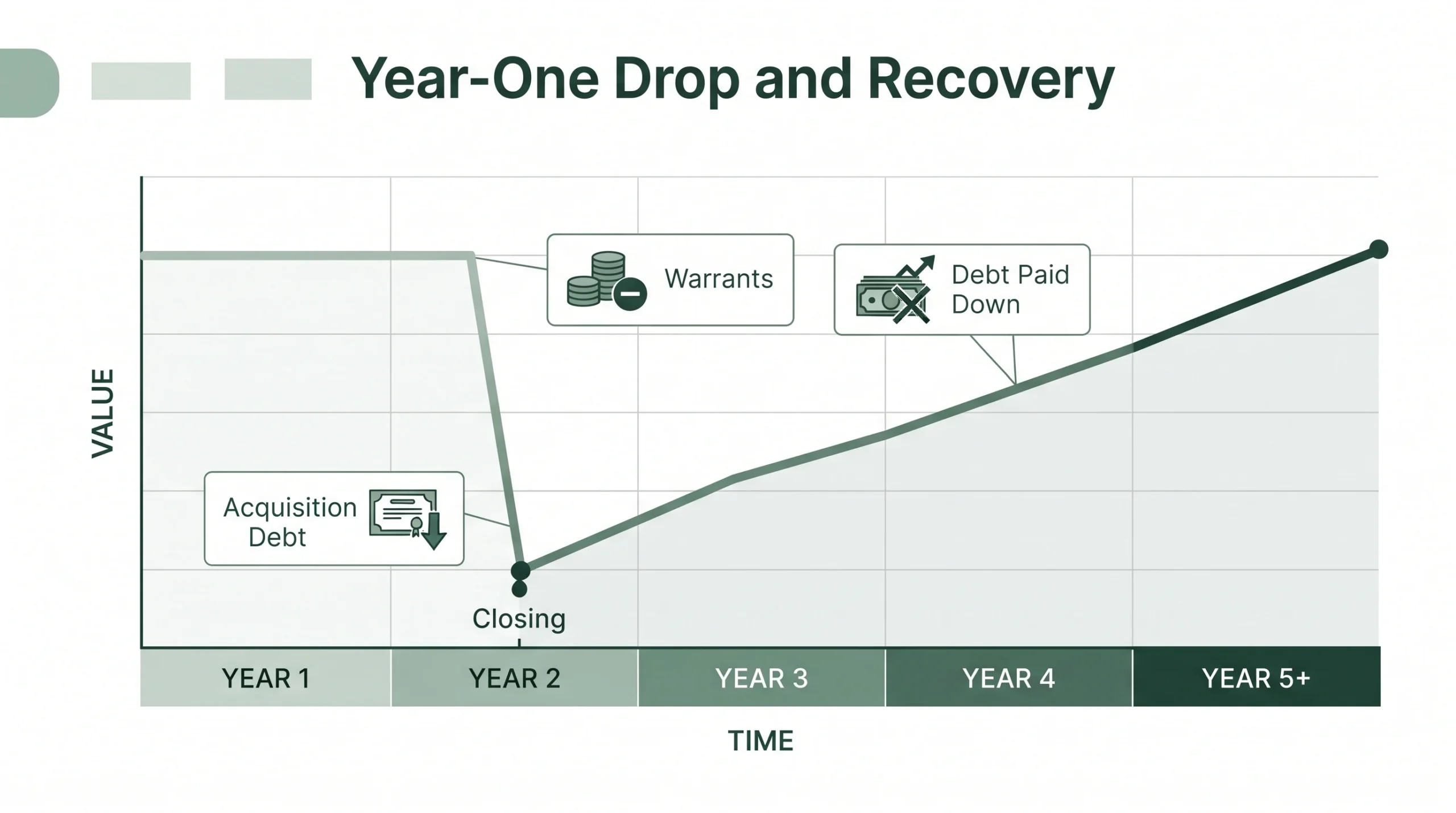
This year-one dip worries employee-owners who expected their shares to climb from day one. It should not. The same debt that lowered the value today gets paid down over time. As the loan shrinks, equity value rises. A growing company can push the share price past its starting point within a few years. Knowing this curve keeps trust intact.
Sofer Advisors provides independent, third-party valuations for ESOP transactions and the annual appraisals that follow. With 180+ five-star Google reviews and expert witness testimony in 11+ cases, the firm applies IRS and Department of Labor standards to complex deal structures. Its senior team explains the numbers in plain terms so trustees and employee-owners see what drives each year’s price.
Key Takeaways
- The drop is expected: a new acquisition loan cuts equity value right after closing, not weak performance.
- Equity value equals enterprise value minus net debt: a large loan lowers the value left for shares.
- Warrants dilute: synthetic equity from the deal reduces the value of ESOP shares on a fully-diluted basis.
- Recovery follows amortization: as the company pays down the loan, net debt falls and share value climbs back.
- Communicate the curve: an independent annual appraisal captures each step for employee-owners.
These forces explain why a strong company can still post a lower share value in year one. The sections below walk through each one and show when the value turns back up.
Why does ESOP share value drop after the transaction?
ESOP share value drops after the transaction because the deal loads new debt onto the company. When an ESOP buys a business with borrowed money, that loan pays the selling owner at closing. The debt then sits on the balance sheet. Equity value is what remains after net debt, so the value left for ESOP shares falls right away. Warrants and deal costs push it lower. None of this signals a weak business. Our ESOP transaction guide walks through each step of the close.
Several parts of the deal press on the first valuation at once:
- The new acquisition loan, which raises net debt
- Warrants and synthetic equity that dilute the shares
- Transaction and financing costs paid at closing
- Standard discounts for lack of control and lack of marketability
The appraiser weighs all of these on the first valuation date. The result is a fair market value set under Department of Labor rules. Because the debt is largest on day one, the share value starts near its low point. That is the base from which it recovers.
How does acquisition debt reduce equity value?
Acquisition debt reduces equity value through simple subtraction. Enterprise value measures the whole business. Equity value is enterprise value minus net debt, and net debt is total debt less cash. A large new loan raises net debt sharply, so equity value drops even when enterprise value holds steady. Our guide to enterprise value versus equity value breaks down the math.
Think of it as buying a house with a big mortgage. The house may be worth a lot, but your equity is small until you pay the loan down. The company works the same way. On the first valuation date, the acquisition loan is at its peak, so the equity slice is thin. Each payment then shifts value from the lender back to the shares.
How do warrants and synthetic equity affect the value?
Warrants and synthetic equity lower the value attributed to ESOP shares on a fully-diluted basis. In many debt-financed ESOP deals, the seller or the lender receives warrants. A warrant is the right to buy stock later at a set price. Synthetic equity, such as stock appreciation rights for key managers, works in a similar way. The appraiser must count these claims, which spreads equity value across more potential shares. The National Center for Employee Ownership explains how discounts and dilution shape the per-share figure.
The effect is real but not permanent. Warrants can be exercised or can expire, and their treatment changes over the years. As the picture clears, the value tied to ESOP shares can rise. The same is true for the discounts an appraiser applies for lack of control and lack of marketability, which our note on marketability discounts covers in depth. Trustees should track how each claim moves each year.
When does post-transaction ESOP share value recover?
Post-transaction ESOP share value recovers as the company pays down the acquisition loan. Each payment lowers net debt. Lower net debt means more equity value for the shares. If the business also grows its earnings, the climb is faster. Many plans see the value approach or pass the original price within several years, though the pace depends on the company. The table below shows the general path, not a promise of any return.
| Time after closing | Acquisition debt | ESOP share value |
| At closing (year one) | Highest, just drawn | Lowest point |
| Years two to three | Falling as payments hit | Rising steadily |
| Years four to five | Much lower | Near or above the start |
| After the loan is paid off | Paid down | Driven by earnings and growth |
The recovery pace turns on three things: how fast the loan is paid down, how much earnings grow, and how warrants are handled. A strong year speeds the climb; a slow year delays it. The independent annual appraisal measures all of this each year, which is why the annual valuation requirement matters so much for employee-owners.
How should you communicate the year-one drop to employee-owners?
The best way to handle the year-one drop is to explain it before it appears. Employee-owners who understand the curve do not panic when the first statement shows a lower price. Set the expectation during onboarding. Show the link between the loan, the debt paydown, and the rising value. Sofer Advisors brings a Heart of a Teacher approach to this work, turning a hard chart into a story people trust. The U.S. Department of Labor also lists the plan documents participants should receive each year.
Frame the message around progress, not a single number. Point to the loan balance falling and the company hitting its goals. Tie the share value to work people can see, such as new clients or better margins. Pair the story with the tax benefits an ESOP brings. Clear, honest updates keep morale steady and protect the plan’s credibility.
Which valuation provider is best for an ESOP?
The best provider for an ESOP is an independent firm with no stake in the deal. Trustees can choose among independent valuation firms, large national advisors, and deal brokers. All three can produce a number, but their incentives differ. An independent appraiser follows USPAP and Department of Labor standards. A broker often treats value as a step toward closing. Large national firms like Alvarez & Marsal, Stout, and Kroll serve the biggest plans. The table below compares the options.
| Provider type | Service focus | Conflict of interest |
| Sofer Advisors | Independent ESOP valuation and annual appraisal | None; fee is flat, not tied to the deal |
| Large national firm | Enterprise transaction advisory | Low to moderate; scale-focused |
| Deal broker or seller advisor | Marketing and closing the sale | High; paid on the transaction |
A conflict arises when the party setting the value also profits from the deal. The Department of Labor watches ESOP valuations closely, so a defensible, independent opinion protects the trustee and the plan. The Sofer Difference is a four-phase process: Discovery, Diligence, Analysis, and Delivery. That method supports the annual appraisal and any transaction advisory work an ESOP needs. It keeps the appraisal separate from any deal-making so employee-owners see the true value of their shares.
The share-value curve confuses many first-year ESOP participants. The questions below cover what they ask most.
Frequently Asked Questions
How much are my ESOP shares worth?
Your ESOP shares are worth their fair market value on the most recent appraisal date. An independent appraiser sets that value at least once a year, based on the company’s earnings, cash flow, and debt. Right after a debt-financed purchase, the value often sits below the price the ESOP paid. It rises as the loan is paid down.
How do I calculate the value of my ESOP shares?
You do not calculate it yourself; an independent appraiser does. The appraiser finds enterprise value using the income and market approaches, then subtracts net debt to reach equity value. That equity value is spread across the shares on a fully-diluted basis, counting warrants and synthetic equity. Discounts for lack of control and lack of marketability may apply. The result is the per-share value on your statement.
How are ESOP shares valued each year?
ESOP shares are valued each year by an independent, outside appraiser hired by the plan trustee. The appraiser reviews financial statements, the debt balance, and market data, then applies fair market value standards. This yearly review is required and captures the recovery in share value as the acquisition loan is paid down. It gives employee-owners a fresh, defensible number every year.
What is the ESOP 25 percent rule?
The 25 percent rule refers to a tax limit on how much a company can deduct for contributions to a leveraged ESOP. In general, contributions used to repay the acquisition loan principal are deductible up to 25 percent of eligible participant payroll. The rule helps a company fund the debt paydown with pre-tax dollars. A tax advisor can confirm how the limit applies to a specific plan.
Why did my ESOP share price drop after the sale?
Your share price dropped because the sale added a large acquisition loan to the company. Equity value equals enterprise value minus net debt, so a new loan lowers the value left for shares. Warrants and deal costs reduce it further. This is a normal result of a debt-financed purchase, not a sign of poor performance. The value recovers as the loan is paid down.
What is the difference between enterprise value and equity value?
Enterprise value is the value of the whole business, including debt. Equity value is what remains for shareholders after net debt is subtracted. In an ESOP, the shares track equity value, so a big acquisition loan shrinks the equity slice at closing. As the company repays that loan, net debt falls and equity value rises, lifting the per-share price over time.
How long does it take for ESOP share value to recover?
Recovery time varies by company, but many plans see the value approach or pass the starting price within several years. The pace depends on how fast the loan is paid down, how much earnings grow, and how warrants are handled. A faster paydown and steady growth speed the climb. No firm can promise a set return or a fixed timeline, since results follow real performance.
Do warrants lower my ESOP share value?
Warrants lower the value attributed to ESOP shares on a fully-diluted basis. A warrant is the right to buy stock later at a set price, often held by the seller or lender. The appraiser counts these claims, which spreads equity value across more potential shares. As warrants are exercised or expire, their effect changes, and the value tied to ESOP shares can rise in later years.
How much does an ESOP valuation cost?
An ESOP valuation from Sofer Advisors runs $15,000 to $35,000, with a timeline of six to ten weeks. Cost depends on company size, deal structure, and the presence of warrants or synthetic equity. Annual appraisals that follow the transaction are scoped separately. For a quote tied to your plan, request a valuation estimate with your financials and deal terms.
Related Case Studies
- ESOP Transaction Process Steps: A Complete Guide for Business Owners
- Leveraged Recapitalization: Take Cash Out Without Selling
- What Is a Leveraged Buyout (LBO)? Structure Explained
Executive Summary
Post-transaction ESOP share value usually drops in the first appraisal after a debt-financed purchase. The reason is arithmetic, not weak performance. A new acquisition loan raises net debt, and equity value equals enterprise value minus net debt, so the value left for shares falls at closing. Warrants, synthetic equity, and deal costs push it lower, and standard discounts for lack of control apply. The value recovers as the company pays down the loan and grows its earnings, often reaching or passing the starting price within several years. An independent annual appraisal measures each step, and clear communication keeps employee-owners confident through the curve.
What Should You Do Next?
Review your closing debt schedule and warrant terms, then map how the loan will be paid down over the next five years. Ask your appraiser to show how each factor moved the year-one value, and share that story with employee-owners before the first statement arrives. Set the expectation early so a normal dip does not read as bad news, and keep the annual appraisal on schedule to capture the recovery.
David Hern CPA ABV ASA, founder of Sofer Advisors, provides independent, defensible valuations for ESOP transactions and annual appraisals. Schedule a consultation to discuss your plan.
People Also Read
- What Is Enterprise Value vs Equity Value: Key Differences
- ESOP Tax Benefits: What Owners and Employees Gain
About the Author
This guide was prepared by David Hern CPA ABV ASA, founder of Sofer Advisors, a business valuation firm headquartered in Atlanta, GA serving clients across the United States. David holds dual accreditations as an Accredited Senior Appraiser (ASA) and is Accredited in Business Valuation (ABV), credentials recognized by the IRS, SEC, and FINRA. He also holds the Certified Exit Planning Advisor (CEPA) designation. With 15+ years of valuation experience, David has served as an expert witness in 11+ cases across multiple jurisdictions and built Sofer Advisors into an Inc. 5000-recognized firm with 180+ five-star Google reviews. Its full W2 employee team maintains subscriptions to all major valuation databases and operates under a next business day response policy.
For professional business valuation services, visit soferadvisors.com/about-us/ or contact Sofer Advisors at soferadvisors.com/contact-us/.
Disclaimer: This content is for informational purposes only and does not constitute professional valuation advice. Business valuation conclusions depend on specific facts and circumstances. Contact Sofer Advisors for guidance regarding your specific situation.









