


Last Updated: November 2026
A medical device company’s value depends on far more than revenue and profit. It rests on FDA regulatory status, patents, clinical evidence, and payer reimbursement. A cleared or approved device carries less risk than one still in review. The method depends on the stage: established firms fit the market approach, while clinical-stage and pre-revenue firms need a risk-adjusted income approach that weights future cash flow by the chance of success.
Sofer Advisors prepares these valuations for owners, CPAs, and attorneys across the country.
This guide explains what drives medtech value, the role of FDA status, and the mistakes to avoid.
Key Takeaways
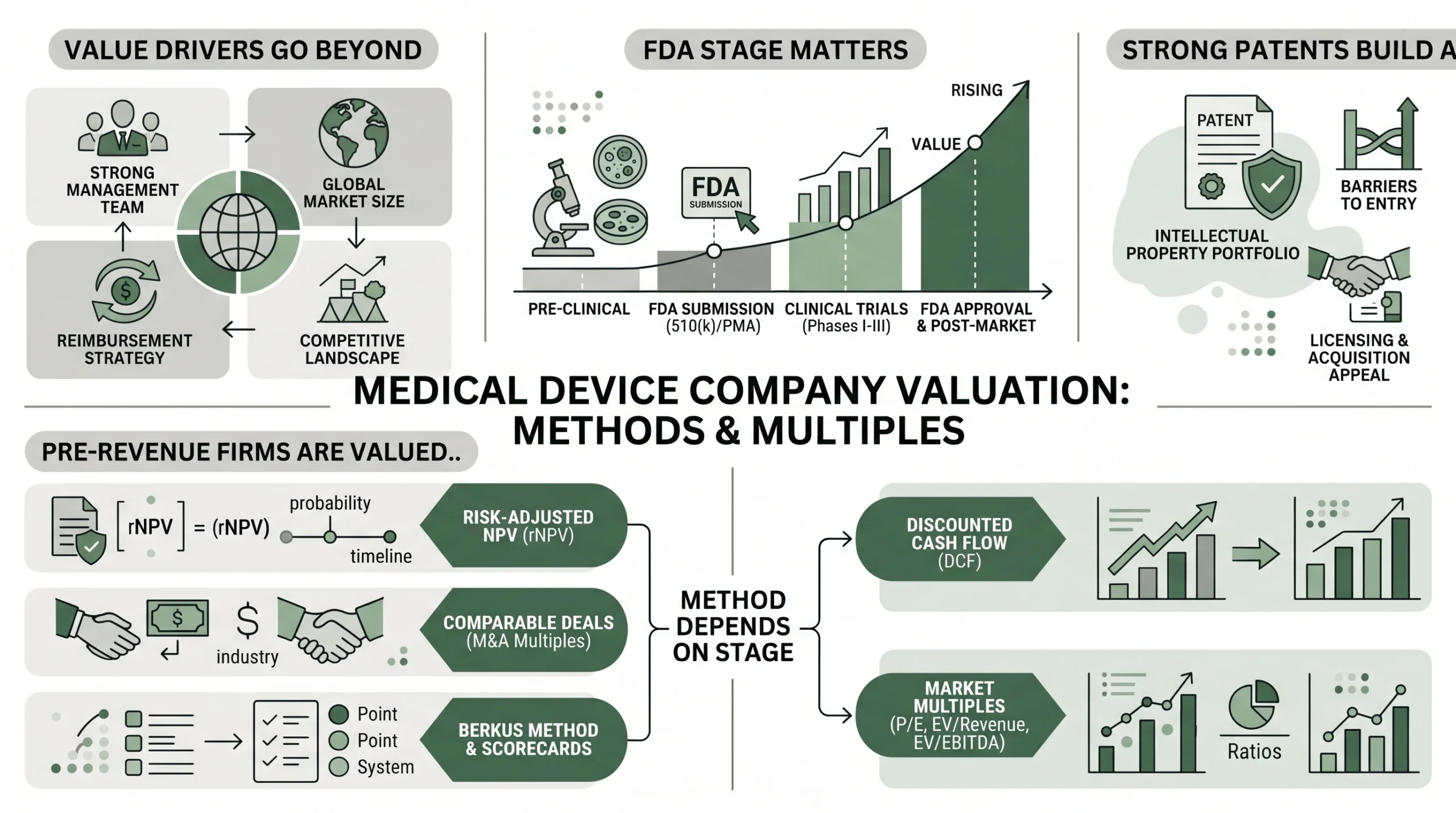
- Value drivers go beyond earnings. FDA status, patents, clinical data, and reimbursement all shape the number.
- FDA stage matters. A cleared or approved device carries less risk than one still in review.
- Strong patents build a moat. They protect future cash flow and support higher margins.
- Method depends on stage. Established firms fit the market approach, while clinical-stage firms need a risk-adjusted income approach.
- Pre-revenue firms are valued on potential. Analysts weight future cash flow by the chance of success.
What drives the value of a medical device company?
Several forces set a medtech company’s value. The first is the product pipeline. Buyers look at what the company sells today and what it plans to launch. A deep pipeline signals future growth.
The second is regulatory status. A device that has cleared the FDA carries less risk than one still in review. Clear approval shortens the path to revenue.
The third is intellectual property. Patents protect a device from copycats. Strong patents let a company defend its prices and margins.
Clinical evidence also matters. Solid trial data shows that a device works and is safe. Doctors and payers trust products backed by good studies. Weak or thin data raises doubt. It can slow adoption and hold back the price buyers will pay. Stronger evidence often supports a higher value.
Reimbursement is just as important. A device only sells well if insurers pay for it. Coverage and billing codes from Medicare and private payers shape real demand.
Finally, buyers weigh the quality system and manufacturing. A device maker must meet strict production standards. Reliable, scalable manufacturing adds value and lowers risk.
Recurring revenue adds value on top of these drivers. Sales of disposables, software, or service contracts bring steady cash. Buyers prize that kind of predictability. A one-time product sale is worth less than an ongoing stream.
How does FDA regulatory status affect value?
FDA status is one of the biggest value drivers in medtech. Each pathway carries a different level of risk and cost.
The 510(k) pathway is the most common. It clears a device that is similar to one already on the market. This route is faster and cheaper, so it lowers risk.
The De Novo pathway fits new low-to-moderate-risk devices with no clear predicate. It is more involved than a 510(k). Still, it is less demanding than full approval.
Premarket approval, or PMA, is the strictest path. It applies to high-risk devices, such as implants. PMA requires strong clinical data and takes more time and money.
A device further along its pathway is worth more. Each cleared milestone removes a layer of risk. Analysts build the stage and timeline of approval straight into the model.
Owners should track where each product sits in the pipeline. A device in early feasibility is far from revenue. A device in a pivotal trial is much closer. Mapping this timeline helps set realistic forecasts. It also shows buyers how much risk remains.
Why do patents and IP matter so much?
Patents sit at the heart of medtech value. They give a company the right to block copycats for a set period. That protection guards future cash flow.
A granted patent is worth more than a pending one. A granted patent that has survived a legal challenge is stronger still. Buyers pay for proven, defensible rights.
Analysts also study freedom to operate. This review checks whether a device infringes on patents held by others. Finding these risks early protects the deal and the valuation.
Strong IP builds a moat. It lets a company hold its prices and margins. Weak or narrow patents invite rivals and press values down.
How does reimbursement shape medtech value?
Reimbursement decides whether a device earns money. A device can be safe, cleared, and well made. It still fails if no one pays for it. That is why analysts study the payer path closely.
Coverage comes from Medicare and private insurers. Each payer decides whether to pay for a device and how much. A clear billing code helps a device get paid. Without coverage, hospitals and doctors hesitate to buy.
Analysts fold this risk into the forecast. A device with broad coverage earns a steadier stream of cash. A device still seeking coverage carries more doubt. That doubt lowers the projected cash flow and the value.
Timing matters too. Coverage can arrive years after FDA clearance. A long gap delays revenue and raises risk.
Which valuation methods fit medtech firms?
Three approaches apply to medtech, the same as in other valuations. Each answers a different question.
The income approach looks at future cash flow. The main tool is the discounted cash flow, or DCF, model. It projects the cash a device will earn. Then it discounts that cash to today’s value. This approach suits firms with cash flow you can forecast.
The market approach compares the company to others. Analysts study public medtech firms and recent deals. For high-growth or pre-profit companies, they often look at EV/Revenue. For established, profitable firms, they look at EV/EBITDA. Finding true comparables is hard in medtech. Each device serves a different need and sits at a different stage. Analysts adjust for these gaps before they trust a multiple.
The asset or cost approach values what the company owns. It sums the worth of tangible and intangible assets. This fits early-stage firms or those winding down.
Most reports use more than one method. Analysts then weigh the results and reconcile them into a single conclusion.
How are pre-revenue and clinical-stage companies valued?
Many medtech firms have no profit yet. Some have no revenue at all. Earnings-based math does not fit these companies.
For these firms, analysts adjust the DCF for risk. A risk-adjusted DCF weights future cash flow by the chance of success. Each milestone, such as a trial result or FDA clearance, carries a probability. This is sometimes framed as a real options view.
Analysts may also value the company on revenue multiples or milestones. The focus shifts from today’s earnings to tomorrow’s potential. The key question is whether the technology will reach the market and sell.
The discount rate carries much of the weight in a DCF. It reflects the risk that a device may never reach the market. Early-stage devices carry a high rate. Established products carry a lower one. A small change in the rate can move the value a lot.
These valuations rest on assumptions. Small changes in the odds of success can swing the result. Careful analysts test a range of inputs rather than one fixed number.
How do the valuation approaches compare?
The table below sums up where each approach fits best.
| Approach | Best for | Key inputs |
|---|---|---|
| Income (DCF) | Firms with cash flow you can forecast | Revenue forecast, margins, discount rate |
| Market (comps) | Firms with public or deal comparables | EV/Revenue, EV/EBITDA multiples |
| Asset or cost | Early-stage or winding-down firms | Value of tangible and intangible assets |
The right method depends on the company’s stage and data. A mature device maker often fits the market approach. A clinical-stage firm usually needs a risk-adjusted income approach. Many engagements blend methods to cross-check the answer.
What valuation mistakes should owners avoid?
A few errors show up again and again. The first is overstating how fast a device will win market share. Adoption in healthcare is often slow.
The second is ignoring reimbursement risk. If payers do not cover a device, sales stay low. A model that assumes easy coverage can overstate value.
The third is skipping the cost of regulatory milestones. Reaching 510(k) clearance or PMA takes real money. Leaving these costs out inflates the result.
A fourth is using the wrong comparables. Medtech is broad. A surgical implant firm differs from a diagnostics firm. Multiples drawn from a different sub-sector can mislead.
A fifth mistake is trusting a single number. Medtech value hinges on uncertain odds. A range of outcomes tells a fuller story. Owners should expect a range, not false precision.
Good analysts guard against each of these. They support every assumption and document their logic.
Frequently Asked Questions
What is a medical device company valuation?
It is the process of estimating what a medtech business is worth. Analysts review financials, patents, FDA status, and market conditions. The result supports tax filings, stock grants, disputes, or a sale.
Which FDA pathway matters most for valuation?
It depends on the device’s risk class. A 510(k) clearance is faster and lowers risk. The PMA path applies to high-risk devices and demands strong clinical data. A device further along its pathway usually carries a higher value.
How are pre-revenue medical device companies valued?
Analysts rely on forecasts rather than current earnings. A risk-adjusted DCF weights future cash flow by the chance of success. Revenue multiples and milestone values are also common. The focus is on the technology’s potential, not past profit.
Why does reimbursement affect value?
A device only sells well if insurers pay for it. Coverage decisions and billing codes drive real demand. Without a clear payer path, adoption often stalls. That risk lowers the valuation.
What multiples are used in medtech valuation?
Analysts often use EV/Revenue for high-growth or pre-profit firms. They use EV/EBITDA for established, profitable firms. The right range depends on the sub-sector, growth, and risk. Analysts draw actual multiples from current market data for each case.
How do patents affect a device company’s value?
Patents block copycats and protect future cash flow. A granted patent that has survived a challenge is the strongest. Analysts also check freedom to operate to spot infringement risk. Strong IP supports higher prices and margins.
What is the difference between enterprise and equity value?
Enterprise value is the worth of the whole business, including debt. Equity value is what remains for shareholders after net debt. The two can differ widely for firms with large debt or cash. A clear report separates them.
Why might a medical device startup need a 409A valuation?
A 409A valuation sets the fair market value of common stock. Startups need it to price stock options under IRC Section 409A. It helps the company and its staff avoid tax penalties. Even pre-revenue firms must comply when they grant equity.
What documents support a medtech valuation?
Analysts ask for financial statements and projections. They also want a patent schedule and clinical trial status. Details on reimbursement coverage and billing codes help too. Notes on the quality system and manufacturing round out the file. Good records lead to a stronger, more defensible report.
Related Case Studies
- Retail Company Valuation Multiples: Complete Guide 2026
- Technology Company Valuation Methods: A Complete Guide
- Medical Practice Valuation Multiples 2025-2026: Complete Guide
Executive Summary
Value drivers go beyond earnings. FDA status, patents, clinical data, and reimbursement all shape the number. FDA stage matters. A cleared or approved device carries less risk than one still in review. Strong patents build a moat. They protect future cash flow and support higher margins. Method depends on stage. Established firms fit the market approach, while clinical-stage firms need a risk-adjusted income approach. Pre-revenue firms are valued on potential. Analysts weight future cash flow by the chance of success.
What Should You Do Next?
Start by naming the purpose of your valuation, such as a tax filing or a planned sale. Then gather your financials, patent schedule, and current clinical status. Sofer Advisors prepares independent medtech valuations led by David Hern CPA ABV ASA CVA. Schedule a free consultation to discuss your situation.
People Also Read
- Construction Company Valuation Multiples by Trade
- Veterinary Practice Valuation: Methods and Multiples
About the Author
This guide was prepared by David Hern CPA ABV ASA CVA, founder of Sofer Advisors, a business valuation firm headquartered in Atlanta, GA serving clients across the United States. David holds accreditations as an Accredited Senior Appraiser (ASA) and is Accredited in Business Valuation (ABV), credentials recognized by the IRS, SEC, and FINRA, and is also a Certified Valuation Analyst (CVA). David has served as an expert witness in dozens of cases across multiple jurisdictions, and Sofer Advisors is an Inc. 5000 honoree in 2024 and 2025 with 240+ five-star Google reviews.
For professional business valuation services, visit soferadvisors.com/about-us/ or contact Sofer Advisors at soferadvisors.com/contact-us/.
Disclaimer: This content is for informational purposes only and does not constitute professional valuation advice. Business valuation conclusions depend on specific facts and circumstances. Contact Sofer Advisors for guidance regarding your specific situation.









