


Last Updated: August 2026
A med spa valuation is an expert opinion of what a medical aesthetics clinic is worth. It is built from earnings, the patient base, the service mix, and legal standing. Clinics with strong repeat revenue often sell for 3.0x to 5.0x SDE. That range comes from recent private-market sales data. Sofer Advisors prepares these reports for owners. They may be planning a sale, setting up a partner buyout, or settling a shareholder dispute.
Why does this number matter so much? For most owners, a med spa is their single largest asset. Its value swings on factors they control. Repeat revenue is the biggest lever. Injectable regulars, membership plans, and a medical director who can stay all point to earnings that will hold after a sale. Owners who map these drivers early gain time to lift the price.
Key Takeaways
- Earnings drive value: Owner-run med spas trade on SDE, often at a 3.0x to 5.0x multiple. Bigger clinics move to EBITDA.
- Add-backs matter: Listing owner pay, personal costs, and one-time costs raises the earnings base and lifts the final number.
- Steady revenue wins: Membership plans and repeat injectables buyers show steady cash flow. That backs a higher multiple than one-off treatments.
- The medical director is a value factor: Follow corporate practice of medicine rules. A director tie that transfers cleanly protects the sale.
- 2026 demand is strong: Private equity roll-ups and steady consumer spending keep buyer interest high for well-run clinics.
Each factor moves the final result. The sections below show how a valuator builds the number, adjusts the earnings, and defends it for a sale, tax filing, or dispute.
What multiples drive a med spa valuation?
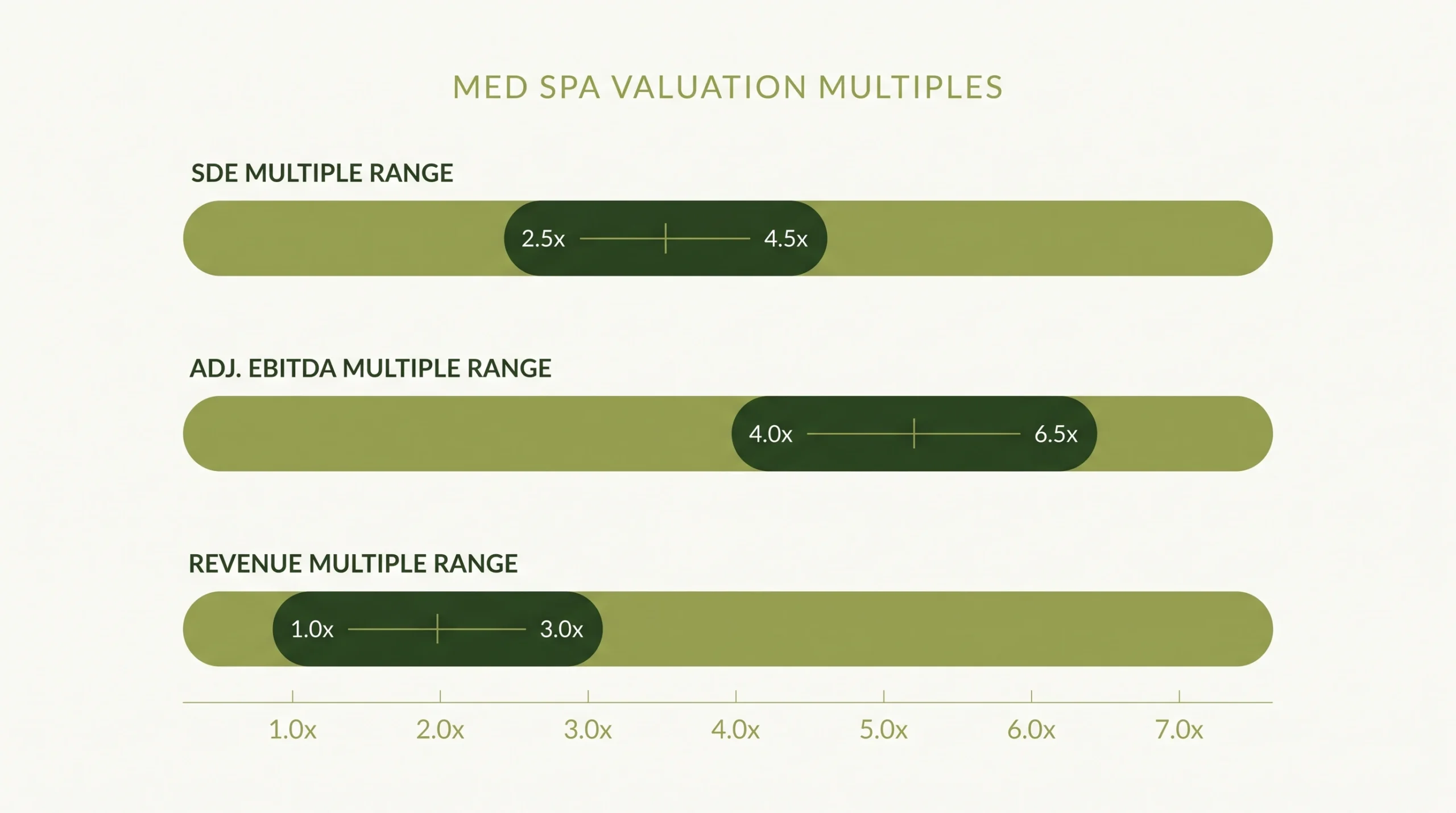
Med spa values rest on two market multiples. One is a multiple of SDE. The other is a multiple of yearly revenue. For owner-run clinics, SDE multiples run from 3.0x to 5.0x. Revenue multiples fall between 1.25x and 1.75x. These ranges give owners a starting point. The exact multiple tracks the service mix, local rivals, and profit margins.
Bigger clinics with layered managers shift to an EBITDA multiple. It strips out owner pay and shows the cash flow a passive owner would keep. Private equity buyers price on that basis. Recent med spa M&A multiple benchmarks anchor these numbers. Lower-middle-market clinics now clear 5.0x to 7.0x adjusted EBITDA. The firm uses that data to place a clinic in today’s market, not a plain rule of thumb.
| Metric | What it measures | Typical multiple | Best suited to |
|---|---|---|---|
| SDE | Owner benefit plus normalized profit | 3.0x to 5.0x | Small, owner-operated med spas |
| Adjusted EBITDA | Cash flow to a passive owner | 4.0x to 7.0x | Multi-site or PE-backed clinics |
| Annual revenue | Top-line sales | 1.25x to 1.75x | Quick benchmarking and sanity checks |
The right metric depends on who buys and how the clinic runs. A single-site clinic where the founder injects most patients sits on SDE, since the owner’s labor and profit cannot be split. A group with regional directors and a passive owner sits on adjusted EBITDA. The wrong base can misstate value by six figures, so a valuator matches the metric to how the clinic really runs.
How do add-backs increase a med spa’s value?
Add-backs raise value because they lift the earnings base that each multiple applies to. By removing costs a new owner would not repeat, an analyst shows the true cash flow of the clinic. That beats the tax-cutting picture the current owner reports.
Common med spa add-backs include:
- Owner pay above the market rate for a director role
- Personal costs run through the clinic, such as travel or a car
- One-time costs like legal fees, a rebrand, or a build-out
- Non-recurring gear buys that are not routine upkeep
Each item must be logged in the general ledger, so a buyer or the IRS can trace it. An add-back you cannot support is a point a buyer will win in due diligence. Sofer Advisors recasts a few years of records to split true one-time items from steady costs. It is the discipline behind the firm’s Heart of a Teacher approach: the owner sees the math, not just the answer.
Why does service mix change the multiple?
Service mix changes the multiple because buyers pay more for revenue they can count on. A clinic weighted toward membership plans and repeat injectables earns a higher multiple. One that leans on one-off device sessions earns less, because steady cash flow lowers buyer risk. Loyalty data that shows steady rebooking is one of the strongest signals a valuator can point to.
A balanced mix spreads risk across several revenue lines. It blends high-margin injectables, membership plans, and device work like laser or body contouring. Injectables drive frequent visits, memberships lock in monthly income, and devices open cross-selling chances. When a clinic proves it does not lean on one service or one provider, it makes a stronger case. That points to stable future earnings. The market and income approaches both reward that with a firmer view of value.
How does a medical director affect value?
The medical director is a core value factor. Med spas are tied to healthcare and cannot legally run without proper clinical oversight. Most states enforce a corporate practice of medicine rule. It sets who may own the entity and how a physician must supervise care. If that director tie does not transfer cleanly, a sale can stall or fall apart. So buyers treat it as a top diligence item.
Federal rules add another layer. The Stark Law and the Anti-Kickback Statute limit improper money ties between referral sources and healthcare entities. A clinic that leans hard on one key provider also carries personal goodwill risk. Revenue can walk out the door if that person leaves. Sofer Advisors flags these compliance and key-person issues early. Unaddressed legal risk lowers the multiple a cautious buyer will pay.
What is driving med spa demand in 2026?
Demand for med spas in 2026 rests on two forces. Spending on aesthetics is rising. And well-funded buyers keep buying up clinics. Injectables and non-invasive treatments have moved into routine self-care budgets. Private equity groups keep building multi-site platforms, and announced med spa deals now top 50 a year. They pay premium EBITDA multiples for clinics with clean books and steady repeat revenue. That mix keeps competition for quality clinics high.
Not every clinic wins that premium. Buyers reward varied service lines and clear compliance. They also want a medical director who can transfer and membership income that survives a change in owner. Clinics that lean on one star provider or a narrow set of treatments see thinner interest and softer pricing. Owners should learn where a clinic sits against these wants, well before going to market. That gives time to build the drivers that raise enterprise value.
How does Sofer Advisors value a med spa?
Sofer Advisors values a med spa through The Sofer Difference. It is a four-phase process: Discovery, Diligence, Analysis, and Delivery. It starts by normalizing earnings, adjusting a few years of records to show true repeat cash flow. Then it applies the income approach, market approach, and asset approach to test the result from more than one angle.
The income approach projects future cash flow. It uses a discounted cash flow model and a fair discount rate. The market approach compares the clinic against recent sales of similar ones to set a fair multiple. Each result is built to meet IRS Revenue Ruling 59-60 and USPAP under The Appraisal Foundation. It also meets AICPA valuation standards. Large firms like Alvarez and Marsal, Kroll, or Stout focus on enterprise clients. The firm brings that senior-level rigor to middle-market owners. And unlike a solo practitioner, it backs each report with a full W2 team of 14 and the major valuation databases.
Frequently Asked Questions
What multiple does a med spa sell for?
Med spas often sell for 3.0x to 5.0x SDE, or 1.25x to 1.75x yearly revenue. The exact multiple depends on profit, the local market, and the share of repeat membership and injectables income. Bigger clinics with formal managers often price on adjusted EBITDA instead. The firm reviews these metrics to set a solid range tied to your clinic’s real earnings history.
How do you value a med spa practice?
Valuing a med spa blends the income, market, and asset approaches to capture both tangible and intangible worth. The income approach projects future cash flow. The market approach compares recent sales of similar clinics. The asset approach values equipment and net assets. Analysts also weigh patient loyalty and brand name. Sofer Advisors weighs all three methods so the final view of fair market value holds up under review.
What add-backs matter most in a med spa valuation?
The top add-backs are owner pay above market rate and personal costs run through the clinic. One-time costs like legal fees or a build-out also count. Each removes a non-recurring item from the profit and loss statement and raises the earnings base. The support must live in the general ledger. The firm logs each item so it survives buyer and IRS review and justifies a higher enterprise value.
Does a med spa need a medical director to be sold?
Yes. By law, most states require a licensed medical director under corporate practice of medicine rules. This holds even when the owner is not a physician. Whether that director tie transfers is a main focus in due diligence. A broken deal can void a sale. The team helps owners confirm their setup fits state rules before the clinic goes to market.
How does recurring membership revenue affect med spa value?
Repeat membership revenue raises value by proving steady cash flow and strong patient loyalty. That steadiness lowers buyer risk, which backs a higher multiple on those revenue streams. Clinics that lean on one-off treatments without a membership model face more earnings swings and softer pricing. The firm reviews your patient loyalty and rebooking data to highlight these steady gains in the value.
How does SDE differ from EBITDA in a med spa valuation?
SDE covers the owner’s full pay, benefits, and one-time owner costs. That fits smaller owner-run clinics. EBITDA leaves out owner pay. It shows the cash flow a passive owner would keep, which fits multi-site or private-equity deals. Both are valid, but each serves a different buyer. Sofer Advisors helps owners pick the metric that matches their exit goals and likely buyer.
Can personal goodwill be separated from enterprise goodwill?
Yes. Personal goodwill can be split out when a clinic’s value ties to the name, skill, or fame of a single provider. Enterprise goodwill belongs to the clinic itself. Analysts gauge how much revenue would vanish if that provider left. This split matters for tax planning and buy-sell deals. The firm uses proven methods to separate practice-based value from person-based value.
What documents are needed to start a med spa valuation?
To begin, provide three years of tax returns, current-year profit and loss statements, and a recent balance sheet. You will also need a medical equipment schedule and a count of active patients and membership numbers. Include copies of the medical director agreement and any non-compete contracts. Organized records speed the work. Sofer Advisors guides owners through this step so each input is ready for a clean review.
How much does a business valuation from Sofer Advisors cost?
A healthcare practice valuation, which covers med spas, runs from 10,000 to 30,000 dollars. The price depends on how complex the clinic is and which reporting standard you need. Simpler planning jobs fall toward the low end. Deals or court work that need deeper review fall higher. Most jobs run four to eight weeks. Contact Sofer Advisors for a fee quote matched to your case.
Related Case Studies
- Healthcare Business Valuation Methods Guide
- How to Value a Business Based on Cash Flow
- Normalized EBITDA: Definition, Formula and Why It Matters
Executive Summary
A med spa valuation turns normalized earnings into fair market value. The market pays 3.0x to 5.0x SDE, or 1.25x to 1.75x yearly revenue, per recent private-market sales data. Add-backs for owner pay, personal costs, and one-time items raise the earnings base. Steady membership and injectables income lift the multiple. Med spas are tied to healthcare. So state medical rules and a medical director who can transfer are real value factors. Strong 2026 demand from private equity and consumers rewards clinics with clean books. Those records stay defensible under IRS Revenue Ruling 59-60, USPAP, and AICPA valuation standards.
What Should You Do Next?
Start by pulling three years of financial statements and a schedule of your repeat membership and injectable revenue. Those numbers set the earnings base and the multiple. Next, confirm that your medical director agreement and any provider non-competes are current and can transfer. Open compliance gaps lower the price a buyer will pay. Then list the add-backs you can document before a review begins.
For a valuation you can defend, work with David Hern CPA ABV ASA, whose team has given expert witness testimony in 11+ cases across Georgia, Florida, California, and New Mexico. Schedule a consultation to discuss the value of your med spa.
People Also Read
- EBITDA Multiple for Business Valuation by Industry
- Adjusted EBITDA vs EBITDA: Key Differences Explained
About the Author
This guide was prepared by David Hern CPA ABV ASA, founder of Sofer Advisors, a business valuation firm headquartered in Atlanta, GA serving clients across the United States. David holds dual accreditations as an Accredited Senior Appraiser (ASA) and is Accredited in Business Valuation (ABV), credentials recognized by the IRS, SEC, and FINRA. He also holds the Certified Exit Planning Advisor (CEPA) designation. With 15+ years of valuation experience, David has served as an expert witness in 11+ cases across multiple jurisdictions and built Sofer Advisors into an Inc. 5000-recognized firm with 180+ five-star Google reviews. Its full W2 employee team maintains subscriptions to all major valuation databases and operates under a next business day response policy. For professional business valuation services, visit soferadvisors.com/about-us/ or contact Sofer Advisors at soferadvisors.com/contact-us/.
Disclaimer: This content is for informational purposes only and does not constitute professional valuation advice. Business valuation conclusions depend on specific facts and circumstances. Contact Sofer Advisors for guidance regarding your specific situation.









