


Last Updated: October 2026
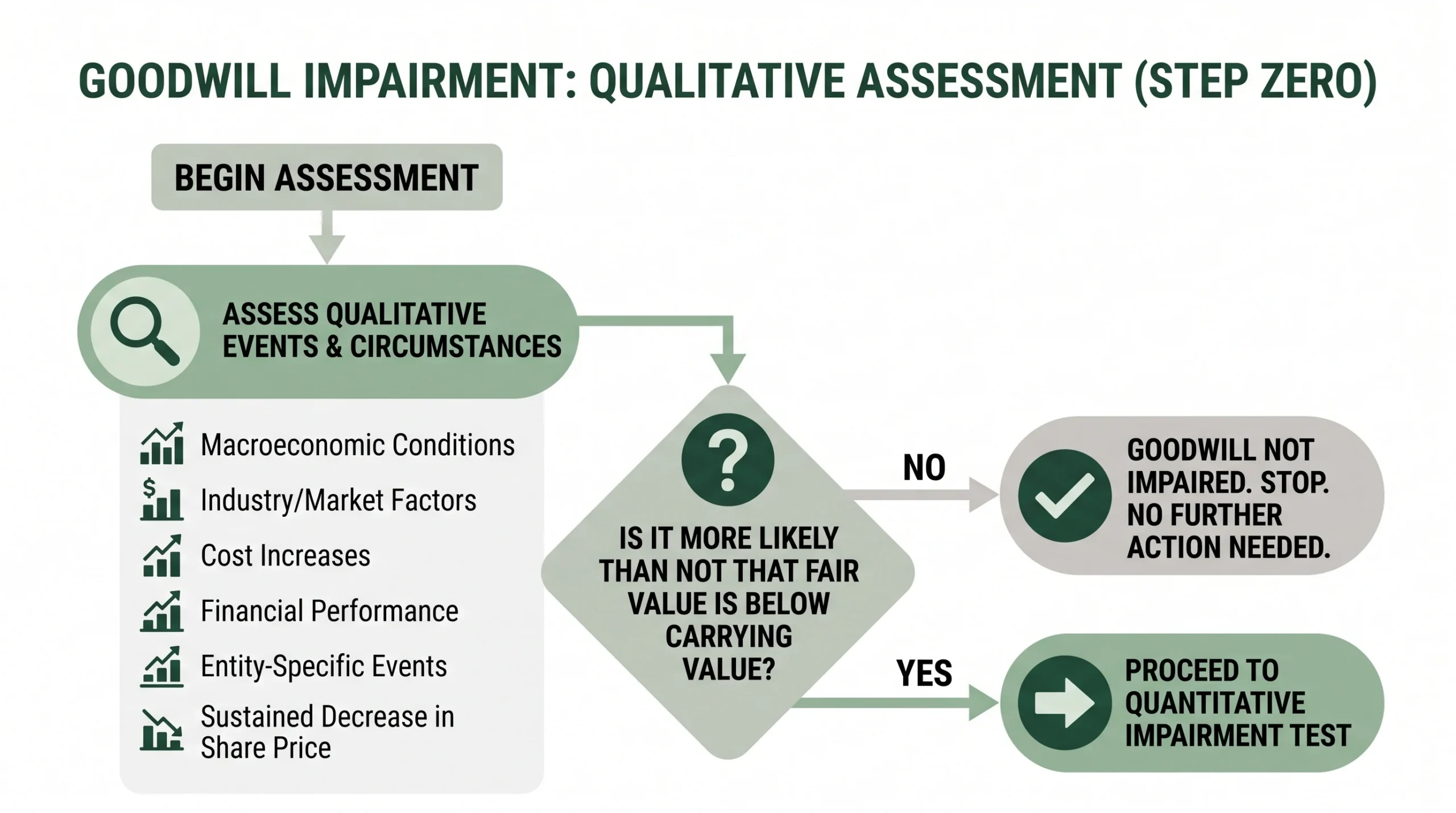
The goodwill qualitative assessment is an optional first step in goodwill impairment testing under ASC 350, often called Step Zero. It lets a company decide whether a full quantitative test is even needed. The test asks one question: is it more likely than not, meaning a greater than 50 percent chance, that a reporting unit’s fair value has fallen below its carrying amount? If the answer is clearly no, the company can stop for that period.
Sofer Advisors performs these assessments and the quantitative tests behind them for CFOs, controllers, and auditors, backed by Inc. 5000 recognition in both 2024 and 2025. If the screen is unclear, or impairment looks likely, the company moves to the full quantitative test.
This guide explains what triggers Step Zero, how it is performed, what factors are weighed, and how the qualitative screen compares to the quantitative test.
Key Takeaways
- Optional screen: Step Zero is an optional qualitative step under ASC 350 that can let a company skip the full quantitative test.
- Cost saver: its main value is avoiding a costly fair value calculation when impairment looks unlikely.
- What is reviewed: the assessment weighs macroeconomic conditions, industry trends, cost factors, and the entity’s own performance.
- The threshold: no further test is needed if there is a greater than 50 percent chance the reporting unit’s fair value exceeds its carrying amount.
- When to proceed: a company moves to the quantitative test if impairment looks likely or if it chooses to skip Step Zero.
Each point depends on sound judgment and a clear record. The sections below examine each one in detail.
Why Is the Step Zero Assessment Important to Understand?
Step Zero matters because it can save real money while keeping the company compliant. ASC 350 requires an annual goodwill impairment test, and ASC 350-20 lets a company first run a qualitative screen to decide whether the full quantitative test is even needed. If fair value clearly exceeds carrying value, that screen meets the requirement for the period, unlike the long-lived asset rules under ASC 360, which test only when a trigger appears. For a business with several reporting units and no signs of decline, the screen focuses effort where real risk sits.
What Triggers a Step Zero Assessment?
Step Zero is triggered by events that suggest a reporting unit’s value has dropped. Under ASC 350-20, a company weighs these events to judge whether impairment is more likely than not. The trigger can be external or internal, and either way it signals that the carrying amount may no longer hold.
Common triggers include a sustained drop in share price or a weak economy. A tougher competitive market can qualify too. Internal signs include the loss of key people or a plan to sell part of the business. When these appear, the company must gauge their effect on fair value, and that judgment keeps the financial statements accurate.
How Is a Step Zero Assessment Conducted?
The assessment reviews events and circumstances that could affect fair value, across three broad areas. The first is macroeconomic conditions, such as interest rates and growth. The second is the industry and market. The third is entity-specific events, such as earnings misses or lost contracts.
The analyst then weighs the positive and negative evidence together. The goal is a single judgment: is fair value more likely than not below carrying value? Positive factors, like strong cash flow, offset negative ones. The conclusion must be documented with clear reasoning, because that record is what an auditor reviews later.
What Factors Are Evaluated in Step Zero?
The review centers on financial performance first. The analyst compares actual results to prior forecasts, since a pattern of missed targets is strong evidence that fair value may have fallen. Changes in the carrying amount of net assets matter too, such as a large disposal or a new liability.
External factors round out the picture. A shift in regulation can change the outlook. Rising competition can squeeze margins. Cost increases can erode profit. Share price serves as a proxy for how investors view the business. No single factor decides the result; the analyst weighs them as a whole to reach a defensible conclusion.
Weighing these factors into a single defensible conclusion is easier with a valuation expert reviewing the evidence. Talk to a Sofer Advisors valuation specialist about your reporting units.
How Does Step Zero Compare to the Quantitative Test?
Step Zero is a screen; the quantitative test is a measurement. Step Zero weighs indicators to judge whether impairment is likely. The quantitative test compares the reporting unit’s fair value directly to its carrying amount. One decides if testing is needed; the other measures the actual result.
The quantitative test requires a full valuation model, so it takes more time and cost. The table below contrasts the two.
| Feature | Step Zero (qualitative) | Quantitative test |
|---|---|---|
| Objective | Screen for impairment risk | Measure actual impairment |
| Primary process | Assess indicators and events | Build a valuation model |
| Complexity | Low to moderate | High |
| Typical cost | Lower; often part of a review | $7,500 to $25,000 or more |
| Typical outcome | Avoid the full test if not needed | Confirm fair value vs carrying amount |
When signs of decline are clear, a company may skip the screen and go straight to measurement. Large national firms such as Alvarez & Marsal, Stout, and Kroll run these tests for big public filers with broad advisory teams. Sofer Advisors focuses on partner-led goodwill and reporting-unit valuations for closely held and middle-market companies, backed by expert witness testimony in 11+ cases. Its four-phase process, The Sofer Difference, moves from Discovery to Diligence to Analysis to Delivery, so both the screen and the full test rest on documented evidence.
How Is the Impairment Charge Measured?
If the quantitative test is needed, the math is direct. The company compares the reporting unit’s carrying amount to its fair value. If carrying value is higher, the difference is the impairment loss. The charge cannot exceed the goodwill allocated to that unit.
This single-step approach reflects the current rules under ASC 350. An earlier two-step method was removed, so companies no longer compute an implied fair value of goodwill. The result is a simpler, faster measurement. Still, the fair value estimate must be well supported, since the charge flows straight to the income statement. Most companies build fair value with an income approach, a market approach, or a blend of both, then reconcile the two to add credibility to the final number.
What Is a Reporting Unit, and Why Does It Matter?
A reporting unit is the level at which goodwill is tested. It is an operating segment, or one level below it, called a component. A component is a reporting unit when it is a business with its own financial information and its own management review. Getting this level right is the foundation of the whole test.
The choice of reporting unit changes the result. Group too broadly, and a weak unit can hide behind a strong one. Group too narrowly, and a single soft unit can trigger a charge on its own. The company must assign assets, liabilities, and goodwill to each unit in a consistent way. A clear map of reporting units makes both Step Zero and the quantitative test more defensible. Sofer Advisors brings a Heart of a Teacher approach to this step, walking the finance team through why each component is or is not a reporting unit rather than simply asserting the structure, an approach reflected in its 180+ five-star Google reviews.
Frequently Asked Questions
How is a goodwill impairment loss determined?
Compare the reporting unit’s carrying amount to its fair value. If carrying value is higher, the difference is the impairment loss, recorded on the income statement for the period. The charge is capped at the goodwill allocated to that unit, so it can never exceed that balance. Sofer Advisors measures the fair value with a documented income or market approach, so the charge, if any, rests on support an auditor can follow.
At what level is goodwill tested for impairment?
Goodwill is tested at the reporting unit level under ASC 350. A reporting unit is an operating segment, or one level below it, for which separate financial information exists and management reviews results. Grouping assets, liabilities, and goodwill correctly matters, because the test depends on where each sits. Sofer Advisors reviews a company’s segment data to map reporting units accurately before any Step Zero or quantitative work begins.
What assets are subject to impairment testing?
Long-lived assets like property, plant, and equipment are tested when events suggest their value may not be recoverable. Intangibles such as goodwill and trademarks are also tested, though on different rules. Goodwill follows ASC 350, while long-lived assets follow ASC 360, and the trigger is a change in circumstances. Sofer Advisors applies the correct standard to each asset class, so the reporting holds up when the auditor reviews it.
What are the ASC 350 disclosure requirements?
A company must disclose the facts and circumstances that led to an impairment loss, the method used to measure fair value, and the segment that holds the impaired goodwill. The disclosure gives readers enough to understand the charge and its cause. Clear supporting documentation gives the accounting team the evidence auditors expect. Sofer Advisors prepares a report that feeds these disclosures directly, so the footnotes match the analysis behind the number.
How much does a goodwill impairment test cost?
A full quantitative goodwill test usually ranges from $7,500 to $25,000. The price reflects the number of reporting units and the quality of the data, since more units and weak records both add work. A Step Zero screen costs less, because it avoids a full valuation model. Sofer Advisors quotes a flat scope up front. Request a free estimate for your reporting units.
Can private companies use the Step Zero assessment?
Yes. A private company can run a qualitative Step Zero test to decide whether a quantitative test is needed, weighing the economy, the industry, and its own performance. Private companies also have an accounting alternative that lets them amortize goodwill, which changes how often testing applies. Sofer Advisors helps private companies choose between these paths and documents the Step Zero conclusion so it satisfies their auditors.
How often should a Step Zero assessment be performed?
Perform it at least once a year, and also whenever a triggering event suggests goodwill may be impaired. Triggers include a sharp drop in market price, a worse business climate, or the loss of key personnel. A routine annual cycle keeps the company ahead of the requirement instead of scrambling at year-end. Sofer Advisors helps teams build that repeatable routine so each period’s conclusion is documented on time.
What documentation is required for a Step Zero assessment?
Keep evidence of the factors you weighed, such as financial history, industry reports, and management forecasts. Record the reasoning that led to the conclusion that impairment is, or is not, more likely than not. Because Step Zero relies on judgment, that written memo is what supports the position if an auditor questions it. Sofer Advisors drafts a clear Step Zero memo that ties each piece of evidence to the final conclusion.
Related Case Studies
- Qualitative Step 0 Goodwill Impairment Assessment
- Goodwill vs Intangible Assets: Key Differences Explained
- Goodwill Impairment Testing: Step-by-Step ASC 350 Guide
Executive Summary
Step Zero is the optional qualitative screen under ASC 350-20 that lets a company decide whether a full goodwill impairment test is needed. It weighs macroeconomic conditions, industry trends, cost factors, and entity-specific performance to judge whether a reporting unit’s fair value is more likely than not, a greater than 50 percent chance, below its carrying amount. If fair value clearly exceeds carrying value, the annual requirement is met and no model is built. If not, the company runs the quantitative test, which generally costs $7,500 to $25,000, and caps any charge at the goodwill in that unit. The first step is to map reporting units and gather the supporting data.
What Should You Do Next?
Review your goodwill policy and confirm how your reporting units are defined, then check them against the triggers that call for a Step Zero screen. If you see signs of decline, such as missed revenue or a weak industry, gather the internal data that supports your conclusion before year-end. A steady routine, repeated each year, is the simplest way to stay ahead of ASC 350. This guide was prepared by David Hern CPA ABV ASA, founder of Sofer Advisors, an Inc. 5000 firm specializing in goodwill and financial reporting valuations. Schedule a free consultation to discuss your specific situation.
People Also Read
About the Author
This guide was prepared by David Hern CPA ABV ASA, founder of Sofer Advisors, a business valuation firm headquartered in Atlanta, GA serving clients across the United States. David holds dual accreditations as an Accredited Senior Appraiser (ASA) and is Accredited in Business Valuation (ABV), credentials recognized by the IRS, SEC, and FINRA. He also holds the Certified Exit Planning Advisor (CEPA) designation. With 15+ years of valuation experience, David has served as an expert witness in 11+ cases across multiple jurisdictions and built Sofer Advisors into an Inc. 5,000-recognized firm with 180+ five-star Google reviews. Its full W2 employee team maintains subscriptions to all major valuation databases and operates under a next business day response policy.
For professional business valuation services, visit soferadvisors.com/about-us/ or contact Sofer Advisors at soferadvisors.com/contact-us/.
This content is for informational purposes only and does not constitute professional valuation advice. Business valuation conclusions depend on specific facts and circumstances. Contact Sofer Advisors for guidance regarding your specific situation.









