


Last Updated: August 2026
A gym valuation sets what a fitness studio or health club is worth. It weighs earnings, the member base, equipment, and the lease. Steady monthly dues drive the result more than any single asset. Private deal data shows most fitness businesses sell for 2.5x to 4.0x Seller’s Discretionary Earnings. Sofer Advisors values gyms and studios nationwide for sales, tax filings, and ownership disputes.
Why does this figure matter? A gym is often an owner’s largest asset, yet its value hinges on how well members stay, not on the treadmills. Steady dues, a transferable lease, and a manager who can run the floor all raise the price. Owners usually need a valuation before a sale, a buy-in, or a bank loan.
Key Takeaways
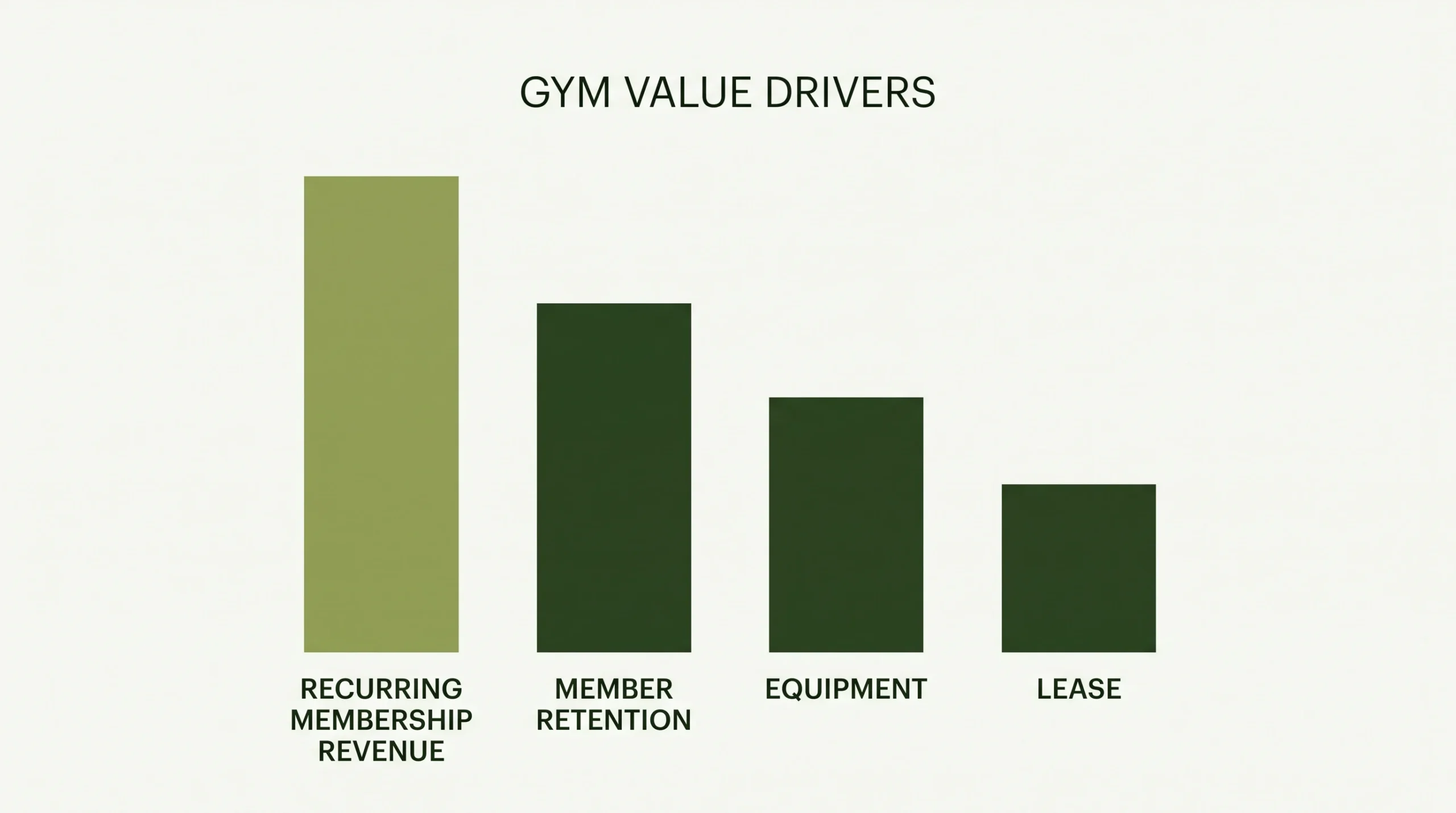
- Steady revenue rules: Regular member dues, not equipment, set a gym’s value.
- Churn is the swing factor: Churn under 4 percent a month signals steady earnings and lifts the multiple.
- SDE and EBITDA multiples: Most gyms trade at 2.5x to 4.0x SDE or 3.0x to 5.0x EBITDA.
- Equipment at value in place: Machines are valued at fair market value in place, not original cost.
- Risk lowers the price: Owner reliance, instructor reliance, and short leases cut the value.
These points frame how a buyer reads a fitness business. The sections below cover each driver, from the revenue base to the risks.
What are the primary drivers of a gym’s value?
A gym’s value rests first on steady member dues. Then come cash flow, retention, and location. Buyers pay for regular dues because that income passes to the new owner. Training packages and one-time class fees still count, but they swing month to month and earn a lower price.
Seller’s Discretionary Earnings, or SDE, is the headline number for most single-site gyms. It shows the full benefit to an owner who runs the place, after adding back owner pay, interest, taxes, and non-cash items. Sofer Advisors reworks three to five years of statements to reach a normalized earnings figure. Then it checks that number against member trends, so the result reflects the real business.
Why does member churn matter so much?
Churn matters because it sets how much of next year’s revenue a buyer can count on. It is the share of members who quit each month. A gym losing 8 percent a month must replace nearly its whole roster within a year, which forces heavy spending to win new members. A gym holding churn under 4 percent keeps its revenue base intact and earns a higher multiple.
Retention drives the ratio of lifetime value to the cost of winning a member. Buyers read that ratio as a sign of staying power. Industry churn benchmarks run 4 to 7 percent a month for most gyms, so a studio that stays below that range stands out. When members stay two or three years, marketing spend drops and margins climb. Sofer Advisors studies month-by-month retention during diligence. It reflects the Heart of a Teacher approach the firm brings to every job: show the owner the numbers behind the price, not just the final figure.
What multiples apply to gyms and studios?
Multiples for fitness businesses run 2.5x to 4.0x SDE or 3.0x to 5.0x EBITDA. Smaller owner-run studios are priced on SDE. Larger managed sites are priced on EBITDA, once a market-rate manager sits in the numbers. Where a gym lands in that range depends on size, location, member base, and lease strength. Recent gym sale benchmarks show smaller marketplace gyms near 2.4x discretionary earnings in 2025, tied to real private sales, not guesswork.
| Facility type | Primary value driver | Typical metric | Common multiple | Main risk |
|---|---|---|---|---|
| Boutique studio | Class programming and instructor draw | SDE | 2.5x to 3.5x SDE | Instructor and owner dependence |
| Independent gym | Recurring membership base | SDE | 2.5x to 4.0x SDE | Local competition and churn |
| Franchise location | Brand systems and lender comfort | SDE or EBITDA | 3.0x to 4.5x SDE | Royalty and contract terms |
| Multi-site or managed | Volume and management depth | EBITDA | 3.0x to 5.0x EBITDA | Lease and capital needs |
Two studios with equal earnings can fetch very different prices. One with month-to-month leases, aging gear, and a single star instructor sits at the low end. A franchise with a long lease, low churn, and a manager who can stay reaches the top. The market approach gives a starting range, and the income approach, through a discounted cash flow model, tests whether the projected dues justify it. The asset approach sets a floor. Sofer Advisors weighs all three under IRS Revenue Ruling 59-60 to reach an enterprise value that holds up under review. That work follows The Sofer Difference, a four-phase path of Discovery, Diligence, Analysis, and Delivery.
How do equipment and lease terms affect value?
Equipment adds value through its use in place, not its original price. An appraiser sets the fair market value in place. That is what a buyer would pay to keep the machines running where they sit, above scrap or quick-sale value. Modern, well-kept cardio and strength gear support the number. Worn or dated gear forces the figure down and points to capital spending soon after the sale.
Lease terms can matter as much as the treadmills. Because a studio leans on its location, a long remaining term at a fair rent is an asset. A short lease or an above-market rent is a burden a buyer prices in at once. The Appraisal Foundation sets the USPAP rules appraisers follow for these calls. Sofer Advisors reviews the lease, the equipment list, and any delayed capital needs together, so the asset approach sets a real floor grounded in the gym’s true condition.
Does a franchise or independent model change value?
A franchise tie usually raises value. It hands a buyer proven systems, a known brand, and easier lender approval, which all lower the risk they see. Independent gyms can still fetch strong prices when they own a loyal crowd and clean books. But more of that trust sits with the owner. The trade-off is cost. Franchise royalties and marketing fees cut owner earnings and carry contract terms the new owner inherits.
The value has to net the brand upside against the franchise burden. A well-run franchise site often prices at a premium, since a lender sees a track record and a buyer sees a playbook. An independent studio with standout classes can match that, as long as its systems and revenue do not live only in the founder’s head. Sofer Advisors models royalty costs, transfer fees, and renewal terms. So the result captures both the goodwill the brand adds and the duties it places on the next owner.
What risk factors lower a gym’s worth?
A gym’s value drops when a buyer sees revenue that may not carry over. The biggest red flags are heavy owner reliance, a narrow member base, reliance on one or two star instructors, weak records, and poor leases. Each raises the discount rate a buyer applies and lowers faith that earnings will last once the owner steps away.
Instructor and member concentration deserve close attention in boutique studios. When one spin or yoga instructor draws a big share of attendance, their exit can take the class revenue too, much like customer concentration in any other business. Thin or messy books raise the same doubt. Sofer Advisors sizes each risk against market evidence. Unlike large firms such as Alvarez and Marsal or Kroll that serve enterprise clients, the firm brings that senior-level review to independent gym owners. It is backed by a full W2 team of 14, not a single solo practitioner.
Frequently Asked Questions
How do you value a gym?
Valuing a gym starts with normalized earnings, usually SDE for a single site. An appraiser uses the income approach to project member cash flow. The market approach compares recent sales in databases such as DealStats. The asset approach values equipment in place. Sofer Advisors weighs all three against churn and lease terms. That shows whether the earnings will last under a new owner.
How does member churn affect a gym valuation?
Churn tracks how many members quit each month, and it sets how steady the revenue is. High churn forces constant marketing to replace lost members and signals a shaky base, which lowers the multiple. A rate under 4 percent points to a loyal base and steady dues that buyers reward. Sofer Advisors reviews month-by-month retention during diligence to prove your revenue will last to buyers and lenders.
What is a good EBITDA multiple for a fitness center?
A profitable fitness center often trades at 3.0x to 5.0x EBITDA. The exact figure depends on size, location, and a steady member base. Smaller owner-run studios are usually priced on SDE instead, at 2.5x to 4.0x. The multiple rises with low churn, a manager who can stay, and a strong lease. Sofer Advisors tests your books to confirm which metric and multiple fit your gym’s real market spot.
What is Seller’s Discretionary Earnings for a gym?
Seller’s Discretionary Earnings, or SDE, is the total benefit an owner draws from the gym. It starts with net profit. Then it adds back owner pay, interest, taxes, depreciation, and one-time costs. The figure shows a buyer the full cash flow on hand before they pick how to run the place. Sofer Advisors builds SDE from tax returns and internal records, so the earnings base is clean and easy to defend.
How much is a gym worth that earns $300,000 a year?
A gym earning 300,000 dollars in SDE usually lands between 750,000 and 1.2 million dollars, at multiples of 2.5x to 4.0x. Where it falls depends on churn, equipment, lease length, and local rivals. A steady, low-churn site with a long lease reaches the top of that range. Sofer Advisors tunes the multiple to the exact risk and growth of your fitness business.
Does a franchise affiliation increase a gym’s value?
A franchise tie often raises value. It gives buyers tested systems, a known brand, and smoother lender approval, which cuts the risk they see. That gain is offset by royalty and marketing fees that lower owner earnings. Transfer and renewal duties also pass to the buyer. Sofer Advisors nets the brand’s goodwill against these contract costs. So the value reflects both the upside and the burden the tie carries.
How does a boutique studio valuation differ from a large gym?
A boutique studio earns value from standout classes and the draw of specific instructors. So its risk centers on instructor and owner concentration. A large gym leans on member volume, packed equipment, and deep management, and is usually priced on EBITDA. Sofer Advisors fits the method to each model. It weighs instructor reliance for studios, and asset and overhead efficiency for larger clubs.
How important is equipment value in a gym’s worth?
Equipment is a minor driver for a profitable gym, but a key floor for a studio not yet earning cash. An appraiser sets fair market value in place, which usually differs from book value shaped by tax depreciation. Delayed upkeep lowers the figure and warns of spending soon. Sofer Advisors reviews your equipment list, so the total value reflects the true state of the place.
How much does a business valuation from Sofer Advisors cost?
Standard business valuation services usually run 7,500 to 25,000 dollars. The price depends on how complex your statements are and the report’s purpose. Simpler jobs for planning or tax sit at the lower end. Deals and court support that need deeper work run higher. Contact Sofer Advisors for a fee quote matched to your gym’s exact case.
Related Case Studies
- EBITDA Multiple for Business Valuation by Industry
- How to Value a Business Based on Cash Flow
- How Do You Determine What a Business Is Worth
Executive Summary
A gym valuation turns steady member dues into a price you can defend. Churn moves it most. Most fitness businesses sell for 2.5x to 4.0x SDE or 3.0x to 5.0x EBITDA. Churn under 4 percent a month supports the higher end, per DealStats evidence. Equipment is valued at fair market value in place. Owner reliance, instructor concentration, and short leases pull the number down. A sound result weighs the income, market, and asset approaches under IRS Revenue Ruling 59-60, USPAP, and AICPA standards. So it holds up for a sale, tax filing, or dispute.
What Should You Do Next?
Start by pulling three to five years of tax returns and monthly profit and loss statements. Then build a current equipment list with the age and state of every major machine. Track your monthly churn and retention, since those numbers drive the multiple more than any asset. Find your lease and any renewal options, so a buyer sees how long the site is locked in.
For a valuation you can stand behind, work with David Hern CPA ABV ASA. His team has given expert witness testimony in 11+ cases across Georgia, Florida, California, and New Mexico. Schedule a consultation to talk through the value of your gym or studio.
People Also Read
- Normalized EBITDA: Definition, Formula and Why It Matters
- Adjusted EBITDA vs EBITDA: Key Differences Explained
About the Author
This guide was prepared by David Hern CPA ABV ASA, founder of Sofer Advisors, a business valuation firm headquartered in Atlanta, GA serving clients across the United States. David holds dual accreditations as an Accredited Senior Appraiser (ASA) and is Accredited in Business Valuation (ABV), credentials recognized by the IRS, SEC, and FINRA. He also holds the Certified Exit Planning Advisor (CEPA) designation. With 15+ years of valuation experience, David has served as an expert witness in 11+ cases across multiple jurisdictions and built Sofer Advisors into an Inc. 5000-recognized firm with 180+ five-star Google reviews. Its full W2 employee team maintains subscriptions to all major valuation databases and operates under a next business day response policy. For professional business valuation services, visit soferadvisors.com/about-us/ or contact Sofer Advisors at soferadvisors.com/contact-us/.
Disclaimer: This content is for informational purposes only and does not constitute professional valuation advice. Business valuation conclusions depend on specific facts and circumstances. Contact Sofer Advisors for guidance regarding your specific situation.









