


Last Updated: October 2026
An impairment test checks whether an asset’s carrying value on the balance sheet is higher than the amount the business can still recover from it. If it is, the company writes the asset down. Both US GAAP and IFRS require this check so assets are not overstated. Studies of large acquisitions show goodwill alone can make up a big share of a deal price, which is why the test matters.
The team at Sofer Advisors performs these valuations for owners, CPAs, and auditors, backed by Inc. 5000 recognition in both 2024 and 2025. A test can run on a fixed annual cycle or when a warning sign appears, such as a market decline, a legal setback, or a run of operating losses.
The goal is simple. The balance sheet should reflect what an asset is worth today, not what it cost years ago. This guide explains when a test is required, how the two-step method works, and how the rules differ for goodwill and under IFRS.
Key Takeaways
- What the test does: it compares an asset’s carrying value to its recoverable amount so the balance sheet is not overstated.
- When it is required: a triggering event, such as a market decline or sustained losses, forces a test under ASC 360.
- The two steps: first a recoverability test, then, if the asset fails, a measurement of the loss against fair value.
- Goodwill is simpler: under ASC 350, as updated by ASU 2017-04, goodwill uses a single-step test.
- GAAP vs IFRS: US GAAP uses two steps and bars reversals; IFRS uses one step and allows reversals for most assets other than goodwill.
Each of these elements interacts with the broader financial reporting framework. The sections below examine each in detail.
Why Is Impairment Testing Important to Understand?
Impairment testing keeps the balance sheet honest, and the standards make it mandatory. ASC 360 governs long-lived assets such as equipment and buildings. ASC 350 governs goodwill and indefinite-lived intangibles. Under IFRS, IAS 36 sets the parallel rules. The FASB simplified goodwill testing through ASU 2017-04, which removed the old implied-fair-value step. A missed or weak test can overstate assets, trigger a later restatement, and shake the confidence of lenders and investors who rely on the reported numbers.
What Triggers an Asset Impairment Test?
A test for long-lived assets is required when a triggering event suggests the carrying amount may not be recoverable. ASC 360 lists the signals. External signals include a sharp drop in an asset’s market price or a worsening business climate. Internal signals include sustained negative cash flows or physical damage to the asset.
Other common triggers include new competition, higher interest rates, lost customers, or a rule change that limits how an asset can be used. A plan to sell or retire an asset early counts too. A single strong signal is enough to require a test. Timing differs by asset type, since goodwill carries a set annual test date while long-lived assets are tested only when a trigger appears.
Goodwill also allows an optional first screen, often called Step 0. It asks whether it is more likely than not that a reporting unit’s fair value sits below its carrying amount. If the answer is clearly no, the company can skip the full calculation for that period. Documenting the trigger, or the reason none applied, matters because auditors will ask why a test was or was not performed.
How Does the Quantitative Impairment Test Work?
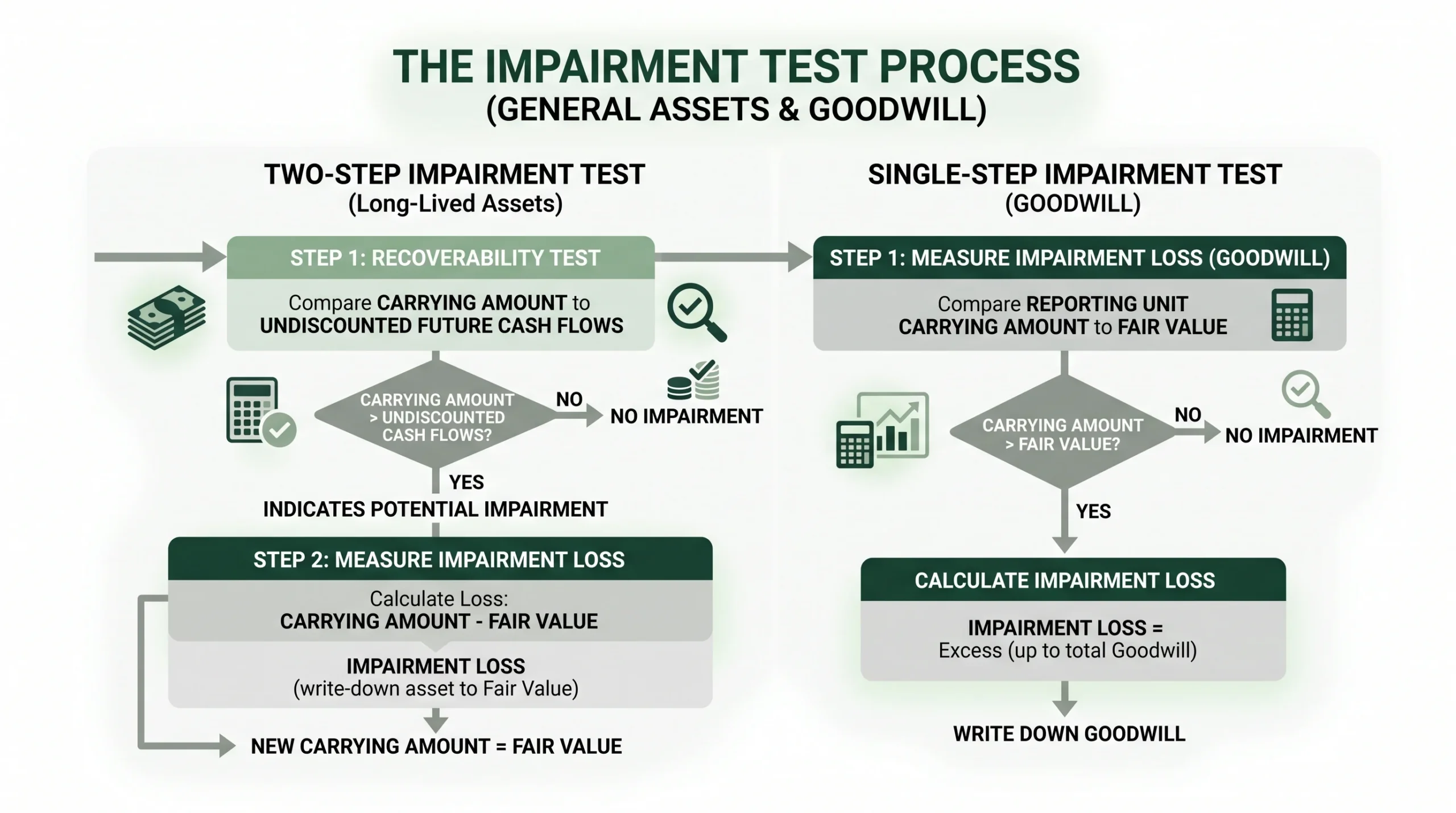
The quantitative test for a long-lived asset runs in two steps. Step 1 is the recoverability test. The company compares the asset’s carrying amount to the undiscounted future cash flows it expects from the asset. If the carrying amount is higher than those cash flows, the asset fails Step 1 and moves on.
Step 2 measures the loss. The impairment charge is the amount by which the carrying value exceeds the asset’s fair value. The company records that charge, and the lower figure becomes the asset’s new basis. A short example shows how the steps connect. Suppose a machine has a carrying amount of $1,000,000 and is expected to produce $900,000 in undiscounted cash flows. The carrying amount is higher, so the machine fails Step 1. In Step 2, an appraiser measures fair value at $700,000. The charge is $300,000, the gap between the $1,000,000 carrying value and the $700,000 fair value. The machine then sits at $700,000, and under US GAAP that figure cannot be written back up later.
Understanding which standard applies and how to measure a loss is easier with a qualified advisor reviewing your situation. Talk to a Sofer Advisors valuation specialist about which approach fits your assets.
How Is Goodwill Impairment Different?
Goodwill uses a simpler path under ASC 350. ASU 2017-04 removed the old second step, so goodwill now uses a single step. The company compares a reporting unit’s carrying amount to its fair value. If the carrying amount is higher, the difference is the impairment loss.
One limit applies. The loss cannot be more than the goodwill assigned to that reporting unit. The same single-step approach also applies to indefinite-lived intangible assets when a quantitative test is needed. Goodwill is tested at the reporting unit level, which is an operating segment or one level below it. This change made goodwill testing faster to run and easier to document for an audit.
What Are the GAAP vs IFRS Rules, and What Happens After a Charge?
US GAAP and IFRS differ in two main ways: the test structure and the treatment of past losses. US GAAP often uses the two-step process above. IFRS, under IAS 36, uses one step. It compares the carrying value to the recoverable amount, which is the higher of fair value less costs to sell or value in use. IFRS also allows a company to reverse an impairment loss for most assets other than goodwill. US GAAP does not permit reversals at all.
Once recorded, an impairment charge is a non-cash entry. It lowers the asset’s value and reduces reported net income, but it does not move cash out of the business. The lower carrying value also changes future periods, since depreciation or amortization is recalculated on the reduced basis. Clear disclosure of the charge and its cause helps management answer questions during the audit. That transparency reflects the Heart of a Teacher approach, which focuses on explaining the data behind a conclusion rather than simply reporting a number.
Who Performs Impairment Testing, and How Do Options Compare?
Companies choose an impairment partner based on asset complexity, audit sensitivity, and budget. Larger national firms such as Alvarez & Marsal, Stout, and Kroll serve big public companies with broad advisory teams. Sofer Advisors focuses on defensible, partner-led valuations for closely held and middle-market businesses, with expert witness testimony in 11+ cases behind its reports. The table below shows how the common options compare.
| Provider | Typical role | Best for |
|---|---|---|
| Specialized valuation firm (e.g. Sofer Advisors) | Performs the independent valuation and fair value measurement | Private, PE-backed, and public companies needing audit-ready support |
| Large national firm | Broad advisory plus valuation at enterprise scale | Large public companies with complex, multi-unit testing |
| Legal counsel | Advises on disputes involving asset values; does not value | Companies facing litigation where impairment is contested |
Sofer Advisors works through a four-phase process it calls The Sofer Difference, moving from Discovery to Diligence to Analysis to Delivery. That structure keeps each test grounded in sound financial principles and backed by clear documentation. For a report that stands up to audit review, an independent valuation firm supplies both the analysis and the trail of evidence behind it.
Frequently Asked Questions
How do I calculate impairment?
For most long-lived assets, you use a two-step process under ASC 360. First, run a recoverability test by comparing the asset’s carrying amount to its undiscounted future cash flows. If the carrying value is higher, move to the second step, where the loss is the gap between the carrying amount and fair value. Sofer Advisors measures that fair value with a defensible, audit-ready analysis.
How often do you test goodwill for impairment?
Companies test goodwill at least once a year under ASC 350. A company must also test sooner if a triggering event suggests a reporting unit’s fair value has dropped below its carrying amount. Such events include a sharp downturn in the business climate or a major legal change. Sofer Advisors helps teams set a repeatable annual testing routine that satisfies their auditors.
Is goodwill impairment good or bad?
It is usually read as a negative sign. A goodwill charge means an acquired business is worth less than its recorded value, often because earnings or market conditions came in below what the buyer expected. The charge is non-cash, but it still affects reported results and how investors read the company. Sofer Advisors documents the cause so management can explain it with confidence.
What is a triggering event for impairment testing?
A triggering event is a change that makes a loss in value more likely than not. Examples include a sharp drop in an asset’s market price, physical damage, or a major change in how the asset is used. Higher interest rates and lost customers can also qualify. Sofer Advisors reviews these indicators to confirm whether a full quantitative test is required under ASC 360.
Can an impairment loss be reversed under US GAAP?
No. Under US GAAP, a loss on a long-lived asset or goodwill cannot be reversed in later periods, and the lower carrying value becomes the new basis. IFRS differs, since under IAS 36 it allows reversals for most assets other than goodwill when conditions later improve. This single difference can leave the same asset carried at different values under the two frameworks over time. Sofer Advisors helps companies reporting under both frameworks reconcile that gap in their records.
What is the difference between ASC 350 and ASC 360?
ASC 350 covers goodwill and indefinite-lived intangibles, while ASC 360 covers long-lived assets held and used, such as equipment or buildings. ASC 350 focuses on the fair value of a reporting unit, while ASC 360 starts with a recoverability test based on undiscounted cash flows. Sofer Advisors applies the correct standard to each asset class so the reporting holds up under review.
Does an impairment charge affect cash flow?
No. An impairment charge is a non-cash expense, so it does not reduce the cash a business holds. It lowers reported net income and the asset’s carrying value on the balance sheet. On the cash flow statement, the charge is added back to net income in the operating section. Sofer Advisors explains these effects so owners understand the full reporting impact.
What is a reporting unit in goodwill testing?
A reporting unit is an operating segment, or one level below it, for which separate financial information exists and management reviews it regularly. Goodwill testing under ASC 350 happens at this level. Defining the units correctly matters, because it decides where goodwill sits and where a loss would show up. Sofer Advisors reviews your segment data to map reporting units accurately.
How much does an impairment test from Sofer Advisors cost?
Most impairment engagements run from $7,500 to $25,000 and take about two to six weeks, depending on the number of assets and reporting units and on the deadline. A flat fee is quoted up front, so the cost is clear before the work starts, with no hourly surprises along the way. Sofer Advisors sets the scope first, then quotes a fixed price. Request a free estimate for a range specific to your engagement.
Related Case Studies
- Goodwill Impairment Testing: Step-by-Step ASC 350 Guide
- The Recoverability Test: Undiscounted Cash Flows Under ASC 360 (Step 1)
- ASC 360 Impairment Loss: Measuring Fair Value (Step 2)
Executive Summary
An impairment test keeps reported assets tied to current value. Confirm which standard applies first: ASC 360 for long-lived assets, ASC 350 for goodwill, or IAS 36 under IFRS. Long-lived assets follow a two-step test, a recoverability check against undiscounted cash flows, then a loss measured against fair value. Goodwill uses a single step capped at the goodwill in the reporting unit. US GAAP bars reversals; IFRS allows them for most assets other than goodwill. Most engagements run $7,500 to $25,000 over two to six weeks. The first action is to gather the asset register, cash flow forecasts, and the purchase price allocation for any goodwill.
What Should You Do Next?
Review which assets face a triggering event this year and confirm the standard that governs each one. Gather the asset register, recent financial statements, and the cash flow forecasts tied to each asset or reporting unit, since a clean file supports a defensible charge. This guide was prepared by David Hern CPA ABV ASA, founder of Sofer Advisors, an Inc. 5000 firm specializing in neutral third-party valuations for financial reporting. Schedule a free consultation to discuss your specific situation.
People Also Read
About the Author
This guide was prepared by David Hern CPA ABV ASA, founder of Sofer Advisors, a business valuation firm headquartered in Atlanta, GA serving clients across the United States. David holds dual accreditations as an Accredited Senior Appraiser (ASA) and is Accredited in Business Valuation (ABV), credentials recognized by the IRS, SEC, and FINRA. He also holds the Certified Exit Planning Advisor (CEPA) designation. With 15+ years of valuation experience, David has served as an expert witness in 11+ cases across multiple jurisdictions and built Sofer Advisors into an Inc. 5,000-recognized firm with 180+ five-star Google reviews. Its full W2 employee team maintains subscriptions to all major valuation databases and operates under a next business day response policy.
For professional business valuation services, visit soferadvisors.com/about-us/ or contact Sofer Advisors at soferadvisors.com/contact-us/.
This content is for informational purposes only and does not constitute professional valuation advice. Business valuation conclusions depend on specific facts and circumstances. Contact Sofer Advisors for guidance regarding your specific situation.









