


Last Updated: October 2026
A Form 709 gift tax valuation sets the fair market value of a gifted asset, such as an interest in a closely held business, for the United States Gift and Generation-Skipping Transfer Tax Return. When you give away a private business interest above the annual exclusion, which the IRS set at $19,000 per recipient in 2025, you must report the transfer. The IRS needs a defensible value to support it.
The team at Sofer Advisors prepares gift and estate valuations for business owners, their attorneys, and their CPAs, backed by 180+ five-star Google reviews. A strong valuation report lowers the risk of an audit adjustment, especially on minority-interest gifts. The value must reflect current market conditions, the company’s financial results, and any discounts for a minority or hard-to-sell interest.
This guide explains what triggers a Form 709, how a business interest is valued, which discounts apply, what adequate disclosure requires, and how gift and estate valuations differ.
Key Takeaways
- Filing threshold: a Form 709 is required when gifts to one person in a year exceed the annual exclusion, which the IRS adjusts for inflation ($19,000 per recipient in 2025).
- Standard of value: gifts are reported at fair market value on the date of the gift, under Revenue Ruling 59-60.
- Discounts matter: discounts for lack of control and lack of marketability lower the taxable value, but need solid support.
- Qualified appraiser: a credentialed appraiser’s report is what survives IRS review of a private-business gift.
- Adequate disclosure: a proper report on the return starts the three-year clock for an IRS challenge.
Each point below connects to a defensible gift tax filing, and the sections that follow work through them one at a time.
Why Is a Form 709 Valuation Important to Understand?
A Form 709 valuation gives the IRS an objective basis for the value you transfer, and the rules make the standard clear. IRC Section 2512 requires gifts to be reported at fair market value, and Revenue Ruling 59-60 sets the framework for valuing closely held stock. The adequate disclosure rules under the Treasury Regulations decide whether the three-year statute of limitations even starts. A weak or missing valuation invites scrutiny, which can lead to an audit, a retroactive adjustment, back tax, interest, and accuracy-related penalties for the donor.
What Triggers a Form 709 Filing for a Business Gift?
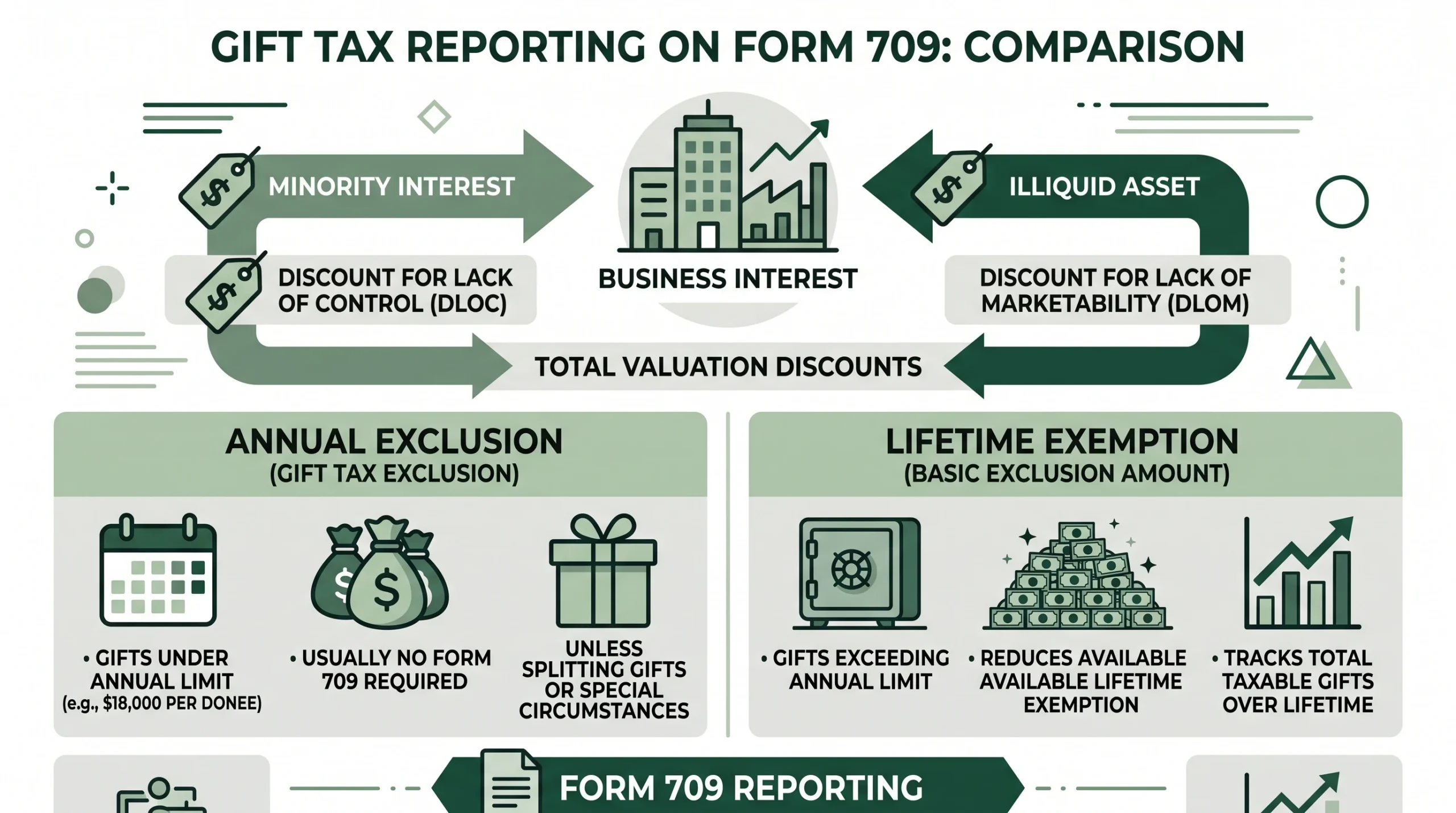
A Form 709 is required when total gifts to one person in a year exceed the annual exclusion. The IRS sets this limit and raises it over time for inflation. If you give shares in a closely held business above that amount, you must report the transfer on this form.
Common triggers include moving company stock to a child or adding a family member as a partner. Because these shares have no public market, an independent valuation is needed to set fair market value. Married couples can use gift splitting, which lets each spouse apply their own exclusion to the same gift. Both spouses must consent to the split on their returns.
How Is a Business Interest Valued for Gift Tax?
For gift tax, a business interest is valued at fair market value under Revenue Ruling 59-60. This is the price a willing buyer and willing seller would agree on, with neither under pressure. It calls for a full analysis, not a quick formula. The appraiser weighs factors such as the nature of the business and the outlook for its industry.
To reach that value, a qualified appraiser uses three approaches: income, market, and asset. The income approach looks at future cash flows. The market approach looks at comparable sales. The asset approach looks at net assets. The appraiser then weighs the results and reflects the specific traits of the gifted interest, such as a lack of control or marketability.
Matching the method to the gift and supporting each discount is easier with an independent appraiser. Talk to a Sofer Advisors valuation specialist about valuing the interest you plan to transfer.
What Valuation Discounts Apply to a Gifted Interest?
Discounts apply because a minority share in a private company is worth less than a controlling stake. The two main ones are the Discount for Lack of Control (DLOC) and the Discount for Lack of Marketability (DLOM). Both lower the taxable value of the gift.
The DLOC reflects limited influence. A minority holder cannot set strategy or force a dividend. The DLOM reflects the trouble of selling a private interest when no ready market exists. The IRS studies these figures closely, so each discount needs data behind it. Per Business Valuation Resources (BVR) data, these adjustments are standard when the evidence supports a lack of control or liquidity.
A short example shows the effect. Suppose a 20% stake in a family business would be worth $2,000,000 on a straight pro-rata basis. An appraiser might apply a 15% discount for lack of control and then a 25% discount for lack of marketability. Applied in sequence, those discounts cut the value to about $1,275,000. That lower figure is what the donor reports on Form 709, and the supporting data is what defends it if the IRS asks.
What Is Adequate Disclosure on Form 709?
Adequate disclosure is the set of rules that decides whether the three-year clock starts. To meet them, the return must describe the transferred interest, name the parties, and explain how the value was reached. A qualified appraisal attached to the return is the cleanest way to satisfy the test.
The report should lay out the method, the data used, and the basis for any discount. It should also note any relationship between the parties, since gifts within a family draw extra review. When the disclosure is complete, the IRS has three years to challenge the value. When it is not, that window never closes, and the gift stays open to review for years. A weak or formula-based value, or deep discounts with no data, is a common red flag that invites a challenge.
What Gifting Structures Use a Form 709 Valuation?
Owners use several structures to pass business interests to the next generation, and each one leans on a defensible valuation. Direct gifts of shares to a child are the simplest. Many owners also use a family limited partnership or an LLC, then gift minority units over time to stay within their planning limits.
Trust-based plans are common too. A grantor trust can receive gifted interests, and some owners sell interests to such a trust in exchange for a note. Each of these moves reports a value on Form 709 or supports a related filing. A minority interest usually qualifies for a lack-of-control and lack-of-marketability discount, which is why the valuation has to be solid.
How Do Gift and Estate Tax Valuations Differ?
The main differences are timing and the form used. A gift tax valuation covers assets transferred while the donor is alive, reported on Form 709. An estate tax valuation sets the value of assets at the date of death, reported on Form 706. Both use the same fair market value standard and face the same level of IRS scrutiny. A transaction, by contrast, often uses investment value, which can include buyer-specific gains that tax standards do not allow. The table below shows how these engagements differ.
| Purpose | Standard of value | Typical form |
|---|---|---|
| Gift tax | Fair market value (Rev. Rul. 59-60) | Form 709 |
| Estate tax | Fair market value (Rev. Rul. 59-60) | Form 706 |
| M&A transaction | Investment value (buyer-specific) | Purchase agreement |
Owners often assume one report fits every need, but the standard of value changes with the purpose, so using a transaction value for a tax filing can create exposure. Large national firms such as Alvarez & Marsal, Stout, and Kroll serve very large estates with broad teams, while Sofer Advisors focuses on partner-led gift and estate valuations for closely held businesses, with expert witness testimony in 11+ cases behind its reports. Sofer Advisors works through a four-phase process it calls The Sofer Difference, moving from Discovery to Diligence to Analysis to Delivery. That approach reflects the Heart of a Teacher, which focuses on explaining the basis for each discount rather than simply stating a number.
Frequently Asked Questions
When do I need to file Form 709?
You file Form 709 when your gifts to any one person in a year go above the annual exclusion, which the IRS adjusts for inflation and set at $19,000 per recipient in 2025. For a business gift, that usually means transferring shares worth more than the yearly limit. You may also file to report gift splitting with a spouse. Sofer Advisors values the interest so the amount you report on the return is defensible.
How is a closely held business valued for a gift?
A closely held business is valued at fair market value under Revenue Ruling 59-60. A qualified appraiser applies the income, market, and asset approaches, then weighs the results against the facts of the company. The final value reflects the specific interest, including any discount for lack of control or marketability. Sofer Advisors prepares that appraisal with the documentation an IRS examiner expects to see behind every figure.
What is the difference between DLOC and DLOM?
The Discount for Lack of Control reflects a minority holder’s limited say in the business, such as an inability to set strategy or force a dividend. The Discount for Lack of Marketability reflects how hard a private interest is to sell when no ready market exists. Both reduce the taxable value, and both need data to support them. Sofer Advisors sizes each discount using empirical studies, not a round percentage the IRS would question.
Does a gift tax valuation start the statute of limitations?
Yes, if you meet the adequate disclosure rules. Filing a complete valuation report with Form 709 starts a three-year window for the IRS to challenge the value you reported. Without proper disclosure, the IRS can revisit the gift with no time limit, leaving it open for years. Sofer Advisors builds the report to satisfy adequate disclosure, so the three-year clock starts and your gift gains certainty.
Can my accountant value the business for Form 709?
A closely held business usually needs a credentialed appraiser, not a formula or a quick estimate from the ledgers. The analysis and the discounts must follow Revenue Ruling 59-60 and stand up to IRS review of a private-business gift. A formal report from a qualified appraiser is the defensible path. Sofer Advisors provides that independent appraisal, which your accountant can rely on when preparing the return.
How is a Form 709 valuation different from a Form 706 valuation?
Form 709 covers gifts made during life, while Form 706 covers assets at the date of death. Both use the same fair market value standard and face the same level of IRS scrutiny. The timing and the triggering event differ, which can change the facts the appraiser must weigh and the data available on the valuation date. Sofer Advisors handles both and keeps the standard of value consistent across a family’s plan.
What records does a gift valuation need?
An appraiser typically needs several years of financial statements and tax returns, the current balance sheet, and the governing documents, such as the operating or shareholder agreement. Any buy-sell terms that limit transfers also matter, since they can affect value. Gathering these early keeps the valuation on track and the report complete. Sofer Advisors sends a clear request list up front so nothing holds up the filing later.
What is gift splitting, and how does it affect Form 709?
Gift splitting lets a married couple treat a gift from one spouse as if each gave half, which effectively doubles the annual exclusion available for the gift. Both spouses must consent to the split on their returns. For a business gift, it can let a couple transfer more value in a single year before any lifetime exemption is used. Sofer Advisors values the interest so a split gift is reported correctly on both returns.
How much does a Form 709 business valuation from Sofer Advisors cost?
A gift tax business valuation generally runs from $7,500 to $25,000. The fee depends on the entity’s complexity, the number of interests gifted, and the deadline for the return. Sofer Advisors quotes a flat fee up front, so the cost is clear before the work starts, with no hourly surprises along the way. Request a free estimate for a range specific to your gift.
Related Case Studies
- Estate Planning Business Valuation Georgia: Gift & Tax Compliance Guide
- Valuation of Closely Held Business for Estate Tax Purposes
- Closely Held Business Valuation for Estate Tax: Atlanta Guide
Executive Summary
A Form 709 gift tax valuation reports a gifted business interest at fair market value on the date of the gift, under IRC Section 2512 and Revenue Ruling 59-60. A return is required once gifts to one person exceed the annual exclusion, set at $19,000 per recipient in 2025. A qualified appraiser applies the income, market, and asset approaches, then supports a Discount for Lack of Control and a Discount for Lack of Marketability with data. Meeting the adequate disclosure rules starts a three-year statute of limitations. Most gift tax valuations run $7,500 to $25,000.
What Should You Do Next?
Confirm the valuation reflects fair market value on the date of the gift and supports any discounts with data. Gather your financials, tax returns, and governing documents early, since clean inputs strengthen the report and keep the filing on time. Build in time for a qualified appraisal, because a rushed or informal value is what draws IRS scrutiny. This guide was prepared by David Hern CPA ABV ASA, founder of Sofer Advisors, an Inc. 5000 firm specializing in neutral third-party valuations for gift and estate tax. Schedule a free consultation to discuss your specific situation.
People Also Read
About the Author
This guide was prepared by David Hern CPA ABV ASA, founder of Sofer Advisors, a business valuation firm headquartered in Atlanta, GA serving clients across the United States. David holds dual accreditations as an Accredited Senior Appraiser (ASA) and is Accredited in Business Valuation (ABV), credentials recognized by the IRS, SEC, and FINRA. He also holds the Certified Exit Planning Advisor (CEPA) designation. With 15+ years of valuation experience, David has served as an expert witness in 11+ cases across multiple jurisdictions and built Sofer Advisors into an Inc. 5,000-recognized firm with 180+ five-star Google reviews. Its full W2 employee team maintains subscriptions to all major valuation databases and operates under a next business day response policy.
For professional business valuation services, visit soferadvisors.com/about-us/ or contact Sofer Advisors at soferadvisors.com/contact-us/.
This content is for informational purposes only and does not constitute professional valuation advice. Business valuation conclusions depend on specific facts and circumstances. Contact Sofer Advisors for guidance regarding your specific situation.









