


Last Updated: October 2026
A tech company valuation multiple is a number that turns one financial metric, such as revenue or profit, into a price for the whole business. A buyer multiplies that metric by the multiple to reach a value. For a private software or SaaS company, the metric is usually recurring revenue, not earnings.
Why revenue and not profit? A fast-growing SaaS company spends almost every dollar on growth, so reported profit stays thin or negative. Revenue shows scale and momentum instead. The team at Sofer Advisors values technology companies for owners, founders, and their advisors, backed by Inc. 5000 recognition in both 2024 and 2025. The multiple is never one fixed figure. It moves with growth, retention, and margin.
This guide explains how ARR and revenue multiples work, what pushes the multiple up or down, and when a profitable software business is priced on EV/EBITDA instead. It also covers how a 409A or M&A valuation applies a real method, not a rule of thumb.
Key Takeaways
- Revenue, not profit, drives SaaS value: high-growth software is valued on ARR or revenue because earnings are reinvested into growth.
- Growth is the biggest lever: a company growing 40% a year can earn roughly double the multiple of one growing 10%, all else equal.
- Retention and margin refine it: net revenue retention, gross margin, and low churn tell a buyer the revenue is durable.
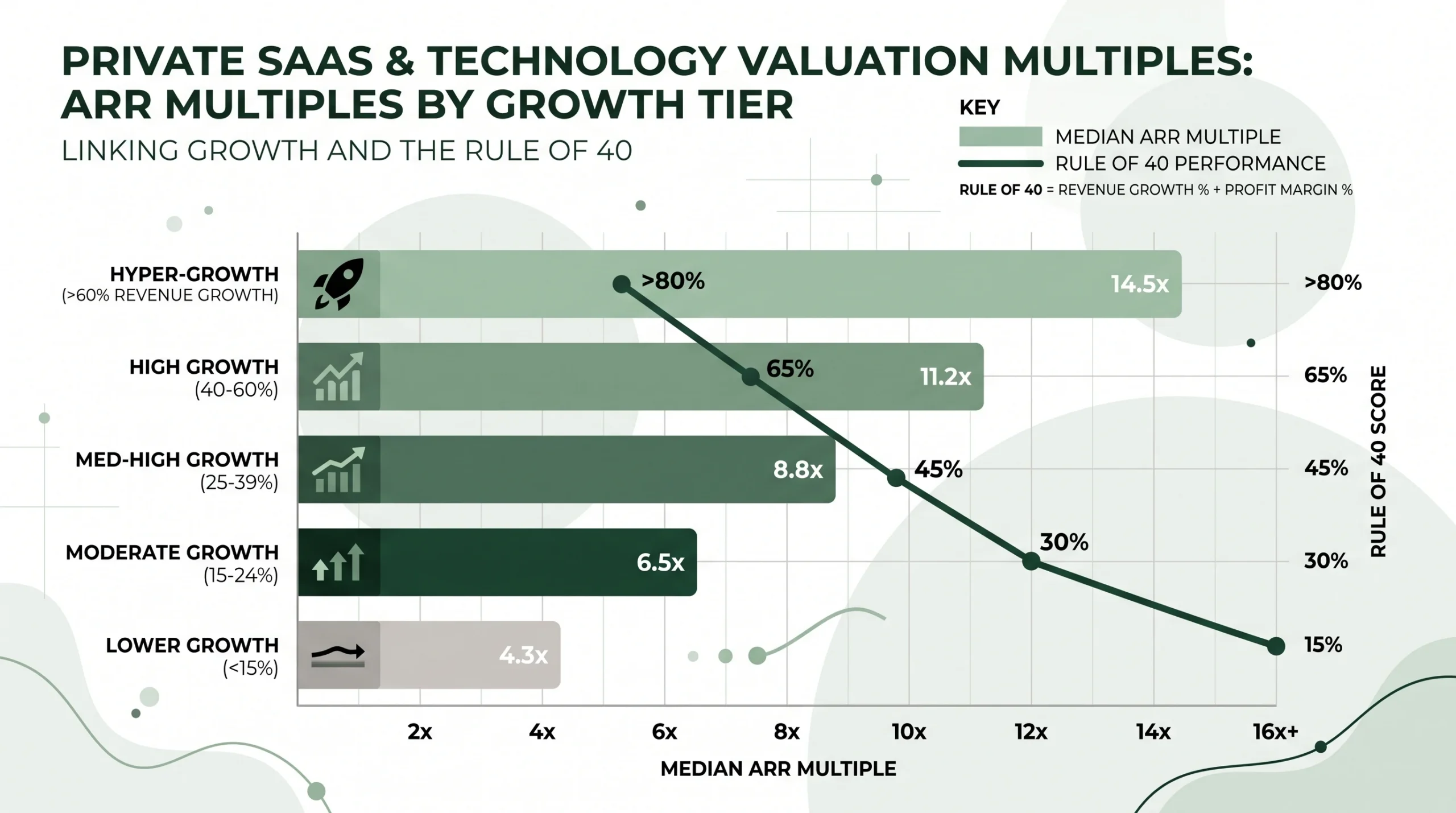
- The Rule of 40 is a quick health check: growth rate plus profit margin above 40 signals efficient scaling and supports a higher multiple.
- Mature software shifts to EV/EBITDA: once a tech company is steadily profitable, buyers price it on earnings, like most other businesses.
These pieces work together, and no single one sets the price alone. The sections below take them one at a time.
Why Do Tech Company Valuation Multiples Matter?
Multiples matter because they set the starting price in almost every tech deal. A funding round, a sale, a partner buyout, or a stock option grant all begin with a value, and that value usually comes from a multiple. Pick the wrong metric or the wrong multiple, and the number can be off by millions. Owners who know the drivers can defend their value and spot a lowball offer.
The multiple is also a shorthand for risk. A high multiple says a buyer trusts the revenue will keep growing. A low multiple says the buyer sees churn, thin margins, or a shaky market. A private company has no stock ticker to check, so the value rests on the appraiser’s choice of metric, the comparable companies, and the adjustments made for size and marketability. A clear, documented valuation turns a guess into a roadmap an owner can act on.
How Are Private SaaS Companies Valued on Revenue?
Most private SaaS companies are valued on a multiple of Annual Recurring Revenue, or ARR. ARR is the yearly value of active subscriptions. A buyer applies a multiple to ARR to reach an enterprise value. Revenue is used instead of profit because a growing SaaS company reinvests cash into sales and product, so reported earnings stay low or negative even when the business is healthy.
As a general and illustrative guide, private SaaS companies in the lower middle market often trade somewhere between 3x and 7x ARR, with many deals clustering near the middle. Faster growers and stickier products sit at the top of that band. These figures are a rough market picture, not a promise, and any real number depends on the specific company and the deal. You can see how this plays out across software in the Sofer guide to SaaS valuation.
What Drives a SaaS Revenue Multiple Up or Down?
Four drivers move a SaaS multiple more than anything else: growth rate, net revenue retention, gross margin, and churn. Growth is the strongest. A company adding 40% a year can earn close to double the multiple of one adding 10%. Net revenue retention above 100% means existing customers spend more each year, which buyers read as low-risk, high-quality revenue.
Gross margin shows how much of each dollar is left after delivering the software. Software margins are high, often 70% to 85%, and that headroom funds growth. Churn works in reverse. High churn means the company keeps refilling a leaking bucket, so buyers cut the multiple. The Rule of 40 bundles these into one check: add your growth rate and your profit margin, and a total above 40 signals efficient scaling. A score above 40 supports a premium. For a closer look at when revenue beats earnings, see the Sofer guide to revenue multiple valuation.
When Does EV/EBITDA Apply to Mature Software?
EV/EBITDA applies once a software company is steadily profitable and growing at a slower, predictable pace. At that point, earnings are real and recurring, so buyers price the business on profit like most other industries. Enterprise value to EBITDA shows how many years of current earnings a buyer pays for. Mature, cash-generating software often trades at a mid to high EBITDA multiple, above a factory but below a hot startup.
The shift from a revenue multiple to an EBITDA multiple marks a real change in a company’s life. Early on, burning cash to win market share makes sense, and profit is beside the point. Later, when growth cools, the market wants proof of earnings. A good valuation often blends both views, pairing a market approach on comparable multiples with an income approach such as a discounted cash flow. Relying on one metric alone can miss how a hybrid software business actually makes money.
How Does a 409A or M&A Valuation Apply a Method?
A 409A or M&A valuation applies a defined method, not a rule of thumb. A 409A sets the fair market value of a private company’s common stock so option grants follow the tax rules under Section 409A. It is deliberately conservative. An M&A valuation estimates what a specific buyer might pay, which is often far higher. The two answer different questions and rarely match.
A 409A is not what the company would sell for. It is fair market value applied to common stock, refreshed every 12 months or after a material event. The rules for measuring that value sit in the Treasury regulations. A sale price, by contrast, is investment value to one buyer and routinely runs many times higher. Mixing the two is a common and costly mistake. The Sofer guide to 409A valuation requirements walks through the compliance side in full.
Who Values a Tech Company, and How Do the Options Compare?
Owners choose a valuation partner based on the size of the business, the reason for the valuation, and the budget. A venture round, a tax filing, and a sale each call for a slightly different report. Large national firms such as Alvarez & Marsal, Stout, and Kroll serve big public companies with broad advisory teams. Sofer Advisors focuses on defensible, partner-led valuations for private and middle-market technology companies, with 180+ five-star Google reviews and expert witness testimony in 11+ cases.
| Provider | Typical role | Best for |
|---|---|---|
| Specialized valuation firm (e.g. Sofer Advisors) | Selects the right metric and documents a defensible value | Private and middle-market tech needing audit-ready or court-ready support |
| Large national firm | Broad advisory plus valuation at enterprise scale | Large public companies with complex, multi-entity needs |
| Automated valuation tool | Applies a generic multiple to the numbers you type in | A fast, rough ballpark before any formal review |
Sofer Advisors runs each engagement through a four-phase process it calls The Sofer Difference, moving from Discovery to Diligence to Analysis to Delivery. That structure keeps every multiple tied to the company’s real numbers and the comparable deals behind it. It reflects a Heart of a Teacher approach, which means explaining the reasoning behind a figure instead of just handing one over. You can see the full scope of its business valuation services for technology companies.
Frequently Asked Questions
What is the Rule of 40 for SaaS valuation?
The Rule of 40 says a healthy software company’s growth rate plus its profit margin should add up to at least 40. A firm growing 30% with a 10% margin hits the mark. A firm growing 50% can lose 10% and still pass. A score above 40 signals efficient scaling, which buyers reward with a higher multiple. Sofer Advisors uses the Rule of 40 as one of several checks when it values a SaaS business.
What is a typical ARR multiple for a private SaaS company?
There is no single fixed number. As a general and illustrative guide, private SaaS companies in the lower middle market often trade between 3x and 7x ARR, with many deals landing near the middle. Faster growth, high retention, and strong margins push toward the top of that range. Slower growth and high churn pull it down. Sofer Advisors builds the multiple from your actual metrics and comparable deals, not a rule of thumb.
Why do SaaS companies use revenue multiples instead of EBITDA?
A growing SaaS company spends heavily on sales, marketing, and product, so its reported profit is thin or negative even when the business is strong. EBITDA would understate the value. Recurring revenue is a cleaner signal of scale and momentum, so buyers apply a multiple to ARR or revenue instead. Once growth slows and profit becomes steady, the same company is usually valued on EBITDA. Sofer Advisors picks the metric that fits the company’s stage.
What valuation multiple does an AI company get?
AI companies often earn a premium over general software because of proprietary models, high switching costs, and strong demand. Standard private SaaS might trade in a 3x to 7x revenue range, while top AI firms with durable advantages can see higher numbers in competitive bidding. These premiums are not automatic and depend on real defensibility. Sofer Advisors examines the actual technology, retention, and margins before it supports any premium in a valuation report.
How do you value a SaaS startup with little or no profit?
You value it on growth and revenue quality, not earnings. The main inputs are ARR, the growth rate, net revenue retention, gross margin, and the size of the market. An appraiser compares the startup to similar companies and recent deals, then adjusts for its size and risk. Forward revenue multiples are common for early-stage firms. Sofer Advisors uses this evidence to build a defensible value for a funding round, a 409A, or an internal transfer.
What is net revenue retention, and why does it affect the multiple?
Net revenue retention measures how much recurring revenue existing customers generate this year versus last year, after upgrades, downgrades, and cancellations. Above 100% means the customer base grows on its own, even before new sales. Buyers treat that as durable, low-risk revenue and pay a higher multiple for it. Below 100% signals churn and weak expansion, which cuts the multiple. Sofer Advisors reviews cohort data closely so retention is measured correctly in the valuation.
Why is a 409A value lower than a sale price?
A 409A sets the fair market value of common stock for option grants under the tax rules. It is deliberately conservative and reflects a minority, non-marketable share of a private company. A sale price is investment value to one specific buyer, who may pay for growth, strategy, or control. That buyer’s price often runs several times the 409A value, and both can be correct. Sofer Advisors prepares each one to the standard that its purpose requires.
How much does a tech company valuation cost?
Most technology company valuations run from $7,500 to $35,000 and take about four to eight weeks, depending on the company’s size, data quality, and the purpose of the report. A 409A valuation sits lower, often $2,500 to $9,000. Sofer Advisors scopes the work first, then quotes a flat fee up front, so the price is clear before the work starts. Request a free estimate for your situation.
Related Case Studies
- How Vertical SaaS Companies Are Valued: ARR Multiples by Niche
- How to Value a Cybersecurity Company: ARR, NRR, and 2026 Comps
- Technology Company Valuation Methods: A Complete Guide
Executive Summary
Tech company valuation multiples turn one metric into a price. For private SaaS, that metric is usually ARR or revenue, because fast growth keeps reported profit low. As a rough and illustrative guide, private SaaS often trades between 3x and 7x ARR, with growth, net revenue retention, gross margin, and churn deciding where a company lands. The Rule of 40 is a fast health check. Once a software business is steadily profitable, buyers switch to EV/EBITDA. A 409A sets conservative fair market value for options, while an M&A price reflects what one buyer will pay. The right answer comes from a method and real comparables, not a rule of thumb.
What Should You Do Next?
Start by pulling your core metrics together: ARR, month-over-month growth, net revenue retention, gross margin, and churn by cohort. Separate recurring subscription revenue from one-time services income, since buyers value them very differently. Clean data shortens diligence and protects your multiple. This guide was prepared by David Hern CPA ABV ASA, founder of Sofer Advisors, an Inc. 5000 firm offering neutral third-party business valuation services. Schedule a free consultation through our contact page to discuss your specific situation.
People Also Read
- FinTech Company Valuation: Revenue Quality and Regulatory Risk
- Enterprise Value to EBITDA: What the Multiple Really Means
About the Author
This guide was prepared by David Hern CPA ABV ASA, founder of Sofer Advisors, a business valuation firm headquartered in Atlanta, GA serving clients across the United States. David holds dual accreditations as an Accredited Senior Appraiser (ASA) and is Accredited in Business Valuation (ABV), credentials recognized by the IRS, SEC, and FINRA. He also holds the Certified Exit Planning Advisor (CEPA) designation. With 15+ years of valuation experience, David has served as an expert witness in 11+ cases across multiple jurisdictions and built Sofer Advisors into an Inc. 5,000-recognized firm with 180+ five-star Google reviews. Its full W2 employee team maintains subscriptions to all major valuation databases and operates under a next business day response policy.
For professional business valuation services, visit soferadvisors.com/about-us/ or contact Sofer Advisors at soferadvisors.com/contact-us/.
This content is for informational purposes only and does not constitute professional valuation advice. Business valuation conclusions depend on specific facts and circumstances. Contact Sofer Advisors for guidance regarding your specific situation.









