


Last Updated: September 2026
Deal price vs fair value vs FMV describes a problem every buyer meets after a sale closes. One transaction produces three different numbers. The negotiated price is what the buyer agreed to pay. The tax fair market value sets the basis for the purchase price allocation. The ASC 805 fair value goes on the buyer’s financial statements. These figures rarely match. In many service and technology deals, goodwill alone can exceed half of the total price paid.
Owners and their advisors meet this puzzle during a merger, an acquisition, or a partial sale. A buyer picks one number to win the deal. The tax code needs another to divide the price. Accounting rules need a third for the books. Knowing which value answers which question keeps a clean deal from becoming a tax or audit problem later.
Sofer Advisors provides independent valuations for buyers and sellers in the middle market. As a business valuation firm based in Atlanta, GA, with 180+ five-star Google reviews, it applies IRS, GAAP, and appraisal standards to the same transaction so each number holds up with its own audience. Its senior team has served as an expert witness in 11+ cases across complex deal work.
Key Takeaways
- Three standards, one deal: every acquisition creates a negotiated price, a tax value, and a book value, each set by a different rule.
- Deal price is investment value: the price reflects what the target is worth to one specific buyer, so it can sit above fair market value.
- Tax FMV drives the Section 1060 split: the buyer and seller allocate the price across asset classes on Form 8594 to set tax basis.
- ASC 805 fair value is a market view: the buyer’s books record assets at what a typical market participant would pay, not at what this buyer paid.
- The gap is normal, not an error: a buyer, the IRS, and the auditors each need a different number from the same deal.
These three standards shape how a deal is priced, taxed, and reported. The sections below show what each value means and why they differ.
What are the three values one deal produces?
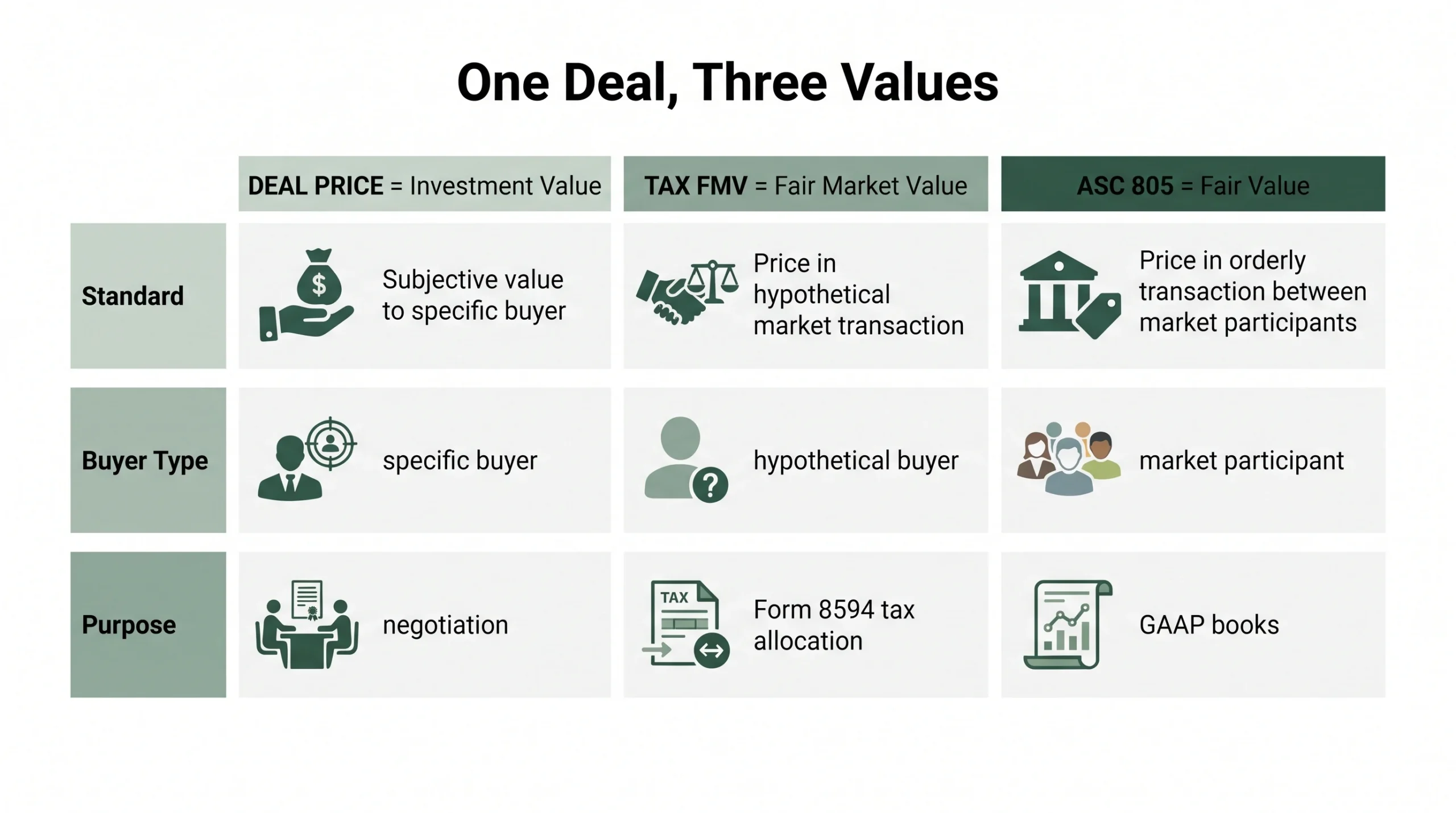
One deal produces three values because three separate standards apply to the same transaction. The negotiated price is investment value, the worth of the business to one specific buyer. The tax number is fair market value, the price a hypothetical willing buyer and seller would reach. The accounting number is fair value, an exit price a typical market participant would pay. Each has its own rule, audience, and purpose, so the three figures seldom line up.
All three carry the word “value,” yet they serve three groups. The buyer and seller care about the price. The IRS cares about the tax basis. The auditors care about the books. Treat them as three linked answers, not one number, and the deal stays clean.
Why is the negotiated deal price investment value?
The negotiated price is investment value because it measures worth to one specific buyer, not to the market at large. Investment value, also called strategic value, reflects that buyer’s own forecasts, financing, and the benefits of combining the target with an existing business. The winning price captures the value to the buyer who saw the most upside.
Fair market value, by contrast, assumes a hypothetical buyer with no special edge, so investment value can rise well above it. A larger competitor that removes duplicate overhead will pay more for those private gains. Our guide to fair market value vs investment value shows how the two standards split apart.
What is tax fair market value in the Section 1060 allocation?
Tax fair market value is the price a hypothetical willing buyer and willing seller would agree on, with neither under pressure and both fully informed. This is the standard set by Treasury rules and IRS Revenue Ruling 59-60. In an asset deal, both sides use fair market value to split the price across asset classes. They report that split on Form 8594 under IRC Section 1060. The allocation sets the buyer’s tax basis and drives future depreciation and amortization.
Section 1060 groups the assets into seven classes. Cash sits first, and goodwill and going concern value sit last as the residual. Whatever price is left after the other assets are covered falls into that final class. Buyers often amortize acquired goodwill over 15 years under Section 197. The IRS Form 8594 set out the rules, and our review of the asset sale vs stock sale choice explains why the structure matters. The Revenue Ruling 59-60 framework still anchors this standard.
How does ASC 805 fair value differ from the price paid?
ASC 805 fair value differs from the price paid because it is a market-participant measurement, not a record of what this buyer spent. Under ASC 805, the buyer records the acquired assets and liabilities at fair value on its GAAP books. ASC 820 defines fair value as an exit price, the amount a typical market participant would pay, and it leaves out benefits that belong only to this buyer. Anything paid above the fair value of the net identifiable assets becomes goodwill.
Say a buyer pays a premium for cost savings only it can capture. A market participant would not share that gain, so it does not raise the fair value of the identifiable assets. The extra amount lands in goodwill instead. The buyer must also value identifiable intangibles, such as customer relationships, trademarks, and technology. Our guides to the ASC 820 fair value hierarchy and the full purchase price allocation under ASC 805 cover the steps, and the FASB standard on business combinations is the source rule.
Why does one deal yield three different numbers?
One deal yields three numbers because each standard answers a different question for a different audience. Investment value asks what the business is worth to this buyer. Fair market value asks what a hypothetical buyer and seller would agree on for tax. Fair value asks what a market participant would pay for the buyer’s books. Three different lenses give three different figures, and that is by design, not by mistake.
| Measure | Investment value (deal price) | Fair market value (tax, 1060) | Fair value (ASC 805) |
| Standard of value | Value to a specific buyer | Hypothetical willing buyer and seller | Typical market participant |
| Buyer viewed | One named strategic buyer | An informed, hypothetical buyer | A typical market participant |
| Main purpose | Set and win the price | Allocate price for tax basis | Record assets on GAAP books |
| Audience | The buyer and seller | The IRS, on Form 8594 | Auditors and investors |
| Buyer-specific benefits | Included | Excluded | Excluded |
The table shows why the numbers move apart. Investment value is the only one that counts benefits unique to the buyer. Both fair market value and fair value strip those out, but for different readers and under different rules. When the price sits above both, the difference is not lost. It shows up as goodwill on the books and, in an asset deal, as the residual class on the tax allocation.
Who should measure the three values in your deal?
The three values should be measured by an independent valuation firm that works to all three standards. Large firms such as Alvarez & Marsal, Stout, and Kroll handle the biggest transactions. Owners in the middle market often need senior attention on a single deal, where one team can reconcile the price, the tax allocation, and the ASC 805 report. Using one firm keeps the three numbers consistent, since each traces back to the same facts.
The Sofer Difference follows four clear steps: Discovery, Diligence, Analysis, and Delivery. That reflects a Heart of a Teacher approach: make each number plain enough to defend in any room. The table below compares the providers.
| Provider type | Main focus | Best fit |
| Sofer Advisors | Independent value to all three standards | Middle-market deals needing senior attention |
| Industry broker | Marketing and closing a sale | Owners who mainly want a listing |
| National firm (A&M, Stout, Kroll) | Large, complex transactions | Enterprise and cross-border deals |
An independent firm works to recognized appraisal standards, such as USPAP, and keeps its work separate from any push to close the deal. That matters most when the price, the tax split, and the book value all draw on the same financials. A single team can carry those facts from the offer through the transaction advisory stage and into the financial reporting work. Owners who want the three numbers to agree start with one neutral opinion of value.
Frequently Asked Questions
What is the difference between FMV and FV?
Fair market value (FMV) is a tax and appraisal standard. It is the price a hypothetical willing buyer and seller would reach, with both informed and neither compelled. Fair value (FV) under ASC 820 is an accounting standard. It is an exit price a typical market participant would pay. FMV is used to allocate the price on the tax return, while fair value is used to record the assets on the buyer’s financial statements.
What is the difference between deal price and fair value?
Deal price is the investment value, the worth of the target to one specific buyer. It can include benefits that only that buyer can capture, such as cost savings or a wider customer base. Fair value under ASC 805 leaves out those buyer-specific benefits, since a typical market participant would not share them. When the deal price sits above the fair value of the net identifiable assets, the extra amount is recorded as goodwill on the buyer’s books.
How do I calculate fair market value?
Fair market value comes from three approaches: the income approach, the market approach, and the asset approach. The income approach discounts projected cash flow to a present value. The market approach uses comparable deals or public multiples. The asset approach nets tangible and intangible assets against liabilities. An appraiser weighs the approaches to fit the business, then applies any discounts for control or marketability.
Which value is used for the tax purchase price allocation?
Fair market value is the standard used for the tax purchase price allocation. In an asset deal, both sides split the price across seven asset classes at fair market value, then report it on Form 8594 under Section 1060. The allocation sets the buyer’s tax basis in each asset, which drives future depreciation and the 15-year amortization of goodwill under Section 197.
Why is the ASC 805 fair value lower than the price we paid?
The ASC 805 fair value of the identifiable assets is often lower than the price paid because the price includes benefits unique to the buyer. Fair value uses a market-participant view and leaves those benefits out. The gap does not vanish. It is recorded as goodwill, the residual after the identifiable assets and liabilities are measured at fair value. A large goodwill figure is common in deals driven by a strategic premium.
What is a good price-to-fair-value ratio?
A price-to-fair-value ratio near 1.0 means the price roughly equals the measured value of the business. A ratio above 1.0 means the buyer paid a premium, often for benefits only that buyer can capture. There is no single “good” ratio, since a strategic buyer may pay well above fair value on purpose. The ratio matters most as a check on whether the premium rests on real gains.
What is FMV versus a preferred price?
Fair market value is the hypothetical market price of a business or an interest, set by an appraisal standard. A preferred price usually refers to the price paid for preferred stock in a financing round. That price is negotiated and often carries extra rights, such as a liquidation preference, that a common share does not. So a preferred price reflects both the business value and those special terms, which fair market value alone does not.
How much does a purchase price allocation from Sofer Advisors cost?
A purchase price allocation under ASC 805 from Sofer Advisors typically runs $15,000 to $50,000, with a timeline of about 6 to 12 weeks. The cost depends on the size of the deal, the number of identifiable intangible assets, and the level of audit review involved. Larger deals with many intangibles reach the higher end. For a quote tied to your transaction, request a valuation estimate with your deal terms and financials.
Related Case Studies
- Purchase Price Allocation ASC 805 and IFRS 3: Complete Guide for Business Leaders
- Calculating Goodwill in an Acquisition: Formula Explained
- Asset Sale vs Stock Sale: Tax and Deal Structure Guide
Executive Summary
One transaction produces three values because three standards apply at once. The negotiated price is investment value, the worth of the target to one specific buyer, and can sit well above fair market value. Tax fair market value sets the split across seven asset classes on Form 8594 under Section 1060, which fixes the buyer’s basis and goodwill amortization. ASC 805 fair value records the assets on the buyer’s GAAP books using a market-participant view, with any premium landing in goodwill. The numbers differ by design, and one independent team can reconcile them from the same facts.
What Should You Do Next?
Gather the signed deal terms, three years of financials, and a list of the target’s key intangibles. Decide early whether the deal is an asset sale or a stock sale, since that drives the Section 1060 allocation. Then plan the ASC 805 report before the first audit, so all three numbers rest on the same facts.
David Hern CPA ABV ASA, founder of Sofer Advisors, provides neutral, defensible valuations for buyers and sellers across the deal cycle. Schedule a consultation to discuss your transaction.
People Also Read
- Fair Market Value vs Investment Value in Business Sales
- ASC 820 Fair Value Measurement: Hierarchy Levels Explained
About the Author
This guide was prepared by David Hern CPA ABV ASA, founder of Sofer Advisors, a business valuation firm headquartered in Atlanta, GA serving clients across the United States. David holds dual accreditations as an Accredited Senior Appraiser (ASA) and is Accredited in Business Valuation (ABV), credentials recognized by the IRS, SEC, and FINRA. He also holds the Certified Exit Planning Advisor (CEPA) designation. With 15+ years of valuation experience, David has served as an expert witness in 11+ cases across multiple jurisdictions and built Sofer Advisors into an Inc. 5000-recognized firm with 180+ five-star Google reviews. Its full W2 employee team maintains subscriptions to all major valuation databases and operates under a next business day response policy.
For professional business valuation services, visit soferadvisors.com/about-us/ or contact Sofer Advisors at soferadvisors.com/contact-us/.
Disclaimer: This content is for informational purposes only and does not constitute professional valuation advice. Business valuation conclusions depend on specific facts and circumstances. Contact Sofer Advisors for guidance regarding your specific situation.









