


Last Updated: June 2026
This article is for founders, early employees, and angel investors who hold C-corporation stock. By the end, you will know the five qualifying tests, common disqualifiers, and the documentation steps needed to protect this benefit before a liquidity event.
A section 1202 QSBS exclusion is a federal tax benefit that lets eligible investors exclude up to $10 million in capital gains when they sell qualifying C-corporation stock. Congress created this provision to reward investment in early-stage companies. A founder could owe zero federal tax on millions in exit gains if the stock meets the five qualifying tests under Internal Revenue Code Section 1202.
Founders, angel investors, and early employees often miss this benefit until it is too late. Entity structure, documentation, and timing all matter. Sofer Advisors, based in Atlanta, GA, works with business owners and their tax counsel to document fair market value at issuance and at exit, a critical element of any defensible Section 1202 claim.
Key Takeaways
- Exclusion Amount – Stock acquired after September 27, 2010 qualifies for a 100% federal exclusion, up to the greater of $10 million or 10 times the taxpayer’s adjusted basis.
- Five Core Tests – Stock must pass five tests: C-corporation status, active qualified business, gross assets under $50 million, original issuance, and a five-year holding period.
- Excluded Industries – Professional service firms in law, health, finance, and consulting are disqualified, along with hotels, restaurants, and financial institutions.
- State Tax Warning – California and Pennsylvania do not conform to the federal exclusion, so shareholders there may owe full state income tax on an otherwise excluded gain.
- Per-Taxpayer Stacking – Each eligible shareholder claims a separate exclusion per issuer, so a four-person team can collectively exclude up to $40 million in gains.
- Valuation at Issuance – A contemporaneous fair market value analysis at each round anchors the gross assets test and creates the audit trail needed to defend the exclusion.
Each point connects to a specific compliance requirement in the statute.
What Is Section 1202 QSBS?
Section 1202 QSBS stands for Qualified Small Business Stock. It is a provision in the Internal Revenue Code that excludes gain from selling qualifying C-corporation stock held for more than five years. The exclusion applies to the greater of $10 million or 10 times the taxpayer’s adjusted basis. For investors with a low cost basis, the 10x multiplier can produce an exclusion far exceeding $10 million.
Congress introduced the provision in 1993 to offset the double-taxation burden on small C-corporation investors. Stock acquired after September 27, 2010 qualifies for a 100% exclusion from federal income tax. The exclusion covers the alternative minimum tax (AMT) and net investment income tax (NIIT) as well.
The IRS administers the provision under IRC Section 1202. Resources like law.cornell.edu publish the full statutory text.
A $10 million exclusion at a 20% rate saves one shareholder $2 million. A founding team of five could save $10 million together.
What Are the Five Qualifying Tests?
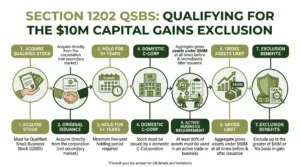
Every block of QSBS must pass five distinct tests. Failing any one test disqualifies the entire block. Some can only be corrected in advance. Here is what each requires:
- C-corporation status – The issuing entity must be a domestic C-corporation at issuance and at sale. S-corporations, LLCs, and partnerships do not qualify.
- Active qualified trade or business – The corporation must use at least 80% of its assets in an active qualified trade or business. Passive vehicles fail this test.
- Gross assets under $50 million – Before and after the issuance, aggregate gross assets must not exceed $50 million, including cash received.
- Original issuance to the taxpayer – The shareholder must have received the stock directly from the corporation for money, property, or services. Secondary purchases do not qualify.
- Five-year holding period – The taxpayer must hold the stock for more than five years. Selling before that mark eliminates the exclusion.
The $50 million test uses adjusted tax basis for non-cash assets, not fair market value. A capital-intensive business may exceed the ceiling sooner than expected. A valuation at each round creates a contemporaneous record the IRS can audit.
Which Industries Are Disqualified?
The statute excludes several industries from QSBS eligibility regardless of company size. This surprises founders who discover their stock fails the qualified business test after years of holding.
Disqualified categories under Section 1202(e)(3) include health, law, engineering, architecture, accounting, performing arts, consulting, athletics, and financial services. Also disqualified are brokerage businesses where the principal asset is employee skill or reputation. Banking, insurance, financing, investing, farming, hotels, and restaurants are also disqualified.
Technology companies, manufacturing businesses, e-commerce retailers, and software firms generally qualify. Any business with a services component should review the test carefully. A legal opinion and fair market value analysis upfront cost far less than a disqualified exclusion at exit.
How Does the Holding Period Work?
The five-year holding period starts on the original issuance date, not the grant or vesting date. For founders with restricted stock, the period begins when stock is issued and an 83(b) election is filed, not when shares vest.
For options and warrants, the period does not begin until exercise. A founder who received options at incorporation but waited eight years to exercise them starts the five-year clock at exercise, not at grant.
Section 1202(h) allows certain exchanges without losing QSBS status. A conversion from preferred to common stock generally preserves the original holding period. A Section 1045 rollover lets an investor sell QSBS early and reinvest in new QSBS within 60 days, deferring tax.
Seed investors in year one who see an exit in year four fall just short.
What Is the $50M Gross Assets Test?
The $50 million gross assets ceiling most often eliminates QSBS eligibility in later-stage financing rounds. The statute measures gross assets using adjusted tax basis, typically original asset cost reduced by depreciation.
Each round must be evaluated separately. A company under $50 million at its Series A may exceed the threshold by Series B. That disqualifies that round’s stock while leaving earlier issuances intact.
| Financing Round | Pre-Money Gross Assets | Capital Raised | Post-Money Gross Assets | QSBS Eligible? |
|---|---|---|---|---|
| Seed Round | $500,000 | $1,000,000 | $1,500,000 | Yes |
| Series A | $8,000,000 | $10,000,000 | $18,000,000 | Yes |
| Series B | $35,000,000 | $20,000,000 | $55,000,000 | No |
| Series C | $55,000,000 | $30,000,000 | $85,000,000 | No |
Early investors from seed and Series A rounds keep QSBS eligibility. Investors at Series B or later receive no exclusion.
A qualified appraisal at each round documents the adjusted gross assets on a defensible basis. Without contemporaneous records, the IRS can challenge the calculation later. Sofer Advisors provides 409A valuations and QSBS-support analyses that build this audit trail round by round.
How Do You Claim the Exclusion?
Claiming the Section 1202 exclusion requires proper reporting on your federal tax return. The gain goes on Form 8949 and Schedule D. You must retain documentation showing each qualifying test was met. The documentation package should include:
- The original stock subscription agreement or certificate showing the issuance date and consideration paid.
- Evidence the issuing corporation was a C-corporation at issuance and at sale.
- A calculation showing gross assets at issuance were under $50 million.
- Evidence of qualified trade or business status through corporate returns or financial statements.
- Proof of the five-year holding period through brokerage or transfer agent records.
The IRS does not require a formal appraisal, but a fair market value analysis strengthens your audit position. David Hern CPA ABV ASA, founder of Sofer Advisors, brings a Heart of a Teacher approach to every QSBS engagement. He explains requirements in plain terms so clients and counsel build the right file from day one.
Why Do State Taxes Still Apply?
Federal exclusion under Section 1202 is a federal income tax benefit only. States set their own conformity rules, and several large states have decoupled from the exclusion.
California does not conform. A California resident with $10 million in excluded federal gain still owes state tax at 13.3%, equaling $1.33 million. New Jersey and Pennsylvania also do not conform. Texas, Florida, and Nevada have no state income tax.
The Sofer Difference is the four-phase process Sofer Advisors uses: Discovery, Diligence, Analysis, and Delivery. In a QSBS context, that means reviewing cap table history and calculating federal and state tax exposure. A clear report is delivered before a sale closes.
Even in California, the federal exclusion saves about 23.8% in federal tax, a large net benefit compared to a fully taxable exit.
Frequently Asked Questions
Is QSBS the same as Section 1202?
Yes. QSBS stands for Qualified Small Business Stock, and the rules are found in Internal Revenue Code Section 1202. Practitioners use “Section 1202 stock” and “QSBS” interchangeably. Both terms point to the same qualifying tests and the same benefit of up to $10 million in excluded gain per taxpayer per issuer.
What is the difference between Section 1202 and Section 1244?
Section 1202 excludes gain when you sell qualifying small business stock at a profit. Section 1244 allows ordinary loss treatment, up to $50,000 per year, when qualifying stock is sold at a loss. They are complementary provisions. A founder who succeeds benefits from Section 1202; one who fails benefits from Section 1244. Both apply to original C-corporation issuances but carry different asset limits.
How do I know if my stock is QSBS?
You find QSBS status by testing all five qualifying rules. Confirm the issuing entity was a domestic C-corporation at issuance and at sale. Verify gross assets were under $50 million at issuance. Confirm the business is in a qualified industry, you received shares directly from the corporation, and you have held them for more than five years. All five tests must pass.
Can S-corporation stock qualify as QSBS?
No. The statute requires the issuing entity to be a domestic C-corporation at stock issuance. S-corporations, LLCs, and partnerships do not qualify. Companies that convert from S-corp to C-corp may issue qualifying QSBS after conversion, but the five-year clock starts at conversion. Stock issued as an S-corporation does not qualify regardless of holding period.
What happens if I sell QSBS before the five-year mark?
Selling before five years disqualifies the exclusion and the full gain becomes taxable income. A Section 1045 rollover lets you sell QSBS before five years and reinvest proceeds in new QSBS within 60 days. The original holding period carries over to the replacement shares, deferring tax until you sell the new stock outside of QSBS eligibility.
Does the $10M exclusion apply per company or per investor?
The $10 million exclusion applies per taxpayer per issuing corporation. Each eligible shareholder can independently exclude up to $10 million from the same issuer. An investor with a $2 million adjusted basis can potentially exclude $20 million using the 10x multiplier. Spouses filing jointly share one exclusion unless each owns stock with separately established basis.
How does QSBS interact with 409A valuations?
A 409A valuation establishes fair market value at each financing round. It helps document the adjusted gross assets and adjusted basis needed for the Section 1202 calculation. A maintained 409A history creates a ready-made QSBS audit trail. Sofer Advisors provides 409A valuations from $2,500 to $9,000, completed in two to four weeks.
How much does a QSBS valuation analysis from Sofer Advisors cost?
A QSBS-support analysis from Sofer Advisors typically ranges from $7,500 to $25,000 depending on complexity and the number of financing rounds to document. Standard engagements complete in four to eight weeks. Rush timelines are available at a 25 to 50 percent premium. Schedule a free consultation to receive a scoped estimate.
What records should I keep to protect my QSBS claim?
Keep the original stock subscription agreement, stock certificate, and capitalization table from the issuance date. Retain corporate tax returns and financial statements for the issuance year. Save C-corporation status records and brokerage statements showing the acquisition date and cost basis. A contemporaneous fair market value analysis at each financing round is the strongest defense in an IRS audit.
Related Case Studies
- Selling A Business In Georgia Complete Exit Planning Guide 2026
- 409A Valuation Atlanta Startup Equity Compensation Guide 2026
- Business Exit Planning Strategies Guide For Owners In 2025
Executive Summary
Section 1202 QSBS is one of the most powerful tax benefits available to founders and early investors in C-corporations. The exclusion can eliminate up to $10 million in federal capital gains tax per taxpayer per issuer. Stock acquired after September 27, 2010 qualifies for a 100% exclusion rate. Stock must pass five tests: entity type, active qualified business, gross assets under $50 million, original issuance, and a five-year holding period. Disqualified industries include professional services, finance, and hospitality. Documentation at each financing round is critical.
What Should You Do Next?
Review your cap table and identify every block of stock you hold, noting the issuance date, entity type, and industry. Gather corporate returns from each financing round to calculate gross assets. Flag holdings that will reach the five-year mark within 12 to 24 months and coordinate with your tax counsel before a sale begins.
David Hern CPA ABV ASA, founder of Sofer Advisors, works with founders, investors, and tax counsel to document QSBS eligibility and build the audit-ready file that protects the exclusion at exit. Schedule a consultation.
People Also Read
- Why You Must Start Planning Your Business Exit Now With The Right Valuation Expert
- When To Start Succession Planning Your Strategic Timeline Guide
About the Author
This guide was prepared by David Hern CPA ABV ASA, founder of Sofer Advisors – a business valuation firm headquartered in Atlanta, GA serving clients across the United States. David holds dual accreditations as an Accredited Senior Appraiser (ASA) and is Accredited in Business Valuation (ABV), credentials recognized by the IRS, SEC, and FINRA. He also holds the Certified Exit Planning Advisor (CEPA) designation. With 15+ years of valuation experience, David has served as an expert witness in 11+ cases across multiple jurisdictions and built Sofer Advisors into an Inc. 5000-recognized firm with 180+ five-star Google reviews. The firm’s full W2 employee team maintains subscriptions to all major valuation databases and operates under a next business day response policy.
For professional business valuation services, visit soferadvisors.com or schedule a consultation.
This content is for informational purposes only and does not constitute professional valuation advice. Business valuation conclusions depend on specific facts and circumstances. Contact Sofer Advisors for guidance regarding your specific situation.









