


Last Updated: September 2026
Under the Daubert standard, a business valuation expert may testify only if the opinion is both relevant and reliable. The standard comes from the 1993 Supreme Court case Daubert v. Merrell Dow Pharmaceuticals, and it is written into Federal Rule of Evidence 702. The rule makes the trial judge a gatekeeper. The judge checks whether the method is sound and fits the facts before a jury hears the value.
For an appraiser, that gate is where a report is won or lost. A value conclusion can look polished and still be kept out if the method is not accepted or the data is thin. Rule 702 was updated in December 2023 to stress that the party offering the expert must prove the opinion is reliable. This guide maps the Daubert factors onto valuation.
Sofer Advisors builds valuation reports designed to hold up under this review. The firm has provided expert witness testimony in 11+ cases across Georgia, Florida, California, and New Mexico, and it carries 180+ five-star Google reviews. Its work follows recognized standards, so the analysis stays defensible in a deposition or on the stand.
Key Takeaways
- Two-part test: a report must be both relevant and reliable before a court will admit it.
- Five factors: judges weigh testing, peer review, error rate, standards, and general acceptance.
- Accepted methods: the income, market, and asset approaches are generally accepted when they fit the facts.
- Common defects: unsupported assumptions, cherry-picked data, and math errors get experts excluded.
- Standards matter: following AICPA SSVS and USPAP shows the work is reliable and can be reproduced.
These points shape whether a value opinion is heard or thrown out. How a court applies them depends on the facts and the jurisdiction, so treat what follows as a framework, not legal advice.
What is the Daubert standard for a valuation expert?
The Daubert standard is the test a federal judge uses to decide if expert testimony can be heard. It asks two things: is the testimony relevant, and is it reliable? The judge acts as a gatekeeper. This role came from Daubert v. Merrell Dow Pharmaceuticals, and it now sits in Federal Rule of Evidence 702. The rule was updated in December 2023 to make clear that the party offering the expert must prove reliability by a preponderance of the evidence.
Reliable means sound methods applied to enough good data. Relevant means the opinion fits the question the court must answer. In Daubert v. Merrell Dow, the Supreme Court told judges to look at the method, not just the result. A report meets that bar when its logic is clear, its inputs are sourced, and another appraiser could follow the same steps to a similar answer.
What are the five Daubert reliability factors?
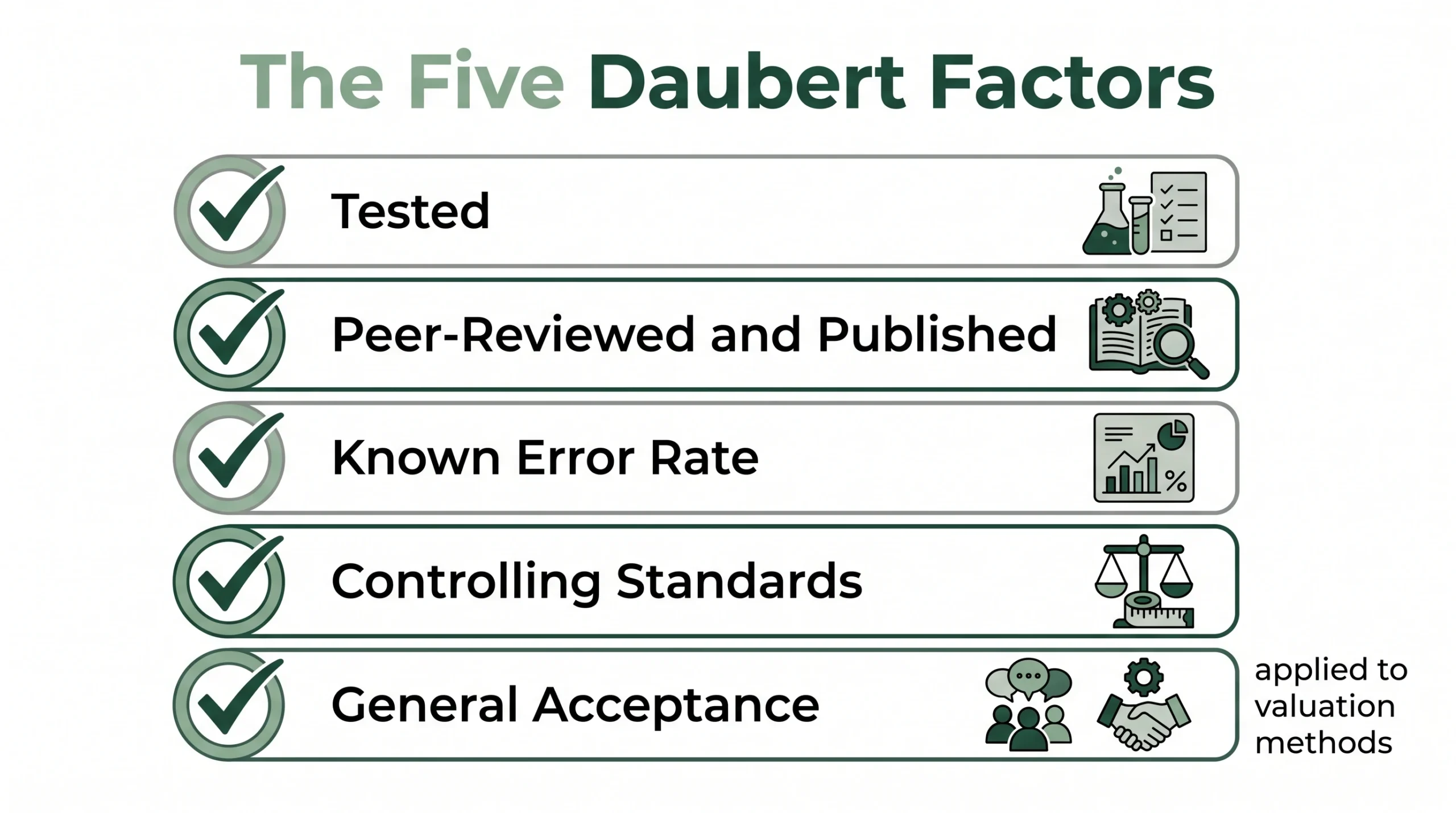
The five Daubert factors are testing, peer review, error rate, controlling standards, and general acceptance. They are not a checklist a court must follow in order. They are flags a judge may use to gauge whether a method is sound. Each one has a direct read in valuation, shown below.
- Tested: can the method be tested and checked? A discounted cash flow or market-multiple model can be re-run and reviewed.
- Peer reviewed: is the method published and studied by others in the field? The income, market, and asset approaches appear across professional literature.
- Known error rate: what is the chance of error? A clear model shows its inputs and assumptions, so the risk of error can be judged.
- Standards: are there standards that control how the work is done? AICPA SSVS and USPAP set those rules for appraisers.
- General acceptance: do other appraisers accept the method? The three main approaches are widely used and accepted.
A valuation report can answer all five without straining. The expert’s job is to apply the methods with care and write the report so a reader can trace every number. Done well, the five factors become a map for a defensible opinion.
Which valuation methods are generally accepted under Daubert?
The generally accepted methods are the income approach, the market approach, and the asset approach. Courts treat all three as sound and well-studied. The income approach, which includes the discounted cash flow method, projects future earnings and brings them to a present value. Our guide to the DCF valuation method explains that math in plain terms.
The market approach compares the business to sales of similar companies. The asset approach values the net worth of what the business owns. A method survives review when it fits the facts. It can be accepted in general yet still be wrong for a case, and a judge may exclude it. Following USPAP and AICPA SSVS keeps the method and the data on record. Sofer Advisors documents why each method fits the company.
What report defects get a valuation expert excluded?
Reports get excluded when the analysis is thin, biased, or disconnected from the data. A judge weighs whether the method is reliable and whether the expert applied it well, not whether the expert is smart. The most common defects that draw a challenge are below.
- Unsupported or cherry-picked assumptions that inflate or deflate the value.
- A method that is not generally accepted, or one that does not fit the facts.
- Ignoring data that cuts against the conclusion.
- Arithmetic or analytical errors that a review would catch.
- Results-driven advocacy, where the number is chosen first and the support is built to reach it.
- An analytical gap, meaning too large a jump between the data and the final opinion.
The table below sets a reliable report against one that invites exclusion. The contrast shows how the same factor plays out in careful work versus rushed work.
| What courts check | Reliable report | Excludable report |
| Method | Accepted approach that fits the facts | Novel or ill-fitting method |
| Assumptions | Sourced and explained | Unsupported or cherry-picked |
| Data | Sufficient and balanced | Thin, with contrary data ignored |
| Logic | Each step traceable to the next | Analytical gap to the conclusion |
| Standards | Follows USPAP and AICPA SSVS | No stated standard |
An appraiser who closes these gaps gives the court little to strike. The report reads as a chain, where every input leads to the next step. That is the core of a reliable opinion, and it separates a report that is heard from one that is set aside.
How does Daubert differ from the Frye standard?
Frye is the older test, and it asks only whether a method has gained general acceptance in its field. Daubert is broader. It keeps general acceptance as one factor and adds testing, peer review, error rate, and standards. Federal courts and many states follow Daubert. Some state courts still follow Frye. A few use their own blend of the two.
For a valuation expert, the result is similar under both tests, since the three main approaches satisfy each one. Daubert just asks the expert to show more of the work. Which test applies depends on the court and can change over time, so confirm the local rule with counsel. This is general information, not legal advice.
How do you choose a Daubert-ready valuation expert?
Choose an expert whose report can stand on its own under review. Look for accepted methods, sourced data, clear logic, and testimony that survived challenge. Large firms such as Alvarez & Marsal, Stout, and Kroll staff big matters and do strong work. Middle-market owners often need senior attention on the file and a report they can read, which is where a focused firm fits.
The Sofer Difference is a four-step process: Discovery, Diligence, Analysis, and Delivery. Discovery frames the assignment and the standard of value. Diligence gathers and tests the data. Analysis applies the accepted approaches and checks the math. Delivery produces a report a judge can read and testimony that holds up in cross-examination. This is the Heart of a Teacher approach, where the expert explains the number. For litigation matters, Sofer Advisors handles conflict resolution engagements.
A litigation valuation falls under the Standard Business Valuation service, which runs $7,500 to $25,000 and takes four to eight weeks. Expert Witness Services, such as deposition and trial testimony, are billed hourly and quoted for each case. The fee depends on company size, the disputed issues, and the depth of the record.
Frequently Asked Questions
How does the Daubert standard apply to a business valuation expert in court?
Daubert lets a federal judge admit a valuation expert only if the testimony is relevant and reliable. The judge acts as a gatekeeper and reviews the method, the data, and the logic before the jury hears the value. A report that uses an accepted approach, cites its sources, and follows professional standards meets that bar. The exact application turns on the facts and the court.
Which valuation methods are considered generally accepted under Daubert?
The income, market, and asset approaches are generally accepted. The income approach, including the discounted cash flow method, projects future earnings to a present value. The market approach compares the business to similar company sales. The asset approach values net asset worth. A method is accepted in general only when it also fits the specific facts of the case, so the choice must match the subject company and the standard of value.
What gets a valuation expert excluded from testifying?
Experts get excluded for unsupported or cherry-picked assumptions, a method that does not fit the facts, ignoring contrary data, math or analysis errors, and results-driven advocacy. Courts also strike opinions with an analytical gap, meaning too large a jump between the data and the conclusion. Each flaw signals that the work is not reliable. Careful sourcing, balanced data, and traceable logic are what keep a report admissible.
What is the difference between the Daubert and Frye standards for valuation testimony?
Frye asks only whether a method has general acceptance in its field. Daubert keeps that factor and adds testing, peer review, error rate, and controlling standards. Federal courts and many states use Daubert, while some state courts still use Frye. For a valuation expert the practical effect is close, since the three main approaches satisfy both. The applicable test depends on the jurisdiction and should be confirmed with counsel.
How does a court assess the reliability of a valuation expert’s report?
A court checks whether the method is sound and whether the expert applied it well to enough good data. The judge reviews the choice of approach, the support for each assumption, the treatment of contrary facts, and the path from data to conclusion. Following USPAP and AICPA SSVS helps show the work is reliable and can be reproduced. The review focuses on method, not on whether the number is popular.
What changed in the 2023 amendment to Rule 702?
The December 2023 amendment made two points clearer. First, the party offering the expert must show by a preponderance of the evidence that the testimony meets the rule. Second, the opinion must reflect a reliable application of the method to the facts, not just a reliable method in the abstract. The change did not create new factors. It restated the judge’s gatekeeping duty and put the burden squarely on the side that calls the expert.
Does the Daubert standard apply in state courts?
It depends on the state. Federal courts apply Daubert, and many states have adopted it or a close version. Some states still follow Frye, and a few use their own approach. The test that applies can also shift as courts issue new rulings. Because the rule varies by place and can change, a party should confirm the current standard in the relevant court with local counsel rather than assume.
What is the analytical gap in a valuation report?
An analytical gap is too large a jump between the data an expert relies on and the conclusion the expert reaches. The method may be fine and the data may be real, yet the report never shows how one leads to the other. Courts treat that missing link as a reliability flaw. Closing it means walking the reader through each step.
How much does a litigation business valuation from Sofer Advisors cost?
A litigation valuation from Sofer Advisors falls under the Standard Business Valuation service, which runs $7,500 to $25,000 and takes four to eight weeks. Expert Witness Services, such as deposition and trial testimony, are billed hourly and quoted per case. Cost depends on company size, the disputed issues, and the depth of the record. For a quote tied to your matter, request a quote.
Related Case Studies
- Expert Witness Business Valuation Georgia: What Attorneys Need to Know
- Shareholder Dispute Valuation Atlanta: Resolving Georgia Business Partner Conflicts
- Economic Damages Expert Witness: When Litigators Hire One
Executive Summary
The Daubert standard lets a federal judge admit a business valuation expert only if the testimony is both relevant and reliable. Courts weigh five factors: testing, peer review, known error rate, controlling standards, and general acceptance. The income, market, and asset approaches meet those factors when they fit the facts and rest on enough data. Reports get excluded for unsupported assumptions, cherry-picked or ignored data, math errors, results-driven advocacy, and an analytical gap between the data and the conclusion. Rule 702, amended in December 2023, puts the burden on the party calling the expert.
What Should You Do Next?
First, confirm which standard the court applies, Daubert or Frye, with your litigation counsel. Second, ask any prospective expert to name the approach they will use and show how the data supports it. Third, request a written scope early, so the method, the standards, and the fee are set before the work starts.
David Hern CPA ABV ASA, founder of Sofer Advisors, prepares court-ready valuations and testimony for litigation matters nationwide. Schedule a consultation to discuss your case.
People Also Read
- USPAP Compliance: What Makes a Valuation Court Defensible
- Forensic Accounting in Business Valuation: When You Need Both
About the Author
This guide was prepared by David Hern CPA ABV ASA, founder of Sofer Advisors, a business valuation firm headquartered in Atlanta, GA serving clients across the United States. David holds dual accreditations as an Accredited Senior Appraiser (ASA) and is Accredited in Business Valuation (ABV), credentials recognized by the IRS, SEC, and FINRA. He also holds the Certified Exit Planning Advisor (CEPA) designation. With 15+ years of valuation experience, David has served as an expert witness in 11+ cases across multiple jurisdictions and built Sofer Advisors into an Inc. 5000-recognized firm with 180+ five-star Google reviews. Its full W2 employee team maintains subscriptions to all major valuation databases and operates under a next business day response policy.
For professional business valuation services, visit soferadvisors.com/about-us/ or contact Sofer Advisors at soferadvisors.com/contact-us/.
Disclaimer: This content is for informational purposes only and does not constitute professional valuation advice. Business valuation conclusions depend on specific facts and circumstances. Contact Sofer Advisors for guidance regarding your specific situation.









