


Last Updated: October 2026
A customer relationship valuation sets the fair value of the intangible asset created by a company’s existing customer base. It most often comes up in a purchase price allocation under ASC 805, when one company buys another. Intangible assets now carry much of a company’s worth. Market studies estimate they make up the large majority of S&P 500 value. That is why buyers must measure them with care.
The team at Sofer Advisors performs these valuations for acquirers, CPAs, and auditors, backed by Inc. 5000 recognition in both 2024 and 2025. The work separates the customer asset from general goodwill, which drives the amortization timetable and shapes long-term financial reporting.
This guide explains why these assets are valued, how the Multi-Period Excess Earnings Method (MPEEM) works, what contributory asset charges are, and how customer attrition drives the final result.
Key Takeaways
- Separate asset: customer relationships are valued apart from goodwill in a business combination under ASC 805.
- Primary method: MPEEM is the most common income approach for these assets.
- Key inputs: forecast revenue from current customers, apply an attrition rate, and deduct contributory asset charges.
- CACs isolate the asset: charges for other assets remove returns that do not belong to the customer relationship.
- Why it matters: analysts use it for purchase price allocation and later impairment testing under US GAAP and IFRS.
Each input traces back to the company’s own records. The sections below examine each one in detail.
Why Is Customer Relationship Valuation Important to Understand?
Valuing customer relationships is required for financial reporting, because they are identifiable intangible assets in a purchase price allocation. ASC 805 and IFRS 3 require a buyer to record them apart from goodwill. ASC 350 later uses that value in annual goodwill impairment testing. Isolating the economic benefit tied to existing contracts gives a clearer balance sheet after a deal. It also supports every write-down decision that follows.
What Is the Multi-Period Excess Earnings Method?
MPEEM is an income approach. It values an intangible asset by capturing the future earnings that belong to that asset alone. For a customer relationship, the analyst projects revenue from the existing base. Then it removes charges for every other asset that helps produce those earnings. What remains is the excess earnings tied to the customers.
The method needs a careful forecast of revenue and expenses. That forecast finds the net income linked to the asset. Contributory asset charges account for the return owed to supporting assets, such as working capital and the assembled workforce. Removing those returns leaves only the residual earnings of the subject asset. That residual is the basis for the value.
What Are the Steps to Apply MPEEM?
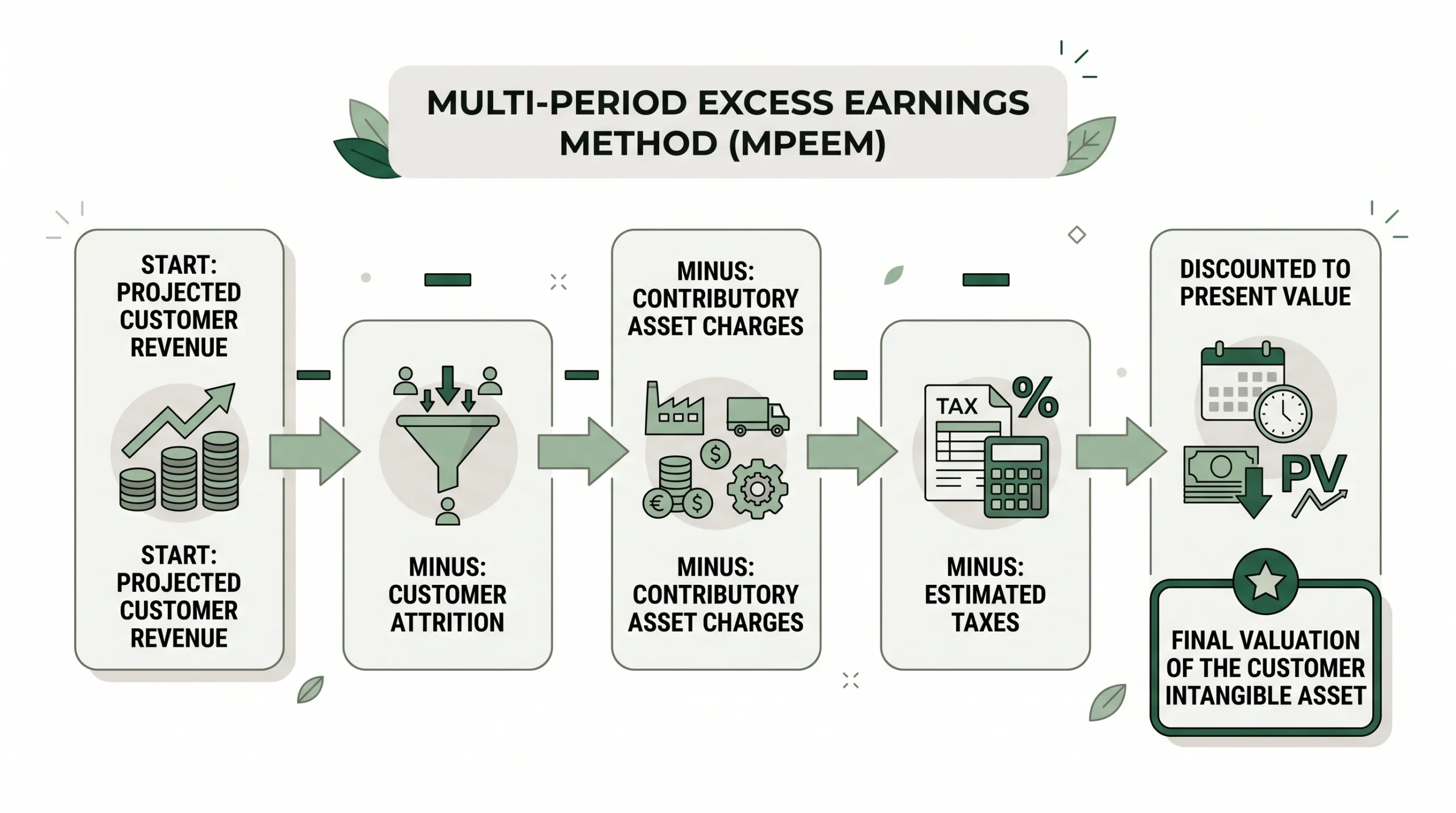
The method follows a clear sequence. First, project revenue from the customer base as of the valuation date. Second, apply an attrition rate, so the forecast shrinks as customers leave over time. Third, subtract the operating costs tied to serving those customers to reach pre-tax earnings.
Next come the charges and the discount. The analyst deducts contributory asset charges for the return on other assets, then applies income tax to the excess earnings. Finally, it discounts the after-tax cash flows to present value using a risk-adjusted rate. The sum of those discounted flows is the value of the customer relationship. A worked case helps. Say the base is set to produce $5,000,000 in revenue next year at a 15% attrition rate. After operating costs and a $300,000 contributory charge, pre-tax excess earnings come to $900,000. The analyst repeats this for each year, shrinks the base by the attrition rate, then discounts every stream to reach the recorded value.
Choosing the right method and supporting each input is easier with an accredited appraiser reviewing your deal. Talk to a Sofer Advisors valuation specialist about the intangibles your transaction created.
What Are Contributory Asset Charges (CACs)?
Contributory asset charges are economic rents for the assets that help produce the cash flow being measured. They make sure only the earnings of the subject asset remain in the model. Without them, the customer relationship would look too valuable. It would absorb returns from the whole business.
Each charge reflects a fair return on and of the supporting asset. Typical charges cover working capital, fixed assets, and other intangibles such as a trade name or developed technology. The model also charges for the assembled workforce that serves the customer base. Deducting these leaves the earnings that the customers alone generate.
How Does Customer Attrition Affect the Valuation?
Attrition, or churn, is a primary input in MPEEM, because it sets the asset’s economic life. When churn rises, the cash flows run for a shorter period, which lowers the present value. So the analyst must model the decline with care.
Analysts build an attrition curve from historical data to show how fast the base will shrink. A steeper curve means faster decay, fewer future cash flows, and a lower value. The same curve usually defines the economic life. That life then drives the amortization pattern after the deal closes. A small error in the rate can swing the value. So grounding the curve in real history keeps the result defensible.
Which Valuation Methods Compare to MPEEM?
Two other income-based methods come up. The With and Without Method compares the company’s cash flows with the asset and without it. It treats the difference as the asset’s value. The Distributor Method estimates value from the profit margin a third-party distributor would earn on the customer base. The table below shows where each fits.
| Method | Best application | Primary focus |
|---|---|---|
| MPEEM | Primary customer or technology intangibles in a PPA | Excess earnings after contributory charges |
| With and Without | Non-compete agreements and litigation modeling | Cash flow variance from the asset |
| Distributor Method | Customer assets in distribution-heavy models | Distributor-level profit margin |
Each method leans on the same discipline. First isolate the earnings that belong to the asset, then discount them. For a primary customer relationship, MPEEM is usually the fit. It captures the full stream of excess earnings over the asset’s life. Large national firms such as Alvarez & Marsal, Stout, and Kroll handle intangible valuations for big public filers. Sofer Advisors focuses on defensible, partner-led purchase price allocations for closely held and middle-market acquirers, backed by expert witness testimony in 11+ cases. Its four-phase process, The Sofer Difference, moves from Discovery to Diligence to Analysis to Delivery. That structure ties every excess-earnings model back to source data an auditor can trace.
What Mistakes Should You Avoid?
A few errors come up often. The first is skipping contributory asset charges, which inflates the value. The second is using a flat attrition rate when the data shows a curve. The third is picking an economic life with no support. Each one weakens the result. Each one draws audit scrutiny. Sofer Advisors applies a Heart of a Teacher approach here, walking owners and auditors through the reasoning behind each input rather than handing over a bare number, a practice reflected in its 180+ five-star Google reviews.
Frequently Asked Questions
What is MPEEM used for?
MPEEM values a primary intangible asset, such as a customer relationship or developed technology, inside a purchase price allocation under ASC 805. It isolates the future cash flows that belong to that one asset, after charging for every supporting asset that helps produce them. The result feeds the acquirer’s opening balance sheet and later impairment tests. Sofer Advisors applies MPEEM when a customer base is the main intangible a deal creates, documenting each assumption for the audit file.
Why are customer relationships valued separately from goodwill?
ASC 805 and IFRS 3 treat a customer relationship as an identifiable intangible asset. When it can be measured reliably and has a definable economic life, accounting rules require the acquirer to record it apart from goodwill. That split gives a clearer opening balance sheet and sets the amortization pattern the asset will follow. Sofer Advisors identifies which intangibles a transaction created early, so the customer asset is carved out and supported well before the auditor ever asks.
What inputs does MPEEM need?
MPEEM needs a revenue forecast for the existing customer base, an attrition rate drawn from history, the operating costs to serve those customers, contributory asset charges, an income tax rate, and a risk-adjusted discount rate. Each input should rest on the company’s own records and reasonable market assumptions, not round guesses. Sofer Advisors builds every input from client data and documents the source, so the excess-earnings model stands up under audit review.
What is a contributory asset charge?
A contributory asset charge is a fair return charged for an asset that helps generate the cash flow being measured, such as working capital, fixed assets, or the assembled workforce. The charge removes returns that belong to those supporting assets, so only the subject asset’s earnings remain in the model. Without it, the customer relationship would look too valuable. Sofer Advisors calculates each charge separately, which keeps the final customer value defensible under review.
How does attrition affect the value?
Attrition, or churn, sets how long the customer cash flows last, so it defines the asset’s economic life. Higher churn shortens that life and lowers the present value, while a loyal base extends it. Analysts build an attrition curve from several years of history, since a small change in the rate can swing the result sharply. Sofer Advisors grounds the curve in the client’s own retention data to keep the conclusion defensible.
How is MPEEM different from the With and Without Method?
MPEEM values an asset directly, from the excess earnings that belong to it after contributory charges. The With and Without Method values an asset indirectly, by comparing the company’s cash flows with the asset in place and without it, then treating the gap as its value. MPEEM suits primary intangibles like customer relationships; the other suits assets such as non-compete agreements. Sofer Advisors selects the method that fits the asset and the available data.
Is customer relationship value amortized?
Yes. A customer relationship has a finite economic life, so the acquirer amortizes it over that life, often following the same attrition pattern used to value it. The expense flows through the income statement each period, and the asset is also tested for impairment when events suggest its value has dropped. Sofer Advisors documents the economic life and the amortization pattern together, so the reporting stays consistent from the deal date forward.
How much does a customer relationship valuation from Sofer Advisors cost?
A customer relationship valuation is usually part of a broader purchase price allocation, which generally runs from $15,000 to $50,000. The fee depends on the number of intangibles, the quality of the data, and the deadline. A flat fee is quoted up front, so the cost is clear before the work begins. Sofer Advisors sets the scope first, then quotes a fixed price. Request a free estimate for a range specific to your deal.
Related Case Studies
- Database Valuation of an Acquired Customer List
- Business Valuation Services United States: Expert Guide 2025
- Healthcare Business Valuation Methods Guide
Executive Summary
A customer relationship valuation isolates the fair value of an acquired customer base, apart from goodwill, under ASC 805 and IFRS 3. The Multi-Period Excess Earnings Method is the usual tool: forecast revenue from the existing base, apply an attrition rate, deduct operating costs and contributory asset charges, tax the remainder, then discount the after-tax excess earnings to present value. Attrition drives the economic life and the amortization pattern that follow. As part of a purchase price allocation, these engagements generally run $15,000 to $50,000. The first move is to assemble three to five years of customer-level revenue, churn, and contract data.
What Should You Do Next?
Confirm which intangibles your transaction created, since that decides whether MPEEM, the With and Without Method, or the Distributor Method applies. Pull together three to five years of customer-level revenue, churn history, and contract terms before the valuation date, because clean inputs shorten the work and reduce auditor questions. Decide early how the economic life will be supported. This guide was prepared by David Hern CPA ABV ASA, founder of Sofer Advisors, an Inc. 5000 firm specializing in purchase price allocations and intangible asset valuations. Schedule a free consultation to discuss your specific situation.
People Also Read
About the Author
This guide was prepared by David Hern CPA ABV ASA, founder of Sofer Advisors, a business valuation firm headquartered in Atlanta, GA serving clients across the United States. David holds dual accreditations as an Accredited Senior Appraiser (ASA) and is Accredited in Business Valuation (ABV), credentials recognized by the IRS, SEC, and FINRA. He also holds the Certified Exit Planning Advisor (CEPA) designation. With 15+ years of valuation experience, David has served as an expert witness in 11+ cases across multiple jurisdictions and built Sofer Advisors into an Inc. 5,000-recognized firm with 180+ five-star Google reviews. Its full W2 employee team maintains subscriptions to all major valuation databases and operates under a next business day response policy.
For professional business valuation services, visit soferadvisors.com/about-us/ or contact Sofer Advisors at soferadvisors.com/contact-us/.
This content is for informational purposes only and does not constitute professional valuation advice. Business valuation conclusions depend on specific facts and circumstances. Contact Sofer Advisors for guidance regarding your specific situation.









