


Last Updated: July 2026
Cross-border M&A valuation finds the worth of a target company in a different country from the buyer. It calls for special adjustments for currency swings, international tax law, and jurisdictional risk. The work modifies standard models to reflect foreign policy, trade rules, and a cost of capital that differs from the home market.
Sofer Advisors provides guidance for these deals, helping professionals work through the details of a global transaction. It has seven years in the field and 180+ five-star Google reviews for its approach to complex engagements. With CPA, ABV, and ASA credentials, its analysts bring technical rigor to every project.
These engagements are common for owners and CFOs expanding beyond domestic borders. Because tax codes and economic signals differ by region, stakeholders need clear data to support a price. Comparing a foreign entity to a domestic peer takes a specific technical framework.
Key Takeaways
- Currency and risk: cross-border valuations adjust for currency risk, local tax law, and regional stability, which all move cash flows.
- Country risk premium: analysts add a CRP to the discount rate to reflect the higher volatility of a foreign market.
- Standardize statements: convert records to one accounting standard, usually IFRS to US GAAP, for a valid comparison.
- Tax and transfer pricing: treaties and transfer pricing rules change the effective price and post-deal cash flow.
- Comparable benchmarks: finding true comps often means adjusting multiples for local growth and risk.
Each element ties to specific tax and reporting rules. The sections below cover the technical detail behind these factors.
What makes cross-border valuation unique?
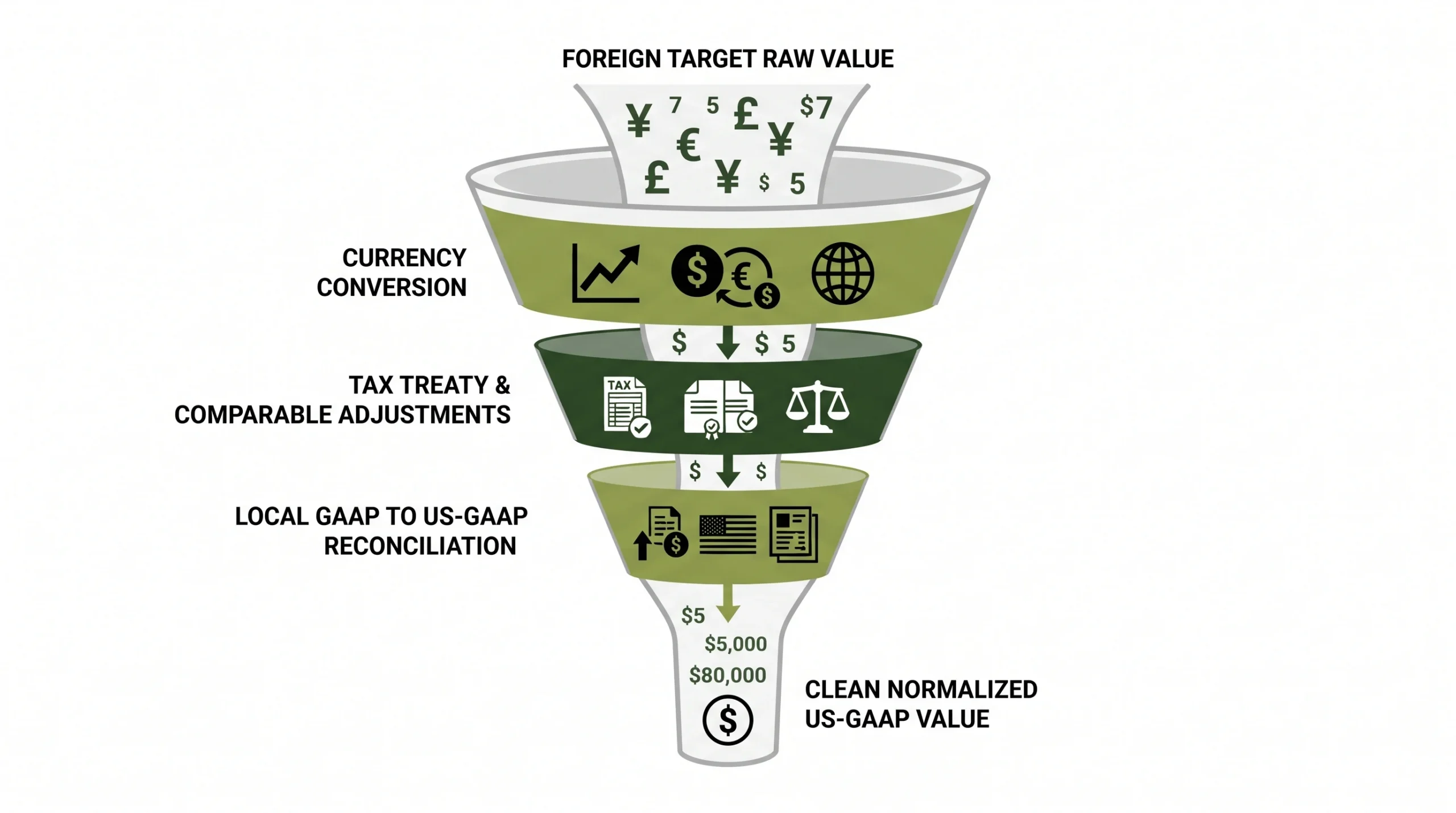
Cross-border valuation is unique because it forces an advisor to weigh three layers at once: shifting exchange rates, different tax systems, and country risk. None of these show up in a domestic deal. When a company works across borders, the analyst must handle exchange rate risk. The fix is to restate cash flows into one currency. Without that step, swings in the rate hide how the business really performs.
Valuators must also adjust for different tax systems to reach a fair comparison. That often means converting statements from IFRS to US GAAP so the rules match. Last, the analyst adds a country risk premium to the discount rate. This reflects the higher political and economic risk a domestic model ignores. Sofer Advisors weighs these factors to reach a defensible value.
How is currency risk handled in M&A models?
Currency risk is handled by converting the target’s forecasts into the buyer’s single presentation currency, using a spot rate or projected forward rates. That aligns all projections with the parent’s reporting standard. After setting the currency, the modeler applies a discounted cash flow model to find present value. Precise exchange rate assumptions keep the model consistent. Our guide to WACC shows how the discount rate comes together.
To limit volatility between signing and closing, many buyers use hedges like forward contracts or currency swaps. These lock a future rate, which shields the price from a sudden market move. Currency also affects post-deal metrics. A target’s local-currency earnings may fall against the parent, which can trip earn-out milestones or breach debt covenants tied to consolidated results. These factors need careful monitoring across the life of the deal.
What tax adjustments are critical in global deals?
The critical tax adjustments in a global deal are bilateral tax treaties, transfer pricing rules, and the value of tax attributes like net operating losses. These belong in a tax structure analysis to prevent value erosion. IRS guidance on cross-border transactions stresses consistent tax positions across jurisdictions. The main items to weigh are:
- Bilateral tax treaties, which set withholding rates and limit double taxation
- Transfer pricing rules, which require arm’s length pricing between related entities
- Net operating losses and other carryforwards, subject to change-in-ownership limits
- Goodwill amortization, treated differently across borders
Analyzing treaties helps set the right withholding on dividends or interest, and misalignment can raise the tax burden and cut cash flow. Transfer pricing records must satisfy the BEPS framework, and non-compliance penalties hit the return. Net operating losses can hold real value, but a change-in-ownership review is needed to confirm they survive the deal. Sofer Advisors quantifies these attributes so they stay viable after closing.
How do you adjust for country-specific risk?
Adjusting for country-specific risk means adding a country risk premium (CRP) to the discount rate. This extra rate compensates the investor for the added risk of a foreign market versus a stable one like the U.S. Adding the CRP raises the total cost of capital, which lowers the present value of future cash flows to reflect the higher uncertainty.
Analysts usually derive these premiums from Business Valuation Resources or Kroll cost-of-capital databases. These sources build the CRP from the country’s sovereign debt rating, inflation history, and quality of legal enforcement. A lower sovereign rating signals higher default risk, which means a larger premium. The CRP feeds the Weighted Average Cost of Capital (WACC), so the discount rate reflects the target’s real economic setting rather than US-only metrics. Data from Business Valuation Resources supports this step.
How do you normalize international financial statements?
Normalizing international statements means restating figures from a local framework, such as IFRS, into the buyer’s standard, such as US GAAP. That gives one basis for comparison, so stakeholders read performance under a single set of rules. It removes gaps caused by regional rules and gives a clean read of enterprise value, in line with AICPA standards.
During due diligence, advisors reconcile the big gaps between frameworks. Revenue recognition timing often differs, so historical earnings need adjustment to meet US GAAP. Teams also reconcile lease accounting, comparing older IFRS models to ASC 842. Inventory differences, such as LIFO versus FIFO, need review to avoid distorting the cost of goods sold. Through these refinements, the team makes sure the data reflects the entity’s true economic position before the price is set.
Talk to Sofer Advisors about how these jurisdictional risks apply to your cross-border deal.
What are the challenges with international comps?
Finding international comps and precedent deals is hard, because local market size, growth, rules, and typical multiples all vary. Public companies in emerging markets often report under looser standards, which changes how an analyst reads their numbers. When running a comparable company analysis, thin local markets push analysts toward foreign peers that may not share the same risk.
Precedent transactions give a narrow view when local legal and tax structures differ by region. Those differences limit applying observed deal data to a private target. The DealStats database offers a large set of private transactions, but it skews domestic and often lacks the detail an international case needs. Adjusting multiples for country-specific factors is essential to account for domestic equity risk premiums and different interest rate environments. Without those corrections, a valuation can misstate the target.
Which valuation provider is best for a cross-border deal?
The right provider depends on your goal, the rules governing the deal, and the depth of analysis you need. For a live transaction, owners usually want the objective, independent view a valuation firm gives. Larger consultancies like Alvarez & Marsal or Stout serve clients who fold valuation into deep corporate strategy or restructuring. Academic models are rigorous but tend to build theory rather than finalize a purchase price. The table below compares the approaches.
| Aspect | Sofer Advisors | Large consultancy |
| Primary goal | A defensible, independent value for a specific deal | Fold valuation into a broader strategy or market-entry thesis |
| Key adjustment focus | Precise CRP, tax impact, and IFRS-to-GAAP normalization | Synergies, integration, and strategic fit |
| Typical client | Owners, CFOs, and attorneys executing a live deal | C-suite or board weighing strategic options |
When you weigh these, consider whether your phase needs a surgical read for a deal or a broad strategic model for the long term. Owners and their advisors often want the objective, independent view during an active transaction. Larger firms integrate valuation into strategy or restructuring. Academic models, while rigorous, usually feed new theory rather than a final purchase price allocation or tax filing.
Cross-border deals reward preparation and consistent data. The questions below cover what buyers ask most.
Frequently Asked Questions
What is the biggest risk in a cross-border acquisition?
The biggest risk is failing to adjust for jurisdictional differences, including legal, political, and regulatory variation that erodes expected cash flow. Currency swings and inconsistent accounting can mask an entity’s true health and lead to overpayment. Sofer Advisors reduces that risk with rigorous normalization and risk assessment, so buyers account for local realities before committing.
What is a country risk premium in valuation?
A country risk premium is the extra return required to compensate investors for the systemic risk of operating in a specific foreign nation. Sofer Advisors folds this premium into the discount rate so the final value reflects the real economic climate of the foreign market rather than US-only data.
How does political instability affect a company’s valuation?
Political instability brings sudden shifts in policy, tax, and property rights, which raises uncertainty about future cash flow. That unpredictability forces a higher discount rate, since returns look less reliable. Sofer Advisors runs multi-scenario analyses that model how government change or shifting trade rules might compress performance over the life of the investment.
Does a cross-border valuation cost more than a domestic one?
Yes. Cross-border engagements usually cost more, because they require deeper work on tax treaties, local economic data, and foreign reporting standards. Reconciling accounts across borders takes more senior time to keep the output defensible under audit. Sofer Advisors is transparent about these costs so clients see the value of a high-quality, independent analysis.
How do you account for different accounting standards like IFRS and GAAP?
You normalize the statements by restating figures from the local framework into the buyer’s standard, such as US GAAP. That means reclassifying line items, adjusting depreciation, and aligning revenue recognition across both sets of books. Sofer Advisors runs these reconciliations through its four-phase process so the report stays accurate and meets the required standards.
What is a quality of earnings report in a cross-border context?
A quality of earnings report tests how sustainable and repeatable a target’s recurring profit is, stripping out one-time boosts or irregular entries. In a cross-border setting, it also filters out foreign exchange gains that are not core operations. Sofer Advisors runs this deep dive so buyers pay for genuine operating strength, not volatile, non-recurring swings.
How long does a cross-border valuation typically take?
A cross-border valuation usually takes six to twelve weeks, based on data availability and the complexity of the tax alignment. That window allows the discovery and diligence work needed for a solid analysis. Sofer Advisors manages the schedule so the delivery meets your closing deadline while holding to high standards.
Why can I not just use a currency conversion app for valuation?
A currency app gives only a single spot rate, which misses the economic reality of long-term cash flow. A valid valuation needs forward-rate expectations, interest rate parity, and any hedging cost that affects future profit. Sofer Advisors replaces a simple conversion with professional models that reconcile these variables to prevent large errors in the target’s value.
How much does a cross-border M&A valuation from Sofer Advisors cost?
A cross-border M&A valuation from Sofer Advisors runs $7,500 to $50,000, based on its published engagement data, with complex multi-jurisdiction consolidations at the higher end. Cost depends on entity complexity, jurisdictional requirements, and the accounting standards involved. For a quote tied to your deal, request a valuation estimate with your target’s financials and jurisdiction details.
Related Case Studies
- Mid-Market M&A Due Diligence: A 14-Category Buyer Checklist
- Quality of Earnings Report: What Buyers Discover Before a Sale
- Terminal Value Formula: How to Calculate It in a DCF
Executive Summary
Cross-border M&A valuation adapts a standard model for three things a domestic deal never faces: currency risk, differing tax systems, and country-specific risk. Analysts convert the target’s cash flows into one functional currency, add a country risk premium to the discount rate, and normalize IFRS statements to US GAAP for a true like-for-like read. Tax treaties, transfer pricing rules, and net operating losses all reshape the effective price and post-deal cash flow. To prepare, gather three years of audited or reviewed financials plus local tax filings, and identify the jurisdictional constraints early. That groundwork keeps the analysis defensible under ASC 805 or IFRS 3.
What Should You Do Next?
Review your acquisition timeline and confirm whether the target needs an independent valuation for tax, audit, or final deal terms. Gather three years of audited or reviewed financials and any local tax filings, since these are the primary inputs. Identify the jurisdictional constraints now to save effort at closing.
David Hern CPA ABV ASA, founder of Sofer Advisors, brings specialized expertise to complex cross-border valuations and tax reporting. Schedule a free consultation to discuss your situation.
People Also Read
- Calculating Goodwill in an Acquisition: The Formula Explained
- What Is a Leveraged Buyout (LBO)? Structure Explained
About the Author
This guide was prepared by David Hern CPA ABV ASA, founder of Sofer Advisors, a business valuation firm headquartered in Atlanta, GA serving clients across the United States. David holds dual accreditations as an Accredited Senior Appraiser (ASA) and is Accredited in Business Valuation (ABV), credentials recognized by the IRS, SEC, and FINRA. He also holds the Certified Exit Planning Advisor (CEPA) designation. With 15+ years of valuation experience, David has served as an expert witness in 11+ cases across multiple jurisdictions and built Sofer Advisors into an Inc. 5000-recognized firm with 180+ five-star Google reviews. Its full W2 employee team maintains subscriptions to all major valuation databases and operates under a next business day response policy.
For professional business valuation services, visit soferadvisors.com/about-us/ or contact Sofer Advisors at soferadvisors.com/contact-us/.
Disclaimer: This content is for informational purposes only and does not constitute professional valuation advice. Business valuation conclusions depend on specific facts and circumstances. Contact Sofer Advisors for guidance regarding your specific situation.









