


Last Updated: November 2026
A comparable company analysis values a business by comparing it to similar public companies, called guideline companies. It is a market approach. Analysts gather the trading multiples of those peers and apply them to the subject company’s own numbers. The result is only as good as the peers you pick. A shared industry label is not enough, because size, growth, margins, and risk all have to line up.
Sofer Advisors prepares these analyses for business owners, attorneys, and CPAs who need defensible figures for tax, transactions, and financial reporting.
This guide explains how to screen guideline firms, where to find the data, which multiples to use, and the adjustments a private company needs.
Key Takeaways
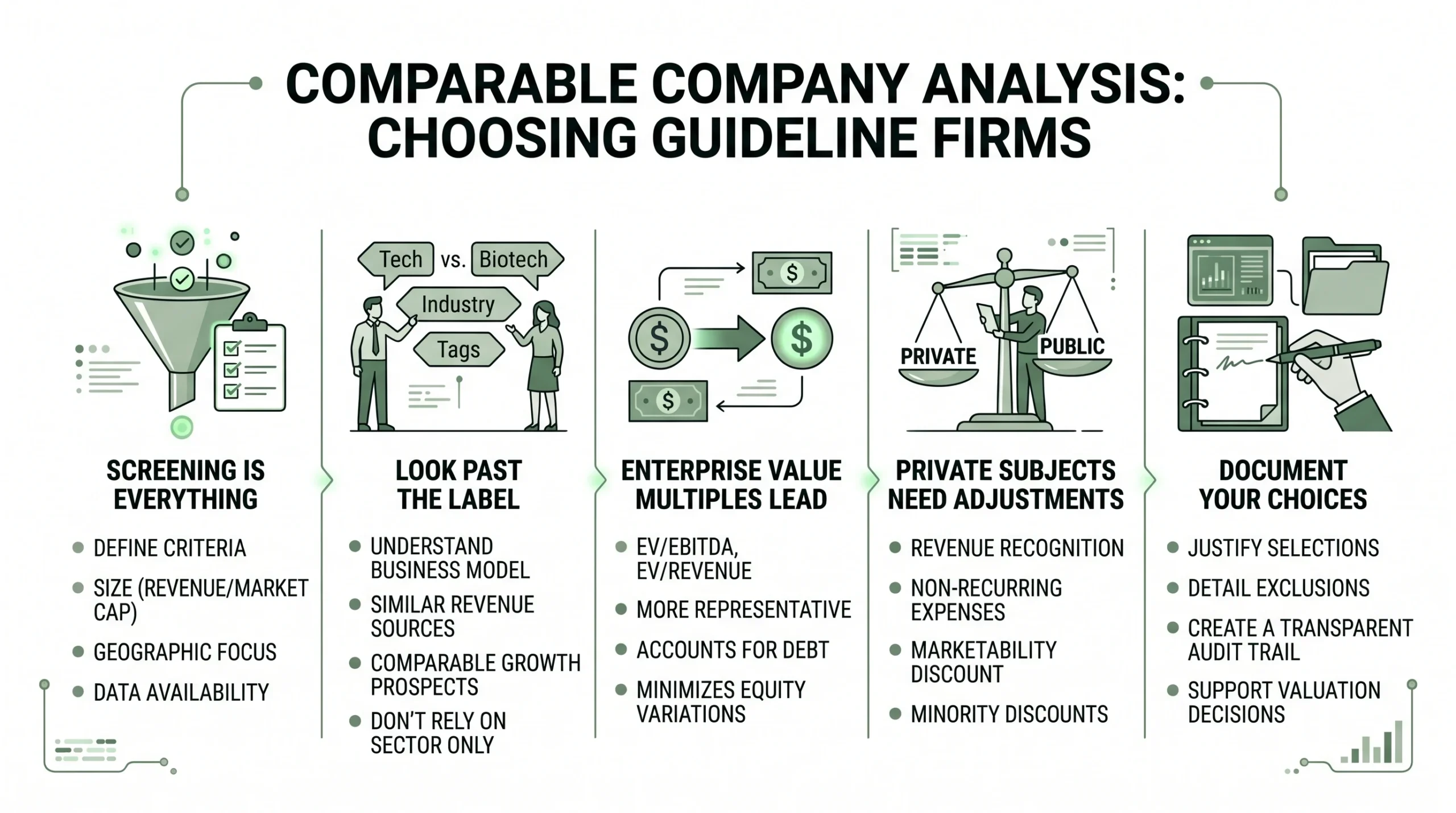
- Screening is everything: a reliable conclusion depends on choosing peers that match the subject on industry, size, growth, and risk.
- Look past the label: two firms in the same sector can still be poor comparables if their margins or business models differ.
- Enterprise value multiples lead: EV/EBITDA, EV/Revenue, and EV/EBIT compare firms without distortion from different debt levels.
- Private subjects need adjustments: a discount for lack of marketability often applies, and control versus minority context drives any control premium.
- Document your choices: write down why each candidate was kept or rejected so the analysis holds up under review.
What is a comparable company analysis?
A comparable company analysis prices a business against a group of similar public firms. It is also called the guideline public company method. The method sits within the market approach to valuation. It uses real trading data rather than forecasts or asset values.
The steps are straightforward in outline. First, you build a set of guideline public companies. Next, you compute their valuation multiples from market prices. Then you apply those multiples to the subject company’s own metrics. The output is an indicated value, which you still have to adjust and sanity check.
Why does choosing the right guideline firms matter?
The peer group is the benchmark for the whole analysis. If the peers are a poor match, the multiples are a poor match too. That skews the final value from the start. No later step can fully fix a weak peer set.
Credibility also depends on your reasoning. You need to explain why each firm is a fair proxy for the subject. Professional valuation standards, such as the AICPA Statement on Standards for Valuation Services, call for a clear and documented process. A transparent selection helps the report stand up to the IRS, a court, or an auditor.
What makes a company truly comparable?
A true comparable shares the subject’s core economics, not just its industry code. Start with the business model. A firm that sells software behaves very differently from one that sells hardware, even in the same market. Match the way each company actually makes money.
Then test the financial profile. Compare size, revenue growth, and profit margins. Look at capital structure and the general risk level. A tiny, fast-growing firm is not a good proxy for a large, mature one. The closer these traits align, the more reliable the multiples become.
Where do analysts find the financial data?
Public company data starts with regulatory filings. The Form 10-K gives audited annual results. The Form 10-Q gives quarterly updates. These filings follow strict rules, so the numbers are reliable and comparable across firms. They are the foundation of any serious peer analysis.
Analysts often use commercial databases on top of the filings. These tools let you screen firms by industry, size, and financial ratios. They save time compared with reading every filing by hand. The raw source is still the public record, so you can always trace a figure back to its origin.
Fresh data matters here. Trading multiples shift as markets move. A peer that looked cheap last quarter may look expensive today. So analysts use prices as of the valuation date, not stale figures. They also read the notes in each filing. A one-time charge or an unusual item can distort a multiple if you miss it.
Which valuation multiples do analysts use?
A multiple relates a company’s value to one of its financial metrics. Common trading multiples include EV/EBITDA, EV/Revenue, and EV/EBIT. These use enterprise value, which covers both debt and equity. That makes them neutral to how each firm is financed. The price-to-earnings, or P/E, ratio is also used, but it reflects capital structure and taxes.
Analysts usually favor enterprise value multiples for cross-company work. EV/EBITDA is the most common choice. It compares operating performance without the noise of different debt loads. You then pick a multiple from the peer set, often the median, and apply it to the subject’s own metric. Any specific multiple you see in a report is particular to that engagement, not a fixed market rule.
How do you adjust for a private company?
Public multiples come from shares that trade freely. A private company’s shares do not. So the raw multiple usually overstates private value. Analysts apply a discount for lack of marketability, often called a DLOM, to bridge that gap. The discount reflects how much harder it is to sell a private stake.
Control is the second adjustment. Public trading prices reflect small, minority stakes. If you are valuing a controlling interest, a control premium may apply. If you are valuing a minority interest, it usually does not. You have to match the adjustment to the exact interest being valued.
Size can call for a further step. Public peers are often much larger than a private subject. Larger firms tend to carry less risk, so their multiples run higher. A small company may not deserve the same multiple. Analysts weigh this gap and adjust with judgment rather than a fixed formula.
How does the guideline transaction method differ?
There are two market-based methods, and people often confuse them. The guideline public company method uses current trading prices of public peers. Those prices reflect minority, freely traded shares. It gives a market view of the subject as a going concern.
The guideline transaction method uses prices from actual acquisitions of similar companies. Those deal prices usually include control, because a buyer took over the whole business. So transaction multiples already carry a control element. Knowing which method produced a multiple tells you how to read it.
The two methods can also work together. Each one checks the other. If both point to a similar range, confidence grows. If they diverge, that gap is a clear signal to dig deeper before you finally settle on a value.
How does this method compare to other approaches?
Comparable company analysis is one of three core approaches to value. It is the market approach. The income approach and the asset approach answer the same question from different angles. Most strong reports use more than one and check whether the results agree.
The table below shows how the three compare at a glance.
| Approach | Basis of value | Common inputs | Often best for |
|---|---|---|---|
| Market approach (CCA) | Pricing of similar firms | Public multiples, SEC filings | Firms with many close public peers |
| Income approach (DCF) | Future cash flow | Projections, discount rate, growth | Unique models or limited peers |
| Asset approach | Net value of assets | Fair value of assets and liabilities | Asset-heavy or holding companies |
Each approach has blind spots, so analysts rarely rely on one alone. The market approach can mislead when good peers are scarce. The income approach leans on forecasts that are hard to prove. Using them together gives a fuller and more defensible picture of value.
What are the common pitfalls?
The biggest mistake is matching on industry alone. Two firms can share a sector and still differ in size, margins, and risk. A screen that stops at the industry code lets poor comparables slip in. Always test the deeper financial profile before you accept a peer.
Using raw, unadjusted numbers is the second trap. Analysts normalize the subject’s results first. That means removing one-time gains, losses, and other items that do not reflect normal operations. Skipping this step distorts the multiples. Careful normalization, paired with clear documentation, keeps the conclusion honest.
A third pitfall is picking peers to hit a target. It is tempting to drop a firm that lowers the value. That bias is easy for a reviewer to spot. The fix is a written rule for inclusion set before you see the results. Apply it the same way to every candidate. Then record why each firm stayed in or dropped out.
Frequently Asked Questions
What is the guideline public company method?
It is the formal name for a comparable company analysis. You value a private business using the trading multiples of similar public firms. The method is part of the market approach. It relies on current market prices rather than forecasts.
How many guideline companies do you need?
There is no fixed rule. Quality matters far more than quantity. A small set of close comparables beats a long list of loose ones. Analysts prefer firms that genuinely mirror the subject’s size, growth, and risk.
What is the difference between the public company and transaction methods?
The public company method uses current trading prices of public peers. Those prices reflect minority, freely traded shares. The transaction method uses prices from actual acquisitions. Deal prices usually include control, so their multiples tend to run higher.
Which valuation multiples are most common?
EV/EBITDA is the most widely used. Analysts also use EV/Revenue, EV/EBIT, and the P/E ratio. Enterprise value multiples are popular because they ignore differences in debt. The right multiple depends on the industry and the data you have.
Why use enterprise value multiples instead of equity multiples?
Enterprise value covers both debt and equity. That makes it neutral to how each firm is financed. Two similar firms with different debt loads can still be compared fairly. Equity multiples like P/E mix in financing and tax effects.
Do you apply a discount for a private company?
Usually, yes. Public shares trade freely, while private shares do not. A discount for lack of marketability reflects that difference. The size of the discount depends on the facts of the specific interest.
When does a control premium apply?
It depends on the interest being valued. Public trading prices reflect minority stakes. If you value a controlling interest, a control premium may be warranted. If you value a minority interest, it generally is not.
Can you use comparable company analysis for a private company?
Yes, and analysts do it often. You apply public multiples to the private subject’s metrics. Then you adjust for marketability and the level of control. Those adjustments bridge the gap between public and private reality.
What are the biggest mistakes in selecting comparables?
Matching on industry alone is the main one. A shared sector does not make two firms alike. Using unadjusted financials is another frequent error. Documenting why each peer was kept or rejected helps avoid both.
Related Case Studies
- Guideline Public Company Method: Comp Sets
- How to Value Manufacturing Company: Complete Guide 2026
- How to Value a Solar Installation Company in 2026
Executive Summary
A reliable conclusion depends on choosing peers that match the subject on industry, size, growth, and risk. Two firms in the same sector can still be poor comparables if their margins or business models differ. EV/EBITDA, EV/Revenue, and EV/EBIT compare firms without distortion from different debt levels. A discount for lack of marketability often applies, and control versus minority context drives any control premium. Write down why each candidate was kept or rejected so the analysis holds up under review.
What Should You Do Next?
Start by pinning down the purpose of your valuation and the standard of value it must meet. Then gather three to five years of financial statements and tax returns so the analysis has a solid base. For a defensible comparable company analysis, Sofer Advisors provides independent business valuations led by David Hern CPA ABV ASA CVA. Schedule a free consultation to discuss your situation.
People Also Read
- How to Value an Electrical Contracting Company in 2026
- How to Value a Logistics or 3PL Company in 2026
About the Author
This guide was prepared by David Hern CPA ABV ASA CVA, founder of Sofer Advisors, a business valuation firm headquartered in Atlanta, GA serving clients across the United States. David holds accreditations as an Accredited Senior Appraiser (ASA) and is Accredited in Business Valuation (ABV), credentials recognized by the IRS, SEC, and FINRA, and is also a Certified Valuation Analyst (CVA). David has served as an expert witness in dozens of cases across multiple jurisdictions, and Sofer Advisors is an Inc. 5000 honoree in 2024 and 2025 with 240+ five-star Google reviews.
For professional business valuation services, visit soferadvisors.com/about-us/ or contact Sofer Advisors at soferadvisors.com/contact-us/.
Disclaimer: This content is for informational purposes only and does not constitute professional valuation advice. Business valuation conclusions depend on specific facts and circumstances. Contact Sofer Advisors for guidance regarding your specific situation.









