


Last Updated: June 2026
This article is for electrical contractors, their CPAs, and business brokers who need a working knowledge of how valuations are calculated. By the end, you will understand which methods appraisers use, what multiples buyers apply in 2026, and which factors you can improve before a deal.
Electrical contracting valuation is the formal process of finding the fair market value of an electrical contracting company. It analyzes financial performance, contract backlog, workforce stability, and risk profile. It matters because every major ownership event – a sale, a partner buyout, an SBA loan, or an estate transfer – requires a credible, defensible number backed by a recognized method. For electrical contractors facing any of these transitions, getting the valuation right is the foundation of every decision that follows.
Most electrical contractors have no clear picture of what their business is worth until they need to know urgently. That gap costs owners money. A company with $3 million in revenue, a trained field crew, a strong contract pipeline, and low owner dependency can trade at a real premium over a similar-revenue firm where the owner personally estimates every job and manages every client. Sofer Advisors, based in Atlanta, GA, works with electrical contracting owners across the United States to produce accurate, standards-compliant valuations for sales, tax planning, and ownership transitions.
Key Takeaways
- EBITDA Multiples Are the Primary Driver – Electrical contracting companies typically sell at 3x to 6x EBITDA, with larger firms that have diverse revenue and a management team commanding the high end of that range.
- Revenue Multiples Offer a Quick Cross-Check – Electrical contractors often trade at 0.4x to 0.9x annual revenue, with the multiple rising as the company moves from owner-operated to professionally managed.
- Contract Backlog Adds Measurable Value – A documented backlog of signed contracts is a direct value driver. Buyers pay a premium for predictable future revenue, particularly on commercial and industrial projects.
- Three Valuation Approaches Confirm the Number – Qualified appraisers apply the income approach, market approach, and asset approach together. No single method is enough on its own.
- Owner Dependency Is the Biggest Value Risk – A business where the owner manages all bids, client relationships, and field oversight is worth much less than one with a trained estimating and project management team.
- Preparation Increases Sale Price by 15 to 25 Percent – Electrical contractors who plan 12 to 24 months before a sale and address key risk factors consistently achieve higher multiples than those who list without preparation.
These takeaways reflect how buyers and credentialed appraisers assess electrical contracting companies. The sections below examine each factor in depth so you can apply the right framework to your situation.
What Is Electrical Contracting Valuation?
Electrical contracting valuation is a formal analysis. It converts financial data, market comparables, licensing assets, and business-specific risk factors into a single defensible value. It is not a ballpark figure or a rule of thumb. A professional valuation follows USPAP and IRS guidelines and produces a finding that can withstand review by a buyer’s counsel, a bank underwriter, or a tax authority.
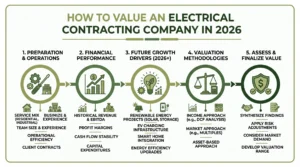
Three core approaches form the foundation of every project. The income approach measures what the business earns and discounts those earnings to a present value. The market approach compares the company to similar businesses that have sold. The asset approach values the underlying tangible and intangible assets, net of liabilities. The income approach carries the most weight for operating contractors.
Deal data confirms that EBITDA multiples for electrical contractors have held in the 3x to 6x range through 2025 and into 2026. A certified appraisal from a credentialed professional holding ABV or ASA designations carries far more weight with lenders, tax authorities, and legal counsel than a broker opinion.
What EBITDA Multiples Apply to Electrical Contractors?
EBITDA – earnings before interest, taxes, depreciation, and amortization – is the most common measure buyers use to price an electrical contracting company. The multiple reflects business size, revenue mix, and how transferable the operation is without its current owner.
| Company Size (Annual Revenue) | Typical EBITDA Multiple | Key Characteristics |
|---|---|---|
| Under $1M | 2.0x – 3.5x | High owner dependency, limited backlog, mostly residential |
| $1M – $3M | 3.0x – 4.5x | Small crew, mixed residential and commercial work |
| $3M – $10M | 4.0x – 5.5x | Project management layer forming, commercial contracts present |
| $10M+ | 5.0x – 6.5x | Diverse project types, management team, PE buyer interest |
The multiple applies to normalized EBITDA, not gross revenue. A qualified appraiser adds back the owner’s above-market pay, personal vehicle costs, one-time expenses, and any items a new owner would not incur. An electrical contractor paying himself $400,000 from a business that needs a $130,000 operations manager creates a $270,000 addback. At a 4x multiple, that single adjustment adds over $1 million to the concluded value.
How Do You Value a Business with $500,000 in Sales?
If EBITDA is 15 to 20 percent of revenue – common for a one-to-two crew operation – the business earns $75,000 to $100,000 before owner addbacks. Adding back excess owner pay might bring normalized EBITDA to $110,000 to $150,000. At a 2.5x to 3x multiple, the business value falls between $275,000 and $450,000.
Revenue multiples offer a cross-check. Small electrical contractors often trade at 0.4x to 0.6x annual revenue. At $500,000 in sales, that produces a value of $200,000 to $300,000 – lower than the EBITDA-based figure because revenue multiples penalize thin margins.
Buyers at this size are typically individual owner-operators or small regional contractors. They care about transferable customer relationships, licensed technicians who will stay, and supplier accounts. A business with a transferable master license and a steady referral base commands more than one where the owner holds the license and all client relationships reside in his personal phone.
Should Electrical Contractors Expect 50 Percent Profit?
Gross profit margin of 40 to 55 percent is achievable for contractors who manage labor costs well and maintain efficient job scheduling. That gross margin must cover overhead – office staff, insurance, vehicles, tools, and owner pay. Net profit, or EBITDA as a percentage of revenue, typically runs 10 to 20 percent for a well-managed business.
Buyers apply EBITDA multiples, not gross margin multiples. A contractor with $2 million in revenue and 50 percent gross margin but 45 percent overhead has a 5 percent net – producing only $100,000 in EBITDA and a value of $400,000 at 4x. A competitor with the same revenue but tighter overhead and a 15 percent net is worth $1.2 million at the same multiple. Margin management, not just revenue, drives value.
David Hern CPA ABV ASA, founder of Sofer Advisors, brings a Heart of a Teacher to every project – breaking down concepts like EBITDA normalization and margin analysis into clear terms that owners and advisors can act on.
What Factors Drive Value Up or Down?
Factors that increase value include:
- A licensed master electrician on staff who is not the selling owner, making the license transferable with the business
- A documented contract backlog of 90 days or more, showing predictable future revenue
- A trained estimating and project management team that operates without daily owner input
- Commercial or industrial clients spread across many accounts rather than dependence on one large client
- Strong bonding capacity, clean insurance history, and no open OSHA violations
Factors that reduce value include a master license held solely by the departing owner, revenue from one customer, no formal estimating system, and undocumented subcontractor relationships. These issues reduce the multiple buyers are willing to pay and extend due diligence. A report that ignores risk factors will not survive a buyer’s attorney’s review or lender underwriting.
How Do Appraisers Normalize Financials?
Normalization adjusts a company’s financial records to reflect what a new owner would actually earn. Common addbacks include excess owner pay above a market-rate replacement salary, personal vehicle leases paid through the business, one-time legal or equipment costs that will not recur, and rent paid to a related party above or below market rates. Each addback increases the normalized EBITDA and the concluded business value.
Common deductions include revenue tied to personal relationships of the departing owner that likely will not transfer, and above-market subcontractor pricing a new owner would renegotiate.
The Sofer Difference is a four-phase process – Discovery, Diligence, Analysis, and Delivery. During the Diligence phase, the team rebuilds three to five years of normalized financials and identifies every material addback and deduction before analysis begins. This produces a more defensible number than a quick multiple applied to the most recent year of revenue.
When Should You Commission a Valuation?
The most common mistake electrical contractors make is waiting until they are ready to sell before commissioning a valuation. By then, there is no time to address the factors that would have increased the multiple.
The right time is 12 to 24 months before any planned deal. This gives you a baseline, identifies value gaps, and allows time to address them. It also gives your CPA time to structure the deal in the most tax-efficient way.
Other trigger events include buy-sell agreement reviews, SBA loan applications, estate and gift tax filings, partner disputes, and divorce proceedings. Sofer Advisors holds dual accreditations – ABV from the American Society of Appraisers and ASA designation – both recognized by the IRS, SEC, and FINRA. Our reports meet the standards required for tax filings, legal proceedings, and lender review.
Frequently Asked Questions
How do you value an electrical contracting company?
Start by normalizing three to five years of financial records to arrive at adjusted EBITDA. Then apply the income approach, market approach, and asset approach, weighting each based on the facts of the business. The income approach typically carries the most weight for an operating contractor. Market comparables from broker databases and prior deals set the multiple.
How much does an electrical contracting valuation from Sofer Advisors cost?
A business valuation from Sofer Advisors typically ranges from $7,500 to $25,000. The cost depends on complexity, purpose, and the size of the business. Most standard projects finish within four to eight weeks. Rush work is available at a 25 to 50 percent premium.
How much is a business worth with $500,000 in sales?
A $500,000-revenue electrical contractor is typically worth $200,000 to $450,000, depending on margins and owner dependency. The income approach uses normalized EBITDA – often $110,000 to $150,000 after addbacks – and applies a 2.5x to 3x multiple. Revenue multiples of 0.4x to 0.6x provide a secondary check. The EBITDA-based method is more accurate when margins are healthy and documented.
Should an electrical contractor expect to make 50 percent profit?
Gross profit margins of 40 to 55 percent are achievable for well-run electrical contractors. Net profit after overhead – the figure that matters for valuation – typically runs 10 to 20 percent of revenue. Buyers apply EBITDA multiples to net earnings, not gross margin. A contractor with a 50 percent gross margin but 45 percent overhead has only a 5 percent net margin, which produces a far lower sale price.
What is the difference between enterprise value and equity value?
Enterprise value is the total value of the business, including all debt. Equity value is what the owner receives after subtracting any debt the buyer does not assume. For electrical contractors with equipment financing or a line of credit, the distinction is meaningful. A business with $1.5 million in enterprise value and $300,000 in long-term debt has $1.2 million in equity value.
How does a contract backlog affect valuation?
A documented backlog of signed contracts adds directly to value by reducing revenue uncertainty for the buyer. Appraisers treat backlog as both a financial metric and a risk adjustment. A company with six months of signed commercial contracts is less risky than one that bids work month to month. That lower risk supports a higher multiple. Buyers verify that backlog contracts are legally transferable.
What credentials should a valuation firm have?
Look for a firm holding ABV credentials from the AICPA Forensic and Valuation Services section, or ASA designation from the American Society of Appraisers. Both credentials require shown competency, continuing education, and adherence to professional standards. A CPA designation adds financial statement depth. Firms without these credentials may produce opinions that fail IRS review, lender scrutiny, or challenge in litigation.
How long does an electrical contracting valuation take?
A standard valuation project typically takes four to eight weeks from the time all financials are received. The process includes a records request phase, financial normalization, selection and use of valuation methods, drafting, and peer review. Providing clean, organized financials for the past three to five years is the biggest factor in keeping the timeline on schedule.
What is goodwill in an electrical contracting company?
Goodwill is the value of the business above and beyond its identifiable tangible and intangible assets. For electrical contractors, goodwill includes customer relationships, reputation, and a trained workforce. Personal goodwill tied to the owner does not transfer with a sale. Enterprise goodwill, which belongs to the company rather than the individual, is transferable and supports a higher sale price.
How is an electrical contracting valuation different from a broker opinion?
A certified valuation follows USPAP standards and a credentialed appraiser produces it. A broker opinion of value is an informal estimate based on comparable deals and market experience. Broker opinions are useful for setting a listing range. They do not carry the evidentiary weight needed for tax filings, lender underwriting, SBA loan applications, buy-sell agreement disputes, or legal proceedings.
Related Case Studies
- Bridging the Gap: Overcoming Common Business Appraisal Hurdles
- Cost Approach Vs Income Approach Complete Guide
- How To Get A Business Valuation Complete Hiring Guide
Executive Summary
Electrical contracting valuation converts financial performance, contract backlog, workforce stability, and market risk into a single defensible value. In 2026, electrical contractors typically sell at 3x to 6x normalized EBITDA. The multiple is driven by business size, management depth, contract transferability, and licensing structure. Three approaches – income, market, and asset – inform every credentialed appraisal. Owner dependency, license portability, and backlog depth are the primary factors that move a company above or below the median multiple.
What Should You Do Next?
Start by gathering three to five years of tax returns, normalized income statements, and a current backlog summary. Then identify whether your master electrician license transfers with the business or is tied to you personally – this single factor affects your value and your pool of qualified buyers. Schedule a formal valuation well before any deal so you have time to address the gaps that matter most.
David Hern CPA ABV ASA, founder of Sofer Advisors, has completed valuations for contractors and middle-market companies across the United States, serving as an expert witness in 11+ cases and earning recognition as an Inc. 5000 firm. Schedule a consultation to get a scoped estimate for your situation.
People Also Read
- Why You Must Start Planning Your Business Exit Now With The Right Valuation Expert
- What To Expect During A Business Valuation Step By Step Process
About the Author
This guide was prepared by David Hern CPA ABV ASA, founder of Sofer Advisors – a business valuation firm headquartered in Atlanta, GA serving clients across the United States. David holds dual accreditations as an Accredited Senior Appraiser (ASA) and is Accredited in Business Valuation (ABV), credentials recognized by the IRS, SEC, and FINRA. He also holds the Certified Exit Planning Advisor (CEPA) designation. With 15+ years of valuation experience, David has served as an expert witness in 11+ cases across multiple jurisdictions and built Sofer Advisors into an Inc. 5000-recognized firm with 180+ five-star Google reviews. The firm’s full W2 employee team maintains subscriptions to all major valuation databases and operates under a next business day response policy.
For professional business valuation services, visit soferadvisors.com or schedule a consultation.
This content is for informational purposes only and does not constitute professional valuation advice. Business valuation conclusions depend on specific facts and circumstances. Contact Sofer Advisors for guidance regarding your specific situation.