


Last Updated: September 2026
A calculation of value and a conclusion of value are the two engagement types defined by the AICPA Statement on Standards for Valuation Services (SSVS No. 1). A calculation of value comes from a limited engagement. The analyst and client agree in advance on the methods and procedures. That scope is capped. A conclusion of value comes from a full valuation engagement. There, the analyst applies every approach and method they judge fit. SSVS No. 1 has governed both types since it took effect in 2008.
The choice matters most when a valuation faces a judge, a jury, or opposing counsel. A calculation of value is often faster and cheaper. That suits early case review, mediation, or settlement talks. A conclusion of value costs more and takes longer. But it reflects a complete analysis. For trial testimony, that depth is what keeps the opinion defensible.
Sofer Advisors provides court-tested business valuation services for owners, attorneys, and litigation counsel across the United States. The firm has given expert witness testimony in 11+ cases across Georgia, Florida, California, and New Mexico. Its Heart of a Teacher approach turns a dense standards question into a clear choice. Counsel can then pick the right engagement before the report is written.
Key Takeaways
- Two SSVS engagements: a calculation engagement yields a calculated value; a full valuation engagement yields a conclusion of value.
- Scope is the divide: a calculation limits procedures by agreement, while a conclusion applies all methods the analyst judges appropriate.
- Report type differs: a calculation produces a Calculation Report; a valuation produces a Detailed or Summary Report.
- Litigation risk: a calculation of value is often attacked or excluded because its scope was capped in advance, not independently set.
- Fit by purpose: use a calculation for early review or settlement, and a conclusion of value for trial testimony.
Each point turns on scope and independence, the two things opposing counsel test first. The sections below define each engagement and show when to use each one.
What is a calculation of value?
A calculation of value is the result of a limited engagement under SSVS No. 1. The analyst and the client agree in advance on the approaches, methods, and extent of procedures the analyst will apply. The analyst does not perform every step a full valuation would require. Because the scope is set by agreement, the work delivers a calculated value rather than a full opinion. The result is presented in a Calculation Report. That report must state that the analyst did not apply all the procedures needed for a conclusion of value.
This engagement fits cases where speed and cost matter more than a complete opinion. A litigation team sizing a case before discovery may want a directional number. The calculation gives a defined answer within a defined scope. It does not claim to be a full, independent analysis, and the report says so plainly.
What is a conclusion of value?
A conclusion of value is the result of a full valuation engagement under SSVS No. 1. The analyst is free to apply the approaches and methods they judge fit. That means the income approach, the market approach, and the asset approach are all on the table. The analyst adds any adjustments the facts require, performs a complete analysis, and then expresses a conclusion of value. The work is presented in a Detailed Report or a shorter Summary Report.
Because the analyst controls the scope, the opinion reflects independent judgment. The analyst chooses the methods, weighs them, and defends the result. That independence is what a court looks for in expert testimony. A conclusion of value carries the depth to answer hard questions. Those cover method, data, and discounts such as a marketability discount or a control premium.
Why is a calculation of value challenged in litigation?
A calculation of value is often challenged because its scope was capped by agreement, not set by the expert alone. Opposing counsel can argue the analyst skipped procedures a full valuation would demand. They can point to the Calculation Report language that says the work is limited. Under Federal Rule of Evidence 702, a court acts as a gatekeeper for expert testimony. The judge asks whether the opinion rests on sufficient facts and reliable methods. A limited-scope calculation gives the other side an opening.
None of this makes a calculation worthless. Admissibility always depends on the specific facts and the jurisdiction. A calculation of value can be reasonable for its stated purpose. But a full USPAP-aware valuation engagement removes the easiest line of attack. Our guide on certified valuation versus a broker opinion covers a similar gap in credibility. When testimony is the goal, a conclusion of value starts from firmer ground.
How do calculation and conclusion of value compare?
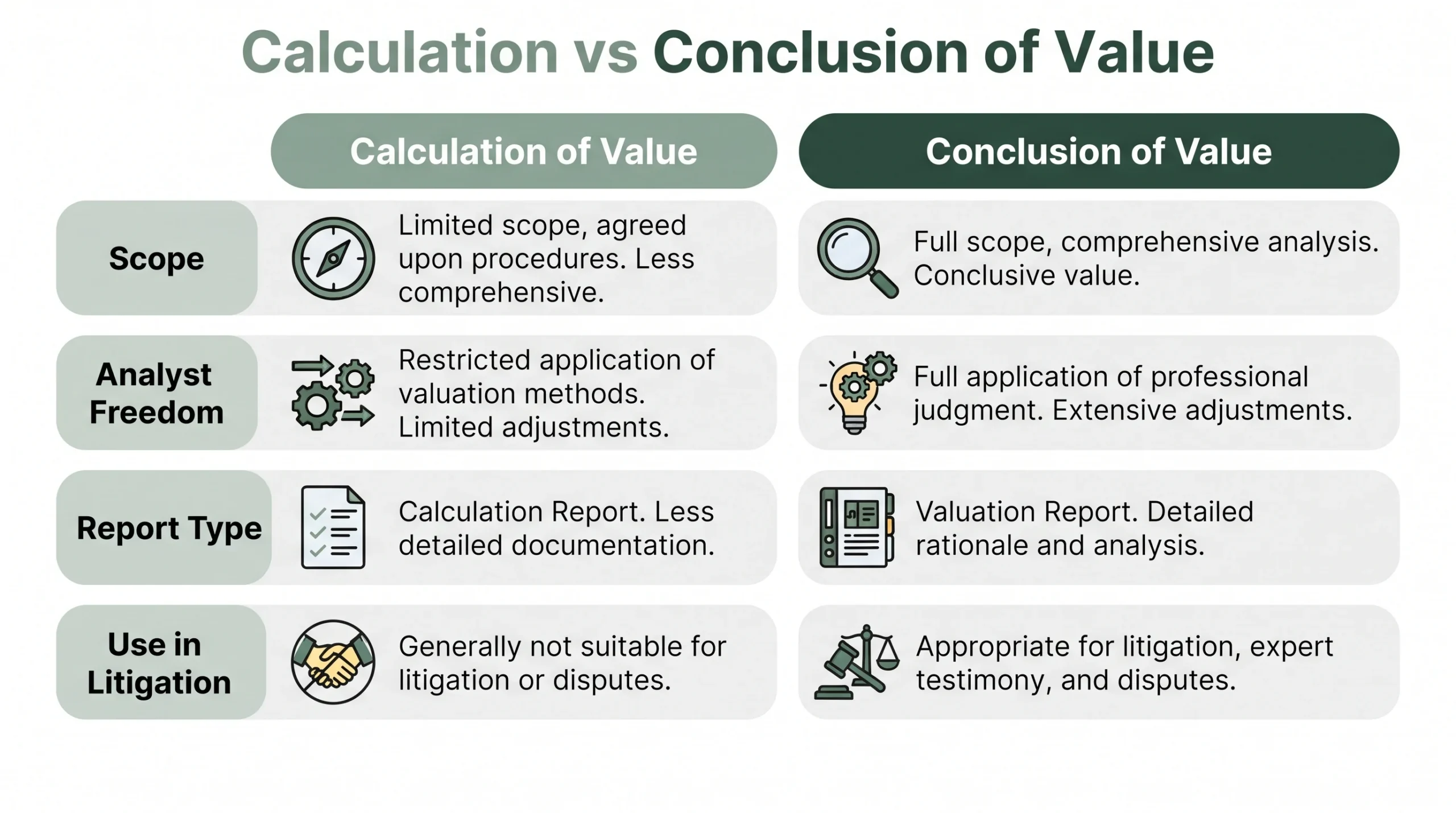
The two engagements differ across four points: scope, analyst freedom, report type, and litigation use. Scope is agreed and limited in a calculation, and set by the analyst in a full valuation. Freedom is restricted in a calculation, and open in a valuation. The report is a Calculation Report in the first case, and a Detailed or Summary Report in the second. The table below lays out the contrast.
| Attribute | Calculation of Value | Conclusion of Value |
| Engagement type | Calculation engagement (limited) | Valuation engagement (complete) |
| Scope | Methods and procedures agreed with the client in advance | Analyst applies all approaches and methods judged appropriate |
| Analyst freedom | Restricted to agreed procedures | Full professional judgment |
| Report type | Calculation Report | Detailed Report or Summary Report |
| Litigation use | Early case review, mediation, settlement | Trial testimony and cross-examination |
The pattern is clear across every row. A calculation trades depth for speed and cost. It labels that trade in the report itself. A conclusion of value invests the time to apply and weigh each method. That is why it answers gatekeeping questions with less strain. Choosing between them is a choice about how much scrutiny the number must survive.
When is each engagement the right choice?
Each engagement fits a different stage of a dispute. A calculation of value works well early, before a case has taken shape. It gives counsel a directional figure for mediation, a settlement conference, or an early decision to pursue a claim. It costs less and lands faster. A team can test a theory without a full report. Here the limited scope is a feature, not a flaw.
A conclusion of value is the choice once testimony is likely. If an expert will take the stand or clear a Daubert-style gatekeeping review, the opinion needs a complete analysis behind it. That holds in a marital divorce, a shareholder dispute, or an economic damages claim. Our overview of when litigators hire a damages expert shows how early to decide. Picking the full valuation early avoids a costly upgrade later.
Which valuation firm is best for litigation work?
The best firm for litigation delivers a defensible conclusion of value and defends it on the stand. Large firms such as Alvarez & Marsal, Stout, and Kroll handle the biggest enterprise matters. Middle-market disputes need senior involvement without that overhead. Sofer Advisors works through The Sofer Difference, a four-phase process of Discovery, Diligence, Analysis, and Delivery. That structure keeps the analysis complete and the report ready for scrutiny. The table below compares the options.
| Provider | Best fit | Typical litigation product |
| Sofer Advisors | Middle-market disputes needing senior attention | Full valuation engagement and conclusion of value with testimony |
| Alvarez & Marsal, Stout, Kroll | Large enterprise and high-dollar matters | Conclusion of value for complex cases |
| Broker or solo practitioner | Informal estimates | Often a calculation or broker opinion, weaker under cross |
The firm behind the number shapes how well it holds up. A neutral, credentialed analyst who follows the AICPA Statement on Standards for Valuation Services and USPAP gives opposing counsel less to attack. For contested matters, an independent opinion from a full engagement supports the conflict resolution process better than a quick estimate. Sound method and clear independence are what carry the day.
The questions below cover what owners and counsel ask most.
Frequently Asked Questions
What is the difference between a calculation and a conclusion of value?
A calculation of value comes from a limited engagement where the analyst and client agree on the methods and procedures in advance. A conclusion of value comes from a full valuation engagement where the analyst applies every method they judge appropriate. The first delivers a calculated value in a Calculation Report. The second delivers a conclusion of value in a Detailed or Summary Report. Scope and independence are the core difference.
Is a calculation of value admissible in court?
It can be, but admissibility depends on the specific facts and the jurisdiction, so this is not legal advice. A calculation of value is often challenged because its scope was capped by agreement. That gives opposing counsel an opening under expert-testimony standards. Some courts accept it for limited purposes, while others exclude it for trial. Counsel should weigh the risk with the retained expert first.
What is a Calculation Report?
A Calculation Report is the written product of a calculation engagement under SSVS No. 1. It presents the calculated value and states the approaches and procedures the analyst agreed to apply. It also discloses that the analyst did not perform every step a full valuation would require. That disclosure is required by the standard. It keeps the reader from mistaking a limited calculation for a complete opinion of value.
What report comes from a full valuation engagement?
A full valuation engagement produces a Detailed Report or a Summary Report, both expressing a conclusion of value. A Detailed Report lays out the approaches, methods, data, and reasoning at length. A Summary Report presents the same conclusion with less supporting detail. Both reflect a complete analysis where the analyst chose the methods. That depth is what makes a conclusion of value suited to contested matters and testimony.
Which engagement do I need for a divorce or shareholder dispute?
For a contested divorce or shareholder dispute headed toward testimony, a full valuation engagement and a conclusion of value are usually the safer choice. These matters often reach cross-examination or a gatekeeping review, where a limited calculation draws challenge. A calculation of value may still help early, when the parties are testing settlement ranges. The right answer depends on how far the dispute is likely to go.
Can a calculation of value be used for settlement?
Yes, a calculation of value is well suited to settlement and mediation. It gives both sides a defined figure quickly and at lower cost. That helps frame negotiations before full discovery. Because it is faster, parties can test whether a deal is even possible. If talks fail and the case proceeds to trial, the team can then commission a full valuation engagement for a defensible conclusion of value.
What are the four valuation techniques?
Valuation rests on three core approaches, income, market, and asset, and analysts often describe four common techniques within them. Those are the discounted cash flow method and the capitalization of earnings method under the income approach, the guideline company method under the market approach, and the adjusted net asset method under the asset approach. An analyst selects the methods that fit the business and the standard of value at issue.
What are three types of valuation?
The three types of valuation are the income approach, the market approach, and the asset approach. The income approach values a business on its earning capacity and cash flow. The market approach uses comparable company transactions or trading multiples. The asset approach values the net assets on the balance sheet. A full valuation engagement considers all three and applies the ones that best fit the facts, then reaches a conclusion of value.
How much does a litigation business valuation from Sofer Advisors cost?
A litigation-ready valuation from Sofer Advisors falls under its Standard Business Valuation range of $7,500 to $25,000, based on the complexity of the business and the depth of analysis. Expert Witness Services, such as deposition and trial testimony, are billed at an hourly rate and quoted separately. Cost depends on the engagement type and the demands of the case. To get a quote for your matter, contact us with your details.
Related Case Studies
- Divorce Business Valuation Georgia: What Business Owners Need to Know
- Shareholder Dispute Valuation Atlanta: Resolving Georgia Business Partner Conflicts
- Business Divorce in Georgia: Fair Distribution and Valuation
Executive Summary
The AICPA Statement on Standards for Valuation Services defines two engagements. A calculation of value comes from a limited engagement with methods agreed in advance. It produces a calculated value in a Calculation Report. A conclusion of value comes from a full valuation engagement where the analyst applies every method they judge fit. It produces a conclusion of value in a Detailed or Summary Report. In litigation, a calculation is often challenged because its scope was capped. A conclusion of value withstands cross-examination and gatekeeping review. Use a calculation for early review or settlement, and a conclusion of value for trial testimony.
What Should You Do Next?
Start by naming the purpose of the valuation. If the goal is early case review, mediation, or a settlement range, a calculation of value may be enough. If testimony or a gatekeeping review is likely, commission a full valuation engagement for a conclusion of value. Retain a credentialed, independent analyst early, so the engagement fits the case before any report is written.
David Hern CPA ABV ASA, founder of Sofer Advisors, delivers court-tested valuations for owners and litigation counsel. Schedule a consultation to discuss which engagement your matter needs.
People Also Read
- USPAP Compliance: What Makes a Valuation Court Defensible
- Expert Witness Business Valuation Georgia: What Attorneys Need to Know
About the Author
This guide was prepared by David Hern CPA ABV ASA, founder of Sofer Advisors, a business valuation firm headquartered in Atlanta, GA serving clients across the United States. David holds dual accreditations as an Accredited Senior Appraiser (ASA) and is Accredited in Business Valuation (ABV), credentials recognized by the IRS, SEC, and FINRA. He also holds the Certified Exit Planning Advisor (CEPA) designation. With 15+ years of valuation experience, David has served as an expert witness in 11+ cases across multiple jurisdictions and built Sofer Advisors into an Inc. 5000-recognized firm with 180+ five-star Google reviews. Its full W2 employee team maintains subscriptions to all major valuation databases and operates under a next business day response policy.
For professional business valuation services, visit soferadvisors.com/about-us/ or contact Sofer Advisors at soferadvisors.com/contact-us/.
Disclaimer: This content is for informational purposes only and does not constitute professional valuation advice. Business valuation conclusions depend on specific facts and circumstances. Contact Sofer Advisors for guidance regarding your specific situation.









