


Last Updated: September 2026
A buy-sell valuation mechanism is the method a buy-sell agreement uses to set the price when an owner exits. The price has to be ready for four common triggers: death, disability, departure, and dispute. Owners pick from three mechanisms: a fixed price they agree on, a formula that calculates value, or an appraisal by an independent expert. Each ages very differently over the years.
The choice matters because most agreements sit unused for years before a trigger occurs. A price that made sense at signing can be far off the mark later. When the number no longer matches reality, partners end up in conflict, and the estate may face a tax mismatch. A broad guide to buy-sell agreement valuation covers the full picture; the sections below show why one mechanism holds its value while the others fade.
Sofer Advisors provides independent, third-party valuations for buy-sell agreements and the owners who rely on them. With 180+ five-star Google reviews and 11+ expert witness cases across Georgia, Florida, California, and New Mexico, the firm applies fair market value standards to closely held businesses. Its Heart of a Teacher approach means owners understand the number, not just receive it.
Key Takeaways
- Three ways to set the price: a buy-sell agreement uses a fixed price, a formula, or an appraisal to value an owner’s stake at a trigger event.
- Fixed prices go stale: owners are meant to update the number each year, but rarely do, so it can badly misstate value later.
- Formulas turn rigid: a single multiple set for today’s business drifts from fair market value as margins and industry pricing shift.
- Appraisal clauses stay current: naming an independent appraiser to value the business at the trigger date keeps the price honest and cuts disputes.
- Tax rules add a test: for estate and gift purposes, an owner-set price binds the IRS only if it meets IRC Section 2703.
Each point traces back to one question: will the price still be fair on the day it is needed? Start with the simplest mechanism, the fixed price.
How does a fixed-price buy-sell clause work?
A fixed-price clause states a single dollar value that the owners agree on, often called an agreed value or a certificate of value. The owners sign it, and that number becomes the buyout price until they change it. The clause is easy to write and understand, and it states the exact payout in advance, with no expert needed at the trigger date.
The trouble is that a fixed price goes stale fast. Owners are supposed to revisit the value each year, but that step is easy to skip. A price set years ago can badly understate a growing business, or overstate a shrinking one. When a partner dies and the agreed value sits far below fair market value, the family feels cheated, a dispute follows, and the stale number can clash with the value the IRS expects.
How does a formula clause set the price?
A formula clause sets the price with a fixed calculation, such as a multiple of EBITDA, a multiple of earnings, or a percentage of book value. It runs the same math every time, so no one has to agree on a number in the moment. A formula is objective and cheap, and it updates itself as the inputs change, since this year’s earnings feed this year’s price.
Even so, a formula ages poorly because it is rigid. A multiple that fit the business at signing can drift far from fair market value as the company changes. Margins move, debt is added or paid down, and buyers start paying different multiples. A single multiple also ignores what makes one company special, such as customer concentration or a strong team, so it can miss real value by a wide margin.
How does an appraisal clause work?
An appraisal clause names an independent appraiser, or a process for picking one, to value the business at the trigger date. Because value is set when it is needed, the price reflects the company as it stands. This is sometimes called a process clause. One version names a single appraiser both sides trust. Another has each side hire its own appraiser, with a third to settle any gap.
The trade-off is cost and time. Each trigger event calls for a new engagement, which takes weeks and carries a fee. In return, the price stays current and defensible, so it produces the fewest disputes of the three mechanisms. A clear process also removes the fight over who values the business, since the method is agreed in advance. Many advisers favor a well-drafted appraisal clause, or a formula paired with a periodic appraisal backstop.
How do the three mechanisms compare over time?
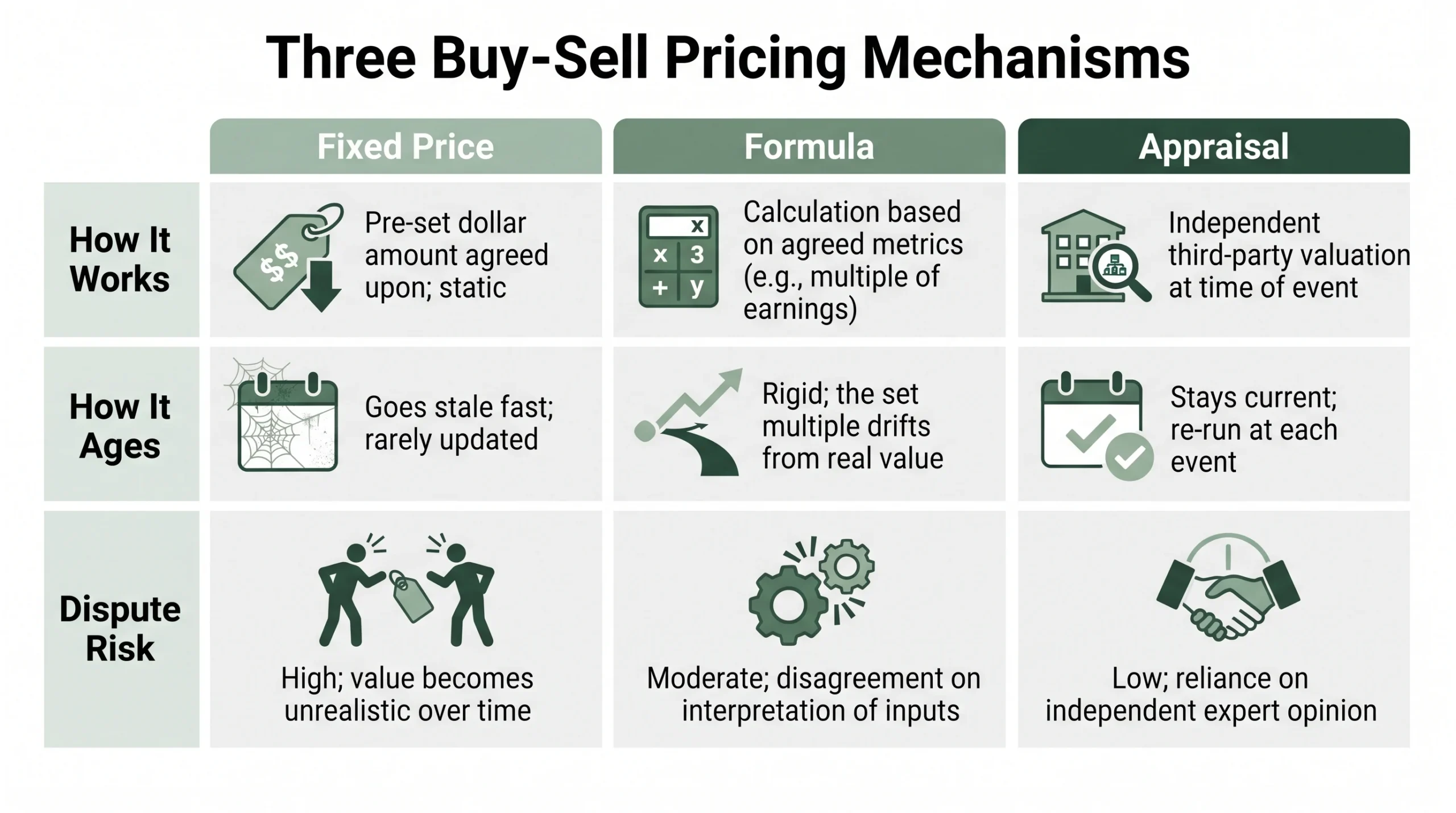
The three mechanisms differ most in how well they hold up over time. A fixed price starts accurate and decays fastest, since it never changes on its own. A formula updates its inputs but keeps a rigid structure, so it drifts more slowly yet still misses company-specific value. An appraisal is set fresh at the trigger date, so it does not age. The table below lines up the three on how they work, age, and their dispute risk.
| Mechanism | How it works | How it ages | Dispute risk |
| Fixed price | Owners agree on a set dollar value | Goes stale fast without yearly updates | High |
| Formula | A set calculation, like an EBITDA multiple | Drifts as margins and multiples shift | Medium |
| Appraisal | An independent expert values at the trigger | Stays current, set at the trigger date | Low |
Speed and low cost pull owners toward a fixed price or a formula, but both age into a fight when a trigger arrives. An appraisal costs more per event, yet it protects the relationship the agreement is meant to guard. Owners who want a formula’s simplicity often add a rule that an appraiser checks the formula price on a set schedule.
Does IRC Section 2703 make your buy-sell price binding?
For estate and gift tax, a price set in a buy-sell agreement binds the IRS only if it meets IRC Section 2703. The rule stops a family from locking in a low value just to cut a tax bill. Under Section 2703, the agreement must clear three tests. It must be a bona fide business arrangement. It must not be a device to pass value to family for less than full value. And its terms must be comparable to an arm’s-length deal.
A stale fixed price or a self-serving formula can fail these tests. The IRS can then ignore the buyout price and tax the estate on a higher fair market value. That gap can trigger extra gift and estate tax. A refreshed appraisal is easier to defend, since it reflects real value on real dates. How buy-sell terms interact with Chapter 14 rules under IRC 2701 and 2703 is fact-dependent, so owners should work with their attorney and appraiser.
Which valuation firm should set your buy-sell price?
The right firm is an independent appraiser that values your business under fair market value standards and stands behind the number if it is challenged. Credentials from bodies like the American Society of Appraisers signal that rigor. Large firms such as Alvarez & Marsal, Stout, and Kroll serve the biggest deals, while middle-market owners usually need senior attention and a faster response. The table below compares the options.
| Provider type | Best fit | Trade-off |
| Sofer Advisors | Middle-market buy-sell and estate valuations | Not built for mega-cap deals |
| National firm (Alvarez & Marsal, Stout, Kroll) | Very large or public-adjacent transactions | Higher cost, junior-staff review layers |
| Solo appraiser | Simple, single-owner situations | Limited data and less court-tested depth |
An independent appraiser keeps the valuation separate from any party to the buyout, which protects both sides. Look for an appraiser who works to USPAP and other recognized standards, which courts expect if a dispute reaches litigation. That approach reflects The Sofer Difference, a four-phase process of Discovery, Diligence, Analysis, and Delivery. Owners can start with transaction advisory support and keep one firm for periodic updates.
The questions below cover what owners ask most about pricing a buy-sell agreement.
Frequently Asked Questions
How is the price set in a buy-sell agreement?
The price is set by one of three mechanisms: a fixed price the owners agree on, a formula that calculates value, or an appraisal by an independent expert. A fixed price is simple but can go stale. A formula updates its inputs but stays rigid. An appraisal is set at the trigger date, so it reflects current value. Some agreements combine methods, such as a formula with a periodic appraisal check.
What are the four types of buy-sell agreements?
The four common structures are the cross-purchase, where owners buy each other’s stakes; the redemption or entity purchase, where the company buys the stake; the hybrid or wait-and-see, which lets either buy; and the one-way agreement, used when a single buyer is planned. Each structure decides who buys, while the valuation mechanism decides the price. The two choices work together but are set separately.
What are the four valuation methods?
In business valuation, the core approaches are the income approach, the market approach, and the asset approach, sometimes joined by a rule-of-thumb check. In a buy-sell setting, though, the practical pricing methods are the three mechanisms: fixed price, formula, and appraisal. An appraiser uses the income, market, and asset approaches to reach fair market value, and the clause decides how that value applies when an owner exits.
What are the 5 steps in the valuation process?
A typical valuation runs in five steps. First, define the purpose and the standard of value. Second, gather financial statements, tax returns, and company records. Third, normalize earnings to remove owner-specific or one-time items. Fourth, apply the income, market, and asset approaches. Fifth, reconcile the results into one supported conclusion. For a buy-sell agreement, this gives the trigger-date value a fixed price or formula only estimates.
Why do fixed-price buy-sell clauses go stale?
Fixed-price clauses go stale because owners are meant to update the agreed value each year, and that step is easy to forget. Once the price sits untouched, the business keeps changing while the number does not. A value set years ago can understate a growing company or overstate a shrinking one. When a trigger arrives, the outdated price no longer matches fair market value, which is how disputes and tax mismatches begin.
What is a formula clause in a buy-sell agreement?
A formula clause sets the buyout price with a fixed calculation, such as a multiple of EBITDA, a multiple of earnings, or a share of book value. It is objective and cheap, and it updates as the inputs change each year. The weakness is rigidity. A multiple chosen at signing can drift from real value as margins, debt, and industry pricing move, and one multiple cannot capture what makes a company different.
How often should you update a buy-sell valuation?
Most advisers suggest refreshing a buy-sell value at least every one to two years, and after any major change in the business. A fixed price needs the most frequent attention, since it never adjusts on its own. A formula should be reviewed to confirm the multiple still fits the market. An appraisal clause solves the timing problem by setting value at the trigger date.
Is a buy-sell price binding on the IRS?
A buy-sell price is binding on the IRS for estate and gift tax only if it meets IRC Section 2703. The agreement must be a bona fide business arrangement, must not be a device to shift value to family for less than full value, and must carry terms comparable to an arm’s-length deal. A stale fixed price or a self-serving formula may fail these tests. This is fact-dependent, so consult your attorney and appraiser.
How much does a buy-sell valuation from Sofer Advisors cost?
A buy-sell valuation from Sofer Advisors runs $7,500 to $25,000, with a typical timeline of four to eight weeks. Cost depends on company size, the number of owners, and the complexity of the business. Agreements that need recurring updates may involve added engagements over time. For a quote tied to your agreement, request a buy-sell valuation estimate with your financials and agreement terms.
Related Case Studies
- Shareholder Dispute Valuation: Resolving Business Partner Conflicts
- Business Valuation for Partner Buyout: Complete Transition Guide
- Partnership Dissociation: How a Departing Partner’s Stake Is Valued
Executive Summary
A buy-sell agreement sets the buyout price with one of three mechanisms, and each ages differently. A fixed price is simple but decays fastest, because owners rarely update the agreed value. A formula updates yearly but stays rigid, so it drifts from fair market value as the business changes. An appraisal clause values the business at the trigger date, so it stays current and causes the fewest disputes. For estate and gift tax, the price binds the IRS only if it meets IRC Section 2703. Sofer Advisors delivers that independent opinion.
What Should You Do Next?
Start by reading your current buy-sell agreement to find which mechanism it uses and when the value was last set. If it relies on a fixed price or a formula, check the number against a fresh estimate of fair market value, since any gap will only widen. Then decide with your attorney whether to add an appraisal clause or a scheduled valuation so the price stays current and can meet Section 2703.
David Hern CPA ABV ASA, founder of Sofer Advisors, provides independent, defensible valuations for buy-sell agreements and closely held businesses. Schedule a consultation to discuss your situation.
People Also Read
- Buy Sell Agreement vs Shareholder Agreement: Key Differences
- How Is a Buy-Sell Agreement Funded with Life Insurance?
About the Author
This guide was prepared by David Hern CPA ABV ASA, founder of Sofer Advisors, a business valuation firm headquartered in Atlanta, GA serving clients across the United States. David holds dual accreditations as an Accredited Senior Appraiser (ASA) and is Accredited in Business Valuation (ABV), credentials recognized by the IRS, SEC, and FINRA. He also holds the Certified Exit Planning Advisor (CEPA) designation. With 15+ years of valuation experience, David has served as an expert witness in 11+ cases across multiple jurisdictions and built Sofer Advisors into an Inc. 5000-recognized firm with 180+ five-star Google reviews. Its full W2 employee team maintains subscriptions to all major valuation databases and operates under a next business day response policy.
For professional business valuation services, visit soferadvisors.com/about-us/ or contact Sofer Advisors at soferadvisors.com/contact-us/.
Disclaimer: This content is for informational purposes only and does not constitute professional valuation advice. Business valuation conclusions depend on specific facts and circumstances. Contact Sofer Advisors for guidance regarding your specific situation.









