

Last Updated: July 2026
A funeral home valuation finds the fair market value of a death care business, including its tangible assets, intangible goodwill, and unique revenue streams like pre-need contracts. Owners use it to prepare for a transition, settle an estate, or secure financing. Since 2019, Sofer Advisors has focused on neutral, evidence-based opinions for firms across the United States, backed by 11+ expert-witness cases and 180+ five-star Google reviews.
Valuing a funeral home takes an understanding of how pre-need contracts, at-need services, and local demographics shape long-term cash flow. Sofer Advisors examines these components for an accurate picture of the company. Its approach delivers professional insight while holding the independence regulators require. Owners use these findings to make informed decisions about growth and succession.
A professional valuation helps owners see their position in the current market. Without a formal assessment, owners can struggle to identify what drives total enterprise value. Sofer Advisors brings clarity through a data-driven process, and a free initial consultation is available to discuss specific needs.
Key Takeaways
- Primary value drivers: case volume, the mix of cremation versus burial, and the stability of pre-need contracts.
- Typical multiples: most firms sell for 4.0x to 8.0x EBITDA, or 2.5x to 4.5x SDE for owner-operated shops.
- Pre-need contracts: a real asset, but each must be offset against its future service liability.
- Normalize the earnings: adjust for owner salary, personal expenses, and one-time items to show true recurring cash flow.
- Credentialed expertise: a USPAP-following appraiser avoids the errors of generic rules of thumb.
Each of these factors shapes the value of a funeral home. The sections below cover pre-need contracts, real estate, and reporting standards in detail.
What are the primary drivers of funeral home value?
The primary drivers are annual case volume, average revenue per service, and the size and stability of the pre-need contract portfolio. Together these show the predictable cash flow a buyer can expect. Sofer Advisors examines these points to help owners set a defensible baseline. A steady case volume signals consistent demand in the local service area.
Beyond core metrics, tangible assets like real estate and the fleet matter. A well-kept property and modern vehicles cut the capital a new owner must spend. Intangibles matter too. A long, positive community presence keeps families loyal across generations. Staff retention plays a real role here, since experienced employees preserve the quality of service that keeps local trust high.
Which valuation methods apply to funeral homes?
The market approach is the primary method, because it relies on real transaction data from similar businesses. Appraisers often use the Business Valuation Resources database to compare EBITDA multiples or Seller’s Discretionary Earnings (SDE) ranges. The income approach adds a forward-looking view of cash flow, while the market method anchors value in current industry trends.
For smaller, owner-operated homes, SDE is the standard profit measure. It captures the owner’s total compensation, benefits, and non-operating expenses added back to net income. As a business scales to professional management, the focus shifts toward EBITDA, so the calculation reflects performance without owner-specific costs. Our guide to SDE versus EBITDA shows how to pick the right metric.
What valuation multiples are used for funeral homes?
Funeral home multiples usually range from 4.0x to 8.0x EBITDA, or 2.5x to 4.5x SDE, based on size, profitability, and market. These give owners a baseline for fair market value from historical earnings. Smaller firms often trade near the lower end. Larger firms with steadier cash flow attract higher premiums. Our EBITDA multiples by industry guide shows how these compare.
The mix of revenue moves the final multiple. Firms with a high share of traditional burials often see steadier revenue. A strong, well-funded pre-need portfolio signals future cash flow. Market position also counts. A firm with limited local competition and a dominant service area usually justifies a higher multiple.
Talk to a Sofer Advisors specialist about where your firm lands on these ranges.
How do pre-need contracts impact a valuation?
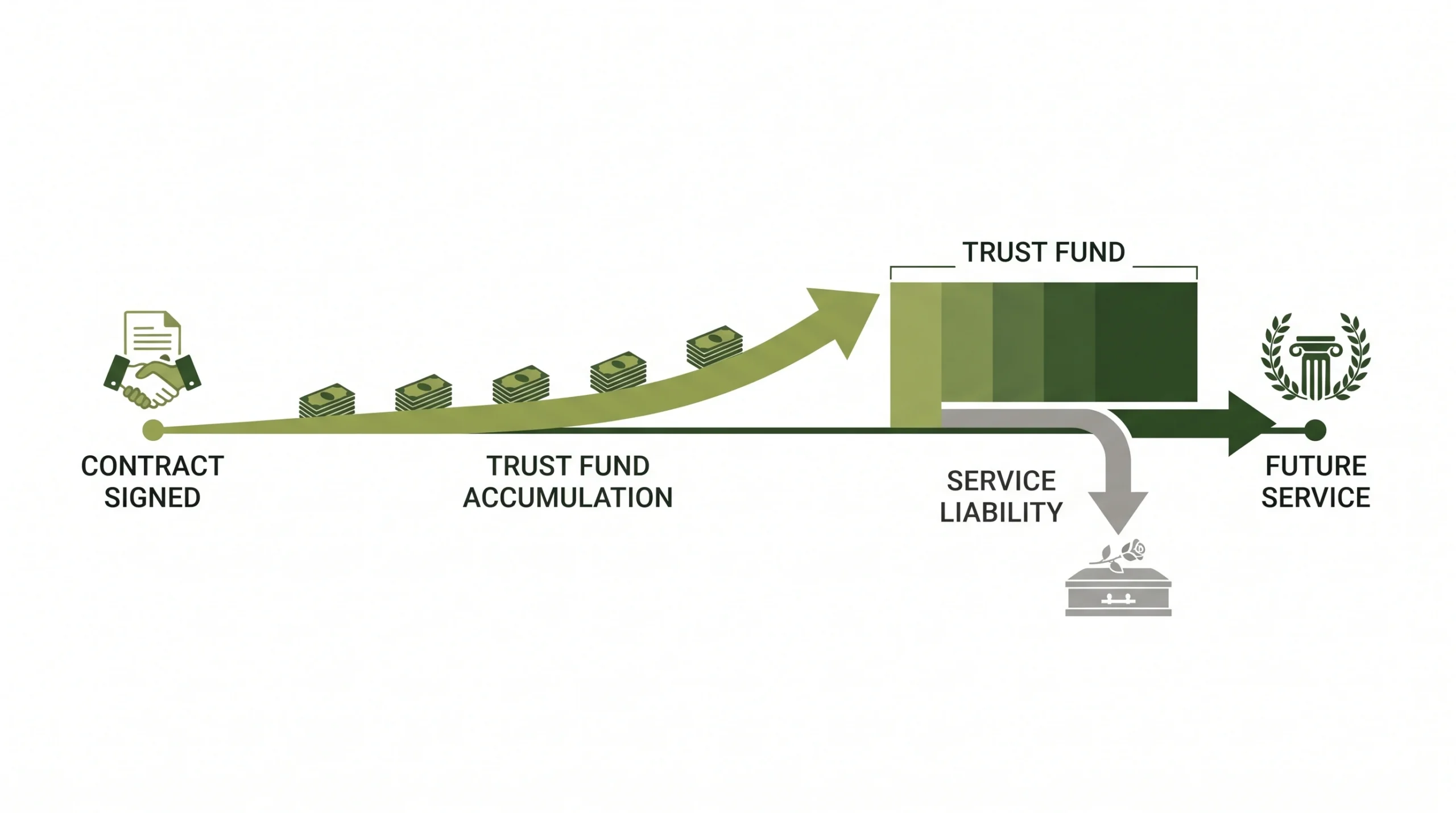
Pre-need contracts both represent future guaranteed revenue and require an adjustment for the future service liability. They act as a pipeline for future business, improving stability and the predictability of cash flow. A valuation professional must check whether the contracts are backed by pre-need trust funds or by third-party insurance, since each structure changes the risk for a buyer.
When funds sit in a trust, the specialist compares the growth of those assets to the current cost of delivering the service. If the held funds do not fully cover the eventual burial or cremation cost, the business carries a burden that lowers equity value. Insurance policies often provide a fixed death benefit that offsets the liability. Sofer Advisors analyzes these components so the net contribution of the contract portfolio reflects the firm’s true cash position.
What are common funeral home valuation adjustments?
Normalization adjustments refine historical statements to show a firm’s true, sustainable earning power. They turn reported net income into a figure that reflects performance for a buyer or tax authority. The most common adjustments are:
- Replacing excess owner salary with a market-rate manager wage
- Removing personal or one-time expenses run through the business
- Adding a fair market rent when the owner holds the facility personally
- Confirming working capital is adequate to fund daily operations
Each adjustment reveals more of the real economics. Replacing an above-market salary shows the true profit. Adding a fair market rent ensures the business covers the full cost of its property use. Together these give a buyer or the IRS a clean view of recurring earnings.
What are common pitfalls in these valuations?
Common pitfalls come from leaning on generic rules of thumb instead of grounded analysis. Those formulas ignore the unique variables of a specific business. An appraiser must normalize the statements to reflect real economics. Failing to weigh the local competitive landscape often produces an inaccurate value.
Appraisers also err by misvaluing the real estate a company holds. Another blind spot is ignoring the shift toward lower-margin cremations, which can compress earnings. Professionals must assess the health of the pre-need trust with care. Under USPAP standards, the process requires a deep look at data specific to the assets.
Sofer Advisors applies the Heart of a Teacher approach so owners understand how these nuances hit their value. By focusing on site-specific facts rather than broad averages, it helps stakeholders find the real value drivers. For owners facing these questions, high-quality analysis brings the clarity to decide well.
Which valuation provider is best for a funeral home?
The right provider depends on the report’s use. For tax, litigation, or financial reporting, owners need a certified, standards-compliant valuation. An operational consultant helps improve the business before a sale, and a brokerage sets a list price for a transaction. Large advisory practices like Alvarez & Marsal, Stout, and Kroll serve big multi-site death care deals. The table below compares the options.
| Provider type | Core focus | Best for |
| Sofer Advisors | Defensible, standards-compliant valuation (USPAP) | Tax, M&A, litigation, or financial reporting |
| Operational consultant | Operations and succession benchmarks | Owners improving operations before a sale |
| M&A brokerage | Transaction and market-focused data | Owners actively buying or selling a firm |
These models serve different points in the business life cycle. A valuation for tax or litigation demands strict USPAP adherence so the result is objective and independent, following ASA standards. A brokerage-led estimate prioritizes market liquidity and a buyer’s motivation to set a list price. Choosing the wrong path can produce a report that lacks the documentation the IRS or a court requires. Sofer Advisors emphasizes that documentation to give owners a defensible result.
Funeral home valuation rewards clean records and site-specific analysis. The questions below cover what owners ask most.
Frequently Asked Questions
How do you value a funeral home?
Valuing a funeral home usually blends the income, market, and asset approaches for a complete result. The process centers on normalizing historical statements, weighing recurring case volume, and valuing the net worth of the pre-need portfolio. Sofer Advisors follows these methods to deliver a valuation that accounts for both tangible property and intangible goodwill.
Is a business worth three times profit?
Shorthand multiples are tempting, but three times profit is usually too simple for a funeral home. Industry data shows multiples often run 4.0x to 8.0x EBITDA, based on growth and scale. Sofer Advisors reviews the specific entity rather than a generic rule, because every death care business has a unique asset profile that shifts the final value.
Do funeral home owners make a lot of money?
Owner income varies widely with scale, location, and how efficient the business is. Larger firms with higher case volumes tend to throw off significant cash flow, while smaller family firms prioritize stability and local position. Sofer Advisors applies a market-based wage adjustment during normalization to show the true profit potential beyond the current owner draw.
What is the difference between enterprise value and equity value for a funeral home?
Enterprise value is the total worth of the operations, including debt, while equity value is what remains for owners after debt and other liabilities. Calculating them requires reviewing all debt tied to the facility and equipment. Sofer Advisors separates these values so buyers and sellers clearly see the net proceeds from a potential deal.
How long does it take to get a funeral home valuation?
A formal engagement usually takes four to eight weeks once all documents are in. That window allows research of market data, analysis of the financials, and the internal quality review professional standards require. Sofer Advisors holds this timeframe to deliver a comprehensive, defensible report that meets the needs of tax authorities or other stakeholders.
Why is real estate often valued separately in a funeral home appraisal?
Real estate often holds value apart from the operating cash flow, so a separate appraisal keeps tax and planning accurate. When the property sits in a different entity or is held personally, the business appraiser sets a market rent to normalize earnings. Sofer Advisors performs this separation so the business value does not inflate the operating company with property value.
Does the rising cremation rate decrease a funeral home’s value?
A rising cremation rate can pressure margins, because these services usually earn less per case than traditional burials. A well-managed firm often adapts by lifting volume or upgrading its offerings to hold cash flow steady. Sofer Advisors weighs how local trends affect long-term earning power so the valuation reflects shifting customer preferences.
What financial documents are needed for a funeral home valuation?
You need at least three years of tax returns, profit and loss statements, and detailed balance sheets. Add lists of active pre-need contracts, accounts receivable aging, and details on debt and property. Sofer Advisors requests these during the discovery phase so every part of the firm’s financial position is captured in the final report.
How much does a funeral home valuation from Sofer Advisors cost?
A funeral home valuation from Sofer Advisors runs $7,500 to $25,000, based on its published engagement data, with multi-site firms and complex pre-need trusts reaching the higher end. Cost reflects the entity’s complexity, the records available, and the report’s intended use. For a quote tied to your firm, request a valuation estimate with your financials and pre-need trust reports.
Related Case Studies
- How to Value an Optometry Practice for Sale or Succession
- How Much Is a Restaurant Worth? A Complete Valuation Guide
- Goodwill Valuation Methods: Which Approach Is Right?
Executive Summary
A funeral home’s value rests on case volume, the cremation-versus-burial mix, and the stability of its pre-need contracts. Most firms sell for 4.0x to 8.0x EBITDA, or 2.5x to 4.5x SDE for owner-operated shops, with the market approach anchoring the number. Pre-need contracts are an asset, but each carries a future service liability that must be netted out, and owned real estate is valued separately with a fair market rent added back. Normalizing for owner salary, personal expenses, and one-time items reveals true recurring earnings. To prepare, finalize your statements through the last full fiscal year and compile all pre-need contract and trust reports.
What Should You Do Next?
Finalize your financial statements through the last full fiscal year, then compile all pre-need contract data and trust reports, since these drive the value under USPAP standards. Gather three years of tax returns, the fixed asset and property details, and accounts receivable aging. Preparing these now allows a more accurate assessment and prevents delays in your next planning step.
David Hern CPA ABV ASA, founder of Sofer Advisors, provides third-party valuations for owners navigating transitions, tax reporting, or disputes. Schedule a free consultation to discuss your situation.
People Also Read
- EBITDA Add-Backs: What Buyers Accept and What They Reject
- Key Person Discount: How Owner Dependence Reduces Value
About the Author
This guide was prepared by David Hern CPA ABV ASA, founder of Sofer Advisors, a business valuation firm headquartered in Atlanta, GA serving clients across the United States. David holds dual accreditations as an Accredited Senior Appraiser (ASA) and is Accredited in Business Valuation (ABV), credentials recognized by the IRS, SEC, and FINRA. He also holds the Certified Exit Planning Advisor (CEPA) designation. With 15+ years of valuation experience, David has served as an expert witness in 11+ cases across multiple jurisdictions and built Sofer Advisors into an Inc. 5000-recognized firm with 180+ five-star Google reviews. Its full W2 employee team maintains subscriptions to all major valuation databases and operates under a next business day response policy.
For professional business valuation services, visit soferadvisors.com/about-us/ or contact Sofer Advisors at soferadvisors.com/contact-us/.
Disclaimer: This content is for informational purposes only and does not constitute professional valuation advice. Business valuation conclusions depend on specific facts and circumstances. Contact Sofer Advisors for guidance regarding your specific situation.