

Last Updated: June 2026
An optometry practice is typically valued at 4x–7x adjusted EBITDA or 0.6x–1.2x gross collected revenue. The range depends on payer mix, patient recall rates, optical dispensary performance, and the transferability of goodwill. Two practices with identical top-line revenue can differ by hundreds of thousands, or millions, in enterprise value.
Multiples have compressed slightly from 2021 peaks as interest rates normalized. But private equity consolidation in eye care has kept floors elevated. PE-backed platforms like MyEyeDr, National Vision, and Vision Source affiliates are active acquirers. Their presence has created a two-tier market: practices that fit a platform thesis and practices that don’t. Sofer Advisors helps owners and their advisors work through exactly these questions and turn the analysis into a defensible business valuation they can act on.
The following takeaways summarize the key valuation and transaction factors covered in this guide.
Key Takeaways
- Optometry Practices Trade 4x – Optometry practices trade at 4x–7x adjusted EBITDA; PE-backed acquirers tend to pay at the upper end for scalable platforms.
- Revenue Multiples 06x 12x – Revenue multiples of 0.6x–1.2x gross collected revenue are a useful cross-check, but EBITDA is the primary driver.
- VSP/EyeMed Payer Mix Patient – VSP/EyeMed payer mix, patient recall rate, and optical capture rate are the three biggest levers on value.
- Associate OD Pay Must – Associate OD pay must be added back to EBITDA only to the extent it exceeds market rate for a replacement associate.
- Frame Lens Inventory Valued – Frame and lens inventory is valued at cost (not retail); aged inventory is typically discounted or excluded.
- Succession Sale Associate Typically – A succession sale to an associate typically yields 10%–20% less than a third-party sale.
Each of these factors is examined in depth in the sections that follow.
What Is My Optometry Practice Worth?
The honest answer: it depends on your adjusted EBITDA margin, your payer mix, and whether goodwill transfers with the business or walks out the door with you.
Start with gross collected revenue, not production, not billed charges. Payers reimburse at contracted rates, so collected revenue is the real number. From there, calculate adjusted EBITDA by adding back the owner OD’s above-market pay, one-time expenses, and non-recurring items. The benchmark for owner OD pay is $150,000–$185,000 annually in most metro markets. If you’re pulling $350,000 as owner-OD, about $165,000–$200,000 gets added back.
EBITDA margins for well-run optometry practices typically run 20%–35%. A practice collecting $1.2M with a 28% EBITDA margin produces about $336,000 in adjusted EBITDA. At a 5.5x multiple, that’s $1.85M enterprise value. At 4x for a thin-margin, payer-dependent practice, it’s $1.34M. The difference is real and it’s driven by specifics.
| Practice Profile | Revenue Multiple | EBITDA Multiple | Notes |
|---|---|---|---|
| Strong optical dispensary, diverse payer mix, 85%+ recall | 1.0x–1.2x | 6x–7x | Premium for transferable goodwill |
| Moderate optical, mixed payer, 70–85% recall | 0.75x–0.95x | 4.5x–5.5x | Mid-market baseline |
| High Medicaid/managed care, low optical capture | 0.6x–0.75x | 3.5x–4.5x | Reimbursement risk discount |
| Single-provider, low recall, outdated EHR | 0.5x–0.7x | 3x–4x | Transition risk, limited scalability |
| PE platform target (3+ locations, $3M+ revenue) | 1.0x–1.3x | 7x–8x | Control premium, strategic value |
Valuations for estate or divorce purposes use the same method but apply different standards of value. Fair market value and fair value treat personal goodwill differently. In Georgia, courts distinguish between enterprise goodwill and personal goodwill in professional practices. That distinction matters a great deal in a divorce proceeding.
A market multiple is a starting point, not a conclusion of value. A defensible fair market value still rests on the factors the IRS sets out for valuing closely held businesses under Revenue Ruling 59-60.
How Does Payer Mix Affect Optometry Practice Value?
Payer mix is the single most scrutinized variable in any optometry valuation. A practice deriving 60% of revenue from VSP and EyeMed is more predictable and transferable than one reliant on a fragmented mix of Medicaid managed care plans.
VSP status is generally transferable with the practice. A buyer retains the patient base. EyeMed works the same way. Medicaid contracts are often state-administered and may require re-credentialing. That creates a 90–180 day revenue gap at transition.
Cash-pay optical is the highest-quality revenue. There are no contractual write-downs, no claims lag, and typically high margins on premium frames and contact lenses. Gross margins run 40%–55%. A practice where 20%+ of revenue comes from cash optical or private-pay specialty lenses commands a meaningful multiple premium.
Insurance payer analysis should break down revenue by plan, reimbursement rate per exam, and write-down percentage. If VSP reimburses $45 per comprehensive exam and your posted fee is $120, that 62% write-down is already baked into collected revenue. But a buyer will model what happens if VSP reduces contracted rates.
What Role Does the Optical Dispensary Play in Value?
The dispensary is often where the real money is in optometry. A disciplined buyer will model it separately. Optical dispensary revenue, frames, lenses, contact lenses, typically represents 40%–60% of a full-scope practice’s collected revenue. Gross margins on optical run 50%–65% when inventory is managed well. That compares to 15%–30% on exam revenue after staffing and overhead.
Capture rate, the percentage of patients who fill optical needs in-house, is a key metric. Industry benchmarks suggest 60%–70% capture is average. A rate of 75%–85% signals strong optical selling and patient retention. Practices below 50% capture are leaving revenue on the table and will be discounted accordingly.
Frame inventory is valued at cost at the time of sale, not retail. Buyers will request a detailed inventory aging report. Frames older than 18–24 months are typically negotiated down or excluded from the purchase price. Don’t assume your $180,000 retail frame inventory translates to anywhere near that in transaction value.
Contact lens revenue is split between in-office and direct-to-consumer. Practices with heavy manufacturer-direct erosion may show lower in-office contact lens revenue than their prescription volume would suggest. Buyers focused on revenue quality will analyze this closely.
How Are Associate OD Salaries Treated in Valuation?
Associate OD pay is one of the most misunderstood add-backs in optometry valuations. The principle: you can only add back what exceeds the cost to replace the associate’s clinical function.
If you employ an associate OD at $120,000 annually and market rate is $130,000, there is no add-back, you’re paying below market. If you’re paying yourself $280,000 as owner-OD and working 4 days per week, a buyer will benchmark your pay against a 4-day-per-week associate ($140,000–$160,000) and add back $120,000–$140,000.
Owner-OD dependency is a value risk. If patient loyalty is tied to the owner’s relationships or reputation, personal goodwill may not transfer. This is especially acute in rural Georgia markets and practices where the owner OD has practiced for 20+ years. Buyers reduce enterprise value or increase holdback provisions in these situations.
Georgia requires OD licensure through the Georgia State Board of Optometry. A buyer who is not yet licensed in Georgia cannot close and operate the practice at the same time. Transition periods must account for licensure timing, which affects deal structure and working capital.
David Hern CPA ABV ASA, founder of Sofer Advisors, brings a Heart of a Teacher to every engagement – translating complex valuation methodology into clear, actionable guidance that clients can act on before and after the report is delivered. The Sofer Difference is a four-phase process of Discovery, Diligence, Analysis, and Delivery that ensures every conclusion is defensible, documented, and tied to the specific facts of the business.
While national firms like Stout and Kroll serve large enterprise clients, Sofer Advisors specializes in middle-market businesses that require personalized attention, direct access to credentialed professionals, and a next business day response policy.
What Makes an Optometry Practice Command a Premium Multiple?
Premium multiples, 6x–7x EBITDA, don’t happen by accident. They happen when a practice has built infrastructure that survives the owner’s departure and presents a clear growth thesis for the buyer.
Patient recall rate above 75%. Automated recall systems (Weave, Solutionreach, Demandforce) that generate confirmed appointments signal a durable revenue base. A 10-percentage-point improvement in recall rate typically adds 8%–12% to practice revenue.
EHR and practice management system compatibility. A practice running Eyefinity, RevolutionEHR, or Compulink on current versions is easier to integrate into a platform. Legacy systems are red flags that trigger IT transition costs.
Multiple exam lanes and capacity headroom. A two-lane practice running at 90% capacity has limited upside. A four-lane practice running at 60% signals expansion potential. PE buyers pay for capacity.
Specialty services. Dry eye clinics, myopia management programs, low vision, or specialty contact lens fitting add revenue diversity and referral relationships that outlast ownership transitions.
Clean lease with favorable terms. An owned building may be retained by the seller as a separate investment with a triple-net lease. A leased space should have at least 5–7 years remaining, or renewal options, to avoid location risk.
How Are Private Equity Buyers Valuing Optometry Practices in 2026?
PE consolidation in eye care has been active since 2018. PE-backed platforms, including regional players active in the Southeast, are seeking practices that fit a hub-and-spoke model. They want a flagship location with satellite offices, or practices positioned for de novo expansion.
PE buyers value on EBITDA, but their analysis goes deeper than a simple multiple. They model normalized EBITDA by removing all owner-specific costs. Then they project a 5-year growth case based on payer mix optimization, optical upgrades, and more exam capacity. Their return threshold is typically 20%–25% IRR. They need to see a credible path from your current EBITDA to a higher multiple at their exit.
A $250,000 EBITDA practice at 5x ($1.25M) may not be worth a PE buyer’s time. Deal size matters. PE buyers typically require $400,000–$600,000 minimum adjusted EBITDA to justify engagement. Below that threshold, the buyer pool shifts to individual OD buyers, group practices, and regional independents.
For Georgia-based optometrists, PE platforms have been active in Atlanta, Savannah, Augusta, and suburban metro markets. Rural practices with strong patient loyalty and no local competition can still command solid multiples from individual buyers.
How Do You Document an Optometry Practice for Valuation?
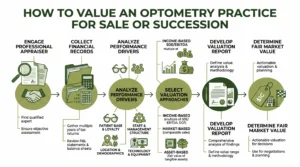
The documentation package for a formal valuation or sale should include three years of tax returns and three years of practice management reports (production, collection, payer breakdown). You also need a current patient count, recall rate data, optical capture rate, associate employment agreements, the space lease, and an equipment list with condition notes.
Include a copy of any managed care contracts with termination notice requirements. An active patient is typically defined as one seen in the last 24 months.
A quality of earnings analysis, required by PE buyers and sophisticated individual buyers, will reconcile tax returns to management reports, identify and test every add-back, and flag concentration risks. Budget 4–6 weeks for a thorough QofE from a credentialed firm.
PECAA, IDOC, and similar buying group affiliations should be disclosed. These may provide volume pricing advantages that don’t transfer to a buyer outside the group.
The questions below address the most common issues business owners raise before engaging a qualified appraiser for a value optometry practice engagement.
Frequently Asked Questions
What is a good EBITDA margin for an optometry practice?
A well-managed practice targets 25%–35% EBITDA margin after adding back owner pay to market rate. Practices below 20% typically reflect below-market optical performance, heavy payer discounting, or an overstaffed office. Practices above 35% are often underpaying associates or deferring equipment maintenance.
How is goodwill treated in an optometry practice sale?
Goodwill is the largest component of most optometry practice sales. It splits between enterprise goodwill (transferable to a new owner) and personal goodwill (tied to the owner OD’s reputation). Georgia courts and IRS guidelines treat these differently. In a third-party sale, buyers pay for enterprise goodwill; personal goodwill may be separately allocated for tax efficiency.
What assets are not included in a standard optometry practice sale?
Typically excluded: accounts receivable (often retained by seller), personal vehicles, non-practice real estate, personal life insurance, and any equipment the buyer deems obsolete. Frame and lens inventory is included at agreed cost value after adjusting for aged stock.
Does real estate add value to an optometry practice?
Real estate is valued separately from the practice. Clean lease terms, long tenure, below-market rent, renewal options, reduce location risk and positively affect practice value. The practice multiple itself is not inflated by real estate ownership.
How long does it take to sell an optometry practice?
From decision to close, a typical sale takes 6–18 months depending on deal structure and due diligence complexity. PE acquisitions can move faster (3–6 months) when a platform buyer is already in diligence. Individual OD buyer transactions are often slower due to SBA financing timelines (60–90 days for loan approval).
What is the role of the patient recall system in valuation?
Recall rate directly affects revenue predictability. A practice with 80%+ recall rate has a more defensible revenue forecast than one relying on walk-ins or new patient marketing. Buyers will test recall data against appointment volume and discount practices where recall rate declines year over year.
Does VSP contracted status transfer with a practice sale?
VSP status is generally transferable with proper notification and credentialing of the new provider. There is typically a 30–60 day transition period. EyeMed works the same way. State Medicaid plans vary, some require new enrollment, which can delay revenue.
What is the difference between a succession sale and a third-party sale?
A succession sale to an associate OD typically yields 10%–20% less than a competitive third-party process. There is no bidding dynamic. The trade-off is transition certainty, continuity of care, and deferred payments the associate funds from practice earnings.
How does SBA financing affect optometry practice valuations?
SBA 7(a) loans are the primary financing vehicle for individual OD buyers. The seller note must be fully subordinated to the SBA loan and is typically limited to 10% of the purchase price. This constrains deal structures and means the buyer must qualify for the full loan amount.
Are optometry practice valuations different for estate or gift tax purposes?
Yes. Estate and gift tax valuations use fair market value, apply marketability and minority interest discounts where appropriate, and are subject to IRS review. Personal goodwill may be excluded from the taxable estate if properly documented as non-transferable. Engage a CVA or ABV-credentialed appraiser for estate valuations.
Related Case Studies
- Medical Practice Valuation Atlanta Healthcare Sale Transition Guide
- Dental Practice Valuation Atlanta Owners Guide 2026
- Healthcare Business Valuation Methods Guide Sofer Advisors
Executive Summary
- Optometry practices are valued at 4x–7x adjusted EBITDA; strong optical performance, diversified payer mix, and high recall rates earn the upper end.
- Revenue multiples of 0.6x–1.2x gross collected revenue serve as a cross-check; EBITDA is the primary method used by acquirers.
- Payer mix analysis – VSP/EyeMed penetration vs. Medicaid exposure – is the most scrutinized variable in any optometry diligence process.
- PE buyers are active in the Southeast, but typically require $400,000+ adjusted EBITDA to engage; individual OD buyers depend on SBA financing.
What Should You Do Next?
If you are considering selling, transitioning, or simply want to know what your practice is worth, a certified business valuation gives you a defensible, documented answer. It holds up to buyer scrutiny, SBA underwriting, or court examination. David Hern CPA ABV ASA, founder of Sofer Advisors, holds dual ASA and ABV credentials recognized by the IRS, SEC, and FINRA, with 15+ years of valuation experience and 180+ five-star Google reviews. Schedule a consultation to discuss your business valuation needs.
People Also Read
- Medical Practice Valuation Multiples 2026 2027 Complete Atlanta Guide
- Medical Practice Valuation Multiples 2025 2026 Complete Guide
About the Author
This guide was prepared by David Hern CPA ABV ASA, founder of Sofer Advisors – a business valuation firm headquartered in Atlanta, GA serving clients across the United States. David holds dual accreditations as an Accredited Senior Appraiser (ASA) and is Accredited in Business Valuation (ABV), credentials recognized by the IRS, SEC, and FINRA. He also holds the Certified Exit Planning Advisor (CEPA) designation. With 15+ years of valuation experience, David has served as an expert witness in 11+ cases across multiple jurisdictions and built Sofer Advisors into an Inc. 5000-recognized firm with 180+ five-star Google reviews. The firm’s full W2 employee team maintains subscriptions to all major valuation databases and operates under a next business day response policy.
For professional business valuation services, visit soferadvisors.com/about-us/ or schedule a consultation at soferadvisors.com/contact-us/.
This content is for informational purposes only and does not constitute professional valuation advice. Business valuation conclusions depend on specific facts and circumstances. Contact Sofer Advisors for guidance regarding your specific situation.