


Last Updated: November 2026
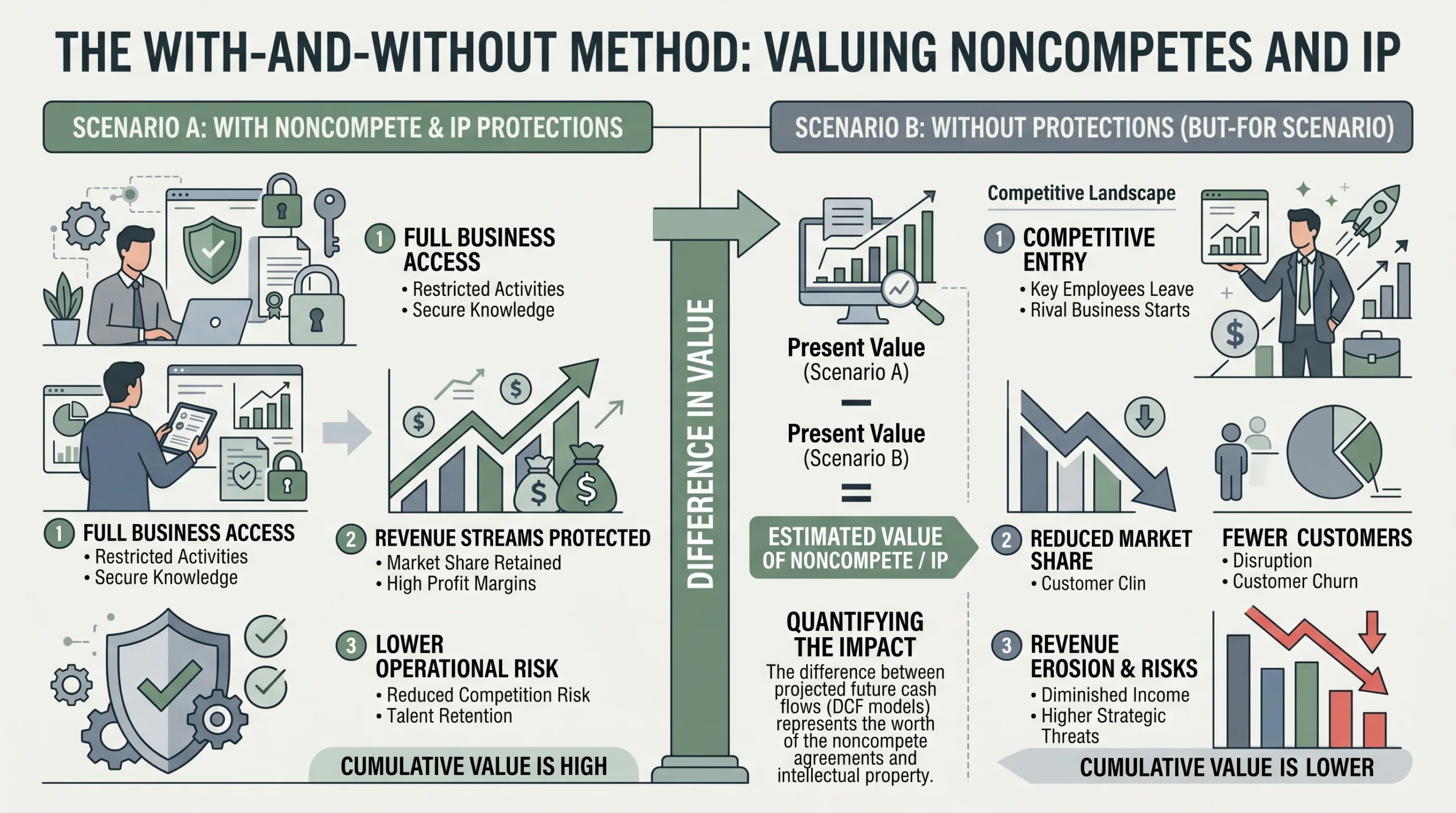
The with-and-without method values a single asset as the gap between a company’s cash flow with the asset in place and its cash flow without it. You build a full forecast that keeps the asset working. Then you model the same business as if the asset were gone. The difference between the two discounted figures is the asset’s value. It is an income approach, and analysts use it most often for intangibles like non-compete agreements, customer lists, and patents.
Sofer Advisors builds these models for business owners, CPAs, and attorneys across the country.
This guide explains how the method works, when to use it, how the math comes together, and where it can go wrong.
Key Takeaways
- Core logic: The method values an asset as the present value of the cash flow a business gains by having it.
- Main use: Analysts apply it to intangibles like non-compete agreements, customer lists, and patents.
- Marginal value: It measures one asset’s contribution, not the value of the whole company.
- Assumptions matter: The result depends on the “without” scenario, which is hypothetical and hard to prove.
- Accepted uses: It is common in purchase price allocation under ASC 805 and in economic-damages disputes.
When is this method most commonly used?
The with-and-without method isolates the value of one intangible asset. Analysts reach for it in three settings: financial reporting, litigation, and tax. In each case the goal is the same. You want to know what a single asset adds to the business.
It fits well when you value a non-compete agreement during a purchase price allocation under ASC 805. A buyer wants to know what the seller’s promise not to compete is actually worth. The method answers that by comparing the business with the non-compete to the same business without it.
In litigation, the method helps measure damages. Suppose a patent is infringed. The owner must prove the profit it lost because of the infringement. By modeling earnings with and without the protected technology, an analyst can estimate that lost profit. Courts accept this logic when the assumptions are clear and well supported.
By holding the other parts of the business steady, the model produces a clean figure for one asset. That is its main appeal. It turns a vague question, “what is this non-compete worth,” into a number you can defend.
How does the “with” scenario work?
The “with” scenario is the base case. You build a full forecast that assumes the asset stays in place and keeps working. Most analysts use a discounted cash flow, or DCF, model for this. It estimates the present value of the earnings the business expects to make.
The model needs a few core inputs. These include revenue growth, operating margins, and operating expenses. It also needs a terminal value. The terminal value captures the company’s worth after the forecast period ends. Together, these inputs show how much cash the business produces with the asset helping it.
The “with” forecast should reflect realistic, supportable plans. If the numbers are too rosy, every later step inherits that error. Analysts often tie the forecast to the company’s own budget and to how the industry has performed. That keeps the base case grounded.
What defines the “without” scenario?
The “without” scenario is the counterfactual. Here you model the same business as if the asset never existed. You strip out the benefit the asset provides and keep everything else the same. The drop in cash flow shows what the asset was worth.
This step takes care. The loss is often more than lost sales. Without a key customer list, a company might spend more on marketing to win those customers back. Without a patent, it might pay engineers to design around the gap, or lose price power to rivals. Each of these costs belongs in the model. If you leave them out, you understate the asset’s value.
The “without” case also needs a ramp. A non-compete does not fail all at once. If a key employee could compete, the damage might build over two or three years as that person rebuilds a client base. A good model phases the harm in over time rather than applying it in a single year.
What are the key calculation steps?
There are three main steps. First, build both forecasts: one “with” the asset and one “without” it. Second, subtract one from the other to find the yearly difference in cash flow. Third, discount that difference back to today’s dollars.
A few details decide whether the result holds up. The two forecasts must share the same base assumptions about growth and costs. That way the only real difference between them is the asset itself. The discount rate must reflect the risk of that specific asset, not the risk of the whole company. A new, unproven technology carries more risk than the business as a whole, so it earns a higher rate.
Analysts also add the tax amortization benefit, or TAB. Many intangibles can be amortized and deducted for tax over 15 years under Section 197. That deduction saves cash, and a buyer pays for that saving. Including the TAB reflects it. Skipping it understates the value.
A simple example shows the flow. Say the “with” forecast produces $1,000,000 in present value and the “without” forecast produces $820,000. The difference is $180,000. The analyst then adds the tax amortization benefit, which might lift the figure to roughly $205,000. That final number is the indicated value of the asset. The inputs are illustrative, but the steps are the same in real engagements.
What are the method’s main limitations?
The biggest weakness is subjectivity. The “without” scenario describes a world that never happened. Analysts have to estimate how the business would perform without the asset, and there is no real data to check it against. That opens the door to bias. It can also make the figure hard to defend when the other side challenges it in court.
A second problem is overlap. Assets rarely work alone. A brand may rely on software to deliver good service, so it is hard to split their value cleanly. When two assets depend on each other, the method can double count or miss value.
The method is also sensitive to the discount rate. A small change in the rate or the growth assumption can swing the answer by a wide margin. Because of this, careful analysts test a range of inputs rather than trusting a single point estimate. They show how the value moves as the key assumptions change. That range, and the judgment behind it, is what makes the conclusion credible. Strong documentation helps too. A report that spells out each assumption, and the reason for it, is far easier to defend than one that simply states a number.
How does this method compare to other methods?
The with-and-without method is one of several income approaches. It works best when an asset has a clear, separate effect on earnings, such as a non-compete or a single production technology. Other methods fit other assets better. The table below shows the common choices.
| Valuation Method | Best for valuing | Key input |
|---|---|---|
| With-and-Without | Non-compete agreements and specific contracts | Two full DCF models, “with” versus “without” |
| Relief from Royalty | Trademarks, patents, and licensable IP | A market royalty rate a third party would pay |
| Multi-Period Excess Earnings (MPEEM) | A primary intangible like a core customer base | Cash flow left after charges for other assets |
Each method answers a different question. The relief-from-royalty method assumes you license the asset instead of owning it, then values the royalties you avoid. MPEEM values the main asset that drives most of a company’s cash flow, after paying for the other assets that support it. The with-and-without method values an asset by the cash flow the business would lose without it.
The right choice depends on the asset, the data you have, and the standard of value the report must meet. For a trademark you could license, royalty savings may be clearer. For the single asset that carries a business, MPEEM often fits. For a non-compete, the with-and-without method is usually the cleanest answer. In many engagements, an analyst uses more than one method and checks whether the results agree.
Frequently Asked Questions
What is the with-and-without method in simple terms?
It is a way to value one asset by comparing two versions of the same business. In the first, the asset is in place. In the second, it is gone. The difference in value between the two is what the asset is worth.
What assets is it best for?
It works best for intangibles that have a clear, separate effect on cash flow. Common examples are non-compete agreements, customer relationships, and proprietary technology. It is less useful when an asset’s value is tangled up with many others.
Is the with-and-without method accepted for tax reporting?
Yes, when it is applied correctly. The IRS accepts methods that follow fair-market-value standards under Revenue Ruling 59-60. The method must be well supported to survive an audit, so clear assumptions and documentation matter.
How is it different from the relief-from-royalty method?
The relief-from-royalty method values an asset by the royalty you would save by owning it instead of licensing it. The with-and-without method values an asset by the cash flow the business would lose without it. Royalty fits licensable IP, while with-and-without fits non-competes.
What is the tax amortization benefit (TAB)?
The TAB is the extra value a buyer gets because many intangibles can be amortized and deducted for tax. Including the TAB reflects that tax saving. Leaving it out understates the asset’s fair value.
Why is the “without” scenario so hard to build?
Because it never happened. Analysts must estimate how the business would run without the asset, with no actual results to confirm it. That judgment is where most disputes arise, so the assumptions need strong support.
What discount rate applies to this method?
The rate should match the risk of the specific asset, not the business as a whole. Analysts often start from the company’s weighted average cost of capital (WACC). They then adjust it up for assets that carry more risk, such as new or unproven technology.
Does it work for customer relationships?
It can. For a company’s primary customer base, though, the multi-period excess earnings method is often the standard choice. The with-and-without method is the better fit for non-competes and discrete contracts.
Can the method value tangible assets?
In theory, yes, if the asset produces its own separate cash flow. In practice, analysts usually value tangible assets with the cost or market approach, based on replacement cost or comparable sales.
What Should You Do Next?
A defensible valuation starts with a clear question: what does this asset add to the business? To answer it, compare your current performance with a model that removes the asset. Begin by reviewing your balance sheet to see which intangibles drive your revenue. If a sale or tax filing is coming, document these assumptions so the report holds up under ASC 805.
Sofer Advisors provides independent asset valuations through its business valuation services practice. This work is led by David Hern CPA ABV ASA CVA. Schedule a free consultation to discuss your situation.
People Also Read
- Purchase Price Allocation ASC 805 and IFRS 3: Complete Guide for Business Leaders
- Goodwill vs Intangible Assets: Key Differences Explained
Related Case Studies
- The Relief-from-Royalty Method for Valuing Trademarks
- Valuation Timing
- A Complete Guide to Funeral Home Valuation
Executive Summary
The with-and-without method isolates the value of a single intangible asset by modeling a business twice: once with the asset in place and once without it. The gap between the two discounted cash flow results is the asset’s value. Analysts use it in financial reporting, such as valuing a non-compete in an ASC 805 purchase price allocation, in litigation to measure lost profits, and in tax work. Holding everything else steady, the method produces a defensible figure when the assumptions are clear and well supported.
About the Author
This guide was prepared by David Hern CPA ABV ASA CVA, founder of Sofer Advisors, a business valuation firm headquartered in Atlanta, GA serving clients across the United States. David holds accreditations as an Accredited Senior Appraiser (ASA) and is Accredited in Business Valuation (ABV), credentials recognized by the IRS, SEC, and FINRA, and is also a Certified Valuation Analyst (CVA). David has served as an expert witness in dozens of cases across multiple jurisdictions, and Sofer Advisors is an Inc. 5000 honoree in 2024 and 2025 with 240+ five-star Google reviews.
For professional business valuation services, visit soferadvisors.com/about-us/ or contact Sofer Advisors at soferadvisors.com/contact-us/.
Disclaimer: This content is for informational purposes only and does not constitute professional valuation advice. Business valuation conclusions depend on specific facts and circumstances. Contact Sofer Advisors for guidance regarding your specific situation.









